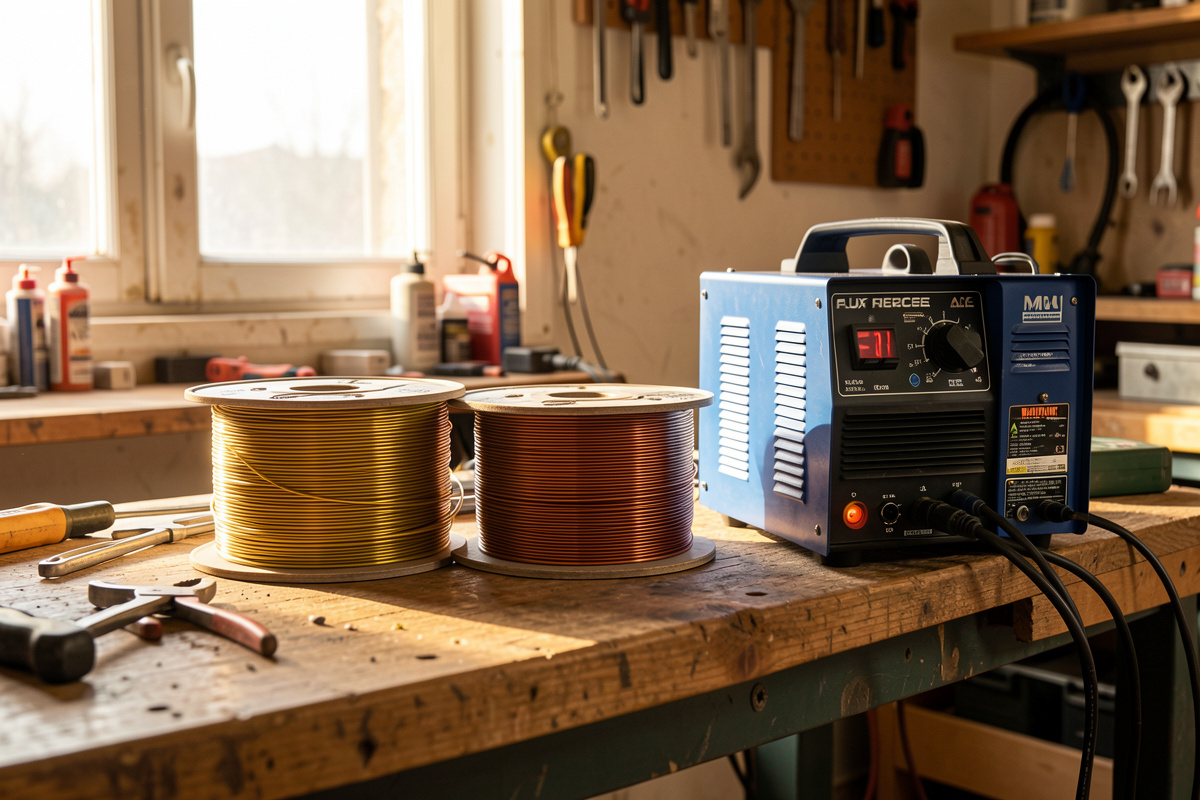

For most home welders the best flux-core wire is .030 E71T-GS — it runs a soft, forgiving arc on a small machine, needs no gas, and handles the brackets, frames, and repairs a home shop actually builds. Step up to E71T-11 when you want an all-position wire rated for slightly thicker, multi-pass structural work. I keep both on the shelf and run them regularly, and the difference is real but narrower than the forums make it sound.
Here’s the thing nobody tells beginners: the wire matters more than the machine at the budget end. Cheap no-name gasless wire feeds inconsistently and shields poorly, and it makes a capable welder feel hopeless — the problem isn’t your hand, it’s the spool. My friend Mike watched me fight a roll of mystery wire once and diagnosed it in three seconds: “That’s not you, that’s the wire.” He was right.
Below I put E71T-GS and E71T-11 side by side, share how each actually welds on my bench, and tell you which to buy first. For the full process, start with the flux-core welding guide.
What Is the Best Flux-Core Wire for Home Use?
The best all-round home flux-core wire is .030 E71T-GS: a self-shielded, single-pass, DCEN wire that runs a smooth soft arc on 140–200 amp machines and welds mild steel from about 2 mm up to 5 mm. It’s the easiest gasless wire to learn on and covers the majority of home projects — brackets, carts, gates, and light frames.
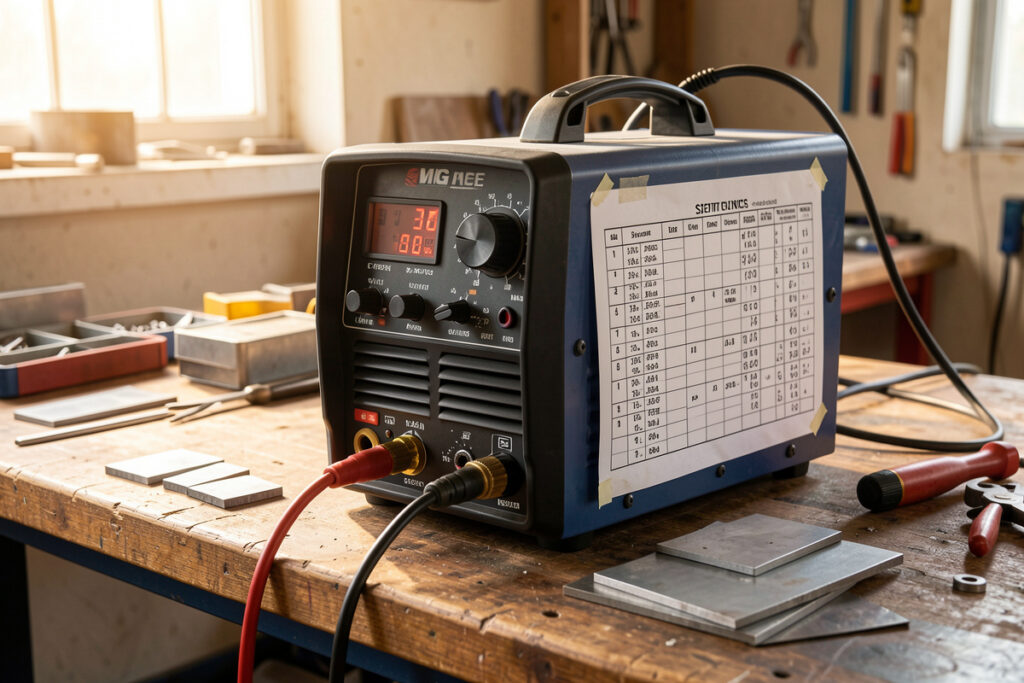
E71T-GS is the “general shop” gasless wire. The “GS” essentially means general-purpose single-pass, and that focus is why it’s so forgiving: the flux is tuned for smooth running rather than maximum deposition, so beginners get a stable arc and a decent bead without a steep learning curve. It’s what I hand anyone starting flux-core, and it pairs naturally with the starting numbers in the settings chart.
Both wires classify under the AWS A5.20 filler-metal specification, and the class code on the spool tells you exactly what you’re holding: E for electrode, 7 for 70 ksi tensile strength, 1 for all-position, T for tubular flux-core, and the suffix (GS or 11) for the specific usability. Reading that label is the first skill I teach — the American Welding Society standard behind it is the authority, not a forum post.
E71T-GS vs E71T-11: What’s the Real Difference?
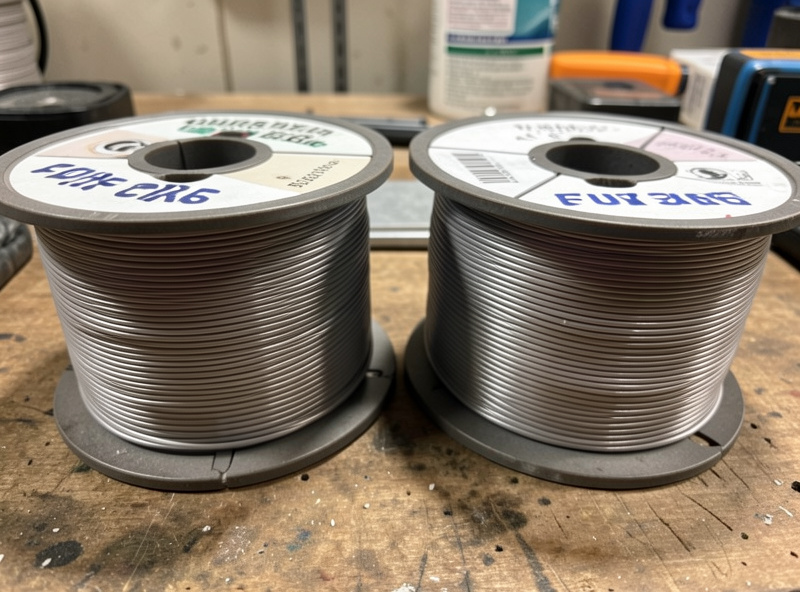
The core difference is scope: E71T-GS is a single-pass, general-purpose wire, while E71T-11 is an all-position wire rated for multi-pass welds on slightly thicker steel. Both are self-shielded gasless wires that run DCEN, both weld mild steel, and for thin single-pass home work they perform very similarly. The gap opens up on thicker, multi-pass structural joints where E71T-11 is the more capable choice.
Here’s how I’d lay them out for someone standing in the store deciding, based on running both on my own bench.
| Feature | E71T-GS | E71T-11 |
|---|---|---|
| Shielding | Self-shielded (gasless) | Self-shielded (gasless) |
| Polarity | DCEN | DCEN |
| Passes | Single-pass | Single and multi-pass |
| Positions | All-position (thin) | All-position |
| Best thickness | ~2–5 mm | ~2 mm up to thicker structural |
| Arc feel | Soft, forgiving | Slightly more penetrating |
| Best for | Beginners, general repairs | Structural, thicker, multi-pass |
Notice how much overlaps. For a beginner welding a 3 mm bracket, the two wires feel close, and either one works. The reason I still keep both is that the day you weld a thick multi-pass structural joint, E71T-11’s multi-pass rating and slightly hotter, deeper arc genuinely matters — and you don’t want to discover that on a load-bearing weld with the wrong wire.
How Do They Actually Weld on My Bench?
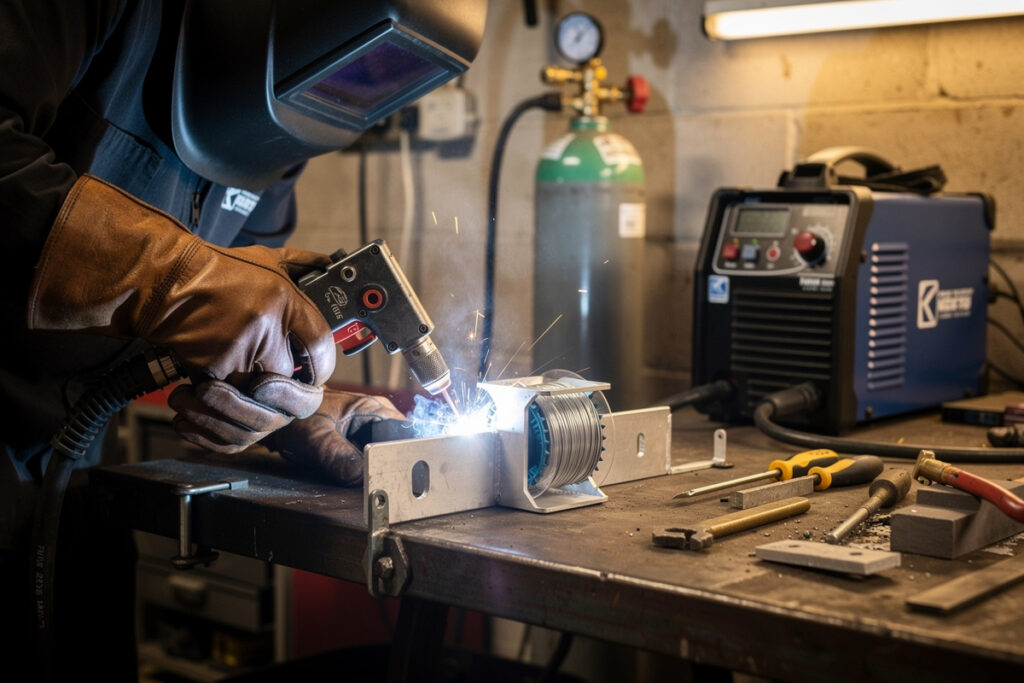
On my MIG-PRO205DS, E71T-GS lays a smooth, soft bead that’s easy to control and clean up — my go-to for shop fixtures and general repairs. E71T-11 runs a touch hotter and more penetrating, stacks multi-pass beads well on thicker steel, and is what I reach for when the joint has to carry real load. Both throw the usual gasless spatter and slag; neither is a cheat code around that.
The sensory difference is subtle but real. The GS wire has a slightly softer, quieter arc — that steady bacon sizzle comes easily and the puddle feels relaxed. The 11 wire bites a little harder, digs a bit deeper, and on a multi-pass fillet you can feel it tie into the previous pass more aggressively. On thin 2–3 mm stock I honestly can’t tell you they’d fail a beginner differently; on a 6 mm multi-pass joint, the 11 is the wire I trust.
Both demand the same fundamentals to weld well: correct DCEN polarity, the long flux-core stickout, a drag angle, and thorough cleaning between passes to avoid slag inclusions. Wire choice won’t rescue bad technique — but good wire removes one variable so your technique can actually show. That’s the whole case for not buying the cheapest spool on the shelf.
What Wire Diameter Should You Buy for Home Use?
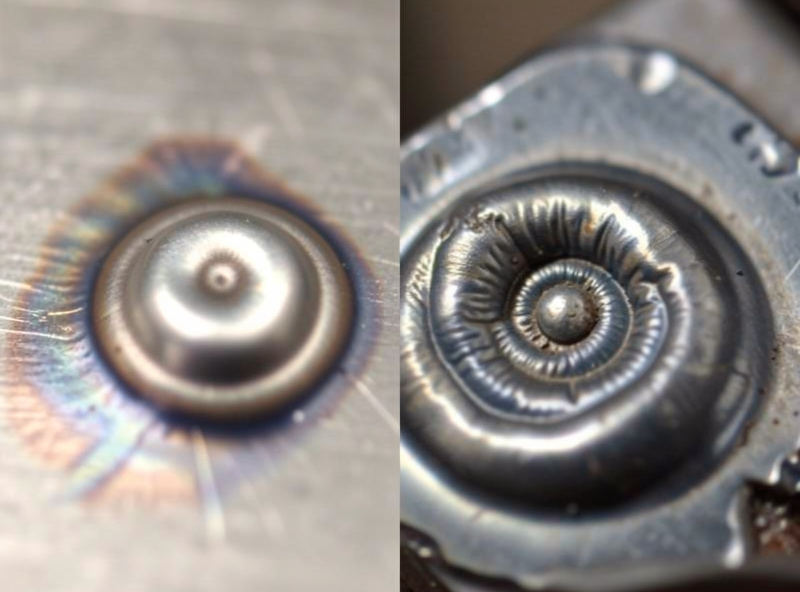
For home work, .030 inch (0.8 mm) is the most versatile diameter — it handles 2 mm up to about 5 mm steel on a typical hobby machine and is easier to control on thin stock. Move to .035 inch (0.9 mm) only when you’re regularly welding 6 mm and thicker, where the bigger wire deposits metal faster and fills heavy joints more efficiently.
The instinct to buy the fattest wire “for strength” is a trap. A .035 wire run too cold on thin stock just piles cold, unfused metal on top of the joint — weaker, not stronger. Match the diameter to the thickness you actually weld most, and for the vast majority of home shops that’s .030. I keep .035 around for the occasional heavy job, but .030 lives on the machine roughly nine sessions out of ten.
If you weld a real spread of thicknesses, .030 is the single most flexible spool to own because it reaches down toward thinner sheet better than .035 does — though genuinely thin material under 2 mm is its own challenge no wire fully solves, which I cover in flux-core on thin metal. Buy for your everyday thickness, not your rare heaviest job.
Does Brand Matter, or Is Cheap Wire Fine?
Brand matters more than most beginners believe. The flux formulation inside the wire is doing 100% of your shielding, and cheap no-name wire tends to feed erratically, shield inconsistently, and rust quickly — problems that read as “I can’t weld” when they’re really “the wire is bad.” Named wire from an established maker eliminates that variable for a few dollars more per spool.
I’m not brand-precious about much, but gasless wire is one place I won’t cut corners, because I’ve watched bad wire demoralize people who were actually welding fine. A consistent, well-made spool feeds smoothly, shields reliably, and gives you a fair shot at a good bead. Spend the small premium on a reputable wire and put the savings-hunting energy somewhere it won’t cost you weld quality. Manufacturers like Lincoln Electric publish detailed datasheets for each wire, and that transparency is itself a quality signal.
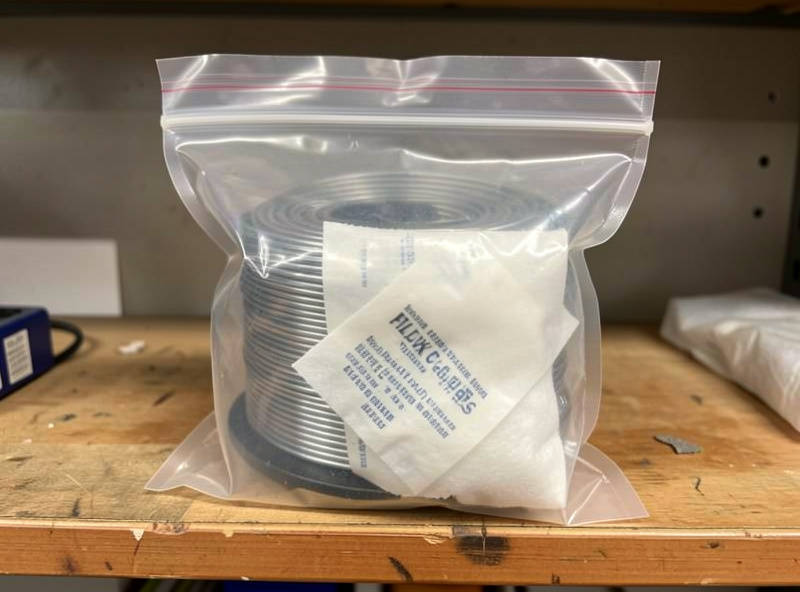
Storage is the flip side of quality: even good wire goes bad if you let it get damp. The flux is hygroscopic, so I keep every spool sealed with desiccant between sessions — a great wire ruined by moisture welds no better than a cheap one. Buy good wire, then protect it. Both halves matter.
As an Amazon Associate I earn from qualifying purchases.
For a home shop I’d stock a spool of .030 E71T-GS gasless wire for general work and, if you do heavier structural jobs, a roll of E71T-11 multi-pass wire alongside it. Keep both dry with a sealed storage and desiccant setup so moisture never ruins a spool.
Which Wire Should a Beginner Buy First?
Buy .030 E71T-GS first. It’s the most forgiving gasless wire to learn on, covers the thickness range most home projects live in, and lets you build puddle-reading skill without fighting the wire. Add E71T-11 later, when a specific thicker or structural multi-pass job actually calls for it. One good spool of GS is a better start than an expensive variety you can’t yet use.
This mirrors how I’d sequence anyone’s whole flux-core journey: learn the process on forgiving wire, get the fundamentals — polarity, stickout, drag, cleanup — into muscle memory, and only then broaden your consumable shelf as real jobs demand. Buying the “pro” wire on day one doesn’t make you weld better; it just adds a variable you’re not ready to use. Start simple, build up.
The one upgrade I’d never delay is buying a named wire over a bargain-bin roll, GS or otherwise. That’s the difference that actually shows up in your beads on day one. Everything else — diameter beyond .030, adding E71T-11 — can wait for the job that needs it.
My Verdict: What I’d Buy Starting Today
Starting from zero today, I’d buy a single spool of quality .030 E71T-GS and nothing else until I’d burned through it. It welds the brackets, carts, and gates a home shop builds, teaches the process forgivingly, and pairs perfectly with a small gasless-capable inverter. When a heavier structural job shows up, I’d add .030 or .035 E71T-11 for its multi-pass capability — but not before.
That’s the honest home-welder verdict: the best wire is the one matched to what you actually build, bought from a maker you can trust, and kept dry. E71T-GS to learn and for general work, E71T-11 when the load demands it. Most of the fixtures on my own bench — the weld cart under the MIG-PRO205DS included — came off a plain spool of good GS wire. Get that spool, run the settings chart, and start burning. The main guide ties the whole process together.
Keep Building
- Flux-Core Welding Guide: Settings, Polarity, and Technique
- Flux-Core Settings Chart: Voltage and Wire Speed by Thickness
- Flux-Core on Thin Metal: How to Stop Burning Through
- Flux-Core Polarity: Why Gasless Wire Runs Electrode-Negative
- Flux-Core Slag Inclusions: Cleaning Between Passes
What is the best flux-core wire for home use?
For most home welders, .030 E71T-GS is the best all-round flux-core wire. It runs a soft, forgiving arc on small 140 to 200 amp machines, needs no gas, and welds mild steel from about 2 mm to 5 mm, covering the brackets, frames, and repairs a home shop builds.
What is the difference between E71T-GS and E71T-11?
E71T-GS is a single-pass general-purpose wire, while E71T-11 is an all-position wire rated for multi-pass welds on slightly thicker steel. Both are gasless and run DCEN. For thin single-pass work they perform similarly; E71T-11 is better for thicker structural joints.
Should I buy .030 or .035 flux-core wire?
For home work, .030 is the most versatile diameter and handles 2 mm up to about 5 mm steel while staying controllable on thin stock. Choose .035 only when you regularly weld 6 mm and thicker, where the larger wire deposits metal faster.
Is cheap flux-core wire worth buying?
No. The flux inside the wire does all the shielding, so cheap no-name wire feeds erratically, shields poorly, and rusts, which makes a capable welder feel hopeless. A named wire from an established maker eliminates that variable for a small premium.
Which flux-core wire should a beginner start with?
Start with .030 E71T-GS. It is the most forgiving gasless wire to learn on and covers most home project thicknesses. Add E71T-11 later when a thicker or structural multi-pass job actually calls for it.


Discussion (0)