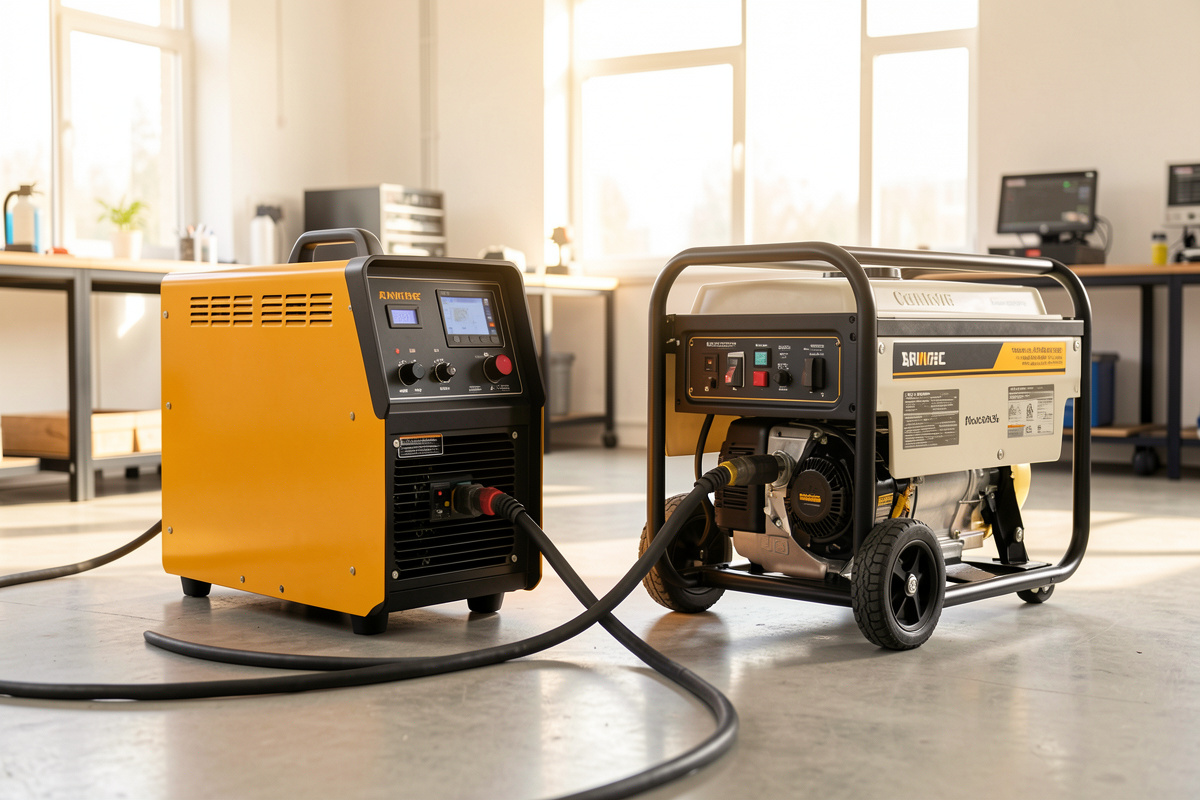

An inverter welder will run on a generator, but only a clean one. Inverter machines rectify incoming AC and are sensitive to voltage spikes and high total harmonic distortion, so a cheap open-frame generator can quietly stress or destroy the electronics even while the arc looks fine. Use an inverter generator with low THD, or a conventional unit with strong automatic voltage regulation, and size it with real headroom. “It welded” is not the same as “it’s safe.”
This is the question I get asked most about portable power, and it’s the one with the highest stakes, because the failure is invisible until it isn’t. A generator that sags is annoying — you feel it in the arc and you fix it. A generator that feeds dirty power is dangerous precisely because everything seems fine, right up until the machine dies weeks later for no reason you can see. Let me explain what’s actually happening inside the welder, and how I decide whether a generator is safe to trust with mine.
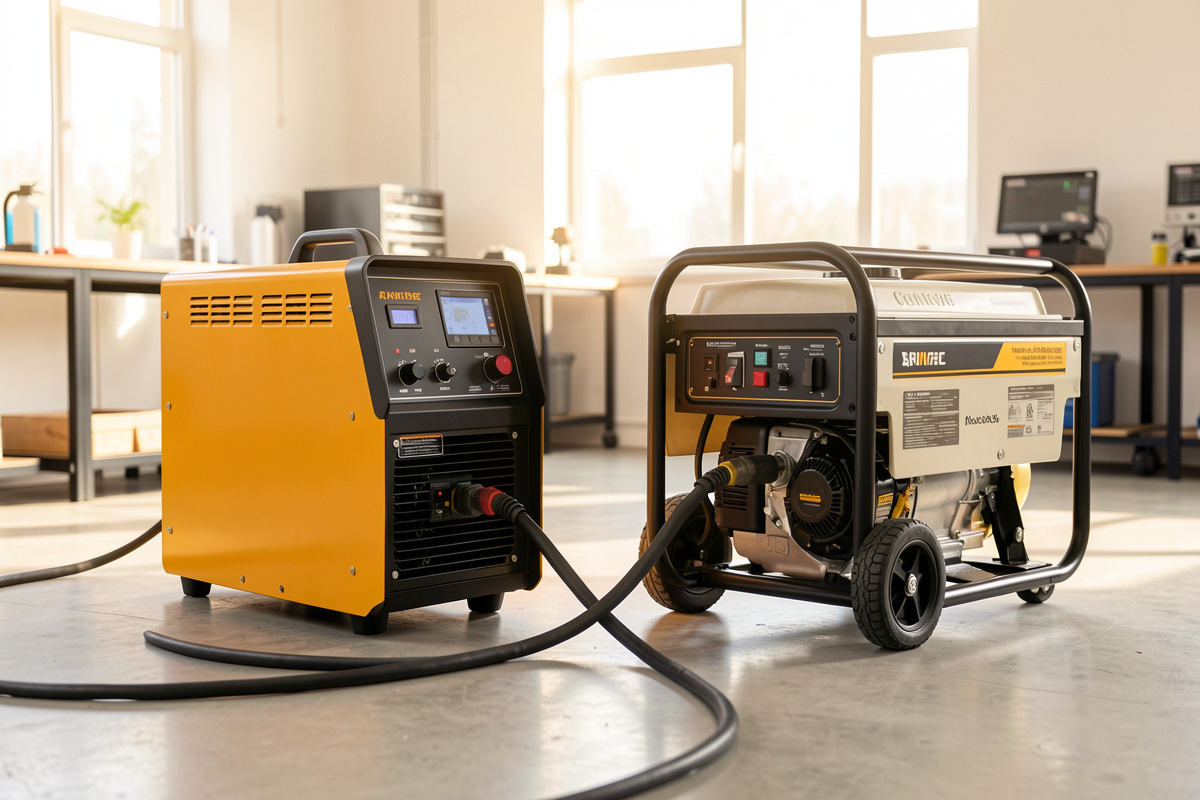
Will an Inverter Welder Run on a Generator?
Yes — an inverter welder runs on a generator as long as that generator supplies enough clean, stable power. The “enough” part is sizing, which I cover in depth for running a welder on a generator. The “clean” part is the piece that’s specific to inverter machines, and it’s the one that gets welders killed. An old transformer welder was fairly tolerant of ugly power; an inverter is not.
The reason comes down to what’s inside. An inverter welder takes your incoming AC, rectifies it to DC, and switches it at high frequency through sensitive electronics to produce a precise, controllable arc. That front-end rectifier and the components behind it expect a reasonably clean input waveform. Feed them power full of spikes and distortion and you’re hammering the very parts that make an inverter better than an old transformer machine. So the honest answer isn’t a simple yes — it’s “yes, if the power is clean enough,” and that qualifier is the whole article.
What Is THD and Why Does It Threaten an Inverter Welder?
Total harmonic distortion, or THD, is a measure of how far a generator’s output waveform strays from a smooth sine wave, expressed as a percentage. A pure sine wave has near-zero THD; a cheap generator can put out power with distortion high enough to upset sensitive electronics. Inverter generators typically produce very low THD — often quoted under 3% — which is why they’re the recommended source for anything with a delicate front end.
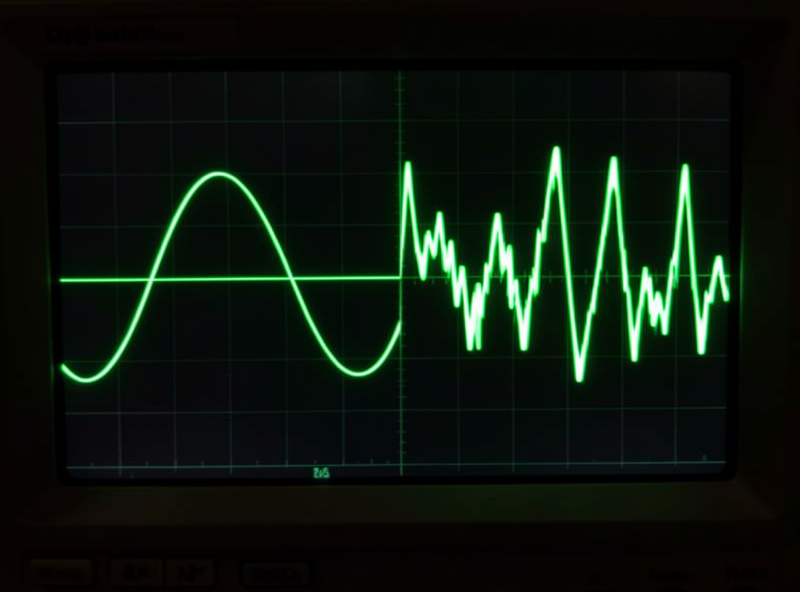
Picture the difference as the shape of the power itself. A clean sine wave is a smooth, rolling curve; a distorted waveform is jagged, with harmonics — extra frequencies riding on top of the fundamental — that a welder’s rectifier never signed up for. Those harmonics create heat and stress in components that were designed around a clean input. The power-quality world has whole standards for this; the harmonic limits engineers work to are laid out in documents like IEEE 519, published by the IEEE. You don’t need to read the standard, but you should internalize the idea: not all 240 volts are created equal. Two generators can both read “240V” on a meter and deliver wildly different power quality.
How Does Dirty Power Actually Damage a Welder?
Dirty power damages an inverter welder mostly through voltage spikes and sustained harmonic stress that cook the input electronics over time. Voltage transients — brief spikes far above the nominal voltage — can punch through components rated for a clean supply, while ongoing distortion adds heat that shortens the life of capacitors and switching parts. The damage is usually cumulative, which is exactly why it’s so sneaky.
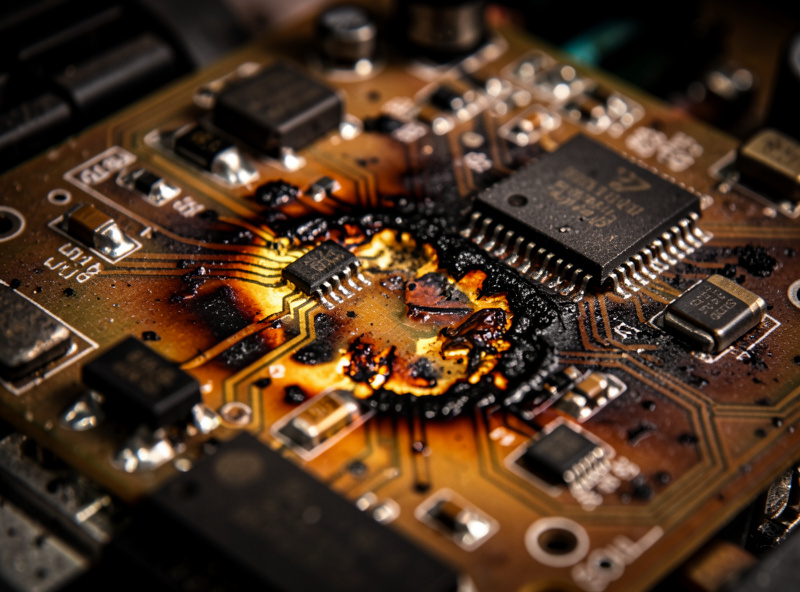
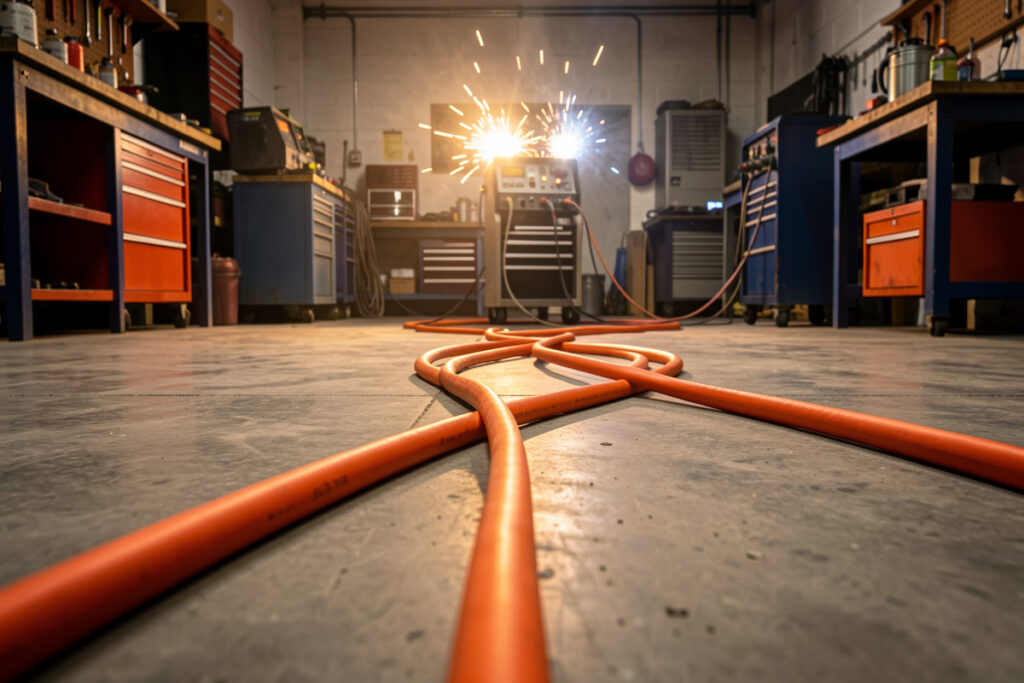
Here’s the part that catches people out: the machine keeps welding while this is happening. The arc looks normal, the beads come out fine, and you have no reason to suspect anything — until one day the machine throws a fault, or simply won’t power up, and a board inside is scorched. Mike, my welder friend with decades in the trade, has watched more than one good inverter machine survive an entire job on a construction-site generator and then die a month later in the shop. Nobody connected the two events, because a month had passed. That delay is the whole danger. A sagging arc warns you in real time; dirty power sends the bill later. If you want the broader picture of how power quality ties into every part of your setup, the welder power requirements guide frames it.
Inverter Generator vs Conventional Generator: Which Is Safe?
For an inverter welder, an inverter generator is the safe default and a bare open-frame generator is the gamble. Here’s how the two stack up on the things that matter to a sensitive machine.
| Factor | Inverter generator | Conventional open-frame |
|---|---|---|
| Waveform / THD | Clean sine, often under 3% | Can be high, varies widely |
| Voltage stability | Tightly regulated electronically | Depends on engine speed and AVR |
| Safe for inverter welder? | Yes, the recommended source | Only with good AVR and caution |
| Cost | Higher | Lower |
| Best use | Sensitive electronics, welders | Pumps, lights, resistive loads |
The cost gap is real, and it’s why people talk themselves into the cheaper unit. My take: the price difference between a good inverter generator and a bargain open-frame one is a fraction of what an inverter welder costs to replace. I’d rather spend once on clean power than twice on a machine. If your generator’s only job is running lights, a pump, or a space heater, a conventional unit is perfectly fine — resistive loads don’t care about waveform. It’s the sensitive electronics that force the upgrade.
How Do I Check if a Generator Is Safe for My Welder?
Before I trust any generator with a machine like mine, I check three things: the THD spec, the running-watts rating, and whether it offers the right voltage receptacle. THD under a few percent, running watts comfortably above the welder’s draw, and a genuine 240V outlet if the welder needs it. If a generator’s spec sheet doesn’t publish a THD figure at all, that silence is itself a warning — the good ones brag about it.
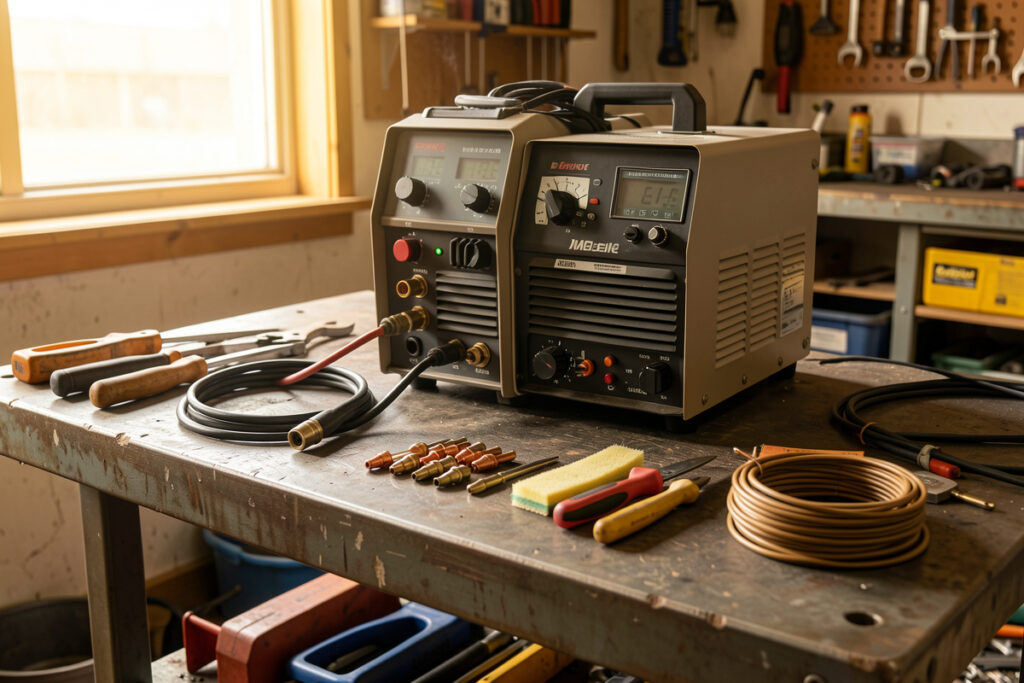
When I can’t get a clean answer from the spec sheet, I default to caution: I treat an unknown generator as unsafe for the inverter machine and either find a better source or accept the risk knowingly, not blindly. On borrowed or rental generators, that’s exactly the situation — you often can’t verify the power quality, so you’re gambling with your own machine. My rule there is simple: I don’t put my MIG-PRO205DS on a generator I can’t vouch for. The manufacturers agree; welding-machine makers like Lincoln Electric publish generator guidance for their inverter machines, and it’s worth reading for your specific model before you plug in.
What About AVR Generators?
Automatic voltage regulation helps, but it isn’t the same as low THD. AVR keeps a conventional generator’s output voltage steady as the load changes, which prevents the big sags and swings that starve an arc. What it doesn’t necessarily do is clean up the waveform — a generator can hold a rock-steady 240 volts and still deliver a distorted wave with meaningful harmonics.
So I treat AVR as necessary-but-not-sufficient for an inverter welder. A conventional generator with good AVR is a big step up from a cheap unregulated one, and for many inverter machines it’s acceptable — but it’s a compromise, not the ideal. The ideal is still a true inverter generator producing a clean sine wave. If I’m buying specifically to feed a sensitive welding machine, I skip the compromise and buy the inverter generator. If I already own a decent AVR unit, I use it with awareness of what it does and doesn’t fix. Either way, the sizing rules from running a welder on a generator still apply on top — clean power that’s undersized still kills the arc.
My Rule Before I Plug In
What I’d do starting today, every time: check the THD spec, confirm the running watts and the right receptacle, and if I can’t verify the power is clean, I don’t risk the machine. An inverter welder is a precise, expensive tool, and the thing that makes it good — sensitive electronics — is the same thing that makes it fragile on bad power. Treat the generator as part of the welding circuit, not a neutral wall socket, and check it with the same seriousness you’d check your gas or your ground. Clean power is cheap insurance. A cooked inverter board is not.
Can I run an inverter welder on any generator?
No. An inverter welder needs clean, stable power. A cheap open-frame generator can output voltage spikes and high harmonic distortion that stress or destroy the machine’s electronics, even while the arc looks normal. Use an inverter generator with low THD, or a conventional generator with strong automatic voltage regulation.
What THD is safe for an inverter welder?
Lower is better, and inverter generators commonly produce total harmonic distortion under about 3 percent, which is the safe target for sensitive electronics. If a generator’s spec sheet does not publish a THD figure at all, treat that as a warning sign, because quality units advertise their clean output.
How does a bad generator damage an inverter welder?
Mainly through voltage spikes and sustained harmonic stress that cook the input electronics over time. The damage is usually cumulative, so the machine keeps welding normally while components degrade, then fails days or weeks later. That delay is why dirty power is so dangerous compared with a generator that simply sags.
Is an AVR generator good enough for an inverter welder?
It helps but is not ideal. Automatic voltage regulation keeps the output voltage steady under changing load, which prevents arc-starving sags, but it does not necessarily clean up the waveform or reduce harmonic distortion. A conventional generator with good AVR is a compromise; a true inverter generator remains the safer choice.
Should I use a rental generator with my inverter welder?
Be cautious. On a borrowed or rental generator you often cannot verify the power quality, so you are gambling with your own machine. If you cannot confirm low THD and adequate running watts, treat the generator as unsafe for a sensitive inverter welder and find a better source or accept the risk knowingly.

Discussion (0)