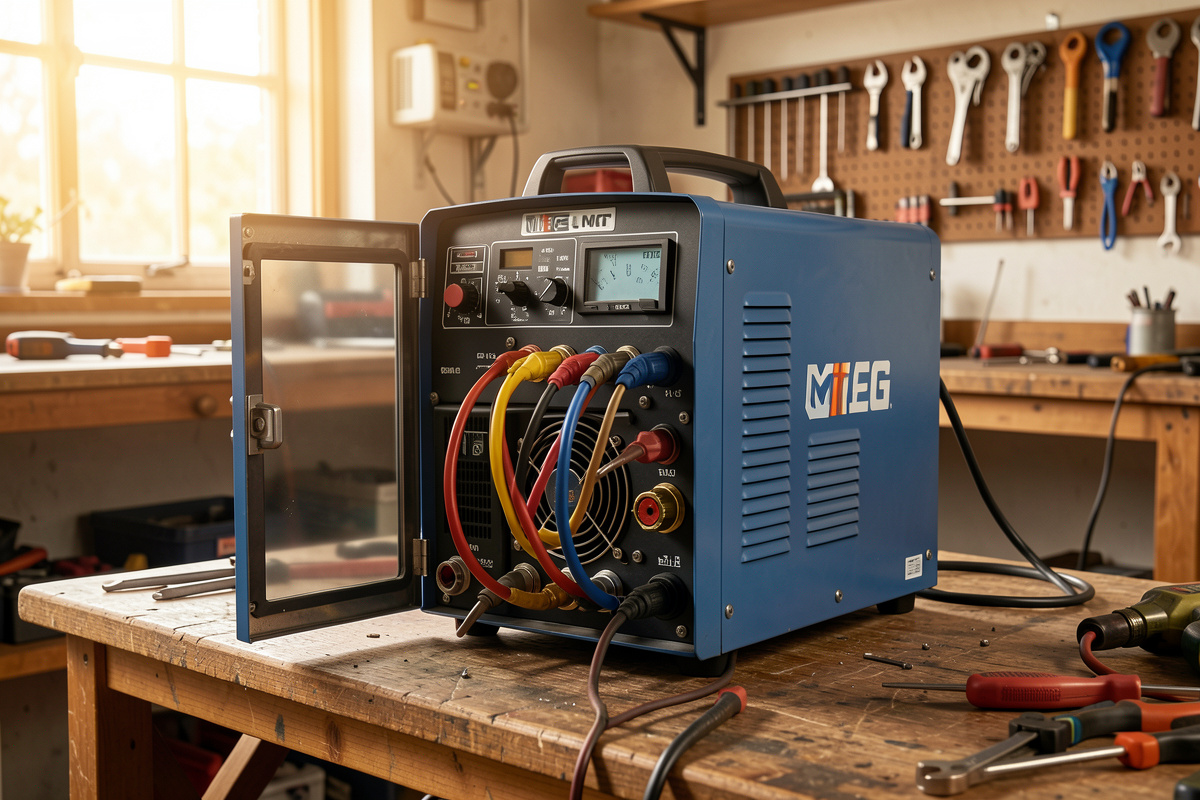

Self-shielded flux-core welds on DCEN — direct current, electrode-negative, also written DC-. The gun lead goes to the negative terminal and the work clamp to positive, which is the exact opposite of solid-wire MIG. That swap is two cables and thirty seconds on my machine, and it’s the single most important setting you’ll never find on a dial.
Here’s why this one detail earns its own article: get polarity backwards and the machine doesn’t warn you. The wire still feeds, the arc still lights, and a beginner assumes everything’s fine — right up until the bead comes out tall, black with baked-on slag, cold, and refusing to tie into the metal. I’ve watched more people quit flux-core over reversed polarity than over any other single mistake. It looks like “I can’t weld.” It’s really “I wired the machine like a MIG.”
Let me walk through what DCEN is, why gasless wire demands it, what wrong polarity actually does to your weld, and how to fix it in under a minute. For the whole process in context, start with the flux-core welding guide.
What Polarity Does Flux-Core Welding Use?
Self-shielded flux-core uses DCEN — electrode-negative. The electrode (your wire) is the negative pole and the workpiece is positive, so electrons flow from wire to work. Solid-wire MIG runs the reverse, DCEP electrode-positive. This one difference trips up nearly every welder crossing from MIG to gasless.
The distinction is worth pinning down because the terminology gets muddled. “Straight polarity” is the old name for DCEN; “reverse polarity” is DCEP. Different machines label their terminals differently, but the rule holds: gasless flux-core wire (the E71T-GS and E71T-11 you buy for home use) is a DCEN wire. Here’s the clean comparison.
| Process | Polarity | Gun Lead To | Old Name |
|---|---|---|---|
| Self-shielded flux-core (FCAW-S) | DCEN (DC-) | Negative terminal | Straight polarity |
| Solid-wire MIG (GMAW) | DCEP (DC+) | Positive terminal | Reverse polarity |
| Gas-shielded flux-core (FCAW-G) | DCEP (DC+) | Positive terminal | Reverse polarity |
Notice the third row — not every flux-core wire is DCEN, which I’ll get to. But for the gasless wire a home welder actually runs, DCEN is the answer, every time. Your settings from the flux-core settings chart only produce good beads once the polarity underneath them is right.
Why Does Self-Shielded Wire Run Electrode-Negative?
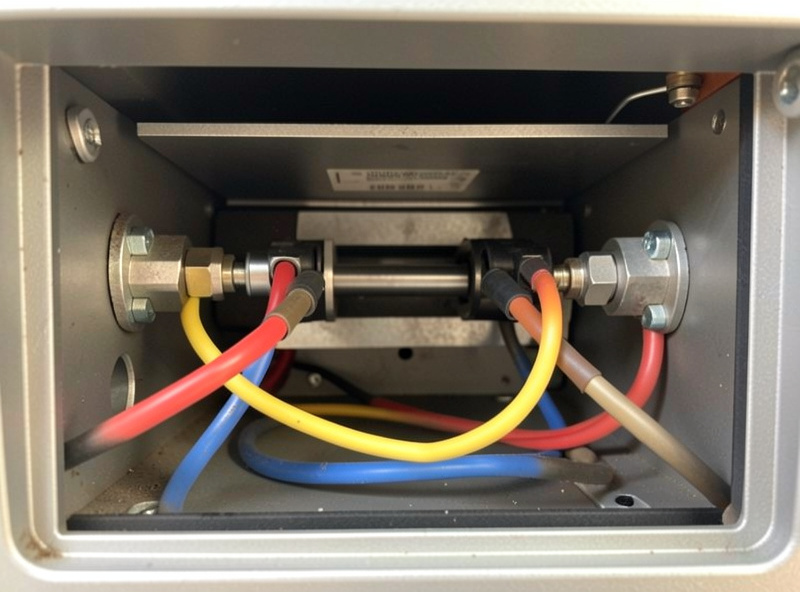
Self-shielded flux-core runs DCEN because it puts more of the arc’s heat into the wire electrode rather than the base metal, which is exactly what the flux needs. The flux column inside the tube has to reach the temperature where it burns and releases its shielding gas and slag — DCEN’s heat balance delivers that, DCEP starves it.
Think about where the energy goes. In DC welding, one pole runs hotter than the other. Electrode-negative concentrates heat toward the electrode tip and the flux, so the flux ignites efficiently and forms a stable self-shield. That self-generated shield is the entire reason gasless wire works outdoors without a bottle. Wire it electrode-positive and you shift the heat balance toward the base plate, the flux doesn’t burn the way it’s designed to, and the shielding falls apart.
The wire manufacturers engineer the flux chemistry around this. The polarity a wire wants is stamped right on the spool label and printed in the datasheet — for E71T-GS and E71T-11 it says DCEN, and it isn’t a suggestion. When I’m setting up a new spool I check the label the way I’d check torque spec on a fastener: it’s the maker telling me the one condition their product needs to perform. Ignore it and you’re fighting the wire’s own chemistry.
What Happens If You Run Flux-Core on the Wrong Polarity?
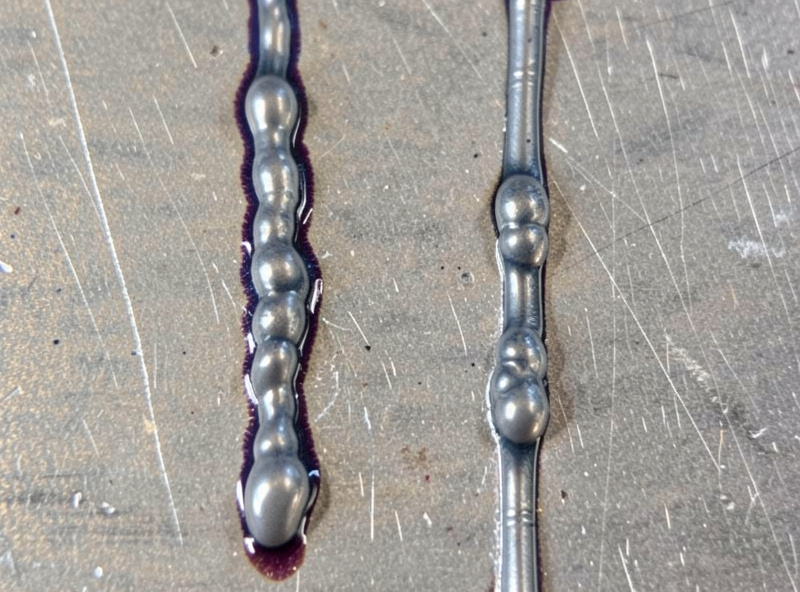
Run gasless flux-core on DCEP and you get a textbook bad bead: tall and ropey, sitting on top of the metal instead of fusing into it, coated in thick clingy slag that’s hard to chip, with visible lack of fusion at the toes. It looks cold because it is cold — the heat’s in the wrong place and the shield is compromised.
The cruel part is that it almost works. The arc lights and the wire burns, so nothing screams “error.” I’ve had beginners send me photos of miserable beads convinced their machine was broken or their technique hopeless, and the first question I ask is always the same: which terminal is your gun lead on? Nine times out of ten, reversing the polarity transforms the next bead. My friend Mike, decades in the trade, has a saying — before you doubt your hand, doubt your hookup. On flux-core that’s polarity first, every time.
There’s a sensory tell, too. Wrong-polarity flux-core sounds wrong — a harsher, more erratic spatter-heavy arc without that steady bacon sizzle — and it throws noticeably more spatter that bakes onto the nozzle. If your gasless beads are ugly and everything on the settings chart checks out, stop adjusting voltage. You can’t dial your way out of a polarity problem; you have to rewire it.
How Do You Change Polarity on a Flux-Core Machine?
On most home MIG machines you change polarity inside the wire-feed compartment: two short cables land on labeled positive and negative terminals, and you swap which one the gun lead and the work clamp connect to. For DCEN flux-core, gun lead to negative, work clamp to positive. It takes under a minute with the machine unplugged.
Always kill the power first — unplug the machine, not just switch it off — before you touch those terminals. On my MIG-PRO205DS the leads are clearly marked and finger-tight, so the whole swap is quick, but I still unplug out of habit because working live on a welding terminal is a genuinely bad idea. Some cheaper machines bury the polarity change under the spool or behind a panel; a few budget units are fixed-polarity and simply can’t run gasless properly, which is worth knowing before you buy.
Once swapped, run a test bead on scrap and confirm. The difference is unmistakable — a proper DCEN bead ties into the metal with even ripples and a manageable slag layer that flicks off in a satisfying curl. If you switch between gas MIG and gasless flux-core regularly like I do, changing polarity becomes part of the setup ritual, right alongside swapping the drive roll and the contact tip. Forget it and the first bead reminds you fast.
Why Is MIG Positive but Flux-Core Negative?
Solid-wire MIG runs DCEP because it relies on an external shielding gas and wants the heat balance that gives clean metal transfer and good penetration into the work. Flux-core carries its shield inside the wire, so it needs the opposite heat balance to burn that internal flux. Same machine, opposite requirement, because the shielding job is done in two completely different places.
It’s a genuinely useful mental model: ask where the shielding comes from and the polarity follows. External gas over solid wire (GMAW) or over a tubular wire (gas-shielded FCAW-G) wants electrode-positive. Self-generated shielding from burning internal flux (self-shielded FCAW-S) wants electrode-negative. That’s why the gas-shielded flux-core in my comparison table above runs DCEP even though it’s also a “flux-core” wire — the shield comes from the bottle, not the flux.
This is also why a single home machine can do both processes so cheaply. Nothing changes mechanically except the drive roll, the tip, and the polarity leads. Understanding the why means you’ll never again stand there wondering which terminal — you’ll know it from what the wire is doing to shield itself. That understanding is the difference between following a chart and actually knowing your machine.
Do All Flux-Core Wires Run DCEN?
No — only self-shielded (gasless) flux-core runs DCEN. Gas-shielded flux-core wire, the FCAW-G used with a CO₂ or mixed-gas bottle in production shops, runs DCEP like solid-wire MIG. So “flux-core” alone doesn’t tell you the polarity; whether it’s self-shielded or gas-shielded does.
For a home welder this rarely causes confusion because the wire worth owning for gasless work — the whole reason you skipped the bottle — is self-shielded and runs DCEN. But if you ever pick up a spool labeled for gas-shielded use and try to run it gasless on DCEN, you’ll get a poor result, and vice versa. Match the wire type, the gas (or no gas), and the polarity as a set. The spool label spells out all three.
This is exactly why I read the label on every new spool. The class code and the datasheet tell you the wire’s designed polarity, its shielding requirement, and its position ratings in one place. When I’m helping someone sort out which gasless wire to buy in the first place, polarity compatibility is baked into the recommendation — that whole decision is in best flux-core wire for home use.
How Do You Tell a Polarity Problem From a Settings Problem?
The quickest diagnostic: if your bead is uniformly cold, tall, and slag-caked no matter how you adjust voltage and wire speed, it’s polarity, not settings. Settings problems respond to the dial — more voltage flattens a cold bead, less voltage tames an undercutting one. A polarity problem stays wrong across the whole dial range.
I run the check in that order deliberately. When a bead’s bad, I first confirm polarity is DCEN, then confirm stickout is the long 13–19 mm flux-core wants, then confirm I’m dragging not pushing — and only then do I start touching voltage and wire speed. Three of those four aren’t on any chart, and polarity is the one that masquerades as everything else. Chase the dial first and you’ll waste an afternoon.
The authority here is the wire itself: the AWS A5.20 filler-metal specification defines these self-shielded classifications and the manufacturers’ datasheets — Lincoln Electric and Hobart both publish clear ones — state the polarity for each product. When in doubt, trust the spool label over any forum post. If you want to cross-check the standard behind the classification, the American Welding Society’s standards resources are the source, and manufacturer sites like Lincoln Electric publish the per-wire datasheets.
What I’d Check First, Starting Today
If you’re fighting ugly gasless beads right now, do this before anything else: unplug the machine, open the wire-feed door, and confirm the gun lead is on the negative terminal and the work clamp on positive. That one check fixes more first-time flux-core disasters than any settings tweak. Polarity is the foundation everything else sits on.
Then, and only then, work the rest of the chain — stickout, drag angle, voltage, wire speed. Flux-core rewards a welder who understands why the wire wants what it wants, and polarity is where that understanding starts. Get it right once, make the swap part of your setup ritual, and you’ll never lose an afternoon to a mystery cold bead again. From here, the settings chart and the main flux-core guide take you the rest of the way.
Further Reading
- Flux-Core Welding Guide: Settings, Polarity, and Technique
- Flux-Core Settings Chart: Voltage and Wire Speed by Thickness
- Best Flux-Core Wire for Home Use: E71T-GS vs E71T-11
- Flux-Core Slag Inclusions: Cleaning Between Passes
- Flux-Core on Thin Metal: How to Stop Burning Through
Is flux-core welding positive or negative polarity?
Self-shielded gasless flux-core welds on DCEN, electrode-negative, with the gun lead on the negative terminal. This is the opposite of solid-wire MIG, which runs DCEP electrode-positive.
What happens if I run flux-core on the wrong polarity?
On the wrong polarity, gasless flux-core still arcs but the bead comes out tall, cold, and ropey with heavy clinging slag and poor fusion into the base metal. The arc also sounds harsher and throws more spatter. Reversing to DCEN fixes it.
How do I change my machine to DCEN for flux-core?
Unplug the machine, open the wire-feed compartment, and move the gun lead to the negative terminal and the work clamp to the positive terminal. On most home MIG machines this takes under a minute. Always disconnect power before touching the terminals.
Do all flux-core wires use the same polarity?
No. Self-shielded gasless flux-core runs DCEN electrode-negative, while gas-shielded flux-core used with a bottle runs DCEP electrode-positive like solid MIG. Always check the spool label, which states the wire’s required polarity.
Why does flux-core use the opposite polarity from MIG?
MIG uses external shielding gas and wants DCEP for clean transfer and penetration. Self-shielded flux-core must burn its internal flux to create its own shield, which needs the DCEN heat balance. The shielding source determines the polarity.
My flux-core beads are ugly at every setting. Why?
If the bead is cold, tall, and slag-caked no matter how you adjust voltage and wire speed, the cause is almost always reversed polarity rather than settings. Confirm DCEN first, then check stickout and drag angle before touching the dials.


Discussion (0)