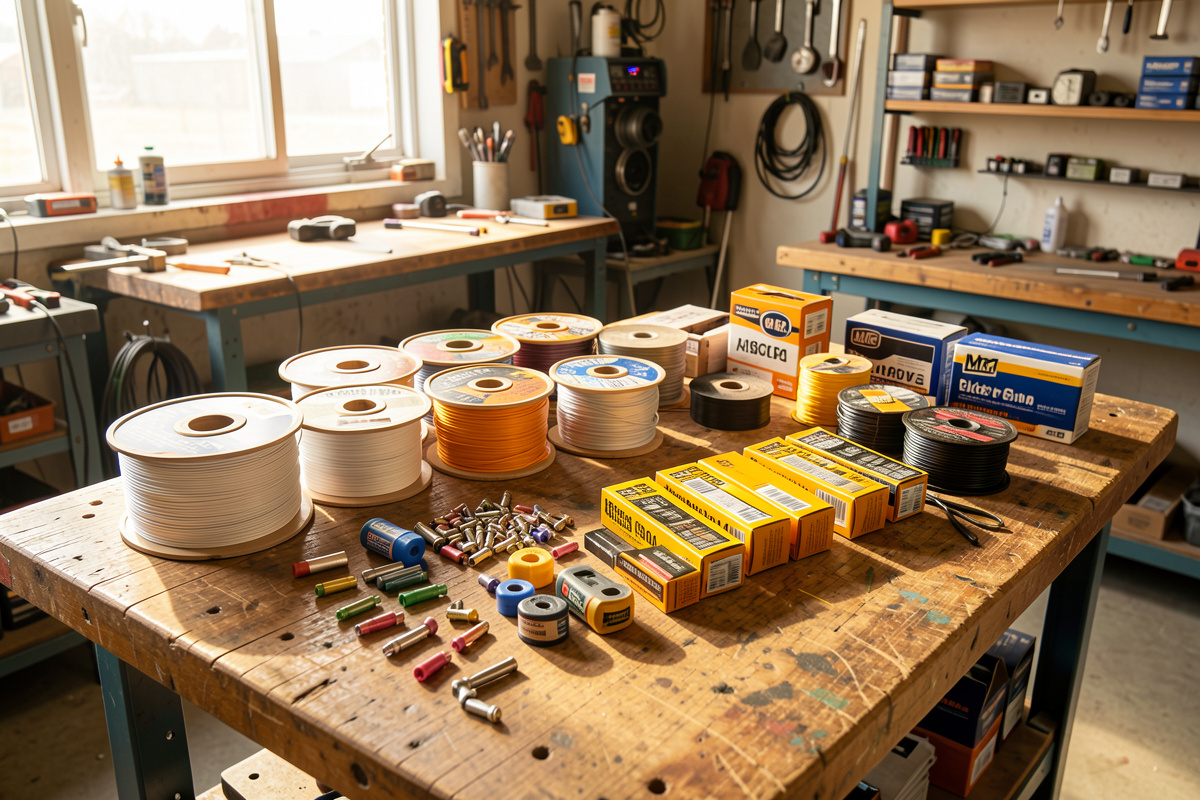

Pick the wire and the feed parts around it right and a MIG welder becomes boring in the best way: the arc lights, the puddle sits where you point it, and the bead looks the same at the end of the spool as it did at the start. Get them wrong and you chase birdnests, porosity, and burnbacks for an afternoon. On my bench the difference between a good day and a bad one usually traces back to a $6 contact tip or a spool that sat out in the humidity — not the machine.
I run a YesWelder MIG-PRO205DS double-pulse MIG, and over the years I’ve burned through more spools of ER70S-6 than I care to count, plus stainless, aluminum, and enough gasless flux-core to build half the fixtures on my scrap rack. This guide is the map for the whole consumable side of MIG: which solid wire, what diameter, the contact tip and drive roll and liner that carry it, how much you’ll actually use, and how to keep it from rusting into porosity before you strike an arc. Each section links to a deeper article, so treat this as the index and drill down where you need it.
What Does Welding Wire Selection Actually Cover?
Wire selection is really four decisions stacked together: the alloy (what the wire is made of), the diameter (how thick it is), the process (solid under gas vs. gasless flux-core), and the feed hardware that moves it — contact tip, drive roll, and liner. Miss any one and the other three can’t save you. A perfect 0.030 ER70S-6 spool feeds like garbage through a worn tip or the wrong drive roll.
Most of the calls beginners agonize over are simpler than the forums make them. For everyday mild steel on a home machine, 0.030 ER70S-6 solid wire under 75/25 argon/CO₂ covers roughly 80% of what lands on my table — brackets, cart frames, trailer repairs, shop fixtures. The rest of this guide is about the other 20%, plus the feed parts that make even that common combo run clean. If you want the raw diameter picture first, my MIG wire size guide comparing 0.023, 0.030, and 0.035 lays out the amperage ranges each diameter likes.
ER70S-6 or ER70S-3: Which Solid Wire for Steel?
For 95% of home mild-steel work, ER70S-6 is the answer. It carries more silicon and manganese deoxidizers than ER70S-3 — roughly 0.80–1.15% silicon and 1.40–1.85% manganese versus the leaner S-3 — so it wets out flatter and tolerates the mill scale, light rust, and oil that real shop steel shows up wearing. Both wires meet AWS A5.18 and both deposit at 70,000 psi tensile, so the strength is identical; the difference is how forgiving the puddle is over dirty base metal.
ER70S-3 still has a place. On clean plate where you’re stacking multi-pass welds, the lower silicon leaves fewer glassy silicon islands to chip between passes, and some fab shops spec it for exactly that. But on a home bench, where “clean” means “I hit it with the DeWalt DWE402 flap disc and called it good,” S-6’s extra deoxidizers are the safety margin you want. I keep a spool of each, and the S-3 comes off the shelf maybe once a year. The full ER70S-6 vs ER70S-3 breakdown gets into the chemistry and when the leaner wire actually earns its spot.
How Do You Match the Contact Tip to the Wire?
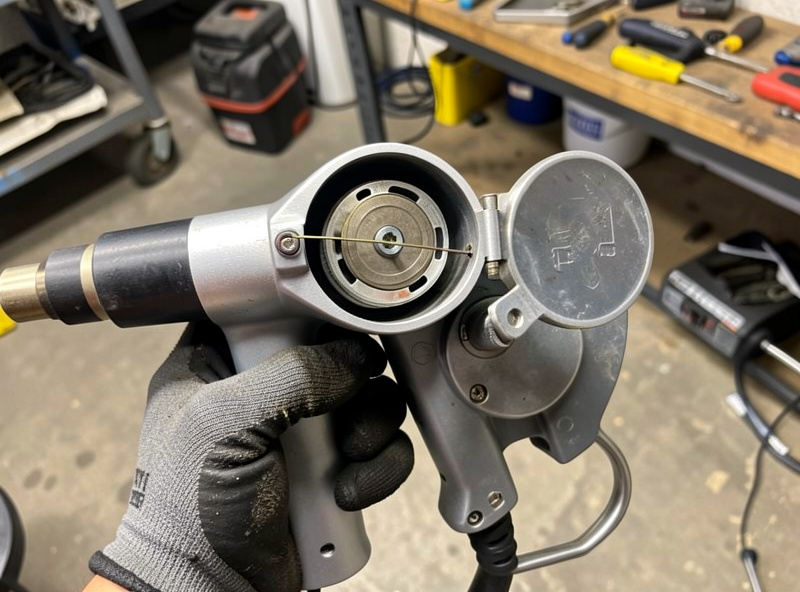
The contact tip is stamped with a wire size, and for solid steel you match it exactly: a 0.030 tip for 0.030 wire, a 0.035 tip for 0.035 wire. The tip is the last point of electrical contact before the arc, and a bore that’s too loose arcs erratically while a worn, oval bore causes the wire to wander and the arc to wander with it. A fresh tip is one of the cheapest fixes in the whole shop.
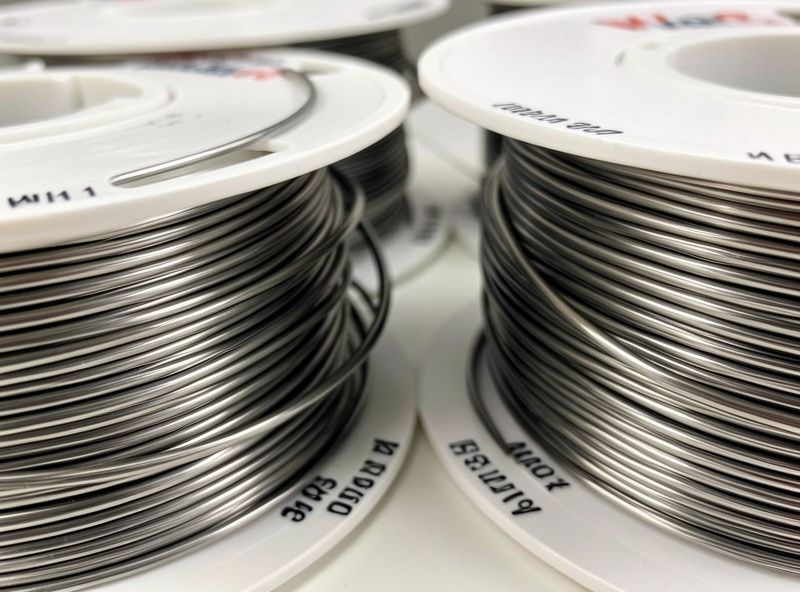
Aluminum breaks the match-exactly rule — soft aluminum wire expands and grabs, so you deliberately run one size up (a 0.035 tip for 0.030 aluminum wire) to keep it from seizing. I learned that the hard way with an early spool-gun setup: a same-size tip on aluminum welded itself shut mid-bead and I stood there confused while the wire piled up. Copper tips are cheap; the chrome-zirconium ones last longer under heat if you weld long. My contact tip sizing guide covers wear signs, keyholing, and when to size up.
Which Drive Roll Belongs on Your Wire?
The drive roll is what grips the wire and pushes it, and the groove has to match the wire type or feed goes to pieces. Smooth V-groove rolls are for solid steel wire — the smooth groove cradles the hard wire without deforming it. Knurled (V-knurled) rolls have teeth that bite into soft tubular flux-core wire so it doesn’t slip. U-groove rolls are for soft aluminum, whose round U cradles the wire without flattening it into a shape that jams the liner.
Put a knurled roll on solid wire and the teeth shave copper flakes off the surface that clog your liner and tip. Put a smooth V on flux-core and it slips and surges because it can’t grip the softer wire. That mismatch is behind a lot of “my feed surges” complaints — before you blame the machine, look at the roll. If you’re chasing feed gremlins, my write-up on MIG wire feed problems like birdnesting and surging pairs with the full drive roll comparison.
Does Liner Size Really Matter That Much?
It matters more than almost anything else in the gun. The liner is the tube the wire rides through from the drive rolls to the contact tip, and it’s sized for a wire-diameter range — a common steel liner covers 0.030–0.035, another handles 0.045. Run wire smaller than the liner’s range and it wanders inside the oversized bore, which is exactly how a birdnest starts at the drive rolls. Run wire too big and friction climbs until you get burnbacks.
Steel uses a coiled steel liner. Aluminum and stainless want a nylon or PTFE (Teflon) liner because the smoother, non-abrasive bore won’t shave those softer wires. Getting the liner trim length right at the gun end matters too — leave it long or short and you introduce a gap or a crush point that snags wire. This is a selection call, not a maintenance one, but if you’re replacing rather than choosing, my liner replacement walkthrough covers the swap. The liner sizing guide is the one to read before you buy.
How Much Wire Will You Actually Use?
Solid MIG wire is efficient — deposition efficiency runs about 90–98%, meaning almost all of the spool ends up in the weld rather than as spatter or slag. As a rough rule, 0.030 steel wire runs about 415 feet per pound, so an 11-pound spool holds roughly 4,500 feet; 0.035 is heavier per foot at about 305 feet per pound. For a weekend of bracket and cart work I’ll burn a pound or two, so a 2-pound spool is a one-project purchase and an 11-pound spool is months of hobby welding.
Buy the bigger spool if you weld regularly — the per-pound price drops hard, and an 11-pound spool of 0.030 ER70S-6 usually lands around $35–45 versus the premium you pay for a 2-pound. The catch is that a big spool sitting half-used is a big spool sitting there rusting, which is the whole reason storage matters (more below). I work out the deposition math and the real cost-per-project in how much welding wire you’ll actually use.
As an Amazon Associate I earn from qualifying purchases. When I need a fresh spool between local runs I’ll grab an 11-pound spool of 0.030 ER70S-6 and store it sealed the day it arrives.
What About Stainless MIG Wire and Tri-Mix Gas?
Stainless is where wire selection gets picky, because the filler has to match or out-alloy the base metal for corrosion resistance. ER308L is the workhorse for welding 304/304L stainless — the “L” is low carbon, which reduces the carbide precipitation that ruins corrosion resistance in the heat-affected zone. ER309L is the buffer alloy: use it to weld stainless to carbon steel, or as a barrier layer, because its extra chromium and nickel survive the dilution. ER316L adds molybdenum for chloride environments — marine, and anything that sees salt.
Gas matters as much as wire here. Short-circuit stainless likes a tri-mix — commonly 90% helium, 7.5% argon, 2.5% CO₂ — where the helium adds heat and the low CO₂ keeps carbon pickup down so you don’t wreck the corrosion resistance you paid for in the low-carbon wire. All three fillers fall under AWS A5.9. I don’t run stainless daily, so I keep my selection conservative and cross-check against the base alloy every time. The stainless MIG wire guide maps filler to base metal, and my MIG gas mix chart covers the shielding side.
How Do You Keep Wire From Rusting?
Rust and moisture are where porosity is born. Steel wire is bare — it has no coating to protect it — so a spool left on the machine in a humid shop grows a film of rust that drags through the liner, wears the contact tip, and introduces hydrogen and oxygen into the puddle as porosity. Once a spool has visible rust, I won’t use it on anything I care about; the pinholes it leaves are invisible until you do a bend test and the weld tears open.
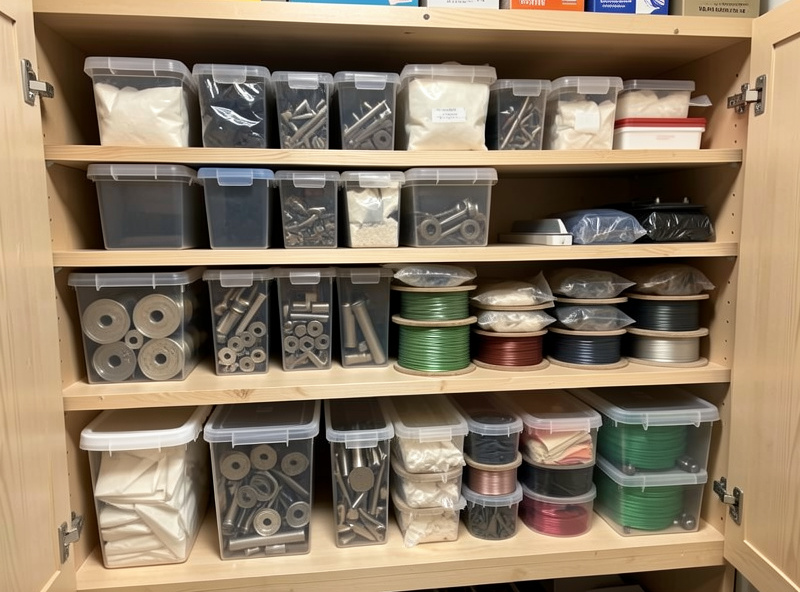
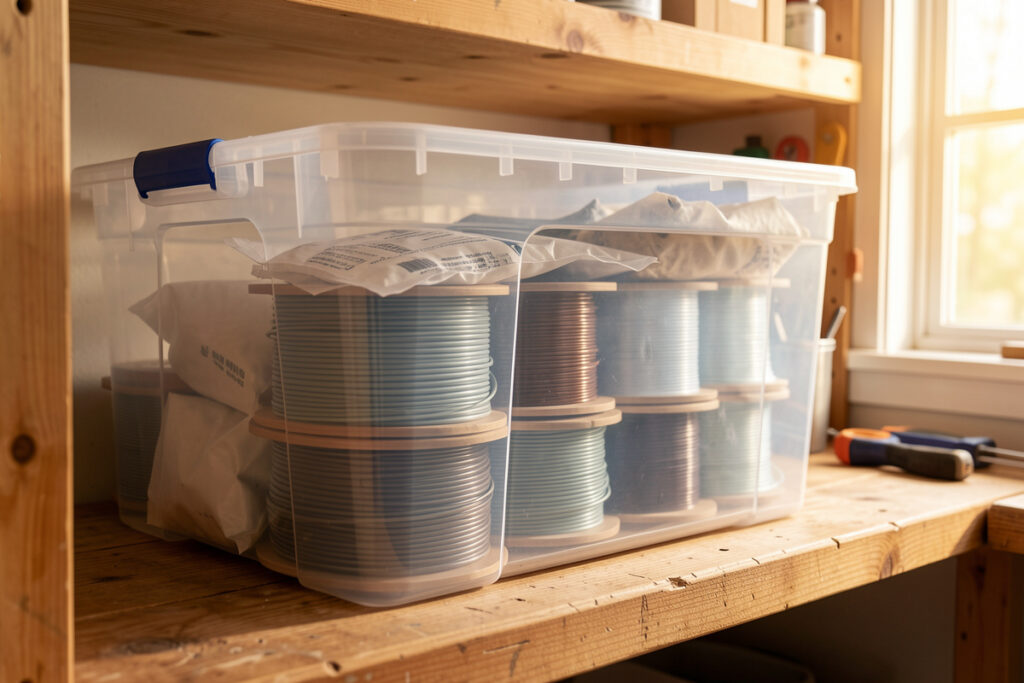
The fix is cheap: pull the spool off the machine between sessions, drop it in a sealed tote or a zip bag with a desiccant pack, and keep the shop relative humidity down. I aim to keep wire below about 60% RH and out of the temperature swings that drive condensation. Wire and rod kept dry is the single easiest porosity prevention there is — spatter and porosity start in the moisture. The full routine, including what to do with a spool that’s already spotted, is in keeping MIG wire from rusting.
How Does Wire Diameter Match Your Machine’s Amperage?
Diameter follows amperage, and amperage follows metal thickness. Thin wire melts at low current and thick wire needs more, so 0.023 wire suits sheet metal in the roughly 30–90 amp range, 0.030 is the general-purpose middle covering most home work up to about 140 amps, and 0.035 carries the higher currents you’d use on 1/4-inch and thicker plate. Push 0.023 too hot and it burns back to the tip; run 0.035 too cold on sheet and you get cold lap and blow-through both.
On the MIG-PRO205DS I run, 0.030 is the wire that stays loaded 90% of the time because it straddles the range I actually weld — 16-gauge brackets up to 3/16 plate on the same spool. I keep 0.023 for the thin auto-body-type sheet where 0.030 is too aggressive, and 0.035 for the occasional heavy bracket or trailer repair where I want deposition. Your machine’s power ceiling also sets the top end: a 120V unit tops out well below a 240V one, which is the whole reason the 110V versus 220V welder decision shapes what wire you can run. The wire size chart ties diameter to amperage row by row.
When Does Gasless Flux-Core Beat Solid Wire?
Gasless flux-core wins the moment you step outside. Self-shielded E71T-GS carries its own shielding in the flux core, so a breeze that would strip the gas off a solid-wire weld and fill it with porosity doesn’t touch it. My first machine — a Forney Easy Weld 140 flux-core unit I still keep on the shelf — earned its keep on fire-pit and cart-frame jobs in the driveway where dragging out a bottle made no sense.
The trade-offs are real: flux-core deposition efficiency runs lower, around 80–85% because you lose some to slag, and there’s slag to chip and more spatter to clean. It runs electrode-negative, needs a knurled drive roll, and the bead won’t look as tidy as solid wire under gas. But for outdoor structural tacking and anywhere wind is a factor, it’s the right call, not a compromise. I break down the process decision in flux-core vs solid wire and the settings in the flux-core settings chart.
Aluminum Wire: ER4043 or ER5356?
Aluminum adds a filler choice and a feeding problem. ER4043 is the more fluid, forgiving general-purpose rod — it wets nicely and cracks less on many alloys, which is why I reach for it first on castings and general repair. ER5356 is stronger and stiffer; the stiffness actually helps it feed, and it’s the pick for structural and marine work where the joint needs the extra strength, or when the part will be anodized and you want a color match.
The feeding problem is that aluminum wire is soft and springy — push it through a three-meter gun with steel drive rolls and it birdnests almost instantly. That’s why aluminum wants U-groove rolls, a nylon or PTFE liner, and usually a spool gun or push-pull setup that shortens the unsupported run. I’m honest that production aluminum and spool-gun deep-cuts are past where I’d call myself an authority — my welder friend Mike, decades in the trade, has straightened me out on thin-alloy edge cases more than once. For the setup basics, see MIG welding aluminum with a spool gun and the aluminum metallurgy guide.
Solid Wire, Flux-Core, or Stainless: A Selection Table
Here’s the consumable picture at a glance — the wire type, the diameter I reach for, the drive roll and gas that go with it, and the job it’s built for. This is the combination side; match all of it, not just the wire.
| Wire | Typical Diameter | Drive Roll | Shielding Gas | Best For |
|---|---|---|---|---|
| ER70S-6 solid | 0.030 / 0.035 | Smooth V-groove | 75/25 Ar/CO₂ | Everyday mild steel, dirty or scaled |
| ER70S-3 solid | 0.030 / 0.035 | Smooth V-groove | 75/25 Ar/CO₂ | Clean multi-pass on prepped steel |
| E71T-GS flux-core | 0.030 / 0.035 | Knurled V | None (gasless) | Outdoor, windy, no bottle |
| ER308L stainless | 0.030 | Smooth V-groove | Tri-mix (He/Ar/CO₂) | 304/304L stainless |
| ER309L stainless | 0.030 | Smooth V-groove | Tri-mix (He/Ar/CO₂) | Stainless-to-carbon-steel joints |
| ER4043 aluminum | 0.030 / 0.035 | U-groove | Straight argon | General aluminum (spool gun) |
Notice the drive roll and gas change with the wire — that’s the whole point of this cluster. If you want the process-level decision behind the first two rows versus the third, my flux-core vs solid wire comparison and the best flux-core wire for home use cover the gasless side in depth.
The Consumable Order That Actually Works
When a feed problem shows up, the order you check things in saves an hour. On my bench it goes: tip first (cheapest and wears fastest), then drive roll tension and groove, then liner, then the spool itself. Nine times out of ten it’s the tip. I once tore a whole gun apart chasing a surge that turned out to be a contact tip I’d run three spools too long — the bore had gone oval and the wire was arcing inside it. New tip, problem gone, and I felt like an idiot.
Keep a small stock of the wear parts you actually use — a strip of contact tips in your wire size, one spare liner, and the drive roll for your main wire — and store your spools sealed. That’s the difference between a shop that welds and a shop that troubleshoots. For keeping the whole feed path clean between jobs, my MIG welder maintenance guide and the gun cleaning walkthrough are the companion reads, and if you’re fighting pinholes, weld-through primer and porosity covers the coating side of the same problem.
The same workshop holds the welder, the CNC, the laser, and the 3D printer, and every one of them has its own consumable rabbit hole — but wire is the one that turns flat stock into the fixtures and frames the rest of the bench is built on. Get the consumable stack dialed and the machine does what you tell it. That’s what all seven of these guides are pointed at.
What I’d Do Starting Today
If you’re setting up a home MIG station right now: buy an 11-pound spool of 0.030 ER70S-6, a smooth V-groove drive roll to match, a strip of 0.030 contact tips, and one spare 0.030–0.035 steel liner. Get a 75/25 argon/CO₂ bottle and a sealed tote with a desiccant pack for the spool. That combination will handle the overwhelming majority of home steel work and it’ll feed clean for years — because the parts match. Then read down into whichever spoke matches the next job on your bench, and you’ll never guess at a consumable again.
Keep Building
- ER70S-6 vs ER70S-3 MIG Wire: Which Solid Wire for Your Steel
- MIG Contact Tip Sizing: Matching Tip to Wire for Steady Feed
- Knurled vs V-Groove vs U-Groove Drive Rolls
- MIG Gun Liner Sizing: Why the Wrong Liner Birdnests Your Wire
- How Much Welding Wire You’ll Actually Use
- Stainless MIG Wire: 308L vs 309L vs 316L and Tri-Mix Gas
- Keeping MIG Wire From Rusting
What is the best all-around MIG wire for a home welder?
For everyday mild steel, 0.030 ER70S-6 solid wire under 75/25 argon/CO2 gas handles roughly 80 percent of home projects. Its higher silicon and manganese deoxidizers tolerate the mill scale and light rust that real shop steel carries, and it wets out flat. Keep a smooth V-groove drive roll and matching 0.030 contact tips with it.
Do I need a different drive roll for flux-core wire?
Yes. Solid steel wire uses a smooth V-groove roll, but soft tubular flux-core wire needs a knurled roll whose teeth bite in so it does not slip. Running solid wire on a knurled roll shaves copper flakes that clog the liner and tip, and running flux-core on a smooth V causes surging.
Why does my MIG wire birdnest at the drive rolls?
The most common cause is a liner that is too large for the wire diameter, letting the wire wander until it kinks and piles up. A worn or wrong contact tip that the wire cannot pass, or drive roll tension set too high, will also birdnest. Check the tip first, then the liner size, then the tension.
How should I store welding wire to prevent rust?
Pull the spool off the machine between sessions and keep it in a sealed tote or zip bag with a desiccant pack, ideally below about 60 percent relative humidity. Bare steel wire has no coating, so a humid shop grows a rust film that wears the tip and causes porosity. A rusted spool should not be used on anything structural.
Which stainless MIG wire do I use for 304 stainless?
ER308L is the standard filler for welding 304 and 304L stainless. The L stands for low carbon, which reduces carbide precipitation that would otherwise ruin corrosion resistance. Use ER309L to join stainless to carbon steel, and ER316L when the part sees chlorides or salt.
External references: the American Welding Society publishes the filler-metal specifications behind these wires — AWS A5.18 for carbon-steel solid wire and AWS A5.9 for bare stainless electrodes — and Lincoln Electric posts the per-product datasheets with the actual silicon and manganese ranges for each ER70S grade.

Discussion (0)