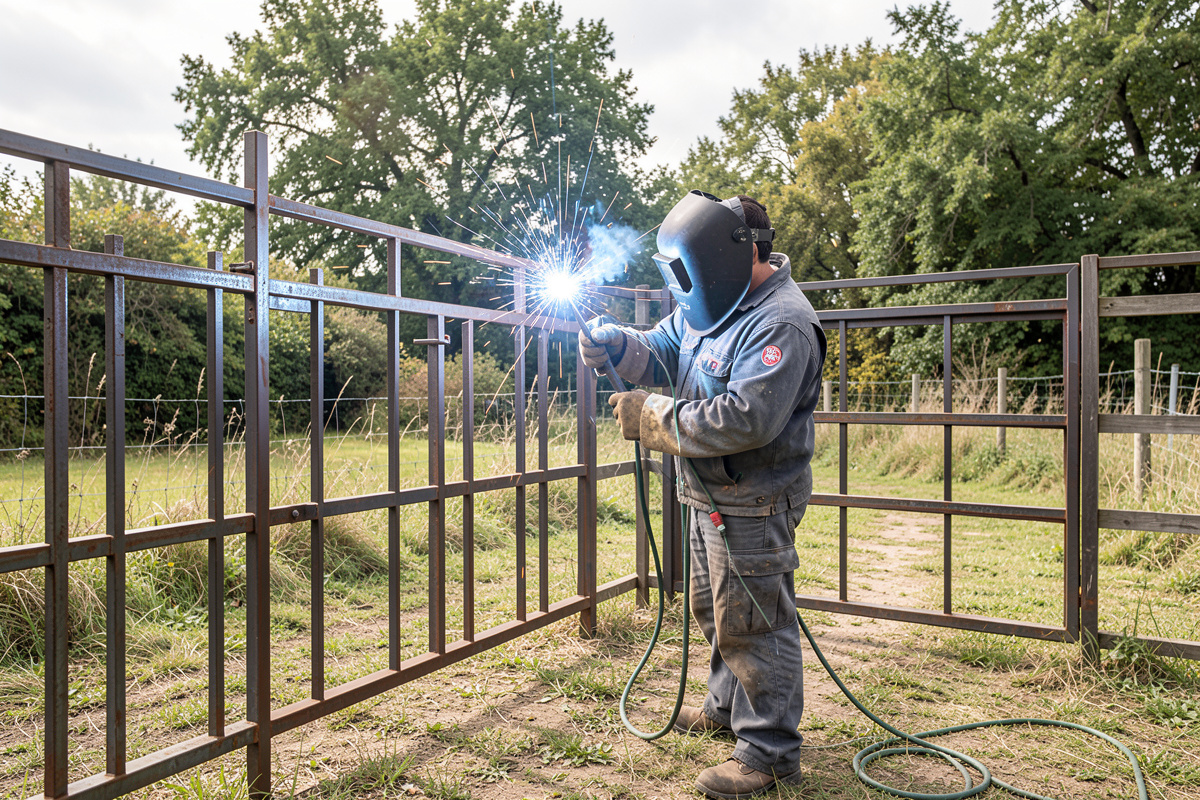

Flux-core wins outdoors because it carries its own shield. Self-shielded gasless wire generates its shielding gas from the flux burning inside it, so there’s no external gas cloud for the wind to blow away — and that single fact lets it hold a sound weld in a 15–20 mph breeze that would fill a gas-MIG bead with porosity. A spool of gasless wire is what comes outside with me every time — no regulator, no bottle, no drama.
I learned the difference the frustrating way. Years back I tried to tack a gate hinge in my open workshop doorway on a gusty Swedish afternoon, running solid wire under 75/25. Every bead came out gray and pinholed — classic wind-blown porosity, the shield stripped clean off the puddle. I swapped to E71T-GS gasless, re-struck the exact same joint, and got a clean, sound bead first try. Same machine, same hand, same wind. The only thing I changed was where the shield came from.
This article is about why that works, how much wind gasless can really take, and where it still lets you down outdoors. For the full process, start at the flux-core welding guide.
Why Does Flux-Core Work Outdoors When MIG Doesn’t?
Gas MIG relies on a cloud of shielding gas flowing from the nozzle to blanket the molten puddle. Outdoors, even a light breeze peels that cloud away, letting atmospheric nitrogen and oxygen into the weld — that’s porosity. Flux-core skips the external cloud entirely: its shield comes from flux burning right at the arc, so there’s nothing for the wind to steal.
The mechanism matters if you want to trust it. As self-shielded wire melts, the flux inside decomposes into a shielding gas and a slag layer, both generated at the puddle itself rather than delivered from a bottle metres of nozzle away. Because the protection is created at point of contact, wind has almost nothing to grab. It’s the same reason stick welding works outdoors — the flux coating on a stick rod does the same job — and flux-core is essentially that principle turned into a continuous spool.
This is why I tell anyone whose welding happens outside a garage to start with gasless. The DCEN polarity that lets the flux burn correctly is the same feature that makes the process wind-proof — they’re two sides of the same design. Get the polarity right and the outdoor performance comes free.
How Much Wind Can Flux-Core Handle?
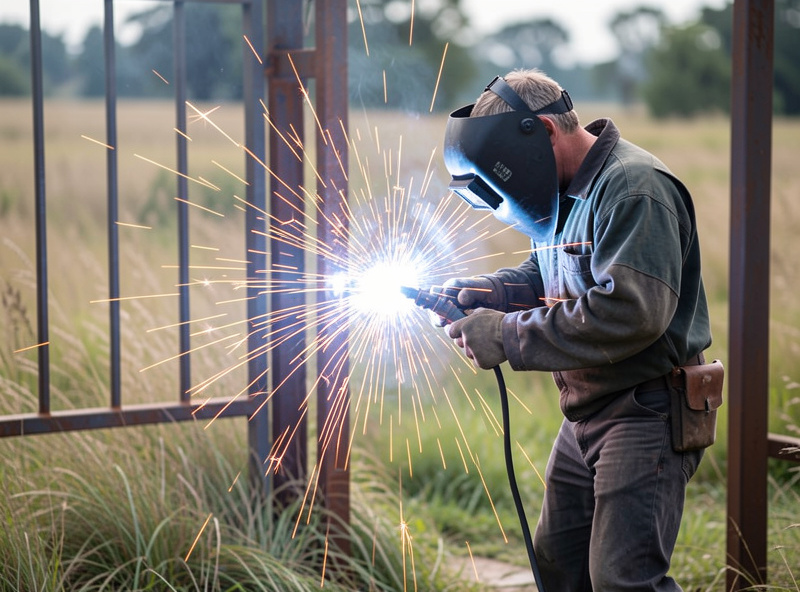
Self-shielded flux-core comfortably handles the kind of wind that shuts gas MIG down — a steady 15–20 mph breeze is no problem, and gusts beyond that are workable with a little care. Gas MIG, by contrast, starts to show porosity in as little as 5–10 mph of crosswind. That’s the practical gap: flux-core keeps welding when the bottle has quit.
There’s still a ceiling, and I don’t pretend otherwise. In a genuine gale, hard driving gusts, or where wind is scouring loose slag and spatter back across the arc, quality suffers on any process. But the everyday reality of outdoor work — building a trailer in the driveway, fixing a fence in a field, welding a bracket on the side of the shop — sits well inside what gasless handles. I’ve run clean structural fillets on a 4 mm gate in wind that would have made solid wire useless.
My rule of thumb: if the wind is strong enough to lean into, put up a simple windbreak anyway to steady the arc, but don’t cancel the job. That flexibility is the whole reason flux-core earns a permanent spot on my shelf even though I run gas MIG indoors most days. When the work comes to the weather instead of the shop, gasless is the answer.
What Exactly Goes Wrong With Gas MIG in Wind?
Wind strips the shielding gas off a MIG puddle, and the instant atmosphere reaches molten steel you get porosity — trapped gas pockets that riddle the bead with pinholes and voids. A porous weld looks gray and pitted instead of bright and even, and worse, it’s structurally weak: those voids are stress risers that crack under load.
The insidious part is that mild porosity can hide. A bead that looks only slightly off on the surface may be honeycombed underneath, and on a load-bearing joint that’s a genuine hazard, not a cosmetic flaw. This is why I won’t run gas MIG outdoors on anything structural even in a light breeze — I can’t see the voids I can’t trust. Cutting a wind-blown MIG coupon in half and seeing the swiss-cheese cross-section is the lesson that sticks. My friend Mike, decades in the trade, put it plainly the first time he watched me try: shield or don’t bother.
You can wrestle gas MIG into working outdoors by cranking the gas flow and building windbreaks, but you’re fighting the process the whole time and burning expensive gas doing it. Flux-core just sidesteps the entire problem. If the wind is the variable you can’t control, change the process, not the flow rate.
Do You Still Need to Prep the Metal for Outdoor Welding?
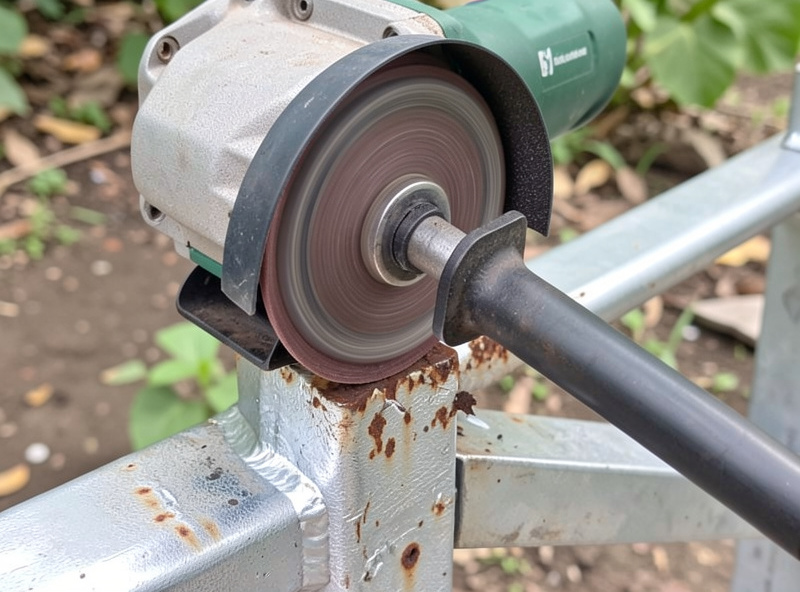
Absolutely — flux-core forgives wind, not filth. Wind resistance has nothing to do with surface cleanliness, and gasless wire is actually a little fussier about mill scale, rust, and paint than you’d hope. Grind the joint to bright metal before you weld, outdoors or in. Dirty steel gives you porosity and inclusions no shield can fix.
Outdoor work often means dirtier metal — a rusty gate, a scaled trailer frame, a painted bracket — precisely the stuff that tempts you to skip prep because “it’s just a field repair.” Don’t. I keep my DeWalt DWE402 angle grinder with a flap disc in the truck for exactly this, and I clean the joint and a good margin around it back to shiny steel before the first tack. Ten seconds of grinding saves a re-do. On genuinely dirty or rusty steel outdoors, this is also where a stick rod like 6011 earns its place — but for clean-prepped joints, gasless flux-core is my go-to.
Moisture is the other outdoor variable. Damp flux inside the wire causes porosity just like a stripped shield does, so I keep spools bagged with desiccant and never leave one sitting out in humid air or drizzle. The wind you can weld through; the wet wire will still bite you. Prep the metal, protect the wire, and gasless does the rest.
What About Rain, Cold, and Damp Conditions?
Never weld in the rain — that’s a safety line, not a quality one. Water and electricity are a lethal combination, and a wet welder, wet gloves, or standing water dramatically raise the risk of electric shock. Wind, flux-core handles; rain, you stop and wait. This is non-negotiable regardless of process.
Cold weather is workable but changes things. Steel below freezing pulls heat out of the puddle fast, so you may need to run a touch hotter or preheat thick sections to get proper fusion — a cold 6 mm plate can chill a bead into a cold lap before it ties in. In a Swedish winter I’ve had to bump settings and warm heavy stock with a torch before it would take a sound weld. Thin material is more forgiving of the cold, but watch your fusion on anything thick.
Damp and humidity are the quiet enemies. Beyond wet wire, condensation on cold steel brought into a warm space, or dew on an early-morning outdoor joint, introduces moisture right where the arc is. Wipe the joint dry, let cold metal acclimate, and keep your consumables sealed. Manage water and cold sensibly and gasless flux-core will weld through conditions that keep a lot of hobby welders indoors — which is exactly why it’s the process I reach for when the job is outside.
What’s the Best Flux-Core Setup for Field and Outdoor Work?
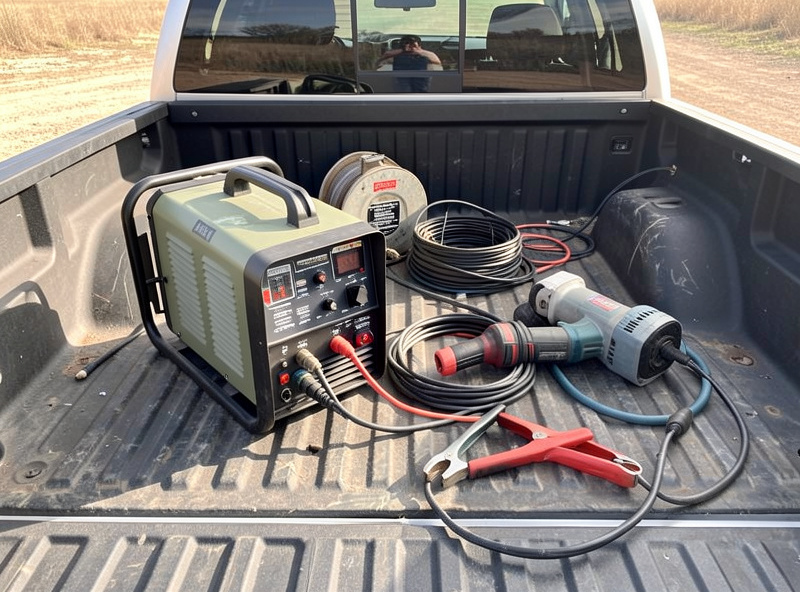
The ideal outdoor rig is simple and portable: a gasless-capable inverter wired for DCEN, a spool of quality E71T-GS or E71T-11, a heavy-gauge extension cord sized to the run, and your grinder and clamps. No bottle, no cart of gas — that’s the whole point. The less you have to drag to the job, the more likely the job gets done.
Power delivery is the detail people miss. Outdoors usually means a long run from the nearest outlet, and a thin cord starves the inverter — the arc goes soft and stubby and you blame your settings. I run an Iron Box heavy-gauge cord for exactly this reason, sized so the machine gets full voltage at the far end of the property. A gutless arc at the end of a skinny orange cord has ruined more field welds than wind ever has.
Round it out with a windbreak you can improvise from a sheet of plywood or the truck itself when gusts get serious, dry consumables in a sealed bag, and fire-watch discipline — dry grass and outdoor spatter start fires, and OSHA’s guidance on fire prevention during welding and cutting is worth internalizing before you strike an arc in a field. Clamp tight with my Bessey GSCC clamps so nothing shifts as it heats, and you’ve got a field kit that goes anywhere.
Where Does Outdoor Flux-Core Still Struggle?
Flux-core’s outdoor superpower doesn’t rewrite its weaknesses: it still burns through thin sheet, still throws more spatter and slag than gas MIG, and still smokes heavily. Wind resistance buys you the ability to work outside — it doesn’t turn gasless into a fine sheet-metal process. Match the tool to the job.
For a rusty gate, a trailer frame, a fence repair, or any structural steel from 3 mm up, outdoor flux-core is close to ideal. For a thin body panel or delicate sheet work, the same deep-penetrating arc that makes it strong will punch holes — that’s a shop-and-gas-MIG job, and I cover the workarounds in flux-core on thin metal. Ventilation is the other honest caveat: outdoors helps disperse the heavy gasless fume, but you still position yourself out of the plume and never weld galvanized without grinding the zinc coating back.
Knowing the edges is what makes the tool trustworthy. Gasless flux-core is the process I’d hand any home welder whose work happens outside, precisely because I know exactly where it shines and where it doesn’t. If you want to sort out which specific wire to load for that field kit, I ran the two common home options head to head in best flux-core wire for home use.
What I’d Take to a Field Job, Starting Today
If I were loading the truck right now for an outdoor weld, it’d be the gasless inverter on DCEN, a bagged spool of E71T-GS, the heavy Iron Box cord, the DWE402 grinder, the Bessey clamps, a fire extinguisher, and a scrap of plywood for a windbreak. That kit welds a gate, a trailer, or a fence in weather that sends bottle-dependent welders home. Simplicity is the whole advantage — carry less, weld more.
The mindset that ties it together: flux-core lets the work come to the weather. I built most of my own shop fixtures and the weld cart that holds the MIG-PRO205DS with gasless wire, and the same portability is why it’ll be the process for the rough outdoor stages of the aluminum boat project I’m building toward. When the job is outside and the wind is up, gasless isn’t a compromise — it’s the right call. From here, dial it in with the settings chart and lock down the polarity.

Discussion (0)