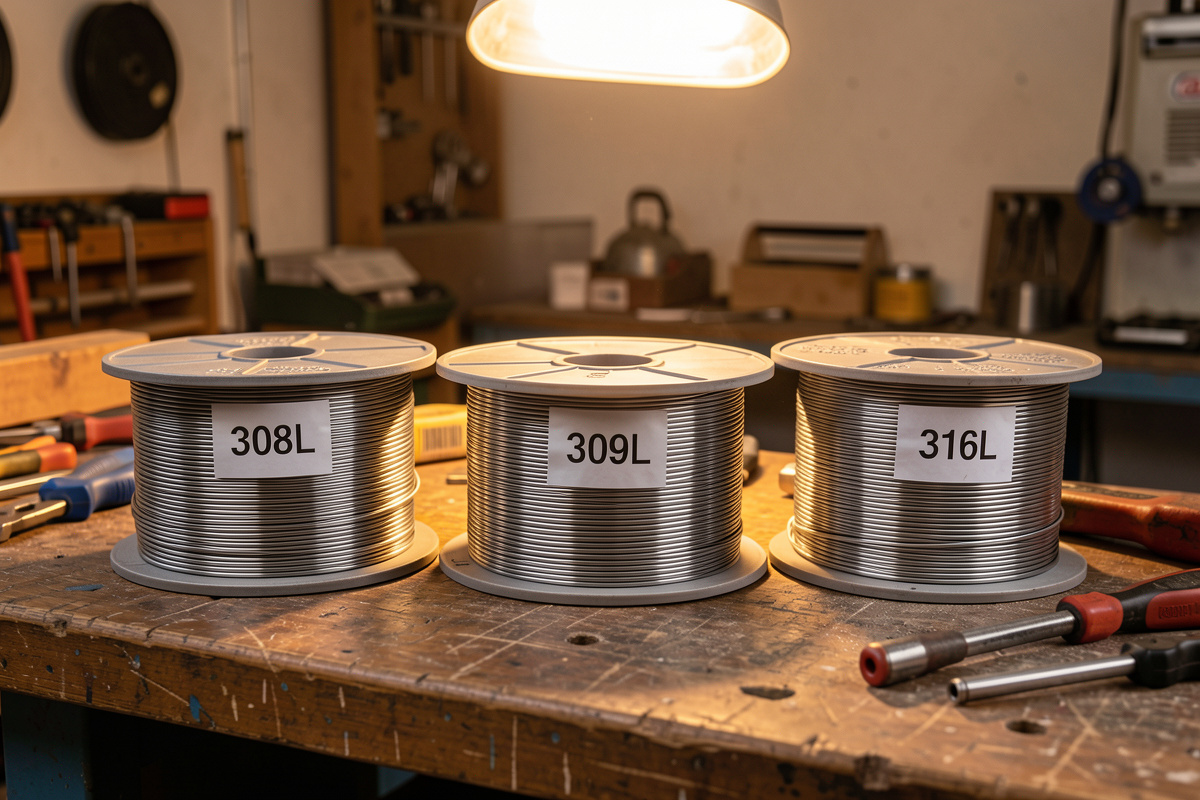

Match the stainless filler to the base metal: ER308L for 304/304L stainless, ER309L to join stainless to carbon steel, and ER316L when the part sees chlorides or salt. The “L” means low carbon — under about 0.03 percent — which protects the corrosion resistance you’re paying for. Pick the wrong grade and the joint can rust or crack in service even when the bead looks perfect. Gas matters just as much, and it isn’t the CO₂ you run on steel.
I don’t weld stainless every day — mild steel is my bread and butter — so I keep my stainless selection conservative and cross-check the base alloy every single time. My welder friend Mike, decades in the trade, has corrected me on dissimilar-metal joints more than once, and code-critical stainless is squarely his territory, not mine. But the everyday home-shop stainless call comes down to three fillers and one gas, and once you understand what each grade is for, it’s not complicated. Here’s how to choose.
Why Does the “L” Matter in ER308L?
The L stands for low carbon, and it’s not a minor detail — it protects corrosion resistance. When stainless is heated in the roughly 800–1500°F range near a weld, carbon combines with chromium to form chromium carbides at the grain boundaries. That robs the surrounding metal of the free chromium it needs to resist corrosion, a problem called sensitization, and the result is intergranular corrosion that eats the weld zone. Keeping carbon under about 0.03 percent starves that reaction.
So for anything that will see moisture or a corrosive environment, you want the L grade — ER308L, not plain ER308. The non-L wires exist for high-temperature service where carbide precipitation matters less and a little extra strength helps, but for home and general fabrication the L grade is the safe default. It’s the same low-carbon logic that runs through stainless design generally. If reading heat tint is new to you, the colors along a stainless weld tell you how hot the zone got, which I cover in the weld color chart.
When Do You Use ER308L?
ER308L is the workhorse, and it’s the answer for welding 304 and 304L stainless — by far the most common stainless you’ll meet, from kitchen and food-grade fabrication to general brackets and tanks. Its chromium and nickel content is formulated to match 304’s roughly 18 percent chromium, 8 percent nickel makeup, slightly over-alloyed so the weld metal keeps its corrosion resistance after dilution with the base.
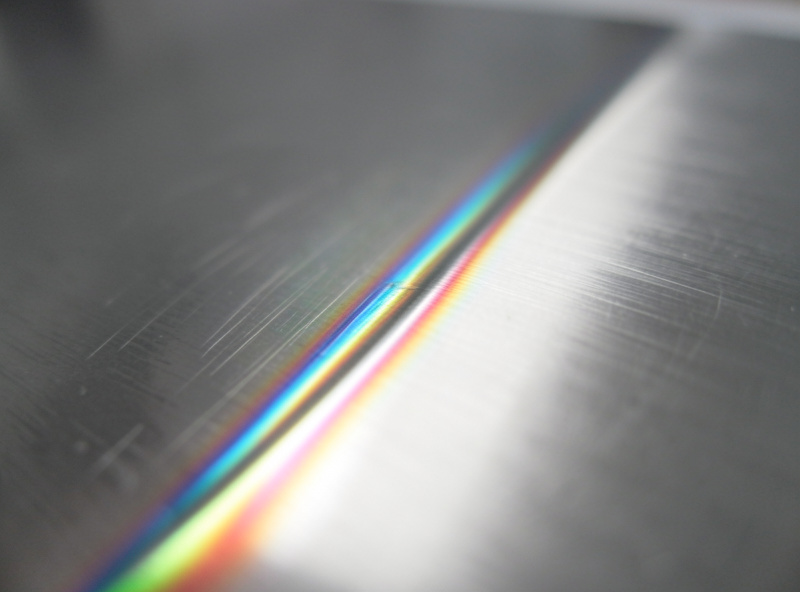
If you’re welding stainless to itself and it’s 304-series, reach for 308L and don’t overthink it. Where people go wrong is assuming one stainless filler covers all stainless — it doesn’t, because the base alloys differ and the filler has to keep up. The bead off 308L is bright and can show gorgeous heat-tint colors, but those colors also warn you about oxidation on the back side if you didn’t shield it. On a home MIG setup, stainless runs on a smooth V-groove drive roll just like solid steel wire, since it’s a hard solid wire — that part doesn’t change, as I note in the drive roll guide.
What Is ER309L For?
ER309L is the dissimilar-metal and buffer-layer wire. Its higher chromium and nickel — roughly 23 percent chromium, 13 percent nickel — let it survive the dilution that happens when you weld stainless to carbon or mild steel. Weld that joint with 308L and the carbon steel dilutes the weld metal below the alloy level it needs, and you can get a hard, crack-prone weld. 309L has the extra alloy headroom to stay sound.
So 309L comes out for two jobs: joining stainless directly to carbon steel, and laying a buffer or barrier layer on carbon steel before capping with another filler. Repair work is where a home welder meets it — fixing a stainless part that bolts or welds to a mild-steel frame, for instance. This is exactly the kind of dissimilar joint I double-check against a spec or ask Mike about before I commit, because the consequences of getting it wrong show up as cracking, not as an obvious bad bead.
When Do You Need ER316L?
ER316L adds molybdenum — about 2 to 3 percent — and that molybdenum is what buys resistance to chloride pitting. If the part lives near salt water, sees road salt, or handles chlorides of any kind, 316L is the filler, matched to a 316/316L base. The moly resists the localized pitting corrosion that chlorides drive, which plain 308L can’t fully stop.
The rule to remember: match 316 base with 316L filler, and don’t downgrade to 308L to save money on a marine or chloride part — the corrosion will find the weld. The aluminum boat I’m building toward is a good reminder of why alloy matching matters near water, even though that hull will be aluminum, not stainless. For any stainless that sees salt, spend the extra on 316L. It’s cheap insurance against a joint that pits out in a season.
Stainless Filler Selection at a Glance
Here’s the three-grade decision on one screen. The alloy figures are nominal, but the base-metal and use columns are the calls you actually make.
| Filler | Base Metal | Key Alloy | Use For |
|---|---|---|---|
| ER308L | 304 / 304L | ~18Cr / 8Ni | General stainless-to-stainless |
| ER309L | Dissimilar | ~23Cr / 13Ni | Stainless to carbon steel, buffer layer |
| ER316L | 316 / 316L | ~18Cr / 12Ni / 2–3Mo | Chloride, marine, salt exposure |
All three fall under the AWS A5.9 specification for bare stainless electrodes, so the classification tells you the guaranteed chemistry. When in doubt about the base alloy, find out before you weld — the filler choice depends entirely on knowing what you’re joining.
Why Does Stainless Need Tri-Mix Gas, Not CO₂?
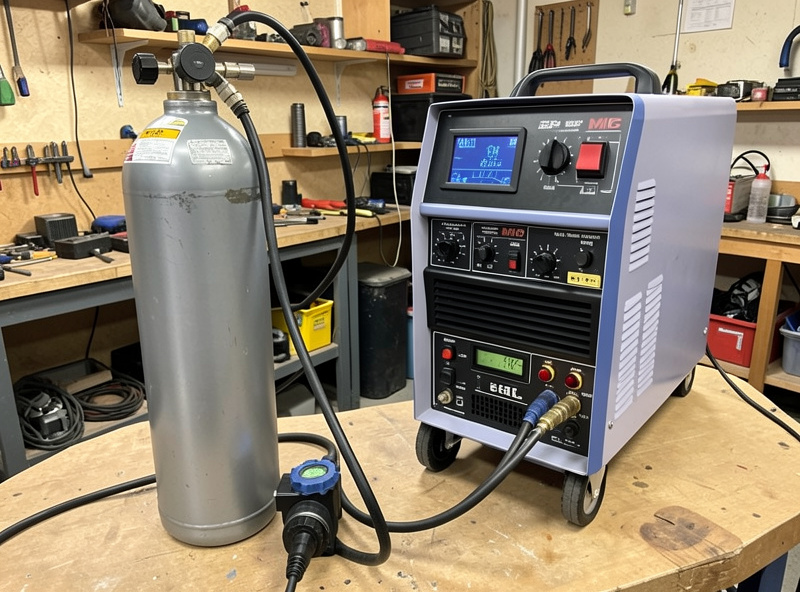
The 75/25 argon/CO₂ you run on mild steel is wrong for stainless, and straight CO₂ is worse. Both put too much carbon into the arc, and carbon pickup in a stainless weld undermines the corrosion resistance you chose a low-carbon wire to protect. For short-circuit stainless MIG, the standard answer is a tri-mix — commonly around 90 percent helium, 7.5 percent argon, 2.5 percent CO₂ — where the helium adds heat for good fusion and the CO₂ is capped low.
That low CO₂ ceiling is the whole point: enough to stabilize the arc, little enough to keep carbon out of the weld. For spray-transfer stainless on thicker material, an argon-rich mix with a small oxygen or CO₂ addition is used instead. The gas is not an accessory here — it’s part of the corrosion-resistance system along with the L-grade wire. My broader MIG gas mix chart lays out the shielding options, and the wire side ties back to the consumable selection hub.
How Do You Weld Stainless Without Wrecking Corrosion Resistance?
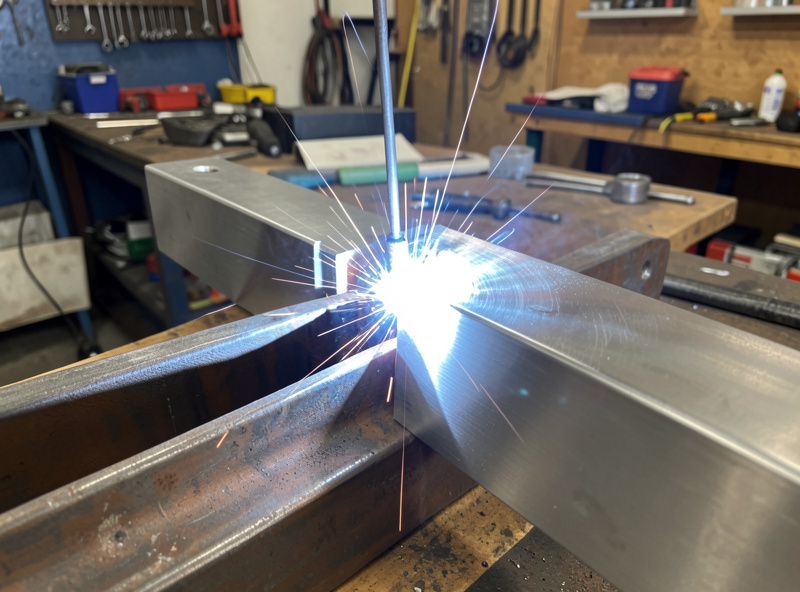
Prep and cleanliness decide the outcome as much as filler choice. Use a stainless-only wire brush and grinding discs — a brush that has touched carbon steel embeds iron particles that rust and cause surface staining. Keep the joint clean and free of oil. And manage heat: stainless holds heat and moves it poorly, so keep interpass temperature down and don’t overheat the part, or you’ll sensitize the zone and warp thin material.
On the back side of a full-penetration stainless weld, unshielded metal oxidizes into that black, sugary scale welders call sugaring, which destroys corrosion resistance locally — critical joints get a back purge with argon. That’s more than most home jobs need, but it’s why food-grade and pipe stainless is a step above general fab. The heat-tint colors on the face are your feedback: straw and light blue are usually fine, dark blue and grey mean you ran too hot. Reading them is a skill worth building, and the weld color chart decodes them.
What I Run and Where I Defer
On my bench, stainless is occasional, so I keep it simple: a spool of ER308L covers the 304 work that shows up, and I’ll buy 316L specifically for anything near salt rather than keep it on the shelf. I run it on the smooth V-groove roll, a dedicated stainless brush lives in its own drawer, and I cross-check the base alloy before I strike an arc. That conservative approach keeps me out of trouble on the general repair and fabrication stainless a home shop sees.
Where I stop and defer is code-critical stainless, pipe, and anything structural — that’s Mike’s world and the world of qualified procedures, not a hobby bench. As an Amazon Associate I earn from qualifying purchases. When I need stainless filler I’ll pick up a spool of 0.030 ER308L for general 304 work and store it dry like any other wire. Knowing your limits is part of the craft, and stainless is where I’m honest about mine — the everyday grades I’ll handle, the coded work I won’t pretend to. The wire-selection thinking that starts with solid steel wire carries right into stainless: match the filler to the metal, keep it dry, and let the base alloy make the call.
What stainless MIG wire do I use for 304 stainless?
ER308L is the standard filler for 304 and 304L stainless. Its chromium and nickel are formulated to match 304 and stay corrosion-resistant after dilution with the base metal. The L means low carbon, under about 0.03 percent, which prevents the carbide precipitation that would otherwise reduce corrosion resistance near the weld.
When should I use ER309L instead of ER308L?
Use ER309L when joining stainless to carbon or mild steel, or as a buffer layer on carbon steel. Its higher chromium and nickel survive the dilution from the carbon steel that would leave a 308L weld under-alloyed and crack-prone. It is the go-to for dissimilar-metal joints a home welder meets in repair work.
What is the difference between 316L and 308L stainless wire?
ER316L adds about 2 to 3 percent molybdenum, which resists chloride pitting corrosion. Use it with a 316/316L base and for any part exposed to salt water, road salt, or chlorides. ER308L lacks the molybdenum and should not be substituted on marine or chloride parts, where the corrosion will attack the weld.
Can I use CO2 or 75/25 gas for stainless MIG?
No. Both put too much carbon into the arc, and carbon pickup undermines the corrosion resistance of a stainless weld. Short-circuit stainless uses a tri-mix, commonly around 90 percent helium, 7.5 percent argon, and 2.5 percent CO2, where the CO2 is capped low on purpose.
Why does my stainless weld turn black on the back?
That is sugaring, oxidation of unshielded hot metal on the back of a full-penetration weld, and it destroys corrosion resistance locally. Critical stainless joints are back-purged with argon to prevent it. On the face, dark blue and grey heat tint means you ran too hot; straw and light blue are usually acceptable.
Related Articles
- Welding Wire and Consumable Selection Guide
- ER70S-6 vs ER70S-3 MIG Wire
- MIG Welding Gas Guide: C25 vs C100 vs C10
- Weld Color Chart: Reading Heat Tint
- Knurled vs V-Groove vs U-Groove Drive Rolls
External references: the classifications here follow AWS A5.9 from the American Welding Society, the specification for bare stainless electrodes and rods, and Lincoln Electric publishes datasheets with the exact chromium, nickel, and molybdenum ranges for each stainless grade.

Discussion (0)