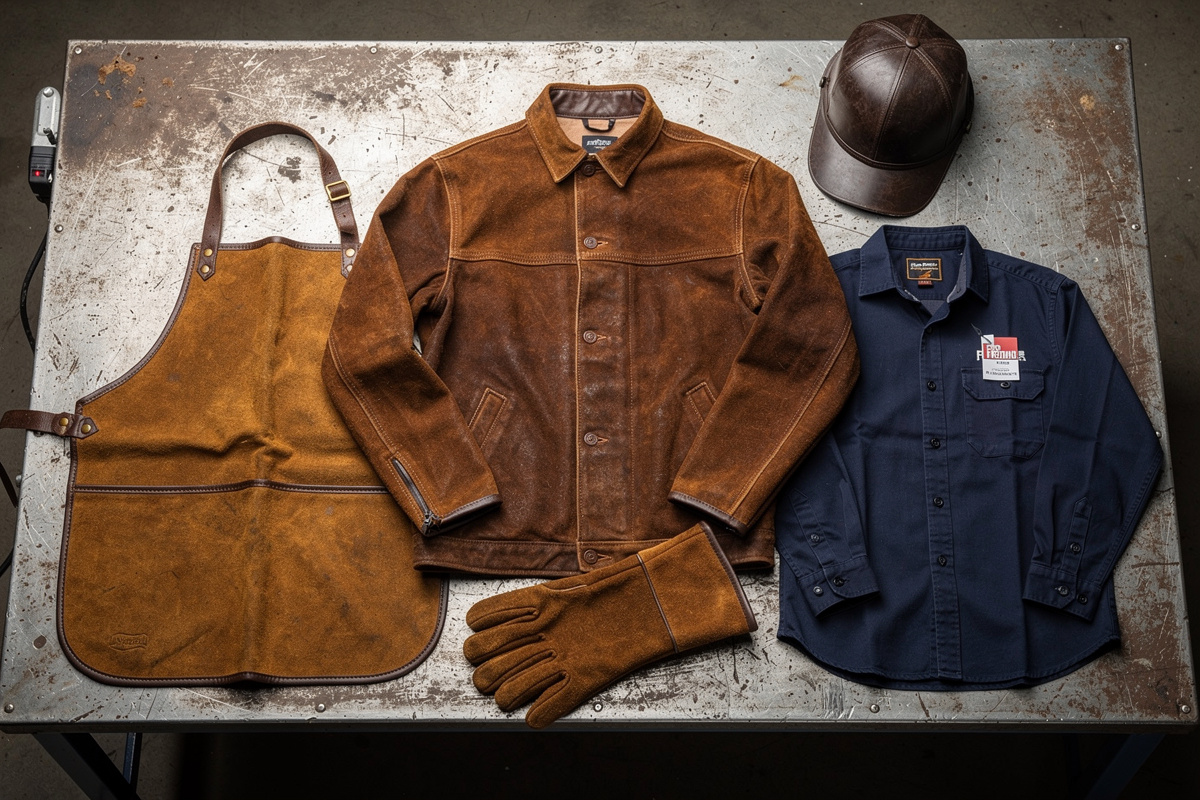

The fabric you weld in matters more than almost any beginner believes, and the dangerous part is counterintuitive: the “comfortable” everyday clothing most people wear to the shop — a polyester hoodie, a nylon jacket, a poly-blend t-shirt — is the worst possible thing to have near an arc. Synthetics melt, stick to skin, and keep burning. The safe choices are leather and flame-resistant cotton, and which one to reach for depends on the job. This is a guide to the materials, not a gear-pick list — for specific gloves and a jacket to buy, see the welding gloves and jacket guide; here we are talking about fabric from the neck down and why it behaves the way it does in spatter and arc flash.
I built my own clothing rules the hard way, through a melted-hoodie burn on an early project, and the principle that came out of it is simple: anything within a few feet of the arc is leather, denim, or FR-rated cotton — never synthetic, never thin. Let me walk through how the materials actually compare and where each belongs.
How Each Fabric Behaves Near an Arc
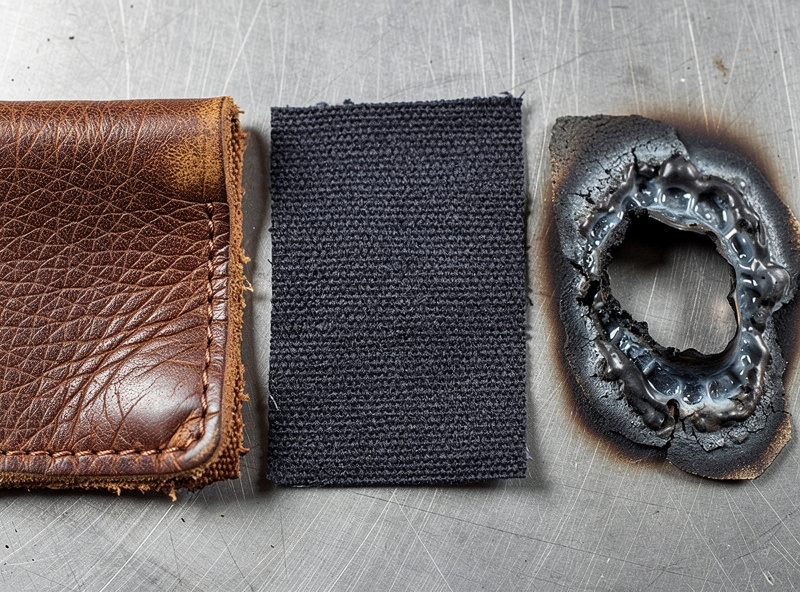
The reason fabric choice is a safety decision and not a comfort preference comes down to what each material does when a 3,000-degree spatter ball or the arc’s radiant heat hits it:
| Material | Reaction to spatter and heat | Verdict for welding |
|---|---|---|
| Leather (cowhide/split) | Chars and resists penetration; does not melt or sustain flame | Best heavy protection — heat, spatter, grinding |
| FR-treated cotton | Resists ignition; self-extinguishes rather than feeding the flame | The everyday welding garment — breathable, covers skin |
| Untreated heavy cotton / denim | Can char and ignite, but does not melt onto skin | Acceptable as a layer; not as safe as FR or leather |
| Polyester / nylon / synthetics | Melts, drips, sticks to skin, keeps burning | Dangerous — never near an arc |
The single most important line in that table is the bottom one. A spark on leather makes a small char mark. The same spark on a polyester hoodie melts a hole and the molten fabric sticks to the skin underneath — which is exactly the burn I gave myself early on. Untreated cotton sits in the middle: it can catch fire, but because it does not melt onto you, a heavy cotton or denim layer is genuinely safer than any synthetic. “Natural fibers near fire” is the rule of thumb, and FR-treated cotton is natural fiber engineered to resist ignition on top of that.
Leather vs FR Cotton: When to Reach for Each
Both are correct answers; they are correct for different jobs. This is the choice an experienced welder makes by feel, and here is the logic behind it.
Leather is the heavy-duty option. It takes the most heat and the most direct spatter, it shrugs off grinding sparks, and it is what you want for overhead work where everything falls on you, for heavy stick or flux-core that throws a lot of spatter, and for any high-heat, high-spatter session. The downside is that leather is hot and stiff — a full leather jacket in a warm shop in summer is a sweatbox.
FR cotton is the everyday option. It is far more breathable and comfortable for long sessions, it covers skin well, and a quality FR cotton jacket handles ordinary MIG and TIG spatter without trouble. Where it gives ground to leather is sustained high heat and heavy grinding spatter, which can eventually overwhelm cotton where leather would just char. My own habit: FR cotton for everyday MIG on my MIG-PRO205DS, leather sleeves or a leather apron added when the job goes overhead, hot, or spattery. Many welders run exactly this hybrid — FR cotton as the base layer, leather where the punishment concentrates.
Coverage: Skin Is the Other Half of the Problem
The right fabric does nothing for skin it does not cover. The arc throws UV that sunburns exposed skin the same way it burns your eyes — a long session in a short-sleeved shirt leaves you with a genuine sunburn on the forearms, and repeated UV exposure is not something to shrug off. So the clothing rule has two parts: the right material, covering all the skin.
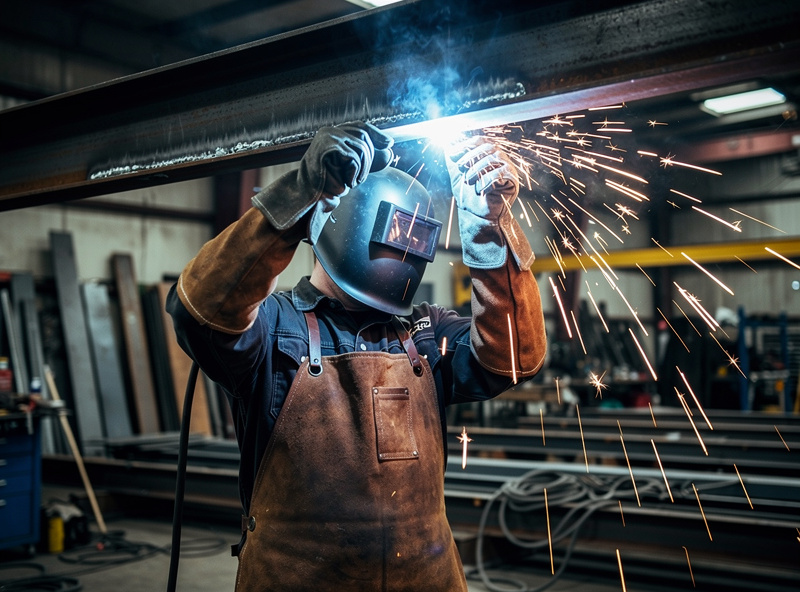
That means long sleeves and full-length pants in the right fabric, no gaps at the wrists or waist, and attention to the spots beginners leave exposed:
- The collar and neck. Spatter that bounces up finds an open collar. A leather or FR cap and a buttoned collar close that gap.
- Wrists and forearms. Where the glove ends and the sleeve should start — leather sleeves or a gauntlet glove overlap close it.
- The lap, when seated or overhead. A leather welding apron catches what falls when you weld sitting down or above your head.
- Pant cuffs and pockets. Cuffs and open pockets catch falling spatter and smolder — wear cuffless pants or tuck them, and keep boots over the cuff, not under.
- Feet. Spatter rolls off the bench onto your feet. Leather boots, laces covered, not canvas sneakers.
Build the kit around an FR cotton welding jacket as the breathable base and add leather welding sleeves or an apron where the heat and spatter concentrate, and you have the leather-where-it-counts, cotton-where-it-breathes balance most welders settle on. The point is never “leather OR cotton” — it is the right material on every part of you, with no synthetic anywhere in the spatter zone.
What “Flame-Resistant” Actually Means
There is a real distinction worth understanding when you shop for FR gear, because the labels are not all the same thing. Flame-resistant cotton resists ignition and, critically, self-extinguishes — when the heat source is removed, it stops burning rather than continuing to feed the flame the way ordinary cotton can. Some garments achieve this with an inherently flame-resistant fiber, and others with a chemical FR treatment applied to standard cotton. For a home welder, both work; the difference shows up over the life of the garment.
A treated FR garment relies on its chemical finish staying intact, and that finish can be degraded by the wrong laundering over time. An inherently FR fabric keeps its resistance for the life of the garment because the resistance is in the fiber itself, not a coating. Neither is “better” for hobby use out of the box — a quality treated FR cotton jacket is perfectly safe — but if you launder your welding clothes a lot, the inherent type is more forgiving of mistakes. The thing to avoid entirely is a garment marketed only as “heavy cotton” or “duck canvas” with no FR claim at all: it does not melt onto you like synthetic, which is a real point in its favor, but it has no engineered resistance to ignition.
One honest hedge: the formal FR standards and arc-rating systems that industrial and electrical workers live by are a deeper world than a hobby welder needs, and the certification specifics are something I defer to the people who work to code. For home welding, the practical takeaway is simpler than the standards: buy a garment that genuinely claims flame resistance, in leather or FR cotton, and do not weld in synthetics. You do not need an arc-rating number to be far safer than the guy in the poly hoodie.
Caring for FR Clothing So It Stays Protective
This is the part nobody tells beginners, and it matters because you can quietly ruin the protection you paid for. Treated FR cotton can have its flame resistance degraded by the wrong washing — the classic mistakes are using chlorine bleach, using fabric softener, or letting the garment get coated in flammable grime. Bleach attacks the FR finish, softener leaves a flammable residue, and a jacket caked in oil, grinding dust, and dried-on spatter is carrying its own fuel load no matter what the fabric underneath is rated for.
- Skip the bleach and the softener. Both undermine FR cotton. Wash it plain, following the garment’s own instructions, and keep it separate from the chlorine.
- Keep it clean of oil and grease. A grease-soaked FR garment can ignite from the contamination even if the fabric resists. If it is saturated with flammables, it is no longer protective — clean it or retire it.
- Inspect leather for hardening and cracks. Leather that has been cooked stiff and cracked has lost integrity at those spots. When the char damage is deep, replace the piece rather than trusting it.
- Replace burned-through gear. A jacket with melt-through or burn holes has gaps exactly where it failed. Patch small char marks, retire anything compromised.
None of this is fussy. It is the same logic as the rest of welding safety — the gear only protects you if it is intact and uncontaminated, and a two-minute habit keeps it that way. Treat the clothing as PPE that needs maintenance, not as a jacket you wear until it falls apart.
Clothing is one layer of welding PPE. The complete picture across helmet, respirator, gloves, fume, fire, and arc is in the welding safety guide, the eye-and-skin UV side is in arc eye and welder’s flash, the air you breathe under all that clothing is covered in how to choose a welding respirator, and specific gloves-and-jacket picks are in the welding gloves and jacket guide.

Discussion (0)