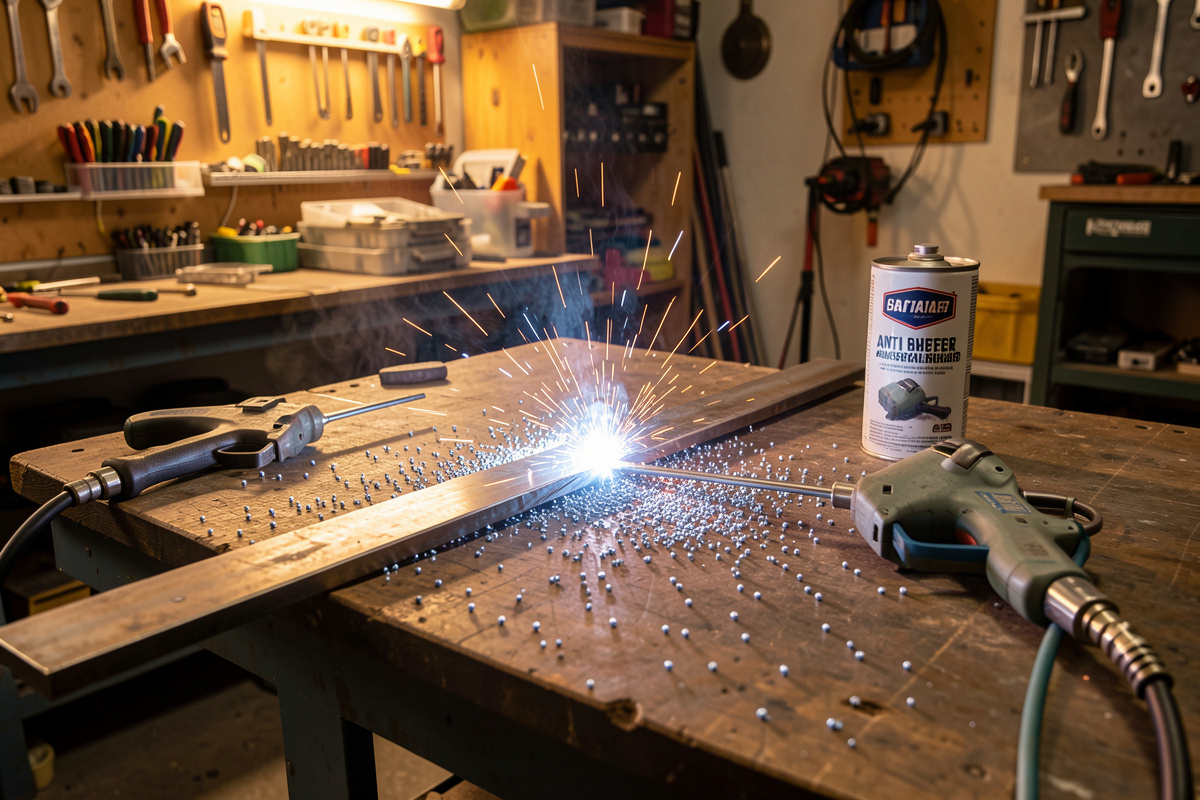

Flux-core spatter is inherent — the flux has to burn off as the wire melts, and that throws molten droplets across your work and your bench. But most of it is controllable: balance your voltage and wire speed, run the long stickout gasless wants, confirm DCEN polarity, and coat the nozzle and work with anti-spatter so what does land wipes off. I’ve gone from beads buried in welded-on balls to clean-cleanup work, and it was settings and habit, not luck.
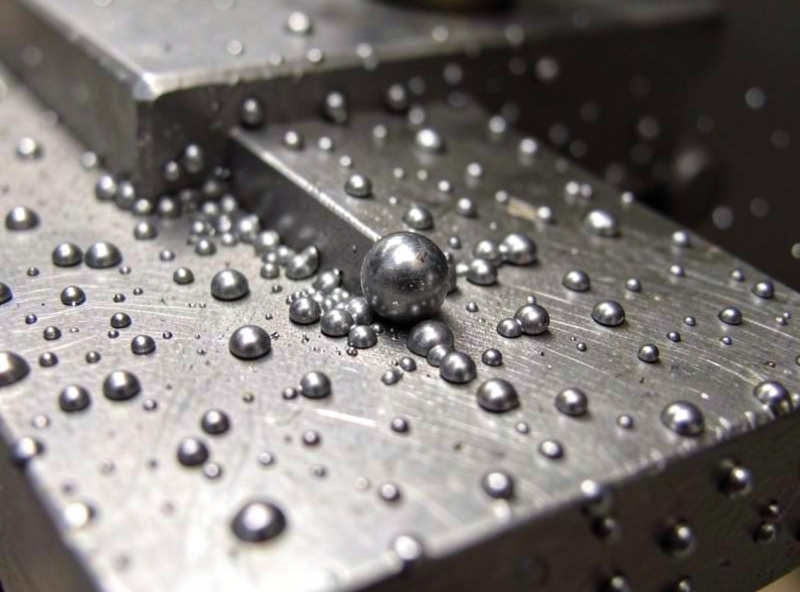
Here’s the cost of ignoring it: spatter isn’t just ugly. It welds itself to your nozzle and clogs the gas path, it fuses to the workpiece as hard little nodules you have to grind off, and — the part beginners forget — those hot droplets travel and start fires. I’ve had spatter skitter off the bench onto a rag two feet away and start smoldering. That’s not a cleanup problem, that’s a fire-watch problem.
This article covers why flux-core spatters, the settings and habits that minimize it, and the fastest way to clean up what’s left. For the full process, start with the flux-core welding guide.
Why Does Flux-Core Make So Much Spatter?
Flux-core spatters heavily because the flux packed inside the wire must combust as the wire melts, and that combustion violently ejects molten metal droplets — far more than solid-wire MIG under a clean gas shield. It’s built into how self-shielded wire works: the same burning flux that shields your weld also throws spatter. You manage it; you don’t eliminate it.
Understanding that keeps you from chasing an impossible zero. A perfectly dialed flux-core weld still throws more spatter than a gas MIG weld, and that’s normal, not a sign you’re doing something wrong. The goal is to get it down to a manageable level — fine spatter that brushes off rather than heavy balls welded to the metal — and to stop it clogging your gun. Both are very achievable with the settings and habits below.
Wrong polarity dramatically worsens it, which is why that’s my first check. Running gasless wire on DCEP instead of DCEN electrode-negative produces a harsh, erratic, spatter-heavy arc that bakes onto everything. If you’re drowning in spatter, verify polarity before you touch anything else — it’s the single biggest amplifier of the problem.
What Settings Reduce Flux-Core Spatter?
Spatter drops sharply when voltage and wire speed are in balance and the arc runs at that steady bacon-sizzle sound. Too much wire speed for the voltage, or too little, both spike spatter. The other big lever is stickout: flux-core wants a long 13–19 mm stickout, and holding it too tight — MIG-style — spikes spatter and clogs the nozzle fast.
I dial it by ear. Set voltage to the chart number for the thickness, lay a test bead, and listen: a smooth even crackle means the balance is right and spatter is minimized; a harsh spitting roar or a stuttering pop means one dial needs a nudge. One variable at a time, judging the spatter each time. The last time I let my stickout creep in too short chasing a “tighter” arc, the nozzle clogged with spatter inside five minutes and the arc went erratic — backing off to the proper long stickout fixed both instantly.
Travel technique matters too. Dragging the gun at a consistent 10–15 degrees keeps the arc stable and the spatter down, where a wandering angle or erratic speed churns up more. So the same fundamentals that give a sound bead — balanced settings, long steady stickout, DCEN polarity, drag angle — are exactly what minimize spatter. Get the weld right and the spatter shrinks as a byproduct.
Does Anti-Spatter Spray Actually Work?
Yes — anti-spatter genuinely works, and it’s cheap insurance. Sprayed or brushed onto the nozzle, contact tip area, and the workpiece around the joint, it forms a barrier that stops molten spatter from fusing on, so it flicks or wipes away instead of welding itself to metal. It doesn’t reduce how much spatter is thrown; it stops what lands from sticking.
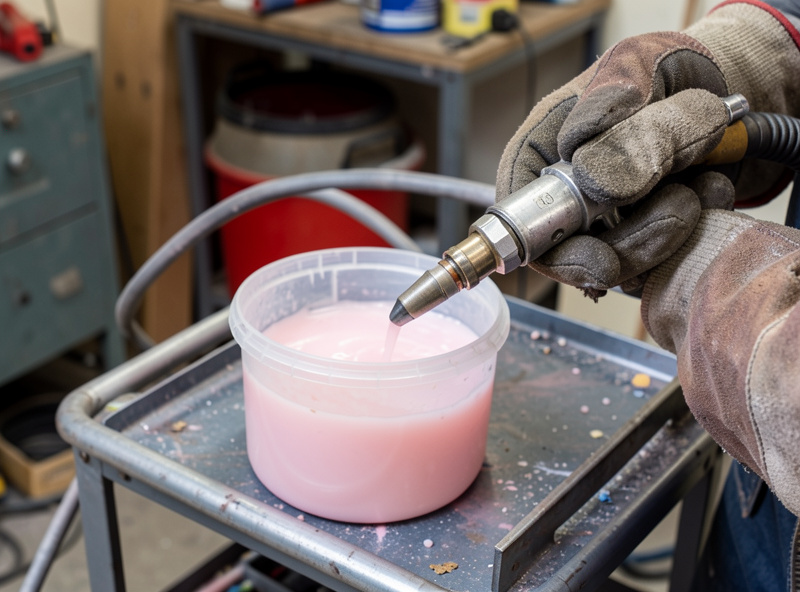
I keep a can of nozzle gel on the welding cart and dip the gun into it every few starts. The difference on the nozzle is dramatic — instead of digging welded balls out of the gas ports with pliers, spatter buildup wipes off and the gun keeps feeding cleanly. On the workpiece, a light spray of anti-spatter around the weld zone means post-weld cleanup is a quick brush rather than a grinding session. For a few dollars a can, it’s one of the best-value consumables in the shop.
A caution worth stating: keep anti-spatter off the actual weld joint itself, since it can interfere with the weld — apply it to the surrounding metal and the gun, not the bead path. Used that way, it’s a genuine time-saver. Manufacturers like Lincoln Electric publish guidance on their spatter-control products, and a nozzle dip gel plus a workpiece spray covers both jobs.
As an Amazon Associate I earn from qualifying purchases.
Two consumables carry the load here: a tub of nozzle dip anti-spatter gel for the gun and a can of anti-spatter spray for the workpiece keep both cleanup jobs fast.
How Do You Keep the Nozzle and Contact Tip Clean?
Keep the nozzle clean by dipping it in anti-spatter gel regularly, clearing built-up spatter with welding pliers or a reamer, and running the proper long stickout so the tip stays back from the worst of the ejecta. A spatter-clogged nozzle chokes the arc and throws even more spatter — a spiral you break by cleaning often, not rarely.
My habit is to check and clean the nozzle every few beads rather than waiting until it’s a solid plug. Welding pliers pull the loose stuff, an occasional dip in the gel keeps new spatter from bonding, and I replace the contact tip when it gets fouled or worn because a rough tip degrades the arc. On flux-core the nozzle actually matters less than on gas MIG since there’s no gas shield to protect — some flux-core guns even run open or with the nozzle removed — but keeping the tip and gun front clean still pays off in arc stability and less spatter.
Short stickout is the hidden nozzle-killer. Hold the gun too close, MIG-style, and you park the nozzle right in the spatter stream where it clogs in minutes. The long flux-core stickout keeps the gun front back from the worst of it, which is one more reason that stickout habit matters — it protects your consumables as much as your bead. I learned that the day I clogged a nozzle solid in one short session by welding too tight.
What’s the Fastest Way to Clean Spatter Off the Workpiece?
The fastest cleanup is prevention plus the right abrasive: spray anti-spatter on the work first so most spatter wipes off, then knock off what remains with a chipping hammer or a wire wheel, and grind stubborn welded-on nodules flush with a flap disc. On my DeWalt DWE402 angle grinder a wire cup brush clears light spatter fast and a flap disc handles the stuck-on stuff.
Sequence saves time. Light, loose spatter comes off with a wire wheel in seconds; a chipping hammer or a sharp scraper knocks off the medium nodules; only the hard, fully-fused balls need actual grinding. Matching the tool to the severity means you’re not reaching for the grinder when a wire brush would do, or vice versa. There’s a satisfying rhythm to it — the ping of loose spatter flicking off, the buzz of the wire wheel, and a clean bright surface emerging around the bead.
This overlaps directly with slag cleanup, since flux-core leaves both to deal with. The chipping hammer and wire wheel that clear slag also clear spatter, so I run them as one cleanup pass — chip the slag crust, brush the whole zone, grind anything stubborn. If you’ve read flux-core slag inclusions, the tools and motion are the same; you’re just clearing two byproducts in one go.
Common Spatter Causes and Their Fixes
Most flux-core spatter traces to a short list of causes, and each has a direct fix. When spatter suddenly spikes, run down this list before you blame the process — nine times out of ten it’s one of these.
| Cause | What You See | Fix |
|---|---|---|
| Wrong polarity (DCEP) | Harsh arc, spatter everywhere | Switch to DCEN electrode-negative |
| Stickout too short | Erratic arc, clogged nozzle | Lengthen stickout to 13–19 mm |
| Voltage/wire out of balance | Spitting or stuttering arc | Rebalance to a steady sizzle |
| Dirty or rusty metal | Popping, extra spatter | Grind joint to bright steel |
| Damp wire | Erratic arc, porosity + spatter | Use dry, sealed-stored wire |
| Clogged nozzle/tip | Worsening spatter over time | Clean nozzle, dip in gel, replace tip |
Notice how many of these are the same fundamentals from the rest of this cluster — polarity, stickout, clean metal, dry wire. Spatter is often just the visible symptom of something else being slightly off, which is why fixing your beads and fixing your spatter are usually the same job. Work the list top to bottom and the spatter almost always falls back into the manageable range.
Can You Stop Spatter Sticking in the First Place?
Largely, yes — and it’s the highest-value move. A workpiece pre-sprayed with anti-spatter and a nozzle kept coated in gel means most spatter never bonds, so “cleanup” becomes a quick wipe and brush instead of a grinding chore. Preventing adhesion beats removing welded-on nodules every time. Ten seconds of spraying saves ten minutes of grinding.
I build it into setup now: before a spatter-heavy job, I spray the work around the joint, dip the nozzle, and lay out my clamps and grinder within reach. That small ritual has changed flux-core from a process I dreaded cleaning up after into one I don’t think twice about. The bench stays cleaner, the beads look better, and the gun keeps running. It’s the difference between fighting the process and working with it.
The fire-safety angle makes prevention non-negotiable, not just convenient. Every spatter droplet is a spark that travels, and OSHA’s guidance on fire prevention during welding and cutting exists because welding spatter starts real fires — I keep a fire extinguisher within arm’s reach and do a fire-watch after every session, because the smoldering rag two feet away is how it gets you. Controlling spatter is partly a housekeeping win and partly a genuine safety practice.
What I’d Do to Cut Spatter, Starting Today
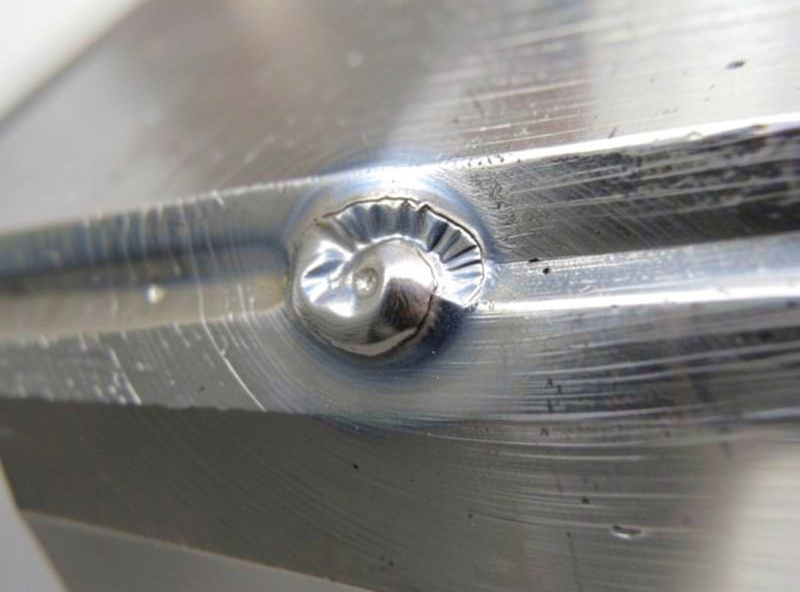
If flux-core spatter is burying your work right now, do this in order: confirm DCEN polarity, lengthen your stickout to a proper 13–19 mm, rebalance voltage and wire speed to a steady sizzle, and grind your joint to bright clean metal. Those four cut spatter at the source. Then coat the nozzle and workpiece with anti-spatter so whatever’s left wipes off instead of welding on.
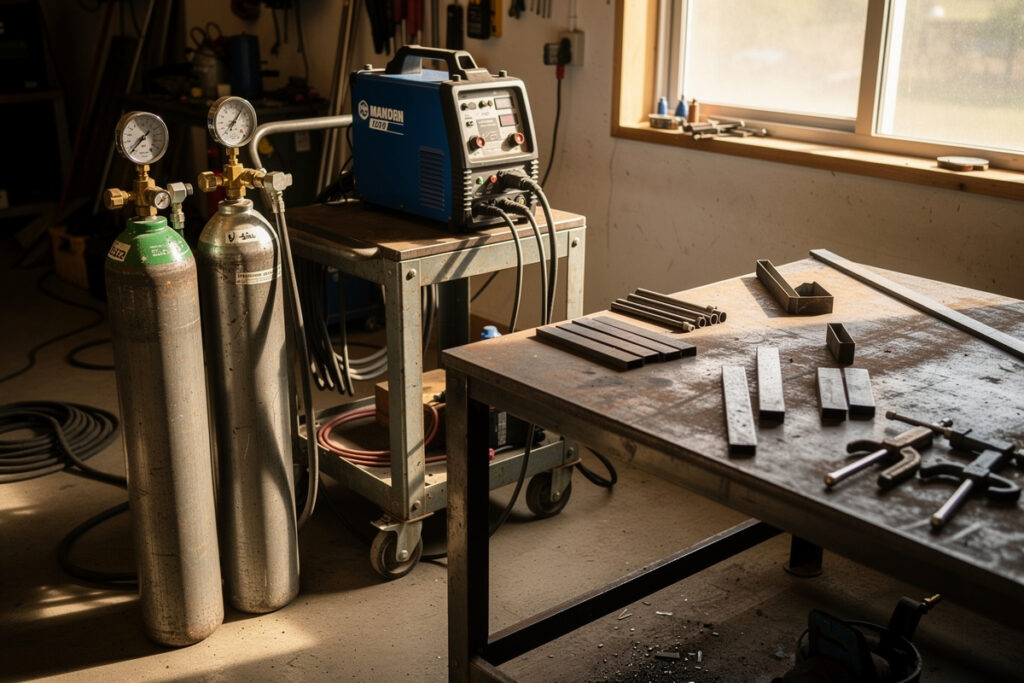
That’s the whole playbook — fix the causes, then defeat adhesion — and it turns flux-core cleanup from a chore into a wipe-down. I run gasless wire on most of my outdoor and structural work precisely because, once you’ve got spatter tamed, its advantages far outweigh a little brushing. Most of the fixtures on my bench, including the weld cart under the MIG-PRO205DS, came off a spattery gasless arc that cleaned up in minutes because I’d sprayed first. Keep a fire watch, keep the anti-spatter handy, and gasless stops feeling messy. Tie it all together with the main flux-core guide and dial your numbers with the settings chart.



Discussion (0)