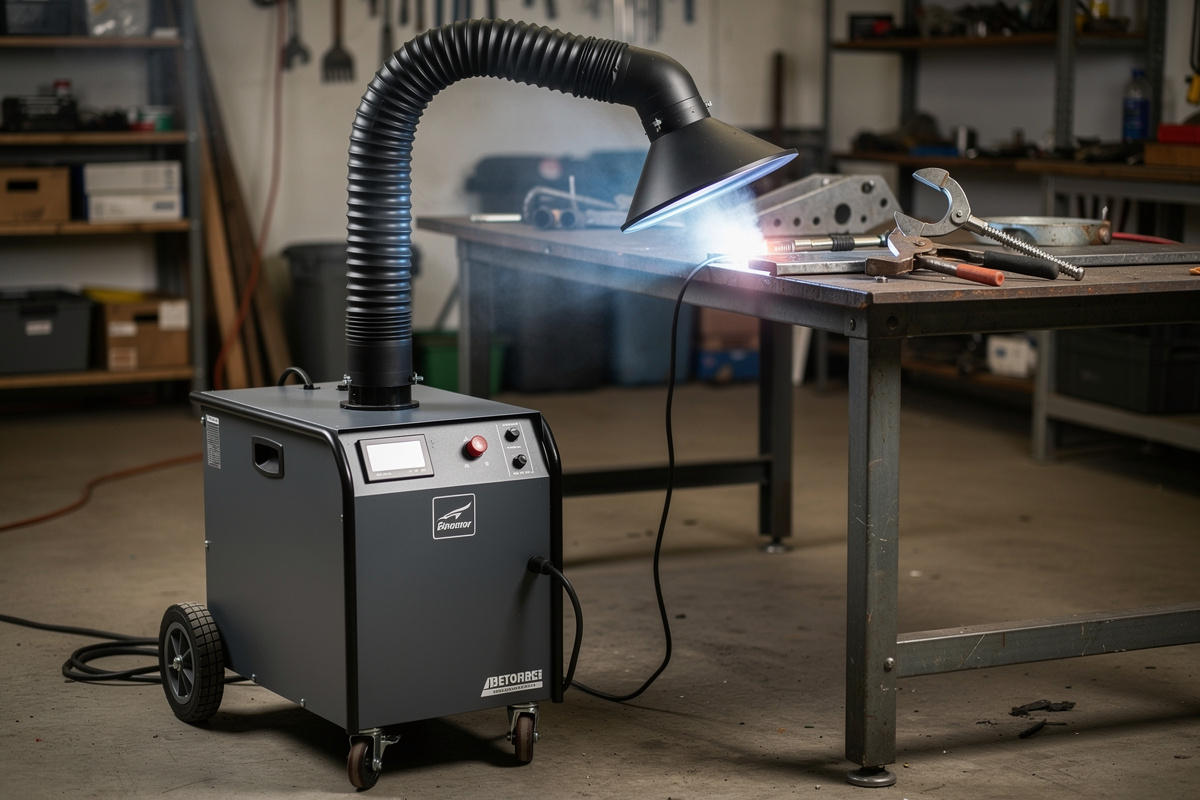

For a home shop, the fume extractor that earns its money is a portable source-capture unit with a flexible arm you park right on the joint — not an expensive fixed installation, and not a room air cleaner pretending to be one. The whole game with welding fume is catching it at the arc before it rises into your face, and that single principle decides which of the four real options is worth your money. This is the buyer’s guide to those options. For the underlying airflow math and the actual rule behind it — OSHA 29 CFR 1910.252(c) requires local exhaust or mechanical ventilation that keeps fume below the limits in 1910.1000 — that lives in welding ventilation requirements for a home garage — here we are choosing hardware.
Adding source capture over the bench where I run my YesWelder MIG-PRO205DS was the single biggest air-quality improvement I made as a home welder, bigger than the respirator, because it stops the fume before it ever reaches me rather than filtering it after. I weld a lot of mild steel under 75/25 and the odd galvanized repair, and an arm parked on the joint pulls that plume away before it ever climbs into my helmet. Here is how the types compare and how I would spend the money.
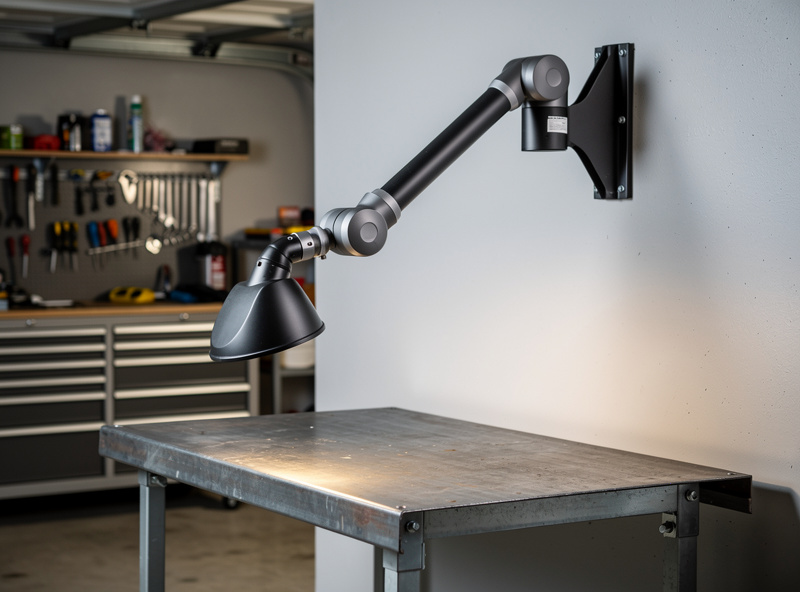
Why Source Capture Beats Everything Else
The most important idea in fume control: capture velocity falls off fast with distance. An extractor hood pulling hard right at the joint grabs the plume before it spreads; the same unit a few feet back barely disturbs it. This is why a modest extractor parked close beats a powerful one parked far, and why a ceiling-mounted ambient cleaner across the room does almost nothing for the plume rising directly into your helmet. Get the capture point close to the arc and you win; let it drift and no amount of fan power saves you.
That one fact is the lens for the whole buying decision. Every option below is really answering the same question — how close can I get the capture to the arc, for a price and convenience that fits a home shop?
The Four Types, Compared
Here are the real choices a home welder weighs, and where each fits:
| Type | How it captures | Best for | Trade-off |
|---|---|---|---|
| Portable unit + flex arm | Hood on an arm you reposition to the joint | Most home shops — flexible, movable, affordable | You must move the arm with the work |
| On-gun (fume gun) extraction | Nozzle built into the MIG gun pulls at the arc | Long MIG runs, hard-to-reach joints | Heavier gun; MIG only; can disturb shielding gas if over-set |
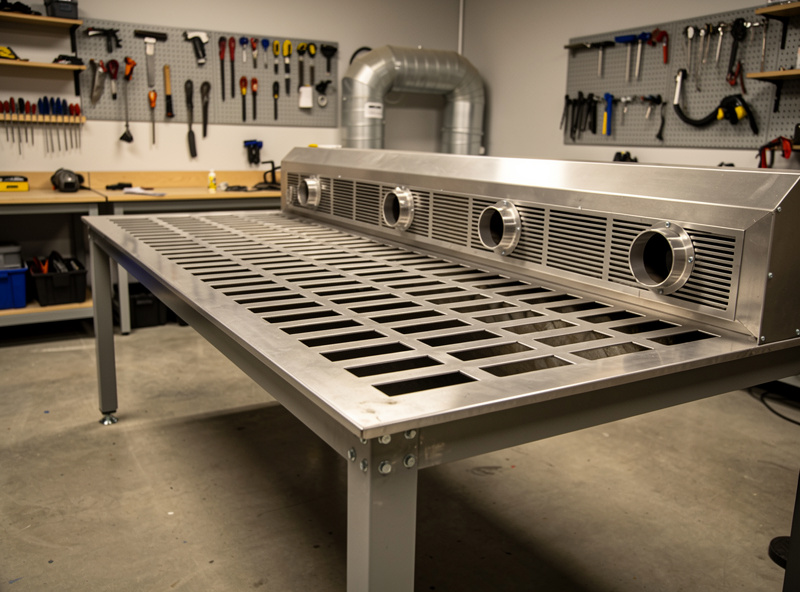
| Downdraft table | Grated bench pulls fume downward | Small-part fabrication done on the table | Fixed location; only works for table-height work |
| Ambient / room air cleaner | Filters the whole room’s air slowly | A secondary backup, never the primary | Does nothing for the plume at your face |
The honest verdict from running source capture on my own bench: the portable unit with a flex arm is the right primary tool for almost every home welder, the fume gun is a genuinely good add for long MIG runs if you do a lot of them, the downdraft table is excellent but only if your work fits on it, and the ambient cleaner is a backup that should never be sold to you as the answer to welding fume.
The Portable Flex-Arm Unit: My Pick for Most Shops
This is what I would buy first. A portable welding fume extractor is a self-contained box with a blower and filter and a flexible, self-supporting arm ending in a capture hood. You roll it to the work, position the hood within a foot or so of the joint, and it pulls the plume away as you weld. The flexibility is the point: a home welder works on different things in different spots, and a unit you can reposition beats anything bolted in one place.
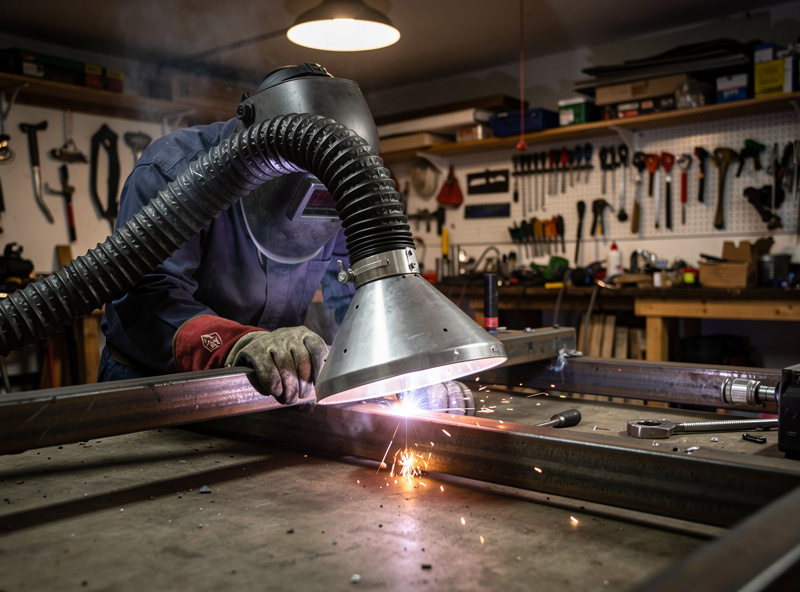
What to look at when buying one: the reach and how well the arm holds position (a floppy arm that drifts off the joint defeats the purpose), the filter type and replacement cost over time, and the noise level, because a screaming unit is one you will be tempted to leave off. Match it honestly to how much you weld — a hobbyist doing short sessions needs less unit than someone running long beads daily, and oversizing wastes money you could put toward better steel.
One practical habit makes any flex-arm unit far more effective: actually move the hood every time you reposition the work. The temptation, once you are deep in a job, is to leave the arm where it was and let the weld drift out from under it — and the moment the joint is more than a foot or so from the hood, the capture collapses. I learned this the dumb way: on my first long bracket job I set the hood once, welded down the whole piece without touching it, and finished with the same metallic taste and headache the extractor was supposed to prevent — the joint had simply walked a couple of feet out from under the hood. AWS F3.2 (the Ventilation Guide for Weld Fume) makes the same point in engineering terms: capture velocity at the breathing zone is what counts, not the fan rating on the box. Now I treat repositioning the hood as part of repositioning the work, the same way I move a clamp or a light. It is a two-second habit that decides whether the unit you paid for is doing anything at all, and it is the single most common way home welders quietly waste a good extractor.
On-Gun Extraction and the Downdraft Table
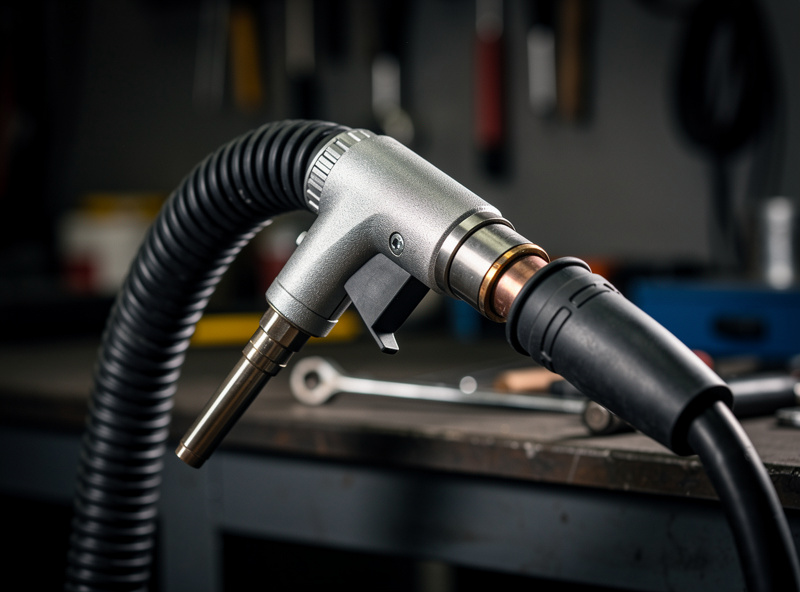
The fume extraction MIG gun moves the capture point as close to the arc as it physically gets — right at the nozzle — which is brilliant for long MIG runs and joints an arm cannot reach. The catches are real: it adds weight to the gun, it is a MIG-only solution, and if the extraction is set too aggressively it can pull at your shielding gas and cause porosity, so it wants dialing in. For a welder who runs a lot of MIG, it is a strong companion to a flex-arm unit rather than a replacement.
The downdraft welding table takes the opposite approach: it pulls fume down through a grated surface, away from your breathing zone, which is genuinely effective for small-part fabrication done on the table. The limitation is obvious — it only helps for work that sits on that table at that height, so it is a specialist’s tool rather than a first purchase for a general home shop.
Where the Extractor Fits in the Plan
An extractor is one layer, not the whole answer. The order that actually keeps your air clean: grind coatings off first so there is less to burn, capture at the source with the extractor, ventilate the room to dilute the rest, and wear a respirator for what gets through. Source capture is the highest-leverage of those after grinding, which is why it is worth real money — but it works alongside ventilation and a mask, not instead of them.
For what is actually in the fume you are capturing, see what is in welding fume; for the airflow and room-ventilation side, welding ventilation requirements for a home garage; and for the respirator that backs it all up, how to choose a welding respirator. The full hazard picture is in the welding safety guide.
What kind of fume extractor is best for a home welding shop?
For most home shops, a portable source-capture unit with a flexible arm is the best first buy. You roll it to the work and park the hood within a foot or so of the joint, capturing the plume before it rises to your face. It is flexible, movable, and affordable, which suits a home welder who works on different things in different spots.
Does a fume extractor replace a respirator?
No. A fume extractor captures most of the plume at the source, but it never gets everything, so the respirator stays as the last line for what escapes — especially on stainless, galvanized, and flux-core. The full plan is grind coatings off first, capture at the source, ventilate the room, and wear a respirator for the remainder. They work together.
Will a fume gun cause weld porosity?
It can if the extraction is set too aggressively, because pulling too hard at the nozzle can disturb the shielding gas on a MIG weld and let air into the puddle. The fix is to dial the extraction back to the level that captures fume without robbing your gas coverage. Set correctly, an on-gun extractor is a strong tool for long MIG runs.
Are ambient room air cleaners good for welding fume?
Only as a secondary backup, never as the primary control. An ambient cleaner filters the whole room’s air slowly and does almost nothing for the concentrated plume rising directly into your helmet at the moment you weld. Source capture at the arc is what protects your breathing zone; an ambient unit just cleans up the haze that escapes.
Why does the extractor have to be so close to the weld?
Because capture velocity falls off fast with distance. A hood pulling hard right at the joint grabs the plume before it spreads, while the same unit a few feet back barely disturbs it. That is why a modest extractor parked close beats a powerful one parked far — get the capture point within about a foot of the arc and reposition it as the work moves.

Discussion (0)