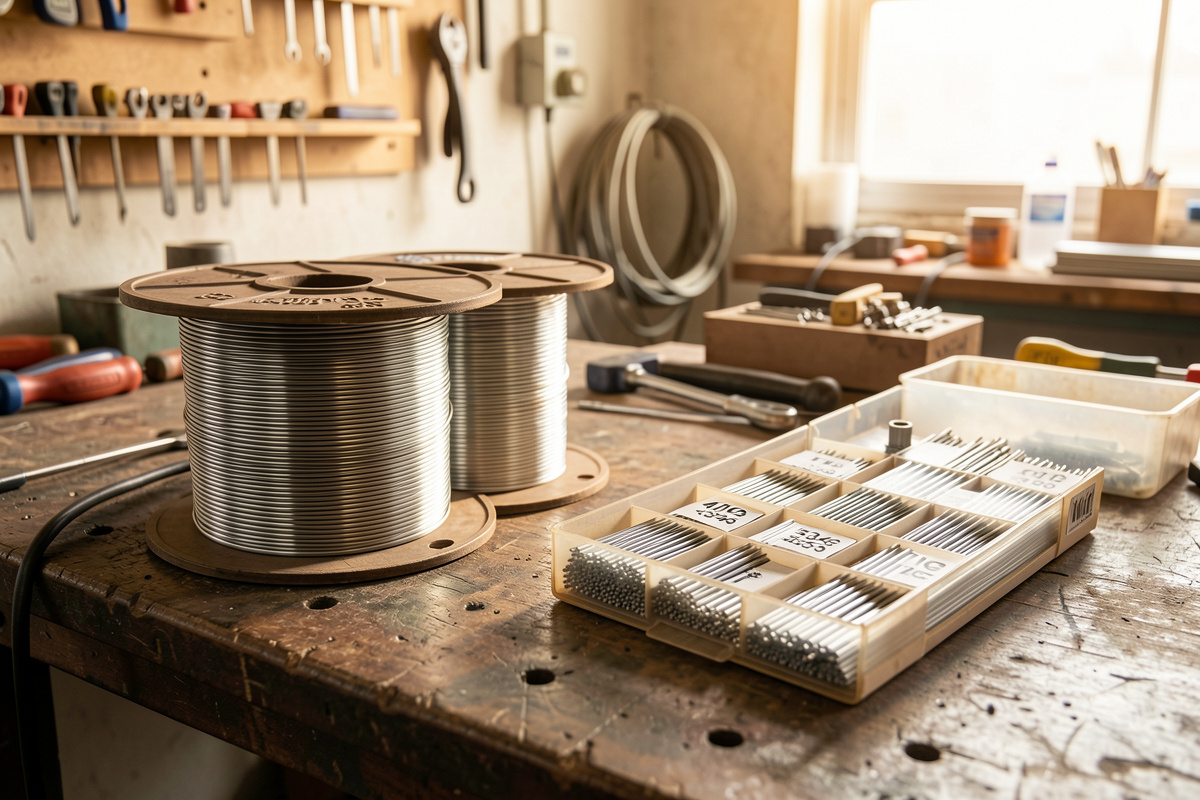

Pick ER5356 for strength, marine and structural work, and parts you will anodize; pick ER4043 for easier feeding, smoother puddle control, and crack resistance on 6061 and castings. The one-line rule that covers most jobs: 5356 when it has to be strong or see saltwater, 4043 when it has to be pretty or forgiving. Choose wrong and you get either cracking or a filler that anodizes a different color than the part.
These two wires cover something like 90% of home aluminum welding, MIG and TIG alike, and the choice between them is one of the few genuine either/or decisions in aluminum. Most of aluminum welding is “do it the one right way.” This is not — both wires are correct, for different jobs. I keep both on the shelf: 4043 as my default for the 6061 extrusions most of my fixtures are built from, and 5356 for anything headed toward the aluminum boat, because a hull lives in water and takes real load. Grab the wrong spool and the failure shows up weeks later as a crack or a mismatched stripe after anodizing, so it is worth understanding why they differ, not just memorizing the rule.
What’s the Core Difference Between ER4043 and ER5356?
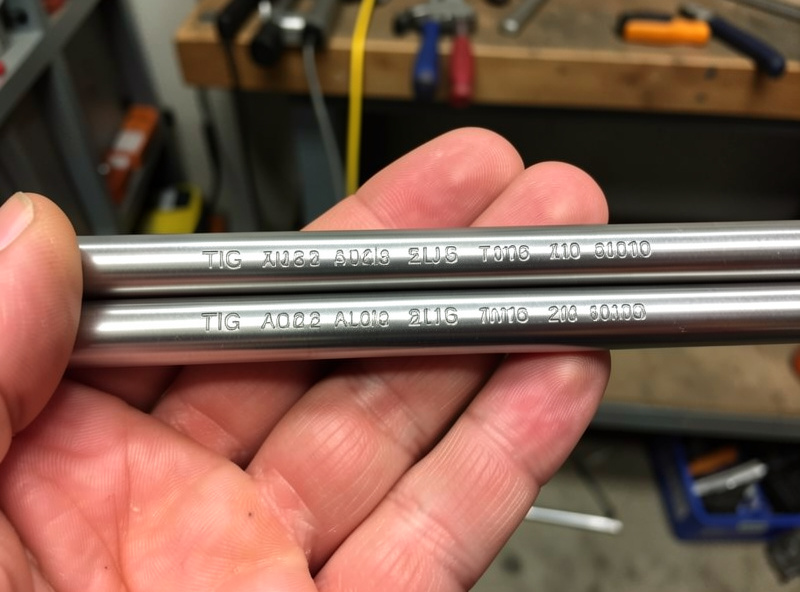
The difference is the main alloying element: ER4043 is aluminum-silicon (about 5% silicon), and ER5356 is aluminum-magnesium (about 5% magnesium). That one swap drives everything downstream — strength, feedability, color after anodizing, operating temperature, and crack behavior. Silicon makes 4043 flow and forgive; magnesium makes 5356 strong and stiff.
Silicon in 4043 lowers the melting point and makes the puddle more fluid, which is why it wets in so nicely and feels forgiving under the arc — the metal flows into the joint and smooths itself out. It also makes the wire physically softer. Magnesium in 5356 does the opposite: it raises tensile strength substantially, improves corrosion resistance in saltwater, and makes the wire noticeably stiffer. Neither is “better.” They are tuned for different priorities. The base-metal chemistry you are welding onto is what should decide, and if you are unsure what grade of aluminum you even have, my aluminum grades for welding guide walks through identifying the common ones. The deeper metallurgy of how these alloys behave as they solidify is in my welding aluminum metallurgy notes.
Which Is Stronger, ER4043 or ER5356?
ER5356 is meaningfully stronger — its as-welded tensile strength lands around 38,000 to 42,000 psi versus roughly 27,000 to 33,000 psi for ER4043. For anything structural, load-bearing, or safety-critical, 5356 is the default. 4043’s lower strength is fine for non-structural fixtures, brackets, and general repair where you are not counting on the joint to carry serious load.
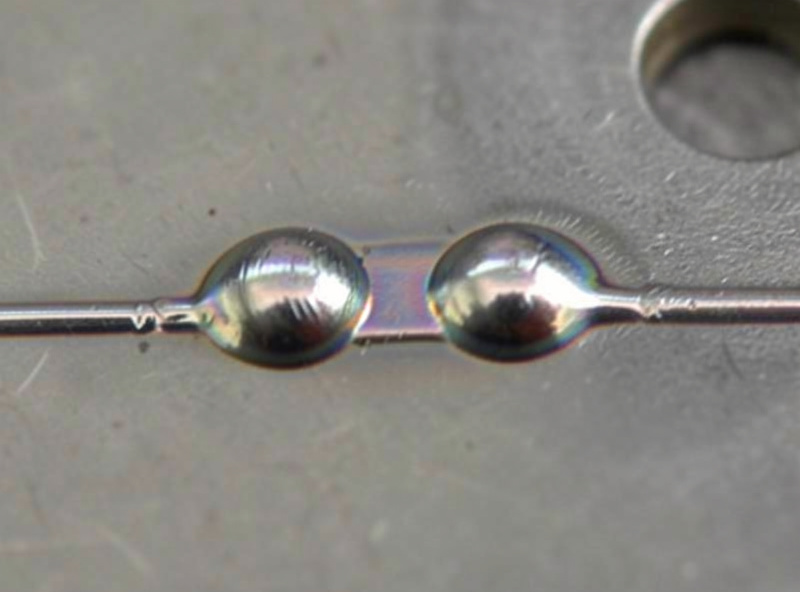
That strength gap is the single biggest reason 5356 gets specified on trailers, railings, boat hulls, and anything a person’s weight or a highway load depends on. When I think about the aluminum boat, every structural seam in my head is 5356 — the hull is not a place to trade strength for an easier puddle. On the flip side, most of what I actually build day to day — welding tables, tool-cart frames, jigs, brackets — is not carrying anywhere near those loads, so 4043’s easier handling wins and the strength difference never matters. Match the filler to the demand: if a failure would hurt someone or wreck the project, reach for 5356. Mike, my welder friend, has a blunter version — “if it holds people or floats, it’s 5356” — and I have never found a reason to argue.
Which Feeds and Welds More Easily?
ER4043 welds more forgivingly — the fluid puddle wets in and hides a shaky hand — but ER5356 actually feeds more reliably through a gun because it is stiffer. It is a genuine split: 4043 is easier at the arc, 5356 is easier through the wire path. Softer 4043 is more prone to birdnesting in a long liner; stiffer 5356 pushes through with less buckling.
This one surprises people because “softer” sounds like it should feed better, and it is the opposite. Soft 4043 is exactly the wire that folded into a birdnest on my first aluminum attempt, because softness is what buckles under feed pressure. Stiffer 5356 has more column strength, so it resists that buckling — through a marginal setup, 5356 can actually be the more reliable feeder even though it is the harder wire to lay a pretty bead with. Whichever you run, aluminum still wants a short, low-friction feed path, which is the whole subject of my spool gun vs push-pull breakdown. At the arc, though, 4043 is the more relaxing wire — the puddle flows, tie-ins smooth out, and beginners get clean-looking beads faster with it. If your feed is solid and you just want forgiving arc behavior, 4043; if your feed is marginal or the part is structural, 5356.
Does Filler Choice Matter for Anodizing?
Yes, and this catches people off guard: after anodizing, ER4043 welds turn dark gray to nearly black while ER5356 stays close to the natural silver of the base metal. If a part will be anodized and appearance matters, use 5356 so the weld does not show as a dark smudge against a bright part.
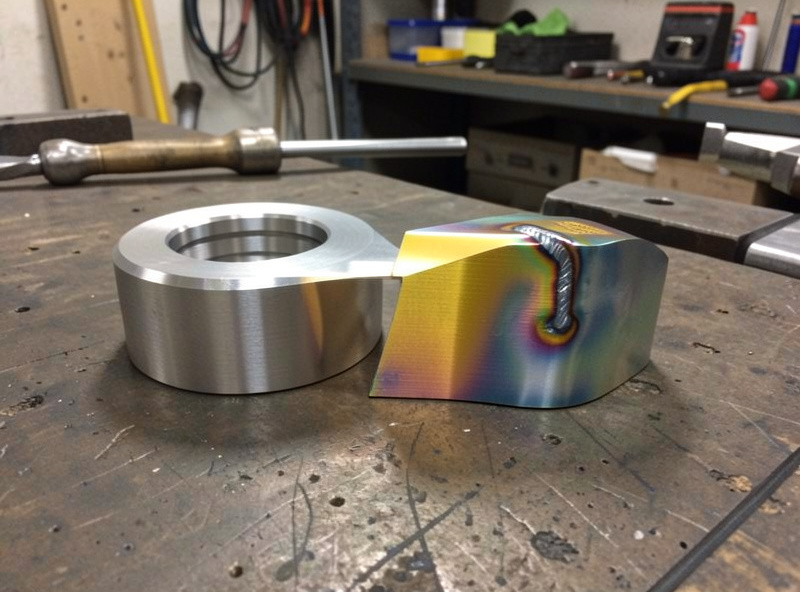
The silicon that makes 4043 flow so nicely is exactly what reacts in the anodizing bath to go dark. On a raw or painted part nobody cares, but on a clear-anodized or architectural piece, a 4043 weld reads as a gray shadow along every seam while a 5356 weld nearly disappears. I learned this secondhand from an anodized-railing job Mike described — the shop had run 4043 for its easy puddle and every joint came back from anodizing as a dark stripe. If anodizing is even a possibility, default to 5356. If the part will be painted, powder-coated, or left bare, it is a non-issue and you can choose on strength and feel alone.
Which Filler for Which Base Alloy?
Match filler to base metal: use 4043 on 6000-series (6061, 6063 extrusions) and cast aluminum, and use 5356 on 5000-series (5052, 5083, 5086) sheet and marine plate. The reason is crack resistance — the wrong pairing invites hot cracking. Running 4043 on high-magnesium 5000-series is a classic mistake that seeds cracks.
Here is the chemistry trap in plain terms. 5000-series base metal is already high in magnesium. Weld it with 4043, which brings silicon, and the magnesium and silicon combine into magnesium-silicide in a ratio that makes the weld crack-prone as it cools. So on high-magnesium alloys, you match with 5356 to keep the chemistry sane. Going the other way, 6061 and castings weld beautifully with 4043 — the silicon reduces cracking on those alloys and gives a cleaner puddle. This is the heart of why aluminum MIG welds crack, and the filler-matching side of the broader picture I cover in weld cracking causes and prevention. When you genuinely do not know the base alloy, 5356 is the safer default because it tolerates more situations without cracking — but identify the metal first when you can.
ER4043 vs ER5356 at a Glance
The whole decision, boiled down to the factors that actually change your pick:
| Factor | ER4043 (Al-Silicon) | ER5356 (Al-Magnesium) |
| As-welded strength | Lower (~27–33 ksi) | Higher (~38–42 ksi) |
| Puddle at the arc | Fluid, forgiving, wets in | Stiffer puddle, less forgiving |
| Feedability | Softer, more birdnest-prone | Stiffer, feeds more reliably |
| Anodized color | Turns dark gray/black | Stays near silver, matches base |
| Best base metals | 6061, 6063, castings | 5052, 5083, 5086, marine |
| Saltwater/corrosion | Adequate | Superior |
| Crater cracking | More resistant | Slightly more prone |
Notice the last row: 4043 actually resists crater cracking a bit better, one of the few places it wins on the strength-and-cracking axis. That is why on 6061 castings 4043 is not just easier but genuinely the right metallurgical call, not a compromise. If you are running TIG rod instead of MIG wire, the exact same 4043-versus-5356 logic applies, and it sits inside my broader TIG filler rod selection guide. You can stock both cheaply — a spool or tube of each covers essentially all home aluminum work, and current ER4043 and ER5356 aluminum filler is a small investment for the range it buys you.
As an Amazon Associate I earn from qualifying purchases.
What I Keep on My Shelf and Why
I keep both, and I reach for 4043 by default because most of my work is 6061 fixtures where its easy puddle and crack resistance shine. The 5356 comes out for anything structural, marine-bound, or destined for anodizing. If I could only own one for general home use, it would be 5356 — it feeds better and covers the safety-critical jobs, and I can live with a slightly stiffer puddle.
That “if I could only own one” answer flips depending on who is asking. For a beginner building non-structural projects who just wants clean-looking beads and an easy time, 4043 is the more encouraging wire — it hides mistakes and feels good. For someone welding trailers, railings, or anything that floats or carries load, 5356 is the responsible default even though it is a hair less forgiving. My honest advice: buy a small spool of each on day one. They are cheap, they do not go bad if you keep them dry, and having both means the base metal in front of you decides the filler instead of your wallet. Keep them dry, by the way — aluminum filler picks up surface oxide and moisture just like the base metal, and that is porosity waiting to happen, the same lesson from the complete aluminum MIG workflow. Match the wire to the job and half the aluminum cracking and cosmetic problems people fight simply never start.
Is ER5356 or ER4043 better for beginners?
For learning to lay clean-looking beads, ER4043 is more forgiving because its fluid puddle wets in and hides a shaky hand. But ER5356 feeds more reliably through the gun because it is stiffer, so if you are fighting birdnesting, 5356 can actually be the easier wire to run. Many beginners keep both and choose by the job.
Can I use ER4043 on marine or boat aluminum?
No, use ER5356 for marine work. Boat and marine aluminum is usually 5000-series, which is high in magnesium, and welding it with silicon-based 4043 invites hot cracking. ER5356 also has better saltwater corrosion resistance and higher strength, which is exactly what a hull needs.
Why did my aluminum weld turn dark after anodizing?
You most likely used ER4043. The silicon in 4043 reacts in the anodizing bath and turns the weld dark gray to black, so it shows as a stripe against a bright part. Use ER5356 for anything that will be anodized where appearance matters, since it stays close to the base metal color.
What filler do I use on 6061 aluminum?
ER4043 is the usual choice for 6061 and other 6000-series extrusions and for cast aluminum, because its silicon content reduces cracking and gives a cleaner, more fluid puddle. ER5356 also works on 6061 if you need more strength, but 4043 is the more forgiving and crack-resistant match.
Does the same 4043 vs 5356 rule apply to TIG?
Yes. The alloy chemistry is identical whether the metal arrives as MIG wire or TIG rod, so the same rules hold: 5356 for strength, marine, and anodizing; 4043 for 6061, castings, and an easier, more fluid puddle. Only the delivery method changes, not the metallurgy.

Discussion (0)