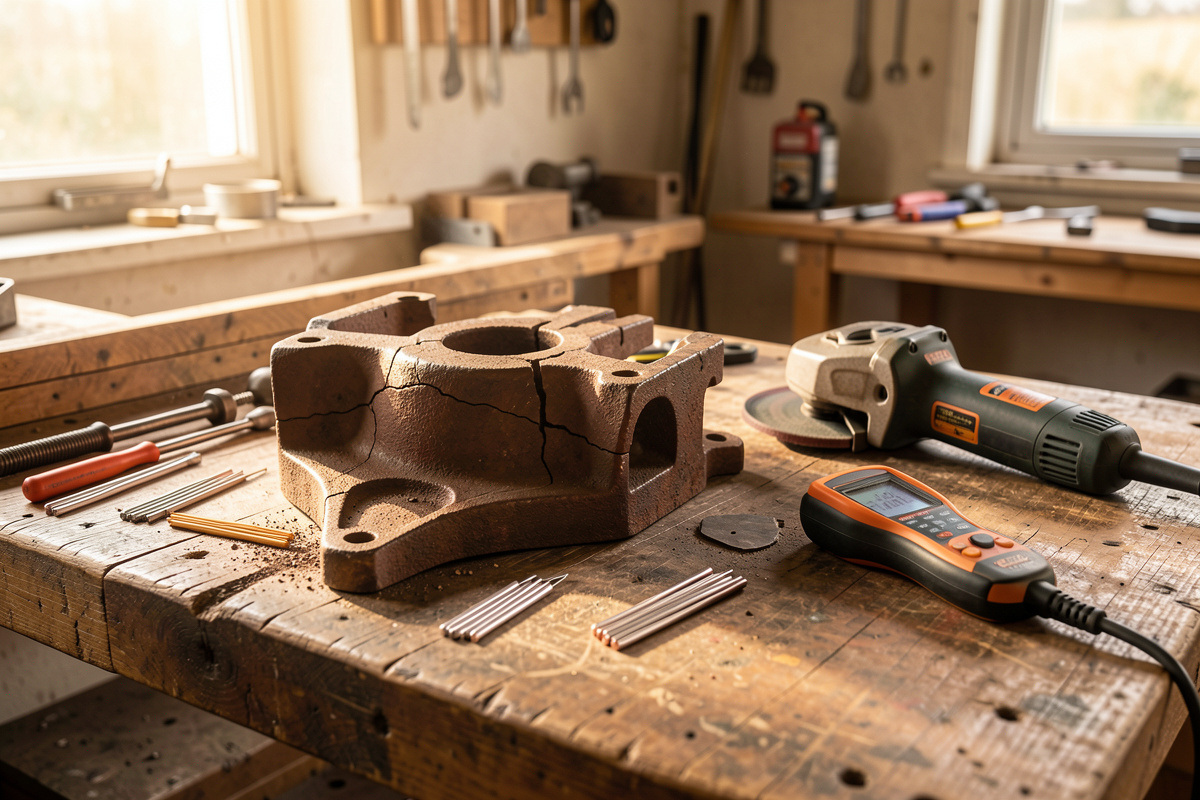

Cast iron is the metal that humbles welders who got cocky on mild steel. It cracks because it is roughly 2-4% carbon, brittle, and has almost no ability to stretch — so the heat of a weld builds stress it cannot absorb. The fix is not a magic rod. It is low heat, nickel filler, and a slow cool-down that the casting never feels as a shock.
I run a YesWelder MIG-PRO205DS as my daily machine, but cast iron is the one job where I usually put the MIG down and reach for stick and nickel electrodes, or skip arc welding entirely and braze. My welder friend Mike has decades in the trade and a steady run of cast iron repair jobs come through his shop — cracked vise bodies, broken machine feet, a snapped pulley, the odd wood-stove door. I have stood over enough of those repairs, and burned in enough of my own, to tell you what actually holds and what cracks again on the cool-down. This is the complete home-bench guide to welding cast iron, and it links out to every deeper piece in the cluster.
Why Cast Iron Is the Hardest Common Metal to Weld
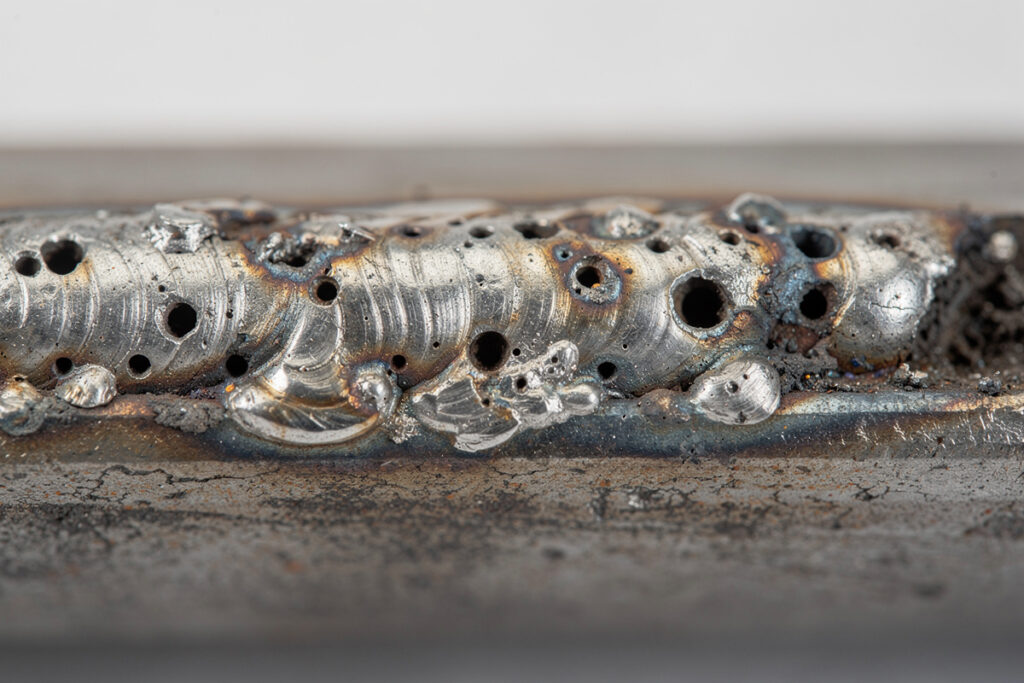
Cast iron welds badly because its carbon content is roughly ten times that of mild steel, it has near-zero ductility, and the weld’s heat-affected zone hardens into brittle white iron that cracks under the shrinkage stress of cooling. Control the heat and the cooling rate and most repairs are doable at home.
Mild steel forgives you. It stretches, it bends, it absorbs the pull of a cooling weld bead. Cast iron does none of that. When you dump arc heat into it, the area right beside the weld — the heat-affected zone, or HAZ — heats fast and then, because the cold casting around it acts as a giant heat sink, cools fast too. That rapid quench turns the carbon-rich iron into hard, glassy white iron and martensite. It is so hard you cannot drill or file it, and so brittle it cracks the moment the bead behind it shrinks. Every rule that follows — preheat, nickel rod, short beads, peening, slow cool — exists to fight that one problem. If you want the deeper science of why the metal behaves this way, my welding metallurgy guide and the piece on the heat-affected zone are the foundation under everything here.
Know Your Cast Iron Before You Strike an Arc
There are four common cast irons — gray, ductile (nodular), white, and malleable. Gray iron is the everyday castable stuff and welds reasonably with nickel rod. Ductile iron welds with care. White iron is effectively unweldable and should be brazed or replaced. Identify the type before you commit a rod to it.
You cannot dial a repair without knowing what is in the vise. Gray cast iron — engine brackets, stove parts, pump housings, machine bases — is the most common and the most weldable, because its graphite is in flakes that give the metal a little give. Ductile (nodular) iron has its graphite in spheres, is tougher, and shows up in gears, crankshafts, and high-stress castings; it welds but wants more preheat discipline. White iron is the hard, wear-resistant stuff and the carbide structure simply will not take a sound weld — braze it or bin it. Malleable iron sits in between.
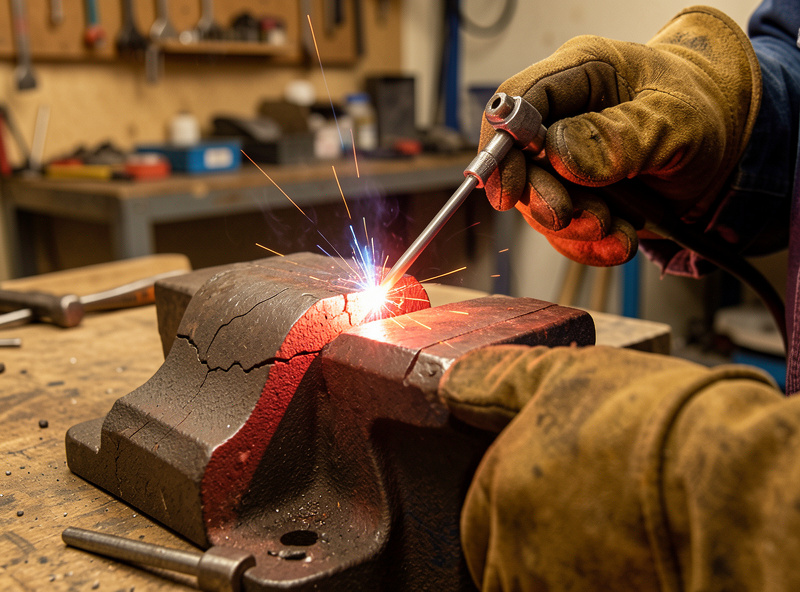
How I tell them apart on the bench: a fresh fracture face on gray iron is dull, dark gray, and gritty; ductile iron’s fracture is brighter and more silvery. The spark test off my DeWalt DWE402 grinder is the giveaway — cast iron throws short, dull-red sparks that burst into little fans close to the wheel, nothing like the bright long streamers of mild steel. A file skating off the surface with no bite means white iron or a hardened skin, and that is your signal to braze, not weld. When I am unsure on a job, I do what Mike does: grind a small notch in a hidden spot and read the chip and the spark before deciding the method. If sourcing a replacement casting is on the table, the metal suppliers comparison and my notes on new versus used stock are worth a look before you sink hours into a marginal repair.
The Three Ways to Join Cast Iron
For home repairs there are three real options: stick welding with nickel electrodes, braze welding with bronze filler, and — for thin, clean gray iron only — specialty MIG with nickel wire. Stick-nickel is the strongest general repair, brazing is the lowest-stress and most forgiving, and MIG is the niche third choice.
Most beginners assume they should MIG cast iron because that is the machine they own. Usually that is the wrong instinct. The high, fast heat input of MIG fights everything cast iron needs. Here is how the three methods actually compare on a home bench:
| Method | Filler | Best for | Preheat | Strength & difficulty |
|---|---|---|---|---|
| Stick (SMAW) | 99% nickel (ENi-CI) or 55% nickel-iron (ENiFe-CI) | Most structural cracks, thick sections, machinable repairs | 500-1200°F depending on section | Strongest, machinable with nickel; moderate skill |
| Braze welding | Bronze/brass rod with flux, oxy-fuel or MAPP | Thin parts, non-structural, oil-soaked or hard-to-clean castings | Dull-red, lower than fusion welding | Lower stress, very forgiving; easiest to get crack-free |
| MIG (specialty) | Nickel MIG wire or hardwire on clean gray iron | Thin clean gray iron, small cosmetic fills | Still preheat; short stitches only | Fast but high heat input; crack-prone, least forgiving |
The honest summary: for a crack you need to hold and maybe machine, stick with 99% nickel. For a thin or oil-contaminated part where you just need it whole again, braze. Reach for MIG only on clean, thin gray iron where you accept the risk. The two cast-iron-specific deep dives — my step-by-step how-to-weld-cast-iron walkthrough and the dedicated preheat and cool-down guide — go far deeper on technique than I can fit in this overview.
Stick Welding Cast Iron With Nickel Rods
Stick welding with 99% nickel (ENi-CI) electrodes is the home welder’s strongest cast iron repair. Run short 1-inch stringer beads at the lowest current that gives fusion — often 70-110 amps on a 3/32″ rod — let each bead cool to where you can lay a bare hand near it, and peen each bead while warm to relieve shrinkage stress.
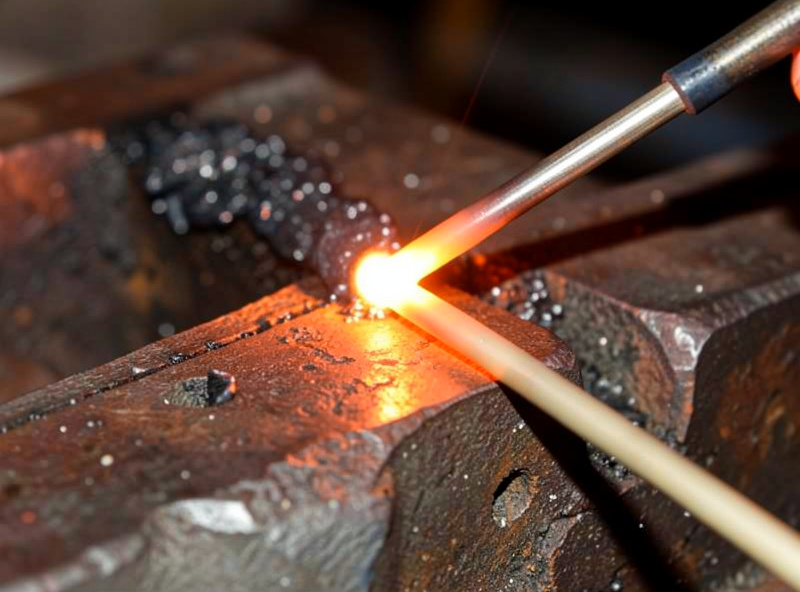
Nickel rod is expensive — there is no way around it — but it is what makes a cast iron weld machinable and crack-resistant, because nickel weld metal stays soft and ductile even when the surrounding iron hardens. I use 99% nickel (ENi-CI) for repairs I want to drill or tap afterward, and 55% nickel-iron (ENiFe-CI) when I want a stronger, slightly cheaper bead on a high-stress ductile-iron part. Prep is non-negotiable: grind the crack out into a V with the DWE402 so you reach clean gray metal, drill a small stop-hole at each end of the crack so it cannot run, and clean off every trace of oil, paint, and rust. Oil-soaked castings — anything off an engine or gearbox — should be baked or burned out first, or you will chase porosity forever.
The technique that matters is heat management, not bead beauty. Run beads about an inch long, skip around so you never build a long hot zone, and the second you finish a bead, peen it firmly with the round end of a ball-peen hammer. Peening stretches the freshly solidified weld metal a touch and cancels some of the shrinkage that would otherwise tear the joint. Then wait. Cast iron rewards patience between beads more than any metal I weld. If you want the full bead-by-bead sequence with current settings by thickness, that lives in the how-to-weld-cast-iron guide; for current ballparks across metals generally, the settings chart is a handy cross-reference even though cast iron is its own animal.
Braze Welding — Often the Smarter Repair
Braze welding cast iron with bronze filler joins the metal below its melting point, so the casting never enters the brittle fusion zone that causes cracking. It is the most forgiving home method for thin, dirty, or oil-soaked parts, and on non-structural repairs it is frequently the better choice than arc welding.
This is the method beginners overlook and Mike reaches for more than people expect. Brazing does not melt the cast iron — it wets the surface with bronze at a much lower temperature, so you sidestep the white-iron HAZ problem almost entirely. For a cracked stove grate, a leaking pump housing, an old bracket that just needs to hold its shape again, brazing is faster, cheaper, and far less likely to crack than a fusion weld. It tolerates contamination better too, which matters on castings you can never get perfectly clean. The trade-off is lower joint strength and you cannot color-match it, so for a hidden structural fix that needs maximum strength, stick-nickel still wins. The deeper flux-and-filler technique carries over from my stainless brazing guide and the thick-metal heat-sink piece, even though the filler and temperatures differ for iron.
Preheat, Interpass, and the Slow Cool-Down
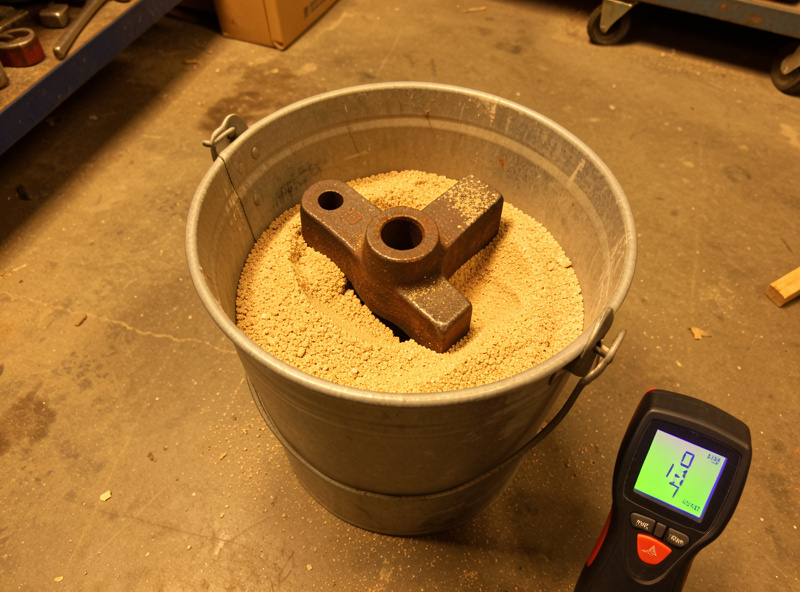
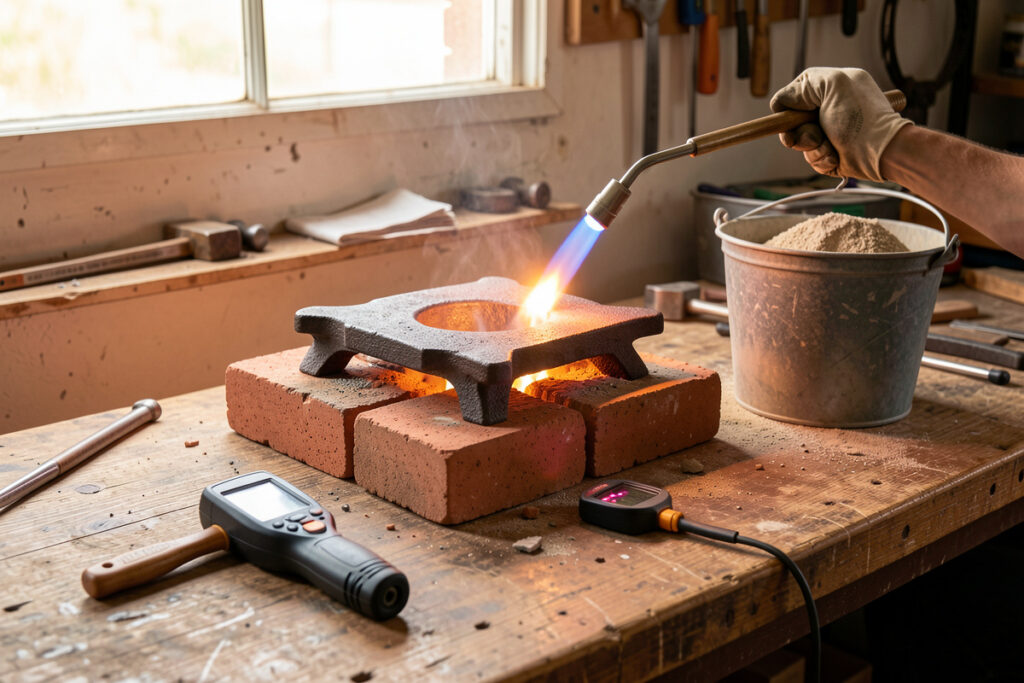
Preheat and a controlled cool-down are what separate a cast iron weld that holds from one that cracks overnight. Bring the casting up to roughly 500-1200°F before welding, keep it warm between beads, and after welding bury it in dry sand or vermiculite so it loses heat over hours, not minutes.
Preheat does two jobs: it slows how fast the weld zone quenches, and it shrinks the temperature gap between your molten puddle and the cold casting so there is less stress to begin with. How hot depends on the part — a thin bracket might only need a warm-to-the-touch preheat, while a thick machine base wants a deep, even soak. I check temperature with an infrared thermometer rather than guessing by color, because the dull-red glow people chase is hotter than most repairs need and can distort thin sections. The cool-down matters just as much: when the last bead is in, I drop the part into a bucket of dry sand or wrap it in a welding blanket so it gives up its heat over an hour or more. A fan, a cold concrete floor, or a careless trip outside in a Swedish winter will crack a perfect weld as it quenches. This is a big enough topic that it has its own home — the preheat and cool-down guide — and it pairs with the general pre-heat and post-heat treatment article for non-cast-iron jobs.
Peening, Studding, and Bigger Repairs
Peening each bead while it is still warm relieves shrinkage stress and is mandatory on cast iron. For large cracks or broken-off sections, studding — threading steel studs into the casting across the joint and welding to them — spreads the load off the brittle iron and into the studs, dramatically reducing crack risk.
On a short crack, careful prep plus nickel rod plus peening is enough. On a big repair — a snapped-off mounting ear, a long structural crack, a heavy section — the casting needs help carrying the stress. That is where studding comes in: you drill and tap a row of holes along the joint faces, thread in short steel studs, and weld over and between them. The studs anchor the weld metal mechanically so the load no longer relies on the bond to brittle iron alone. It is fiddly, slow work, and it is honestly the point where I hand the really high-stakes jobs to Mike — anything load-bearing or safety-critical is not where a home welder should be learning. Distortion control matters here too; the same principles in my distortion control guide and the why-metal-moves piece apply, just amplified because cast iron punishes uneven heat harder than steel.
When Not to Weld Cast Iron at All
Do not arc weld cast iron when the part is white iron, safety-critical, thin and badly oil-soaked, or cheaply replaceable. Brazing, mechanical repair, or replacement is often smarter than a fusion weld that may crack under load. Knowing when to walk away is part of the skill.
I have talked people out of welding more cast iron than I have talked them into it. An engine block crack, a brake component, anything where failure hurts someone — that is coded, high-stakes territory, and Mike’s answer and mine is the same: that is not a home-bench job. White iron will not weld soundly no matter your skill. And sometimes the brutal truth is that a replacement casting costs less than the nickel rod, gas, and three evenings the repair will eat. Welding cast iron well is as much about judgment as technique. When the repair does make sense, work through the cluster below in order, and keep your fume and fire discipline tight — cast iron repairs often involve burning out old oil, which means smoke you do not want in your lungs.
My Cast Iron Repair Toolkit
You do not need exotic gear, but you do need the right consumables. The expensive item is the nickel rod, and it is not the place to cut corners. Here is the short list I keep on the shelf for cast iron work.
For arc repairs I keep 99% nickel cast iron stick electrodes and a pack of 55% nickel-iron rods for the higher-stress jobs. For brazing I run bronze brazing rod and flux. The one tool that changed my cast iron results most was a cheap infrared thermometer that reads to 1000°F+, so I stopped guessing preheat by eye. As an Amazon Associate I earn from qualifying purchases.
What a Cast Iron Repair Actually Costs
A home cast iron repair is cheap in tools but not in consumables: a 1-lb pack of 99% nickel (ENi-CI) electrode runs roughly four to ten times the price of the same weight of mild-steel rod, which is why nickel is the line item that decides whether a repair beats replacement. Budget for the rod first and everything else is pocket change.
Here is the rough math I run before committing an evening to a casting. Nickel stick electrode is the big cost — a small crack might burn through only a few rods, but a long structural crack with studding can eat a meaningful fraction of a pack. Bronze brazing rod is far cheaper per stick than nickel, which is one more reason brazing wins on non-structural parts. The infrared thermometer, a bag of sand, and a propane torch you likely already own are one-time, low-cost items. Against that, weigh the replacement casting: a generic bracket or stove grate is often cheaper to buy than to repair, while an obsolete or no-longer-made part — the snapped foot off a vintage machine, a discontinued pump housing — is where the repair pays for itself many times over. The electrodes themselves are classified under AWS A5.15, the filler-metal specification for cast iron welding rods, so a pack marked ENi-CI or ENiFe-CI is held to a known standard rather than a vague “cast iron rod” label — worth checking before you buy. My rule is simple: if the part is replaceable for less than the rod and the gas, replace it; if it is irreplaceable or the casting carries the machine’s value, the nickel is cheap insurance.
Fume and Fire Safety on Cast Iron Repairs
Cast iron repairs often mean burning out old oil, paint, and grease, which produces smoke you should never breathe. Run a powered fume extractor or work in strong cross-ventilation, keep a fire extinguisher within reach, and never weld an oil-soaked casting near anything flammable.
The castings that land on my bench have usually spent years soaked in engine oil or buried under old paint, and the first arc turns that into acrid smoke. I pull fumes off the bench with a powered extractor and keep the shop doors open even in a Swedish winter, because no repair is worth a lungful of burnt-oil haze. Strike an arc on a greasy casting and you can also get a flare-up, so I wipe and burn the joint area clean first, keep a fire watch on hidden combustibles, and step out of the plume between beads. The same ventilate-hard instinct that keeps you safe around coated steel applies to every oily casting that hits the bench.
Related Guides in This Cluster
- How to Weld Cast Iron: A Step-by-Step Home Guide
- Preheat and Cool-Down for Cast Iron Welding
- Welding Dissimilar Metals: Joining Different Alloys
- Welding Thin Sheet Metal Without Warping or Blow-Through
- Hardening and Heat Treating Steel at Home
- Welding Galvanized Steel Safely
Frequently Asked Questions
Can you weld cast iron with a normal MIG welder?
You can on clean, thin gray iron with nickel MIG wire and proper preheat, but MIG’s high heat input makes cast iron crack-prone. For most repairs, stick welding with nickel rod or brazing gives far more reliable, crack-free results than MIG.
What rod do you use to weld cast iron?
Use nickel electrodes: 99% nickel (ENi-CI) for repairs you want to machine or drill afterward, and 55% nickel-iron (ENiFe-CI) for stronger, higher-stress joints on ductile iron. Plain mild-steel rod will crack on cast iron.
Do you have to preheat cast iron before welding?
For almost every repair, yes. Preheating to roughly 500-1200°F depending on section thickness slows the cooling rate and shrinks the stress between weld and casting. Skipping preheat is the single most common reason a cast iron weld cracks.
Why does my cast iron weld keep cracking?
Cracking comes from too-fast cooling, no preheat, mild-steel filler, or skipping peening. The heat-affected zone hardens into brittle white iron and the shrinking bead tears it. Use nickel rod, short beads, peen each bead warm, and cool the part slowly in sand.
Is brazing better than welding cast iron?
Often, yes, for home repairs. Brazing joins below the iron’s melting point, so it avoids the brittle fusion zone that causes cracking. It is more forgiving on thin or oil-soaked parts. Stick-nickel welding still wins for maximum strength on structural repairs.
How do I know if a part is cast iron and not steel?
A spark test throws short, dull-red sparks that burst close to the grinder wheel, unlike steel’s long bright streamers. A fresh fracture is dull dark gray and gritty. If a file skates off with no bite, it is white iron or a hardened skin and should be brazed, not welded.

Discussion (0)