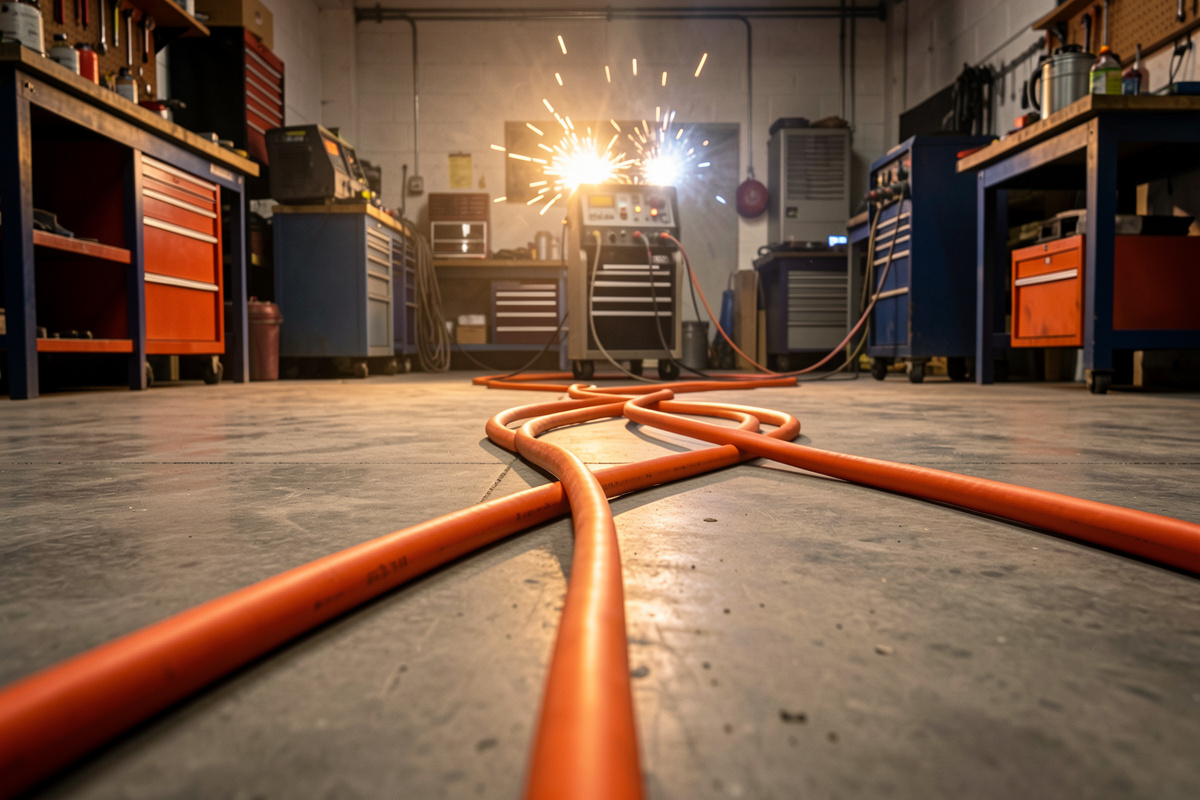

Voltage drop is voltage lost to resistance as current travels down a wire, and on a welder it shows up as an arc that stutters, sags, and won’t penetrate. The fix is almost never the machine — it’s a fatter cord or a shorter run. On a long pull, jump up a wire gauge or two: a 240V welder that’s happy on 10 AWG at 25 feet may want 8 or 6 AWG at 100.
I lost a whole afternoon to this once, and it still stings. I’d dragged a long, skinny extension cord across the shop to reach a job at the far wall, and the arc on 6 mm plate kept dropping out on me. I changed tips, re-set wire speed, checked the gas, even swapped the ground clamp. Everything but the cord. The machine was starving — the voltage at the far end had sagged low enough that the inverter simply couldn’t hold an arc under load. That day taught me that a cord isn’t a neutral extension of the outlet. It’s a load all its own.
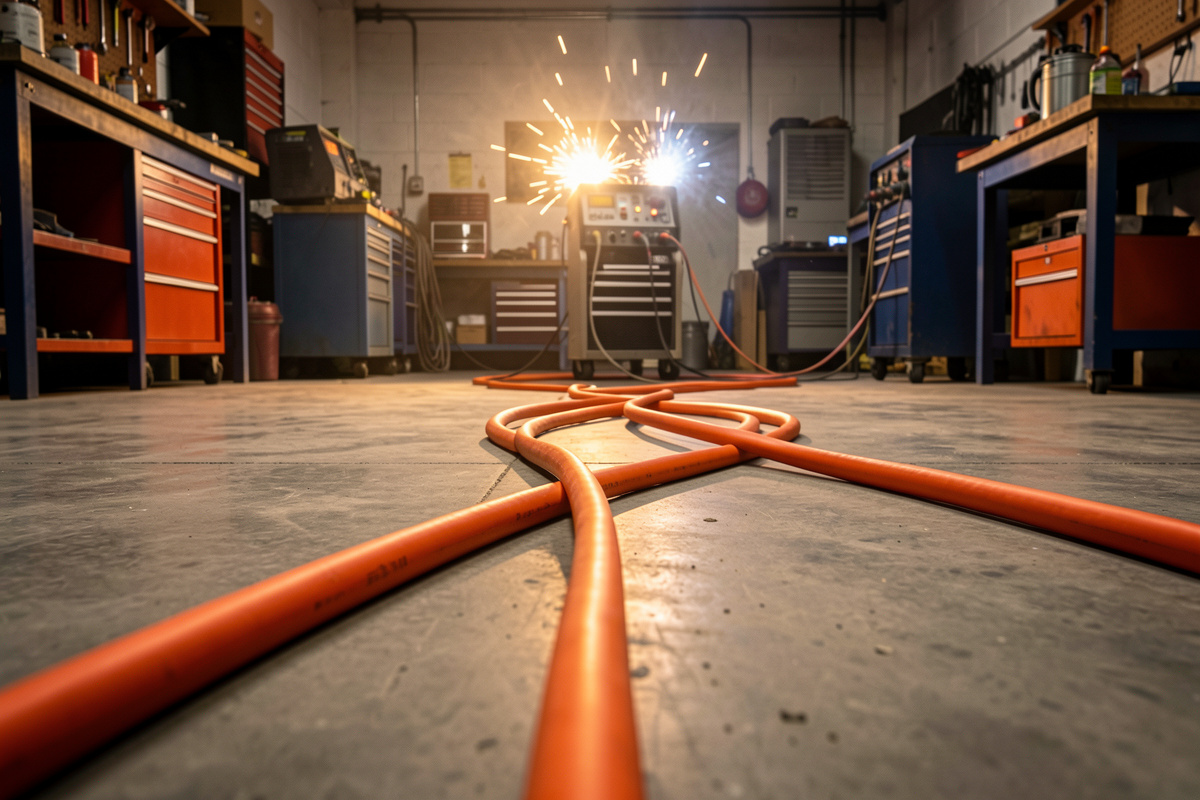
What Is Voltage Drop and Why Does It Kill a Weld Arc?
Voltage drop is the voltage a conductor loses to its own resistance as current flows through it. Every foot of wire has resistance, and pushing welding-level current through a long, thin conductor bleeds off voltage as heat along the way — so the machine at the far end sees less voltage than the outlet actually supplies. A welder needs that voltage to strike and hold a stable arc, and when it’s not there, the arc suffers first.
Here’s why a welder is uniquely sensitive. It’s a high-current load with a demanding appetite the instant you pull the trigger, and an inverter machine in particular expects a firm input voltage to regulate cleanly against. Starve it and it can’t maintain the output it promised — the puddle goes cold, penetration drops, and you fight lack of fusion and cold lap that no amount of technique will cure. The electrical code addresses this by recommending branch-circuit voltage drop be held under about 3%, guidance published in the informational notes of NFPA 70 by the National Fire Protection Association. Cross that threshold and sensitive equipment starts complaining. A welder complains loudly.
How Do I Know Voltage Drop Is the Problem?
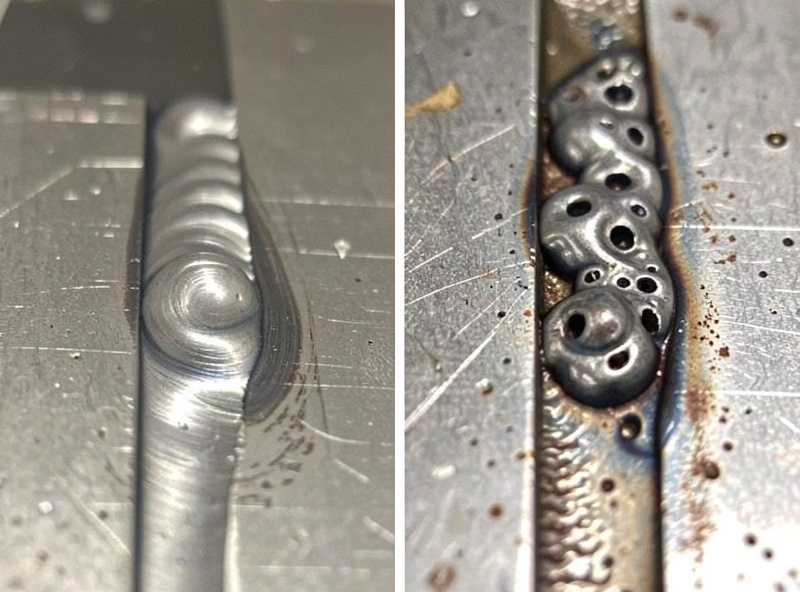
The classic tell is an arc that behaves worse the farther you get from the panel. If the machine welds fine plugged in near the outlet but turns weak and stuttery on a long cord, that’s voltage drop, not a faulty welder. The symptoms cluster: a soft, wandering arc, shallow penetration, more spatter, and on inverters sometimes an under-voltage warning or an outright cutout under load.
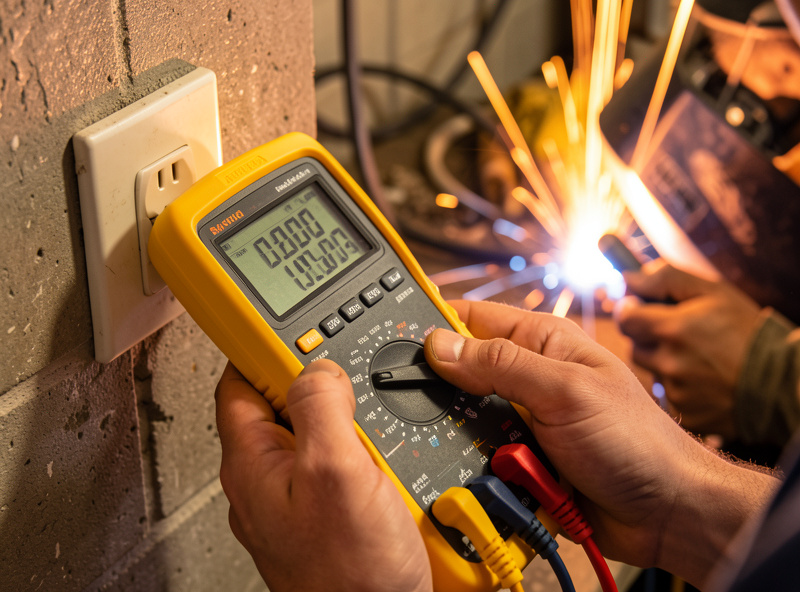
You can confirm it with a multimeter, and I’d rather measure than guess. Read the voltage at the far end of the cord — the point where the welder plugs in — with the machine idle, then have a helper hold the trigger under a real welding load and watch the number sag. A little sag is normal; a big dive tells you the cord or circuit can’t feed the machine. When I finally did this on that miserable afternoon, the drop under load was ugly, and the culprit was obvious. A cheap digital multimeter turns this from a mystery into a two-minute check.
As an Amazon Associate I earn from qualifying purchases.
The other giveaway is heat. Run a marginal cord under welding load for a few minutes and put a hand on it — a cord that’s warm along its length, or a plug that’s hot at the outlet, is dissipating your welding voltage as waste heat. That warmth is the voltage you’re missing, made physical. It’s also a fire risk, which is the other reason I never ignore a warm cord.
What Cord Gauge Do I Need for a Long Welder Run?
Match the cord gauge to both the current and the distance — the longer the run, the fatter the wire has to be to deliver the same voltage. Here’s the practical map I work from, sized to hold voltage drop reasonable for typical home welders. Remember cord gauge works backward: a smaller AWG number is a thicker, better wire.
| Run length | 120V welder (~20A) | 240V welder (~30A) |
|---|---|---|
| Up to 25 ft | 12 AWG | 10 AWG |
| 25–50 ft | 10 AWG | 10 AWG |
| 50–100 ft | 8 AWG | 8 AWG |
| 100–150 ft | 6 AWG | 8 AWG |
| 150 ft and beyond | Rethink the setup | 6 AWG |
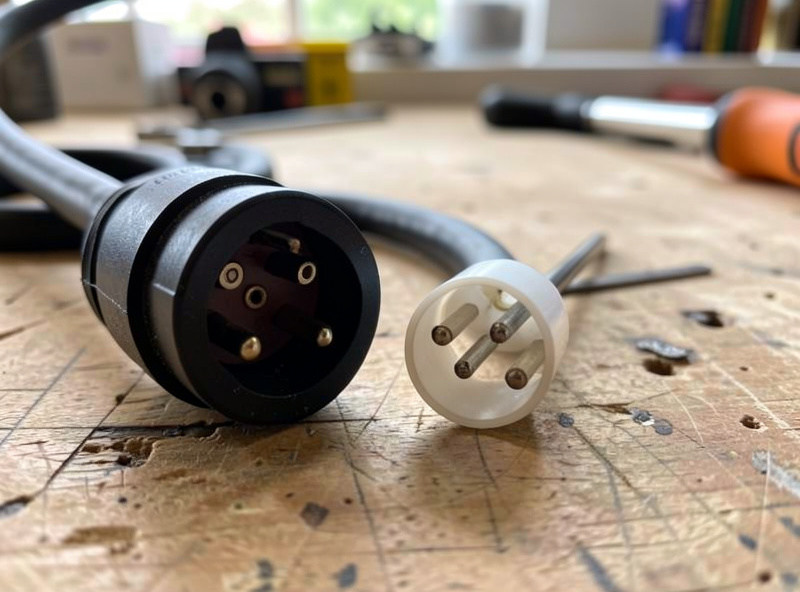
Two rules that keep me out of trouble. First, buy the cord for the longest run you’ll actually use, not the average — a 100-foot 8 AWG cord coiled to 30 feet is fine, but a 30-foot 12 AWG cord stretched to 100 is a stuttering arc waiting to happen. Second, never chain cords. Two cords joined double the connections, double the resistance, and stack their drops. My own long-run cord is a heavy Iron Box, sized deliberately so the inverter never goes hungry on a pull to the far bench. I went deeper on cord selection, connector quality, and reel-versus-loose in the welding extension cord gauge guide. Wire makers like Southwire publish voltage-drop calculators if you want to run your exact numbers.
Does 240V Suffer Less Voltage Drop Than 120V?
Yes — for the same welding power, a 240V feed suffers proportionally less voltage drop than a 120V one. It draws roughly half the current to deliver the same watts, and since drop scales with current, halving the amps roughly halves the volts lost in the wire. On top of that, the same few volts lost is a smaller percentage of 240 than of 120, so the machine feels it less.
This is one more quiet argument for wiring 240V, and it stacks on all the others. When I moved my heavy work to the 240V side of the MIG-PRO, long runs stopped being nearly as fragile — the same distance that made the 120V side stutter was a non-event at 240V. If you’re still weighing the two, I laid out the full trade in 110V vs 220V welders, and the circuit sizing behind it in the breaker and wire chart. Higher voltage isn’t just more power; it’s more forgiving of distance.
Fixed Wiring: When the Drop Is in Your Walls, Not the Cord
Voltage drop doesn’t only live in extension cords. The permanent run from your panel to a far outlet has the same physics, and a long home run on undersized wire will sag under a welder just as surely as a skinny cord will. If your machine welds weakly at a particular outlet even with a short, heavy cord, the problem may be baked into the wall.
This is why electricians upsize conductors on long branch circuits as a matter of course — a 6 AWG circuit that’s fine at 30 feet might want 4 AWG at 120 feet to hold the same voltage. It’s not something to solve with a bigger breaker; the breaker protects the wire, it doesn’t feed voltage. Fixing drop in fixed wiring means fatter conductors, and that’s electrician territory. My welder friend Mike, decades in the trade, sizes long runs a gauge heavier almost reflexively, and I’ve stopped arguing with him about it. If you suspect the wall, get the run measured and sized properly — the electrical safety guide covers why guessing here is the wrong move.
The Fixes That Actually Work
The reliable fixes are short and boring: shorten the run, fatten the wire, or move the power closer to the work. In rough order of what I reach for first — reposition the machine nearer the outlet so the cord does less work; swap to a heavier-gauge cord sized for the distance; uncoil the cord fully, because a tightly wound cord under load builds heat and adds resistance; and stop chaining cords together.
When none of those are enough, the real answer is infrastructure: add a dedicated, correctly-sized circuit where you actually weld, so you’re not reaching across the shop at all. That’s the permanent cure, and it’s cheaper than a season of ruined welds and re-grinding. The whole power picture — circuits, breakers, and where to put your outlets — lives in the welder power requirements guide, and the first-year equipment checklist budgets for doing it right the first time.
My Long-Run Rules
What I’d do starting today, learned the hard way: keep the welder close to a proper outlet whenever you can; own one heavy cord sized for your worst-case run instead of a drawer of thin ones; uncoil it fully every time; never chain cords; and keep a multimeter handy so you diagnose a sagging arc in two minutes instead of blaming the machine for two hours. Do that, and voltage drop goes from a mystery that ruins welds to a thing you simply never hit. The machine was never the problem on that lost afternoon. The cord was — and now I know the difference by feel.
What causes a welder arc to stutter on a long extension cord?
Voltage drop. A long or undersized cord loses voltage to its own resistance, so the welder at the far end sees less voltage than the outlet supplies. Starved of voltage, the machine cannot hold a stable arc, so it stutters, sags, and loses penetration. A heavier-gauge cord or a shorter run fixes it.
What size extension cord do I need for a welder?
Match gauge to current and distance. For a small 120V welder, use 12 AWG up to about 25 feet, 10 AWG to 50 feet, and 8 AWG beyond. For a 240V machine drawing around 30 amps, use 10 AWG up to 50 feet, 8 AWG to 100 feet, and 6 AWG past that. Buy for your longest run.
How do I test for voltage drop on my welder circuit?
Measure the voltage at the point where the welder plugs in with a multimeter, first with the machine idle, then under a real welding load. A small sag is normal, but a large dive under load means the cord or circuit cannot supply enough voltage. Heat in the cord or plug is another sign.
Does a longer cord need thicker wire?
Yes. Resistance grows with length, so a longer run loses more voltage at the same current. To hold voltage drop in check you step up to a thicker, lower-AWG wire as the distance increases. A cord gauge that is fine at 25 feet may be inadequate at 100 feet.
Can I just use a bigger breaker to fix a weak arc on a long run?
No. A bigger breaker does not add voltage or reduce drop, and never up-size a breaker beyond the wire rating. The fix for voltage drop is a thicker conductor, a shorter run, or moving the welder closer to the outlet. Fixed-wiring drop should be corrected by an electrician sizing heavier conductors.

Discussion (0)