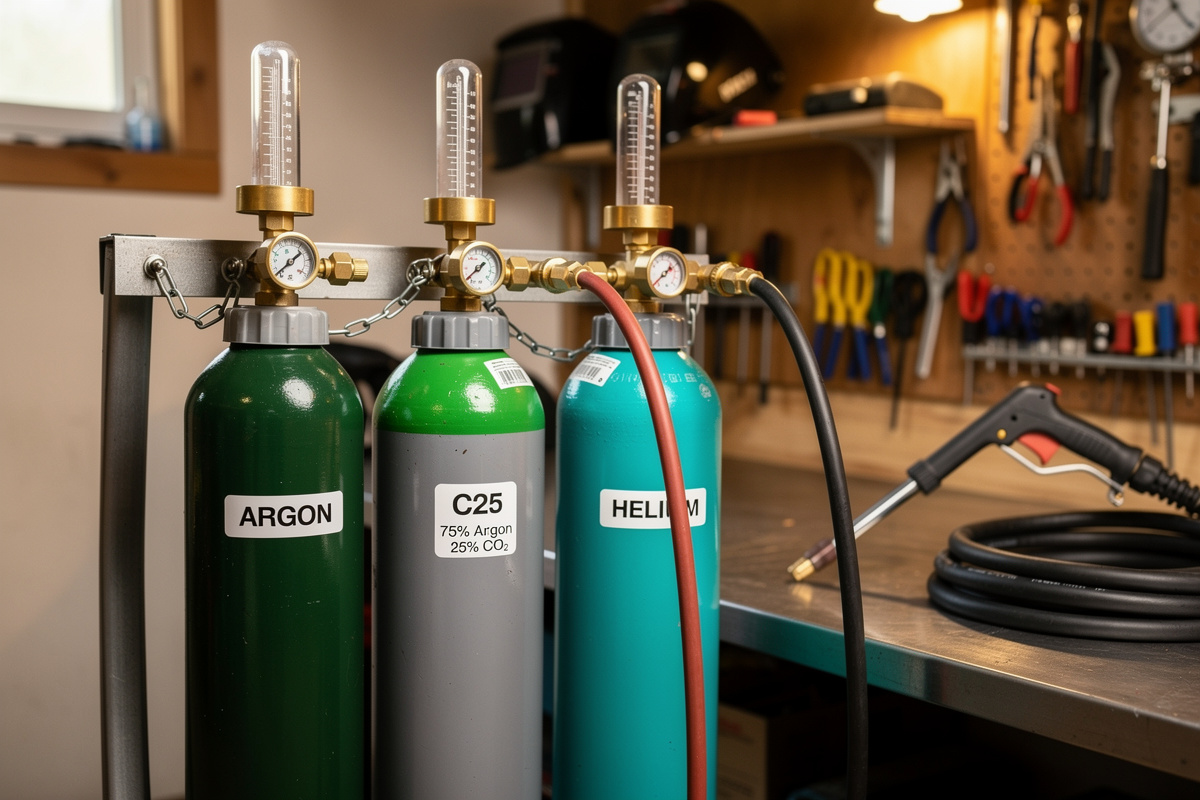

Home welders need three gases: C25 (75% argon / 25% CO2) for MIG mild steel, pure argon for TIG everything and MIG aluminum, and tri-mix (90% helium / 7.5% argon / 2.5% CO2) for MIG stainless steel.
Pure CO2 is the budget alternative for MIG mild steel — cheaper per fill but harsher arc and 50-80% more spatter. Skip CO2 for C25 and you cut spatter cleanup time in half; pick the wrong cylinder size and you’ll burn an entire refill chasing porosity that’s really a flow-rate problem. The CFH trap is buried in section 4 — most beginners crank flow too high, not too low.
I started on flux-core with no gas at all, then upgraded to C25 six months in, then added pure argon for TIG a year later. Each gas change felt like a different welder — C25 smoothed the arc that flux-core had me fighting, and argon TIG was so quiet and clean compared to MIG that I checked twice to make sure the machine was actually on. The first day I swapped from flux-core to C25 I left the flowmeter cranked at 35 CFH because higher flow felt like more protection — turns out the turbulence pulled atmosphere INTO the puddle and gave me a row of pinholes along the first six inches of bead. Dropped to 22 CFH on the same joint and the porosity vanished instantly. Flow rate matters more than total volume. This guide covers which gas for which process and material, what each gas does inside the arc, cylinder sizes and costs, and the safety rules that keep a compressed gas cylinder from becoming a missile in your garage. For the full equipment picture, the essential welding equipment guide covers every tool. For the process-level decision, see gas vs gasless MIG explained.
What Shielding Gas Actually Does
Shielding gas does one job: it pushes atmospheric oxygen, nitrogen, and hydrogen away from the molten weld puddle. Without shielding, the puddle instantly oxidizes — the bead surface turns black and crusty, internal porosity forms as trapped gas bubbles, and the weld metal loses ductility because nitrogen dissolves into the steel and embrittles it. The gas creates an invisible dome of inert or semi-inert atmosphere around the arc, and the gas composition determines arc characteristics, penetration profile, spatter level, and the materials you can weld.
The flow rate sweet spot is 20-25 cubic feet per hour (CFH) for most home MIG welding. Below 15 CFH, coverage is incomplete and porosity appears at the bead edges. Above 35 CFH, turbulence pulls atmosphere into the shielding zone, also causing porosity. The gas flow that produces a quiet, stable arc with no visible surface porosity is the correct flow — adjust in 2-3 CFH increments and watch the bead surface, not the flowmeter number.
Gas by Process: What Each Welding Method Needs
MIG mild steel: C25 (75% argon / 25% CO2) is the standard. Argon provides the stable, smooth arc and low spatter that makes gas-MIG pleasant to use. CO2 adds penetration by increasing arc energy and improves puddle wetting into the joint. Pure CO2 is the budget option — 50-70% cheaper per fill, but the arc is harsher, spatter increases roughly 50-80%, and the bead surface is duller with more oxidation. Pure CO2 works for structural and outdoor projects where appearance does not matter.
MIG aluminum: Pure argon, 100%. No CO2, no helium, no mixes — aluminum reacts instantly with CO2 and oxygen, and any CO2 in the gas creates black sooty oxide on the bead surface. Aluminum MIG also requires a spool gun (the soft aluminum wire birdnests in a standard MIG gun liner) and DCEP polarity. For the full aluminum setup, see the MIG welding complete guide.
MIG stainless steel: Tri-mix (90% helium / 7.5% argon / 2.5% CO2) for short-circuit MIG on thin stainless. The helium-heavy mix provides the high heat input that stainless needs to wet out properly, while the small CO2 percentage stabilizes the arc without creating excessive oxidation. Using C25 on stainless produces a dull, gray, oxidized bead with poor appearance — structurally fine but cosmetically unacceptable for anything visible.
TIG all metals: Pure argon for everything — mild steel, stainless steel, aluminum, chromoly, titanium. Argon is the universal TIG shielding gas because the TIG arc is more sensitive to gas composition than MIG, and the welder controls heat independently via the foot pedal. Helium can be added to argon (25-50% helium) for TIG welding thick aluminum to increase heat input, but pure argon handles 90% of home TIG work. For the full TIG story, see the TIG welding guide.
Cylinder Sizes: What to Rent vs What to Buy
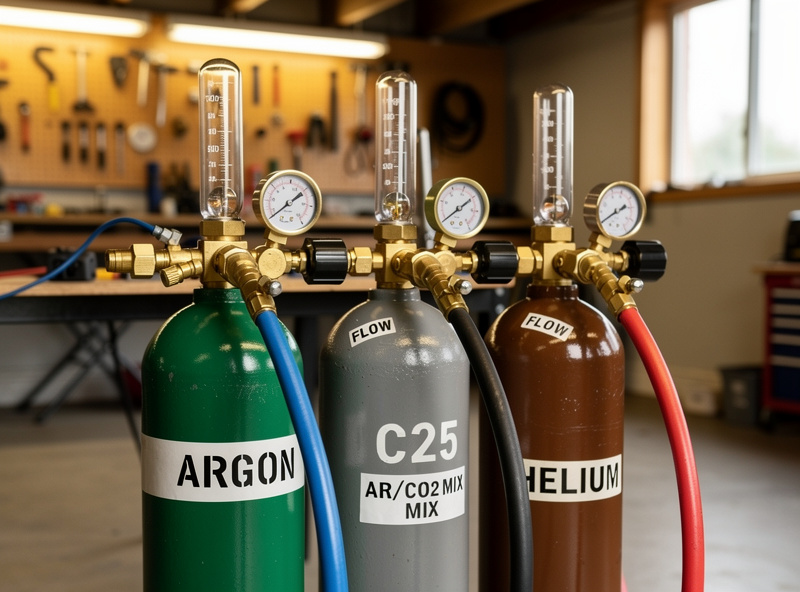
Welding gas cylinders come in standard sizes defined by cubic feet of gas capacity. The right size for a home welder balances refill frequency against portability and rental cost:
| Cylinder Size | Capacity (CF) | Approx. Weld Hours | Rental/Year | Best For |
|---|---|---|---|---|
| 40 CF (small) | 40 | 3-5 hrs | $50-70 | Occasional hobbyist, tight storage |
| 80 CF (medium) | 80 | 8-12 hrs | $60-80 | Regular hobbyist, most home welders |
| 125 CF (large) | 125 | 12-18 hrs | $80-100 | Frequent welder, shared between processes |
| 250-330 CF (commercial) | 250+ | 25-35 hrs | $120-150 | Full-time home shop, permanent install |
The 80 CF cylinder is the sweet spot for a home welder welding 2-6 hours per week — it fits under a welding cart shelf, lasts 8-12 hours of arc time, and refills are 35-50 dollars. A 40 CF cylinder runs out mid-project frequently enough to be frustrating; a 125 CF cylinder requires a hand truck to move. Buy the cylinder outright (250-400 dollars) if you weld 50+ hours per year — the rental pays for itself in 3-4 years. Rent (50-100 dollars/year) if you weld 10-20 hours per year. I bought my 80 CF Airgas C25 cylinder outright two years ago at 310 dollars; local exchange fills run 42 dollars, so the buy decision pays back inside year five — and every year after that is pure rental savings versus the 70 dollars/year my local supplier was quoting.
Cylinder safety: Always chain or strap the cylinder to the welding cart or wall. CGA P-1 (the Compressed Gas Association handling standard) covers securing every compressed gas cylinder, and it’s incorporated into federal law by OSHA 29 CFR 1910.101(b) — the general compressed-gases standard that governs the argon, C25, and tri-mix bottles a welder actually runs (1910.253 is the oxy-fuel welding and cutting standard, oxygen and acetylene only — a different regulation for a different pair of gases). A cylinder that tips over and shears the valve can become an unguided missile capable of punching through a masonry wall and traveling a long distance before it stops. Secure the chain or strap roughly two-thirds of the way up the cylinder, above its center of gravity — too low or too high and it won’t hold the cylinder if it starts to fall. Always cap the cylinder when not connected to the regulator. Never weld near the cylinder, and never use the cylinder as a work rest or ground clamp attachment point. The welding safety guide covers cylinder safety in detail.
Gas Mixes Compared: Arc, Spatter, Penetration, Cost
| Gas/Mix | Process | Arc Quality | Spatter | Penetration | Cost/Fill (80 CF) |
|---|---|---|---|---|---|
| C25 (75% Ar / 25% CO2) | MIG mild steel | Smooth, stable | Low | Good | $35-50 |
| 100% CO2 | MIG mild steel | Harsh, erratic | High | Deep | $18-25 |
| 100% Argon | TIG all / MIG aluminum | Soft, quiet | None | Moderate | $40-55 |
| Tri-Mix (He/Ar/CO2) | MIG stainless | Hot, fluid | Low | Deep | $70-100 |
| Argon + 25-50% Helium | TIG thick aluminum | Hot, focused | None | Deep | $80-120 |
| 98% Ar / 2% CO2 | MIG stainless (spray) | Smooth, controlled | Very low | Medium | $50-70 |
Flowmeter and Regulator Setup
As an Amazon Associate I earn from qualifying purchases.
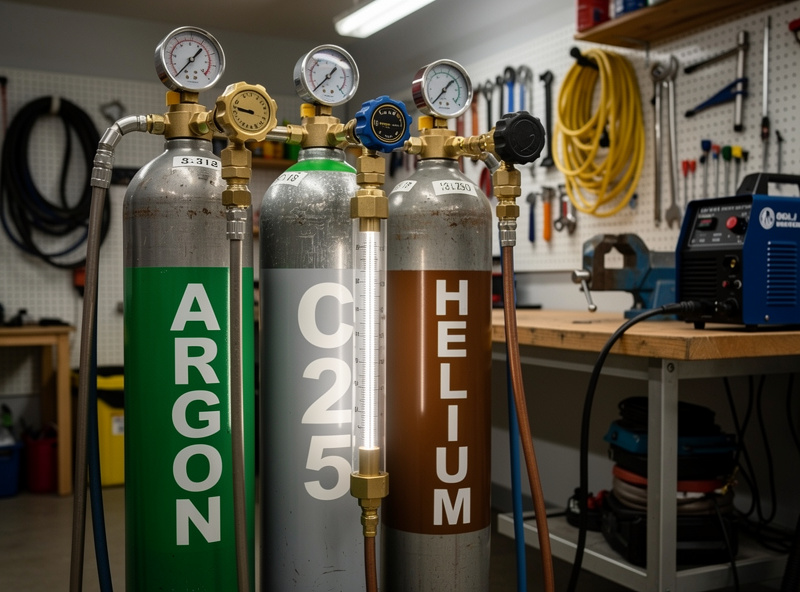
The flowmeter is the gauge that controls gas flow from the cylinder to the welder. Two types exist: floating-ball flowmeters (the glass tube with a ball floating at the CFH reading) and regulator-style flowmeters with a dial gauge. The floating-ball type is standard for home welders — it is simple, reliable, and shows actual flow visually. The ball should float at the 20-25 CFH mark for standard MIG; if the ball bounces or drops, the gas supply line has a leak, kink, or empty cylinder. I run a Smith 30-150-580 floating-ball flowmeter on my YesWelder MIG-PRO205DS — the brass body has outlasted three plastic-bodied no-name units I burned through in my first year, and the ball reading is stable enough that I no longer second-guess the gauge. (That MIG is my daily; I’ve run the double-pulse YesWelder Firstess DP200 at a friend’s shop and it is my planned upgrade.)
Setup procedure:
- Chain or strap the cylinder to the cart or wall before connecting anything.
- Crack the cylinder valve open briefly (quarter turn, then close) to blow any debris out of the valve port — stand to the side, never face the valve during this step.
- Attach the regulator/flowmeter to the cylinder valve, tighten the nut with a wrench.
- Attach the gas hose from the flowmeter to the welder’s gas input port.
- Open the cylinder valve fully (counterclockwise).
- Adjust the flowmeter to 20-25 CFH with the welder trigger pulled (gas flowing). Adjust with gas flowing because static pressure reads higher than dynamic flow.
- Check for leaks at every connection with soapy water — bubbles = leak = tighten and retest.
Once set, the flowmeter typically stays at the correct setting session to session. Check the ball before starting each session — if it has drifted, adjust. If the ball does not rise at all, the cylinder is empty or the valve is closed. I run my MIG-PRO205DS at 22 CFH on C25 in my closed garage — clean bead surface, no porosity, and the 80 CF Airgas cylinder lasts about 11 hours of arc time at that flow before the ball starts dipping near the end of a session.
Annual Gas Cost for Home Welders
For a hobbyist welding 40-60 hours per year on C25 with an 80 CF cylinder, the annual gas cost is roughly:
- Cylinder rental: 60-80 dollars per year (if renting)
- Refills: 2-3 refills per year at 35-50 dollars each = 70-150 dollars per year
- Total annual gas: 130-230 dollars renting, or 70-150 dollars if you own the cylinder
Gas cost per hour of arc time is roughly 5-8 dollars for C25 on an 80 CF cylinder — about the same as the wire you are burning. For the full consumables cost picture, see the welding consumables guide.
Frequently Asked Questions
What gas do I need for MIG welding mild steel at home?
C25 — 75% argon and 25% CO2 — is the standard MIG gas for mild steel. It provides the best balance of arc stability, low spatter, and good penetration. Pure CO2 is the cheaper alternative at roughly half the refill cost but produces a harsher arc and significantly more spatter.
Can I use the same gas cylinder for MIG and TIG welding?
Yes for argon — a pure argon cylinder works for both TIG welding (all metals) and MIG welding aluminum. However, MIG mild steel uses C25 (argon-CO2 mix) which cannot be used for TIG because the CO2 contaminates the tungsten electrode. Most home welders keep two cylinders: C25 for MIG steel and pure argon for TIG or aluminum MIG.
What size gas cylinder should a home welder get?
An 80 cubic foot cylinder is the sweet spot for home welders — it fits under a welding cart, lasts 8-12 hours of arc time, and refills are 35-50 dollars. A 40 CF cylinder runs out mid-project too often. A 125 CF cylinder is better for welders using 6-10 hours of arc time per week.
Why is my MIG weld full of pinholes even with gas flowing?
Pinholing with gas flowing is usually caused by wind blowing the shielding gas away, too low a flow rate (below 15 CFH), a gas leak in the hose or connections, or a clogged nozzle that redirects gas flow. Check flow with a pea-sized ball of tissue at the nozzle — it should flutter, not blow away or sit still.
Do I need different gas for welding stainless steel with MIG?
Yes — tri-mix (90% helium, 7.5% argon, 2.5% CO2) is the recommended gas for short-circuit MIG on stainless steel. C25 on stainless produces a dull, gray, oxidized bead that is structurally functional but cosmetically unacceptable. Tri-mix costs roughly double C25 per fill but produces the bright, clean stainless bead appearance.
How long does an 80 CF gas cylinder last?
An 80 CF cylinder of C25 lasts approximately 8-12 hours of continuous arc time, or roughly 2-4 months for a hobbyist welding 2-4 hours per week. The flow rate determines duration: at 20 CFH, an 80 CF cylinder provides 4 hours of continuous flow, but actual arc-on time is about 30-50% of shop time due to fit-up, grinding, and repositioning.

Discussion (0)