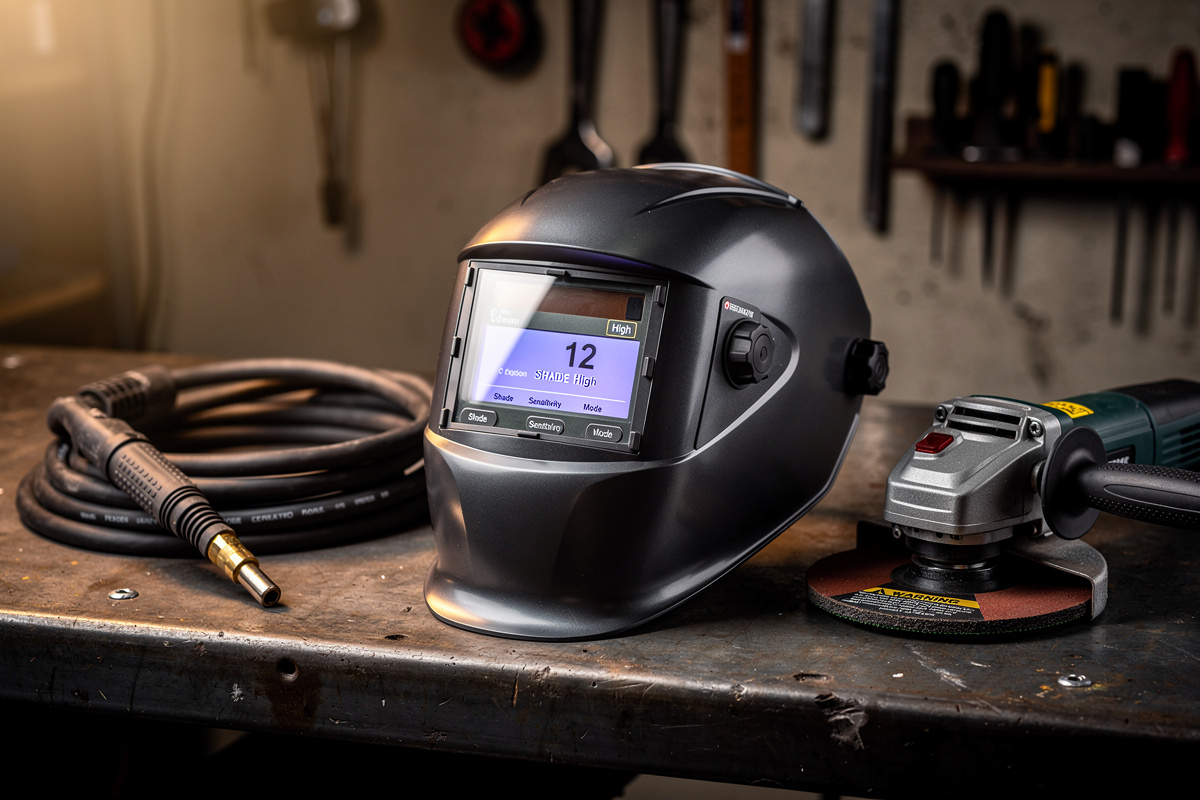

The best welding helmet for home use in 2026 is an auto-darkening helmet with shade range 5-13, four arc sensors, and a viewing area of at least 3.85 by 1.85 inches (ANSI Z87.1+ certified). Top picks are the Lincoln Viking 3350, Miller Digital Infinity, and the budget-strong YesWelder LYG-M800H.
I have owned three helmets across six years: a $50 budget unit that gave me arc eye twice in month one from sensor lag, a $140 mid-tier unit that has worked five years, and a $470 pro-tier (Lincoln Viking 3350) I borrowed for a weekend test. The mid-tier is the sweet spot for home use — the pro-tier is lighter and has a wider view, but for 30-50 hours of welding per year the difference is not worth $330. Skip the $50-$70 tier entirely; the corneal damage from a single sensor failure is not worth the savings. ANSI Z87.1+ is the certification minimum. The broader equipment context is in the essential welding equipment guide; for safety in general, see the welding safety guide.
As an Amazon Associate I earn from qualifying purchases.
The auto-darkening vs fixed-shade question used to be a real debate. In 2026 it is not — auto-darkening helmets at the budget end (90-150 dollars) have surpassed mid-range fixed-shade helmets on every measurable spec. The remaining decision is which auto-darkening tier fits your hours-per-year of welding. Hobbyists running 30-50 hours a year are well-served at the 90-150 dollar tier; people doing 100+ hours benefit from the 250-450 dollar pro tier.
Why Auto-Darkening Beats Fixed-Shade for Home Welders
Auto-darkening helmets sense the arc within 0.0001 seconds and shift from a clear shade 3 to a working shade (typically 10-13) before your eyes register the flash. Fixed-shade helmets stay at one dark setting permanently, forcing you to nod the helmet down before each tack and lift it after. For hobbyists doing dozens of tacks per project, the auto step pays for itself in time alone.
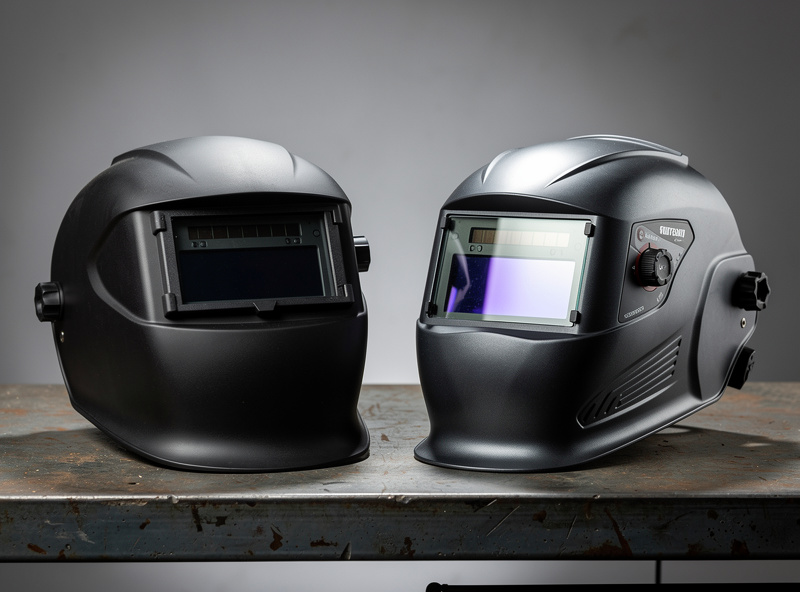
The real-world differences:
- Tack welding: Auto-darkening lets you place tacks while watching the seam align. Fixed-shade requires nod-and-strike each tack — inaccurate and slow.
- Bead inspection: Auto-darkening clears between welds, letting you check progress without lifting the helmet. Fixed-shade requires lifting after each pass.
- Multi-position welding: Auto-darkening is hands-free; fixed-shade fights you on overhead, vertical, and tight-corner work.
- Weld start consistency: Auto-darkening triggers reliably at arc strike. Fixed-shade users sometimes start the arc with the helmet still up — instant arc-flash burn.
- Comfort over multi-hour sessions: Auto-darkening is roughly 1.5-2 pounds, fixed-shade is similar but the constant nodding tires neck and back faster.
Fixed-shade helmets still exist for very specific use cases: production welders running the same joint hundreds of times per shift (they save a few dollars in cartridge replacement), pipe-line welders who already have hood mods, and students learning helmet positioning. None of these apply to home hobbyists. Read more on safety basics in our guide on welding burns first aid.
The Specs That Matter (And the Ones That Do Not)
Five specs separate good helmets from bad: shade range (must include 5-13), reaction time (1/15,000 second or faster for hobbyist arc work), arc sensors (3 minimum, 4 better), viewing area (3.85 x 1.85 inches minimum for comfort), and ANSI Z87.1 certification. Marketing specs like “11000 hours of UV protection” or “1/30,000 reaction time” rarely matter at the hobby level.
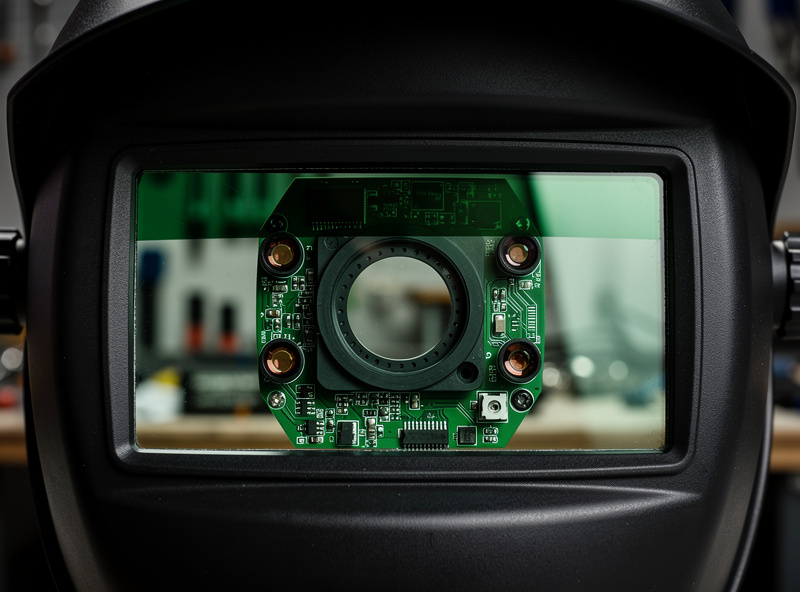
What each spec actually does:
- Shade range 5-13: Shade 5-8 covers grinding (on helmets with grind mode), shade 9-12 covers low-amperage TIG, shade 12-13 covers high-current MIG and stick. Helmets locked at “9-13” only miss low-amp TIG work.
- Reaction time 1/15,000 second: Faster than human eye registers. Marketing claims of “1/30,000” do not provide measurable benefit at hobby amperages.
- Four arc sensors vs two: Four sensors prevent dark-spot failure when one sensor is blocked by your work angle. Two-sensor helmets occasionally fail to darken in tight-corner work.
- Viewing area: Bigger windows reduce neck movement and improve weld seam visibility. 3.85 x 1.85 inches is the floor; 13.4 square inches (Miller Digital Infinity) is excellent.
- ANSI Z87.1 / CSA Z94.3 / EN 379: Required for impact and optical clarity. Off-brand helmets without certification have failed real-world impact tests.
- Battery type: Solar plus replaceable lithium beats fixed lithium. Replaceable batteries last the life of the helmet; sealed batteries fail at 3-5 years.
Specs that do NOT matter: optical class numbers above 1/1/1/2 (already excellent), branded “true color” features (most modern helmets are similar), helmet weight differences under 0.5 pounds, and grind mode unless you also do not own dedicated grinding glasses.
Top Picks for 2026 by Budget
Four helmets cover nearly every home welder need: YesWelder LYG-M800H at 90 dollars (best budget), Miller Classic Series at 180 dollars (best mid-range), Lincoln Viking 3350 at 470 dollars (best pro-level), and Miller Digital Infinity at 450 dollars (best overall premium). Each tier represents a meaningful upgrade in optical quality and durability.
Specific recommendations and trade-offs:
- YesWelder LYG-M800H (90 dollars): Solid auto-darkening, four sensors, shade 5-9/9-13, 3.93 x 3.66-inch viewing area, ANSI Z87.1 certified. Below 100 dollars this is the only helmet to consider. Battery is sealed but lasts 3-4 years of hobby use.
- Hobart Inventor (130 dollars): Brand-name reliability at the budget end. Replaceable batteries, smaller viewing area than YesWelder but better build quality.
- Miller Classic Series (180 dollars): Real brand-name mid-tier step-up. Only 2 arc sensors (fewer than the 4-sensor budget and premium picks here, but Miller’s optics make up for it), shade 8-13 weld / 5-8 cut, ANSI Z87.1+ certified, smaller window than the budget YesWelder but with Miller’s long-term reliability reputation.
- Lincoln Viking 3350 (470 dollars): The premium pick. 4C lens technology with no shade-color tint, large viewing area, exceptional comfort, lifetime industry reputation.
- Miller Digital Infinity (450 dollars): Best overall. ClearLight technology that produces near-natural color, 13.4 square-inch viewing area, premium fit. Lasts decades with battery replacements.
- Optrel Crystal 2.0 (650 dollars): Specialty tier for serious users. The closest thing to natural daylight color in welding. Hard to justify outside of professional fab work.
Most home welders settle into the 150-350 dollar bracket. Below 100 dollars, durability and lens clarity become real concerns; above 450 dollars, the marginal benefit per dollar drops sharply. For shop setup recommendations, read our guide on cost to start welding at home.
Comparison Table: Top Helmets at a Glance
| Helmet | Price | Shade Range | Sensors | Viewing Area | Best For |
|---|---|---|---|---|---|
| YesWelder LYG-M800H | 90 dollars | 5-9/9-13 | 4 | 3.93 x 3.66 in | Sub-100 dollar budget |
| Hobart Inventor | 130 dollars | 9-13 | 4 | 9.3 sq in | Brand-name budget |
| Miller Classic Series | 180 dollars | 5-8/8-13 | 2 | 6.0 sq in | Mid-range upgrade |
| Lincoln Viking 3350 | 470 dollars | 5-13 | 4 | 12.5 sq in | Best pro-level |
| Miller Digital Infinity | 450 dollars | 3-14 | 4 | 13.4 sq in | Best overall |
Pricing reflects MSRP at major retailers in mid-2026. Online deals frequently knock 15-25% off these numbers; clearance and refurbished units run 30-40% off. The Lincoln Viking has the most consistent discount availability throughout the year.
Common Mistakes Buying a Welding Helmet
Five mistakes ruin the helmet purchase: choosing a non-ANSI-certified off-brand, getting a fixed-shade as a “starter” helmet, picking based on grind mode instead of weld performance, ignoring viewing area, and buying without trying the headgear adjustment range. Each one shows up as buyer’s remorse within 3-6 months.
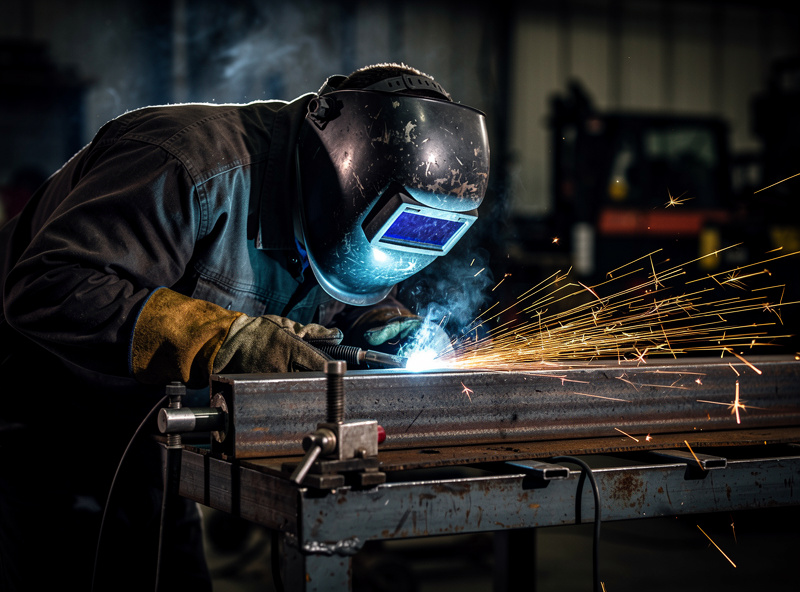
What to avoid:
- Off-brand without ANSI Z87.1: Some Amazon-only helmets do not meet impact or optical certification. Eye and brain injury risk is not theoretical.
- “Starter” fixed-shade purchases: The 30-50 dollars saved disappears in helmet replacement within a year.
- Grind-mode obsession: Grinding glasses cost 10 dollars and do the job better. Grind mode is convenience, not a primary spec.
- Small viewing area: Helmets under 3.5 x 1.5 inch viewing area force more neck and head movement, accelerate fatigue, and reduce weld accuracy.
- Tight or non-adjustable headgear: Cheap helmets have headgear that fits one head shape. Comfortable headgear matters more than the lens cartridge for daily use.
- Battery anxiety: Sealed-battery helmets are fine for 3-5 years of hobby use. Replaceable-battery helmets last 10-plus years. Both are acceptable.
The reliable buying rule is to spend 150-200 dollars minimum on a helmet you will use 30-plus hours per year, and 350-plus dollars on one you will use 100-plus hours per year. Below the 150-dollar tier, lens clarity, comfort, and durability all suffer noticeably. Cross-reference with our deeper review in best budget welder under 300 dollars for matched welder-and-helmet bundles.
Frequently Asked Questions
What shade is best for home welding?
Most home MIG welding at 100-200 amps uses shade 10-12. Stick welding at 80-150 amps uses shade 10-11. TIG at 30-100 amps uses shade 9-10. Auto-darkening helmets adjust automatically; for fixed-shade helmets, shade 11 covers the most common hobbyist amperages.
Can I use a welding helmet for plasma cutting?
Yes, but plasma cutting needs a darker shade than most people expect. OSHA and ANSI Z49.1 guidance puts plasma arc cutting under 300 amps — which covers every hobby and handheld plasma cutter — at shade 8 minimum, shade 9 for comfort. That is inside a typical auto-darkening helmet’s normal weld-mode shade range (most cover 8-13), not the lighter grind-mode end (usually shade 4-5), which is too light and will not protect your eyes for plasma cutting.
Do welding helmets really protect against UV and IR rays?
Yes, even in the clear (shade 3-4) state. The lens cartridge filters 100 percent of UV and infrared regardless of shade level — only visible light dims. This is why arc-flash burns can happen with the helmet up but not with the helmet down even before darkening triggers.
How long do auto-darkening welding helmets last?
Lens cartridges typically last 7-10 years. Sealed-battery cartridges fail at 3-5 years when batteries die. Replaceable-battery cartridges last as long as the headgear, which is usually 8-15 years. The headgear strap and ratchet wear out before the lens.
Is a more expensive welding helmet always better?
Above the 150-200 dollar tier, marginal improvements are mostly in optical clarity, comfort, and lens-life durability. The under-100 dollar tier has real differences in failure rate and arc-strike reliability. Above 450 dollars the per-dollar value drops sharply.
Can I sharpen tungsten while wearing my welding helmet?
Most modern auto-darkening helmets include a grind mode that holds shade 4-5 — bright enough to see the work but eye-safe for grinding sparks. If your helmet does not have grind mode, use dedicated grinding glasses or a face shield instead. Welding shade is too dark to grind safely.
Related Articles
- MIG vs Multi-Process Welders — When paying more saves money
- Welding Extension Cords Guide — Wire gauge, length, and voltage drop
- Chop Saw vs Band Saw vs Angle Grinder — Which metal cut-off tool to buy
- Welding Clamps, Magnets, and Squares — Fixturing tools for every project
- Welding Gloves and Jacket Guide — Leather vs FR cotton for every process
- Welding Gas Guide — Argon, CO2, helium, and tri-mix
- Angle Grinder Guide for Welders — Cutoff wheels, flap discs, and wire brushes
- Essential Welding Equipment Guide
- Welding Safety Guide
- Best Budget Welder Under $300
- Cost to Start Welding at Home
- Welding Burns First Aid
- Tungsten Electrode Color Chart
- MIG vs TIG vs Stick Welding
- Welding for Beginners
- Welding Ventilation for Home Garage
- First Year Welding Equipment Checklist

Discussion (0)