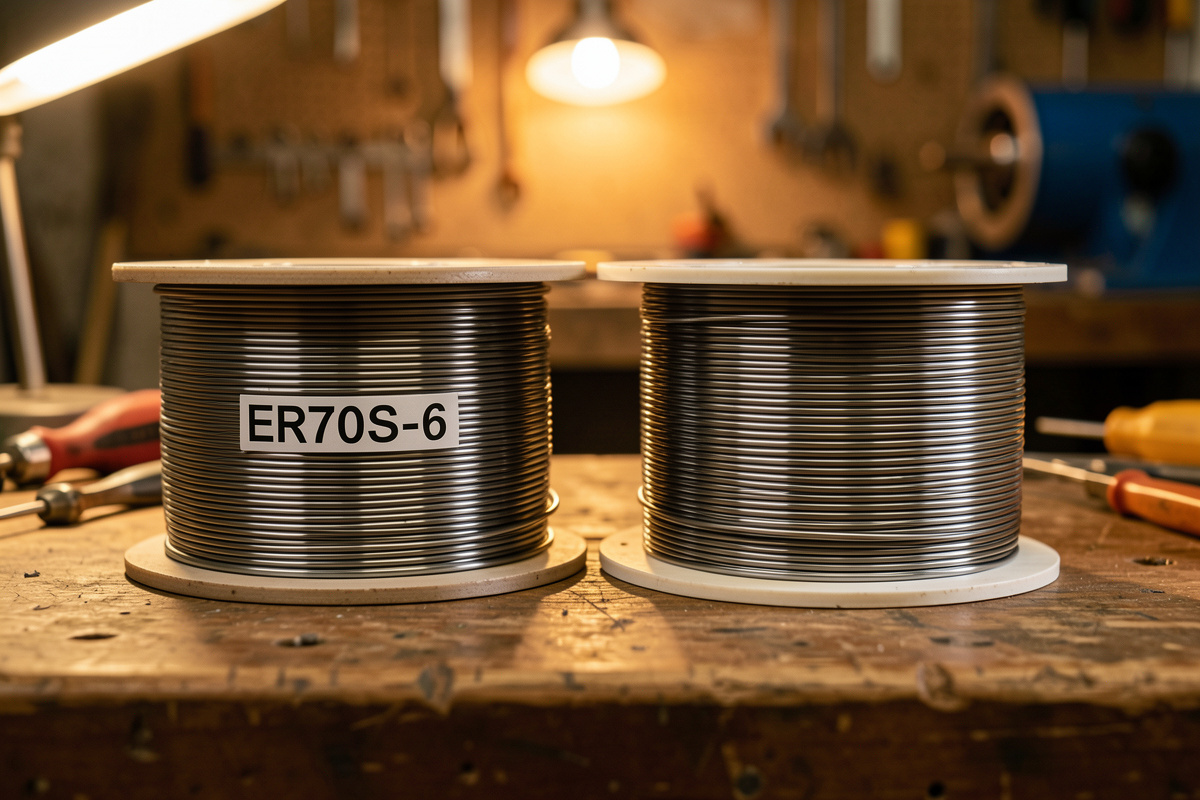

ER70S-6 and ER70S-3 are both solid mild-steel MIG wires that deposit weld metal at the same 70,000 psi tensile strength — the difference is deoxidizers. ER70S-6 carries noticeably more silicon and manganese, so it wets out flatter and forgives the rust, mill scale, and oil that real shop steel wears. For 95% of home welding, that makes S-6 the wire to load.
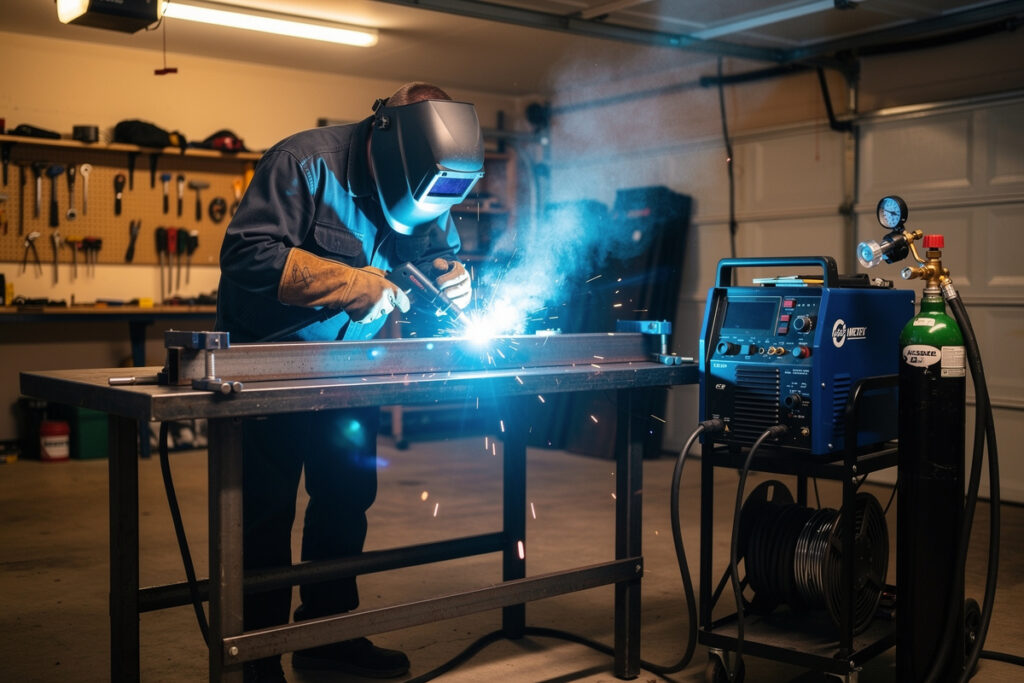
I’ve run both off the same YesWelder MIG-PRO205DS, on the same 75/25 argon/CO₂, over the same steel, and the S-6 puddle is simply more relaxed. But S-3 isn’t a downgrade — it exists for a reason, and there’s a specific kind of work where the leaner chemistry is the right call. Here’s exactly what separates them, what the puddle looks like with each, and which spool belongs on your machine.
What Do the Numbers in ER70S-6 Actually Mean?
The code breaks down cleanly. “ER” means electrode/rod (bare wire), “70” is the minimum tensile strength in thousands of psi — 70,000 psi — “S” means solid, and the final digit is the chemistry classification. So ER70S-6 and ER70S-3 are both 70-ksi solid wires; the 6 and the 3 point to two different deoxidizer recipes under the AWS A5.18 specification.
The practical numbers are the alloy ranges. ER70S-6 runs roughly 0.80–1.15% silicon and 1.40–1.85% manganese. ER70S-3 is leaner: about 0.45–0.70% silicon and 0.90–1.40% manganese. Those two elements are deoxidizers — they scavenge oxygen out of the molten puddle before it can form porosity or slag. More deoxidizer means the wire can clean up a dirtier weld pool on its own. That single difference drives almost everything else about how the two wires behave. If the letter-and-number soup is new to you, my MIG wire size guide covers the diameter side of the same labels.
Why Does ER70S-6 Handle Rust and Mill Scale Better?
Because the extra silicon and manganese burn off the contaminants the puddle picks up. When you weld over mill scale, light surface rust, or a film of oil you missed, those contaminants throw oxygen and other junk into the melt. S-6’s higher deoxidizer load ties that oxygen up, so instead of porosity you get a sound bead that wets out flat to the toes. Over the kind of steel that shows up on a home bench — reclaimed, scaled, lightly rusted — that margin is real.
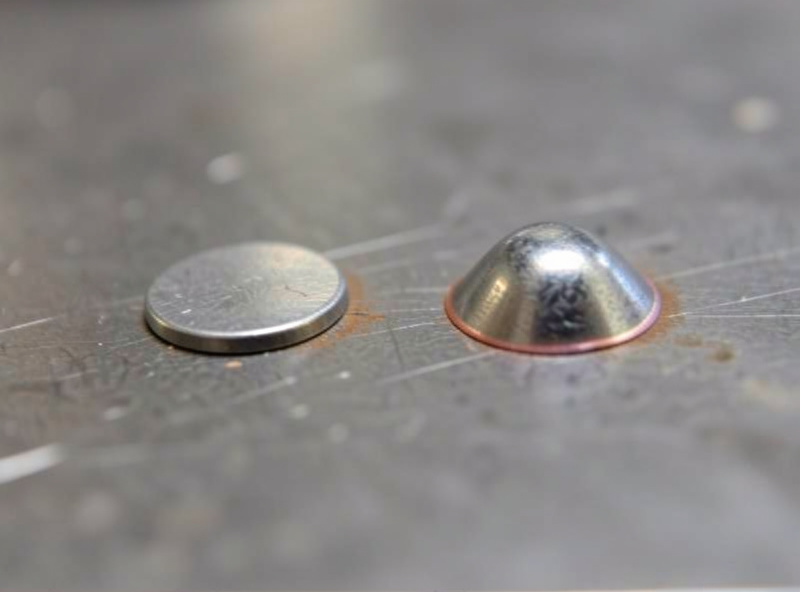
I still prep — the DeWalt DWE402 with a flap disc knocks the worst of the scale back — but I’m a home welder, not a fabricator with a shot-blast cabinet, and “clean” on my bench has limits. The last trailer bracket I burned in went over steel I’d only wire-wheeled, and the S-6 laid in flat with no pinholes. Run S-3 over that same lightly-scaled steel and you’re more likely to see porosity show up on the bend test. Sound counts more than shine, and S-6 buys you the margin. It also puts down slightly more silicon islands — those glassy brown spots on the bead — which brings us to where S-3 earns its keep.
When Is ER70S-3 the Better Choice?
ER70S-3 shines on clean, prepped steel and in multi-pass welds. Its lower silicon leaves fewer of those glassy silicon islands on the bead surface, and those islands, if you don’t chip them, can get trapped as inclusions between passes on a thick multi-pass joint. Fab shops welding clean plate to a procedure often spec S-3 for exactly that reason. On genuinely clean metal, it runs beautifully.
The catch for a home welder is twofold: you rarely have genuinely clean steel, and S-3 is harder to find at retail — most farm stores and welding-supply shelves stock S-6 by default. So S-3 makes sense if you’re doing repeat multi-pass work on new, prepped plate and you can source it, or if a specific procedure calls for it. For the general run of brackets, frames, and repairs, that’s not most of us. I keep one spool of S-3 for the rare clean multi-pass job, and it comes off the shelf maybe once a year.
Do ER70S-6 and ER70S-3 Weld at Different Settings?
Not meaningfully. Both are solid 70-ksi wires of the same diameter, so your voltage and wire-feed-speed starting points are effectively identical — set the machine by thickness and diameter the way you always would, then fine-tune by ear. On my MIG-PRO205DS I don’t touch the dial-in when I swap between them; the arc sound and puddle tell me if I need to nudge anything, and I usually don’t.
What you may notice is bead appearance and spatter. S-6’s higher silicon can wet flatter and, on some setups, run with a touch more spatter and more silicon deposits; S-3 can look a little cleaner on prepped steel. But there’s no separate settings chart to learn — the diameter drives the amperage, not the classification. For dialing the numbers themselves, work from the wire size and amperage chart and tune from there.
Which Shielding Gas Runs With Each?
Both wires are designed for a shielding gas, and both run on the same mixes. The home default is 75/25 argon/CO₂ (often sold as C25), which balances penetration against a soft arc and low spatter. Straight CO₂ (C100) digs deeper and costs less but throws more spatter; a higher-argon mix like 90/10 runs hotter and flatter for spray transfer on thicker steel. The wire classification doesn’t change the gas choice — the metal thickness and transfer mode do.
What gas won’t do is rescue the wrong wire over dirty steel. I’ve watched a beginner blame his gas for porosity when the real problem was S-3 over rusty stock — S-6 and a wire brush would have fixed it. Gas and wire are separate levers; get both right. My MIG gas mix chart breaks the shielding side down, and if you’re weighing gas against gasless entirely, the flux-core vs solid wire comparison is the next read.
ER70S-6 vs ER70S-3 at a Glance
Here’s the side-by-side. The strength is a tie; everything else comes down to deoxidizers and how clean your steel really is.
| Property | ER70S-6 | ER70S-3 |
|---|---|---|
| Tensile strength | 70,000 psi | 70,000 psi |
| Silicon content | ~0.80–1.15% | ~0.45–0.70% |
| Manganese content | ~1.40–1.85% | ~0.90–1.40% |
| Over rust / mill scale | Very forgiving | Less forgiving |
| Silicon islands on bead | More | Fewer |
| Best use | Dirty or single-pass steel | Clean multi-pass steel |
| Retail availability | Everywhere | Harder to find |
Does the Wire Brand Matter, or Just the Classification?
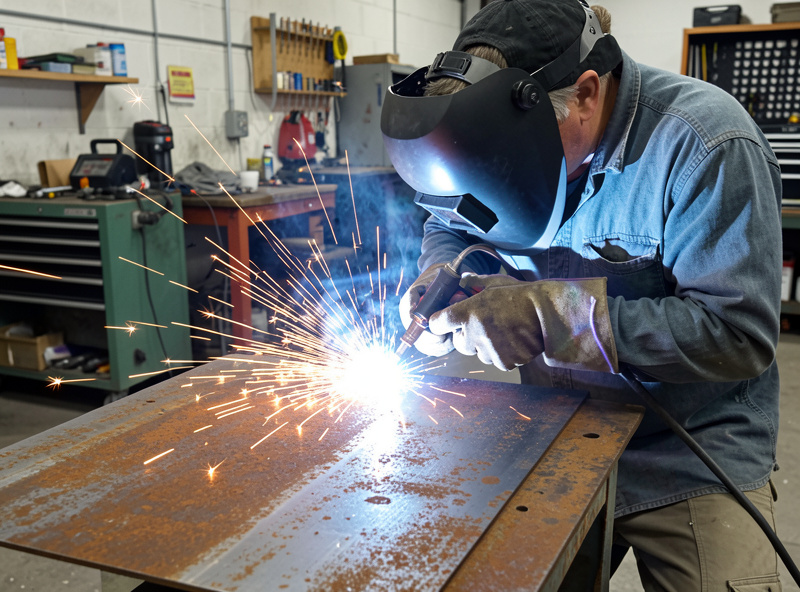
The classification sets the floor; brand sets the consistency. Any wire stamped ER70S-6 has to meet the AWS A5.18 chemistry and strength minimums, so a budget spool and a premium spool will both weld sound steel. Where the money shows up is in copper coating quality, cast and helix (how the wire sits and curves off the spool), and how tightly it’s wound — the things that decide whether it feeds smooth or fights you.
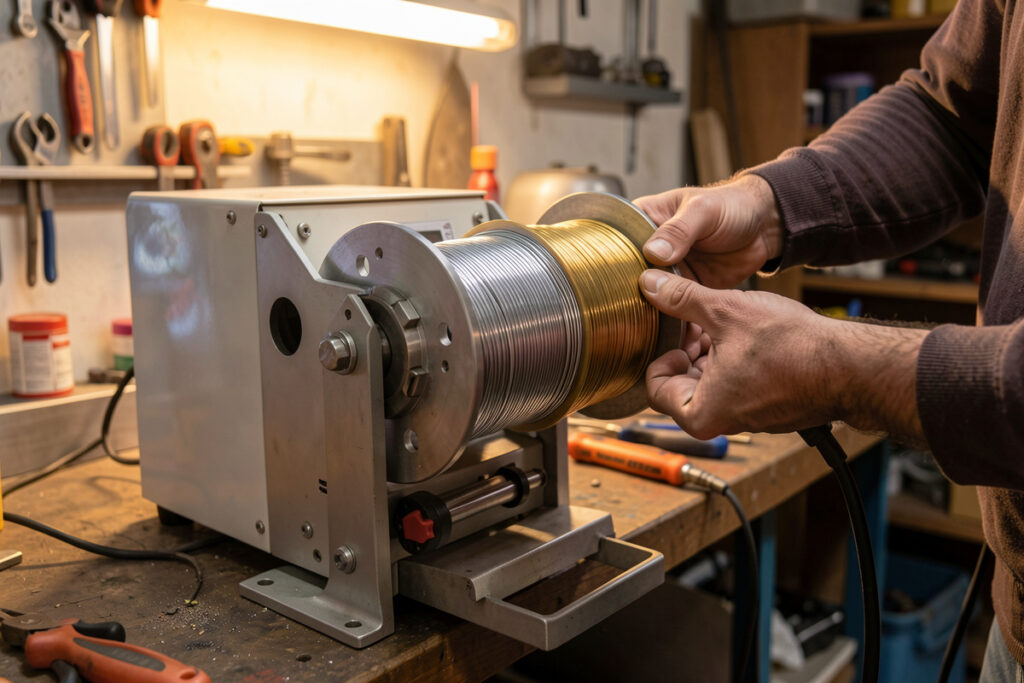
I’ve run cheap no-name spools that fed fine and one bargain spool whose copper flaking clogged my liner inside an afternoon. My rule now: buy a known filler-metal brand for anything I care about, and treat mystery spools as flux for practice beads. A poorly wound spool with bad cast will whip and surge no matter how good the chemistry is, and you’ll swear the machine is broken. The classification tells you what the wire is; the brand tells you whether it’ll behave. When a good spool still fights you, look downstream at the drive rolls and liner before you blame the wire.
Which One Should You Buy?
For a home welder, buy ER70S-6 and don’t overthink it. It handles the steel you actually have, it’s on every shelf, and it costs the same as S-3. Load a 0.030 spool for general work, keep a 0.035 for heavier stock, and you’ve covered the vast majority of home projects. The only reason to seek out S-3 is repeat multi-pass welding on genuinely clean, prepped plate — and if that’s your work, you already know it.
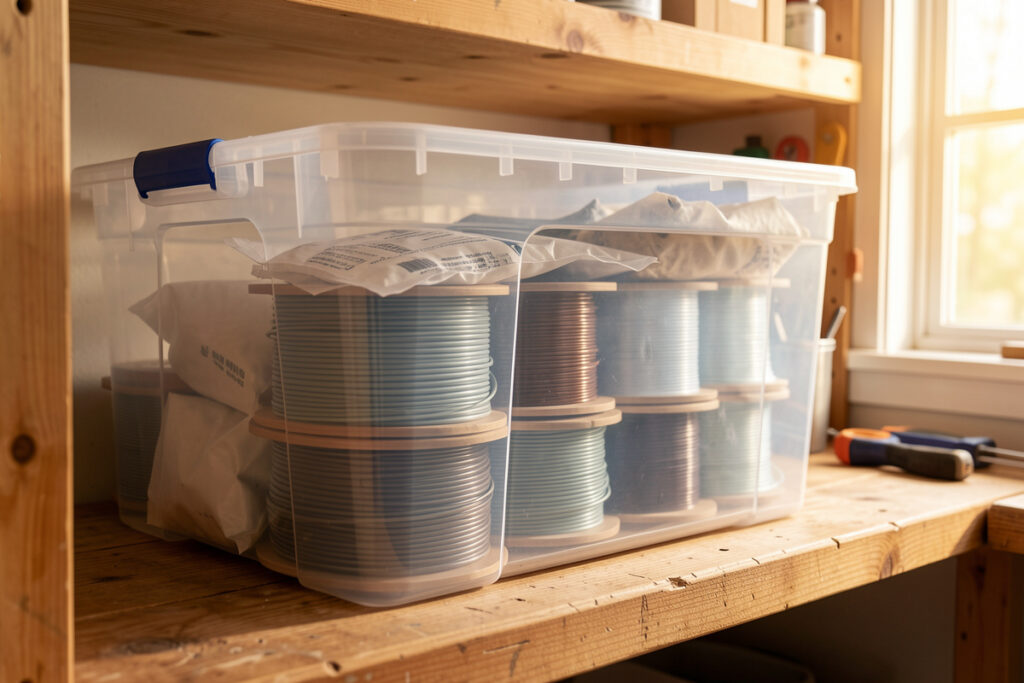
As an Amazon Associate I earn from qualifying purchases. When my local supplier is out, I’ll order a spool of 0.030 ER70S-6 and get it into a sealed container the day it lands so it never has a chance to pick up moisture — because a rusty spool of the “right” wire welds worse than a clean spool of the “wrong” one. If your feed acts up regardless of which wire you run, the fix is usually downstream, in the feed path itself, and the whole consumable picture ties together in the welding wire selection guide.
Is ER70S-6 stronger than ER70S-3?
No. Both wires deposit weld metal rated at 70,000 psi minimum tensile strength under the AWS A5.18 specification, so the joint strength is the same. The difference is deoxidizer content, not strength. ER70S-6 carries more silicon and manganese, which makes it more forgiving over rust and mill scale, but it does not make the weld stronger.
Can I use ER70S-6 for everything?
For home welding, essentially yes. ER70S-6 handles dirty, scaled, and lightly rusted steel and welds clean steel fine too, so a single 0.030 spool covers the large majority of home projects. The only time ER70S-3 has an edge is repeat multi-pass welding on genuinely clean, prepped plate where fewer silicon islands matter.
Do ER70S-6 and ER70S-3 use different welding settings?
No. Both are solid 70-ksi wires, so for a given diameter your voltage and wire feed speed starting points are the same. Set the machine by metal thickness and wire diameter, then tune by ear. You do not need a separate settings chart when you swap between the two classifications.
Why does my ER70S-6 leave brown glassy spots on the weld?
Those are silicon islands, a normal byproduct of the higher silicon in ER70S-6. They are deoxidizers that floated to the surface. On a single-pass weld you can usually leave them, but on a multi-pass joint chip or brush them off between passes so they do not get trapped as inclusions.
What gas do I run with ER70S-6?
A 75/25 argon/CO2 mix (C25) is the home default and runs a soft, low-spatter arc. Straight CO2 penetrates deeper but spatters more and costs less. The wire classification does not change the gas choice; metal thickness and transfer mode do.
Related Articles
- Welding Wire and Consumable Selection Guide
- MIG Wire Size Guide: 0.023 vs 0.030 vs 0.035
- MIG Welding Gas Guide: C25 vs C100 vs C10
- Flux Core vs Solid Wire MIG
- MIG Contact Tip Sizing: Match the Tip to Your Wire
- Keeping MIG Wire From Rusting: Stop Porosity
External references: the classification ranges here come from AWS A5.18, the American Welding Society specification for carbon-steel gas-shielded wire, and Lincoln Electric publishes per-product datasheets with the exact silicon and manganese percentages for each ER70S grade.

Discussion (0)