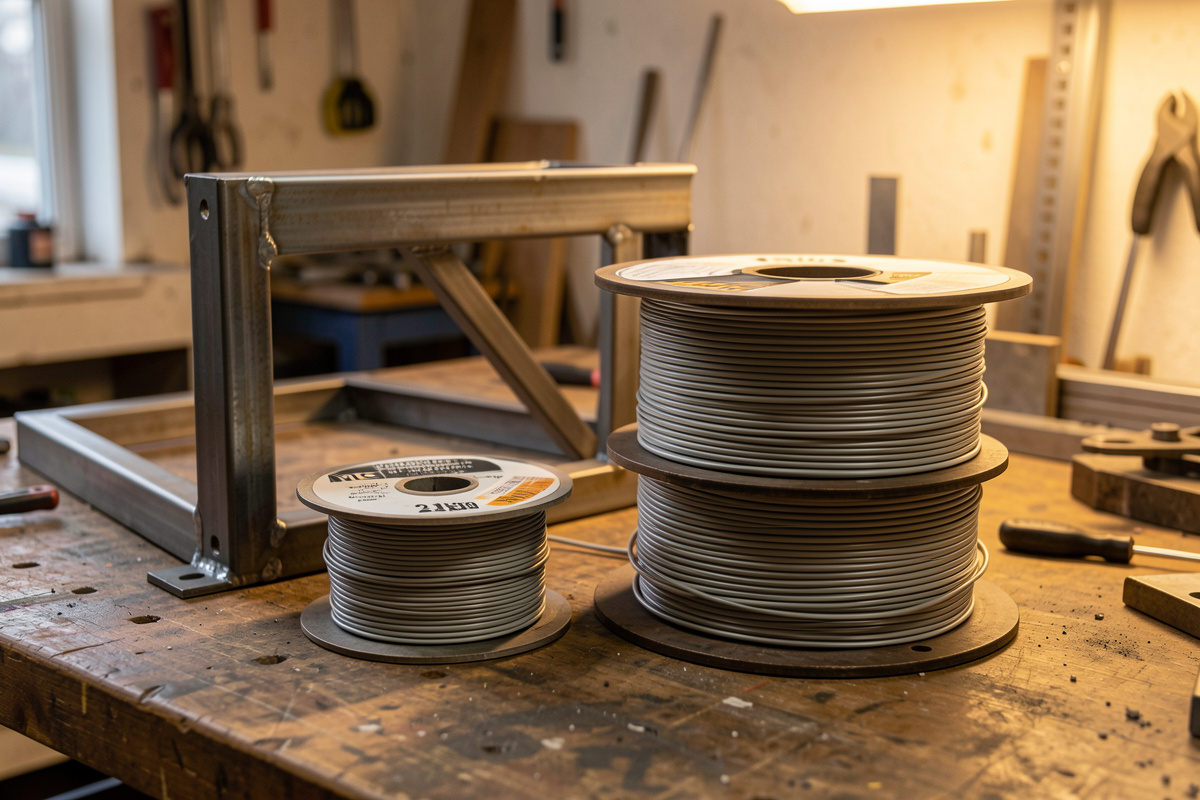

Most home welding projects use far less wire than people expect. A welded steel workbench frame — call it 30 feet of quarter-inch fillet weld — burns roughly 3 to 4 pounds of solid wire, so a single 11-pound spool builds it with margin to spare. Small brackets and repairs use ounces, not pounds. Knowing the math keeps you from over-buying a job or running dry three welds from the end.
I’ve built enough fixtures, carts, and frames off my YesWelder MIG-PRO205DS to have a feel for it, but feel isn’t a number you can plan a purchase around. There’s a simple way to estimate wire for any project, and it comes down to how many feet are on a spool, how much of that wire actually ends up in the weld, and how much weld metal your joints need. Here’s the whole calculation in plain terms, plus the real cost per project.
How Many Feet of Wire Are on a Spool?
Wire is sold by weight, but you weld by length, so the first conversion is feet per pound — and it depends heavily on diameter. Thinner wire packs far more length into a pound: 0.023 wire runs roughly 700 feet per pound, 0.030 about 415, 0.035 around 305, and 0.045 only about 185. So an 11-pound spool of 0.030 holds roughly 4,500 feet, while the same weight in 0.035 gives you about 3,350 feet.
That’s a big swing, and it’s why a spool of thin wire seems to last forever while heavy wire disappears fast — you’re laying down more metal per inch of travel with the thick stuff. These numbers come straight from steel’s density of about 0.284 pounds per cubic inch and the wire’s cross-section, so they’re consistent across brands. If you’re still choosing a diameter, the wire size chart covers which one your amperage and thickness want; this article assumes you’ve picked one.
What Is Deposition Efficiency and Why Does It Matter?
Not all the wire off the spool ends up in your weld. Deposition efficiency is the fraction that does, and for solid MIG wire under gas it’s high — about 90 to 98 percent — because the losses are just spatter and a little vaporization. Gasless flux-core is lower, around 80 to 85 percent, because some of the wire’s weight is flux that becomes slag rather than weld metal.
For planning, that means solid wire is close to a one-to-one buy: nearly every pound you purchase becomes weld. With flux-core you should budget maybe 15 to 20 percent extra wire for the same finished joint. It’s a real difference over a big project, and it’s one more entry in the ledger when you weigh gas against gasless, which I lay out in the flux-core vs solid wire comparison. For estimating, I use 95 percent for solid and 82 percent for flux-core and round up.
How Do You Estimate Wire for a Project?
The estimate has three steps: total your weld length, figure the weld metal per foot for your joint size, then divide by efficiency. A quarter-inch (6 mm) fillet weld deposits about 0.10 pounds of metal per foot. So 30 feet of quarter-inch fillet is about 3 pounds deposited, and at 95 percent efficiency that’s roughly 3.2 pounds of solid wire. Scale the fillet up and the metal-per-foot climbs fast, because weld area grows with the square of the leg size.
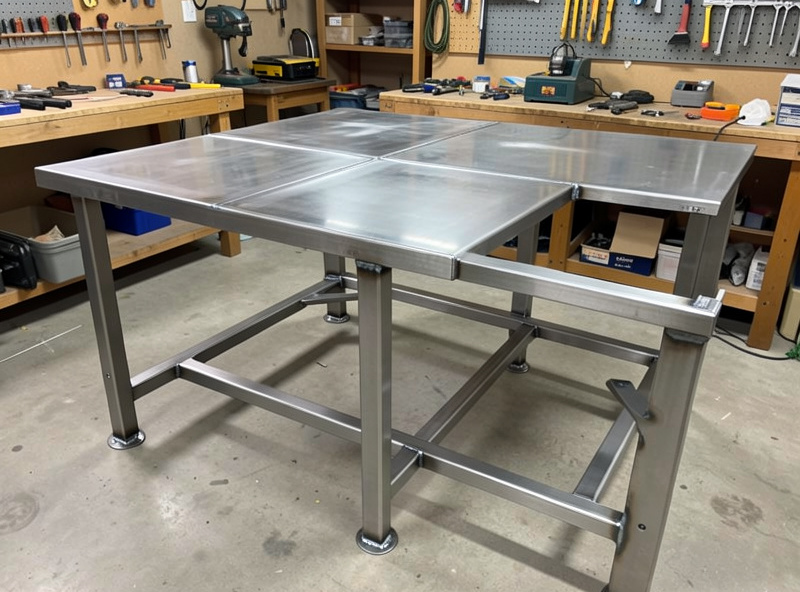
Small work almost disappears on this scale. A handful of brackets with a few inches of weld each might total a foot or two — a few ounces of wire. That’s why I don’t sweat wire on repair jobs; a 2-pound spool covers a dozen small fixes. It’s the big fabrications — a trailer, a smoker, a workbench frame — where the pounds add up and the estimate is worth doing before you buy. My welded workbench frame plans are a good example of a project where a few pounds of wire builds the whole thing.
Wire Length and Usage by Diameter
Here’s the reference table I plan from. Deposition rates are rough — they climb with wire feed speed and amperage — but they give you a sense of how fast a spool goes when you’re actually welding, not just how much length it holds.
| Diameter | Feet per Pound | Feet on 11-lb Spool | Rough Deposition Rate |
|---|---|---|---|
| 0.023 in | ~700 | ~7,700 | ~2 lb/hr |
| 0.030 in | ~415 | ~4,500 | ~3–4 lb/hr |
| 0.035 in | ~305 | ~3,350 | ~4–5 lb/hr |
| 0.045 in | ~185 | ~2,000 | ~6–8 lb/hr |
Read the deposition column as arc-on time, which for a hobbyist is a small fraction of shop time — you spend far longer fitting, tacking, and grinding than actually welding. A “3 to 4 pounds per hour” rate doesn’t mean you’ll burn a spool in three hours; it means the wire moves that fast while the arc is lit, and the arc is lit maybe 10 to 20 percent of a home session.
Which Spool Size Should You Buy?
Buy the biggest spool your machine takes and your wire storage can keep dry. Wire comes in 2-pound (4-inch), 10 to 11-pound (8-inch), and 33 to 44-pound (12-inch) spools, and the per-pound price drops sharply as the spool grows. For anyone welding regularly, the 11-pound spool is the sweet spot on most home machines — enough to build real projects without buying constantly, small enough to store sealed.
The 2-pound spool has two jobs: fitting small machines that won’t take an 8-inch spool, and being a single-project or trial purchase. The catch with big spools is that a half-used one sitting on the machine for months is a lot of bare steel exposed to shop humidity — which is exactly why storage matters as much as size, a topic big enough that it’s the whole point of keeping wire dry in the consumable selection guide. Buy big, but store it sealed the day you open it.
What Does Welding Wire Cost Per Project?
Wire is one of the cheapest inputs in the whole hobby. An 11-pound spool of 0.030 ER70S-6 typically runs about $35 to $45, which works out to roughly $3 to $4 a pound. So that 30-foot workbench frame using 3 to 4 pounds costs maybe $12 to $16 in wire — less than the steel, far less than the gas over time, and a rounding error next to the machine.
The 2-pound spool costs more per pound — often $12 to $18 for the spool — so if you weld more than occasionally, the big spool pays for itself in a couple of projects. As an Amazon Associate I earn from qualifying purchases. When I restock between local runs I’ll grab an 11-pound spool of 0.030 ER70S-6 and get it into a sealed tote the day it arrives, because a rusted spool is wasted money no matter how cheap the wire was. Which wire to buy in the first place is its own call — ER70S-6 vs ER70S-3 sorts that out.
My Real-World Wire Usage
Here’s the honest pattern on my bench. A weekend of bracket and shop-fixture work uses a pound or two. A cart or a small frame, two to four pounds. A big build — a trailer, a smoker — can run five to ten pounds across the whole project. I keep one 11-pound spool of 0.030 loaded as my daily driver and a 2-pound spool of 0.035 for the occasional heavy joint, and that combination covers a year of home welding without much thought.
The one time the math bit me was running out of wire three welds from finishing a cart frame late on a Sunday, with the supplier closed until Tuesday. Now I check the spool weight before I start anything big and keep a backup spool on the shelf. Wire’s cheap; the momentum you lose stopping mid-project isn’t. And a backup spool only helps if it’s stored dry — which loops right back to keeping every spool sealed against moisture, the difference between a spare you can trust and a rusty paperweight. The full feed-and-consumable picture ties together in the liner sizing and contact tip guides.
How much MIG wire does a typical home project use?
Less than most people expect. A welded steel workbench frame with about 30 feet of quarter-inch fillet weld uses roughly 3 to 4 pounds of solid wire. Small brackets and repairs use ounces. Big fabrications like a trailer or smoker can run 5 to 10 pounds across the whole build.
How many feet of wire are on an 11-pound spool?
It depends on diameter. An 11-pound spool holds about 4,500 feet of 0.030 wire, about 3,350 feet of 0.035, and around 7,700 feet of thin 0.023. Thinner wire packs far more length per pound because it lays down less metal per inch of weld.
Is solid wire or flux-core more efficient?
Solid wire is more efficient. Under gas it deposits about 90 to 98 percent of its weight as weld metal, losing only spatter. Gasless flux-core runs about 80 to 85 percent because some of the wire is flux that becomes slag. Budget roughly 15 to 20 percent extra flux-core for the same finished joint.
Should I buy a 2-pound or 11-pound spool of wire?
Buy the 11-pound spool if you weld regularly and can store it dry, because the per-pound price is much lower. The 2-pound spool is for small machines that will not take an 8-inch spool, or as a single-project purchase. Always store an opened spool sealed against moisture.
How do I estimate wire for a welding project?
Total your weld length, multiply by the weld metal per foot for your joint size, then divide by deposition efficiency. A quarter-inch fillet deposits about 0.10 pounds per foot, so 30 feet is about 3 pounds deposited, or roughly 3.2 pounds of solid wire at 95 percent efficiency.
Keep Reading
- Welding Wire and Consumable Selection Guide
- ER70S-6 vs ER70S-3 MIG Wire
- MIG Wire Size Guide: 0.023 vs 0.030 vs 0.035
- Flux Core vs Solid Wire MIG
- How to Weld a Steel Workbench Frame
External references: filler-metal makers such as Lincoln Electric and Hobart Filler Metals publish deposition-rate and efficiency data per wire, and the feet-per-pound figures follow from steel’s density of about 0.284 lb/in³.



Discussion (0)