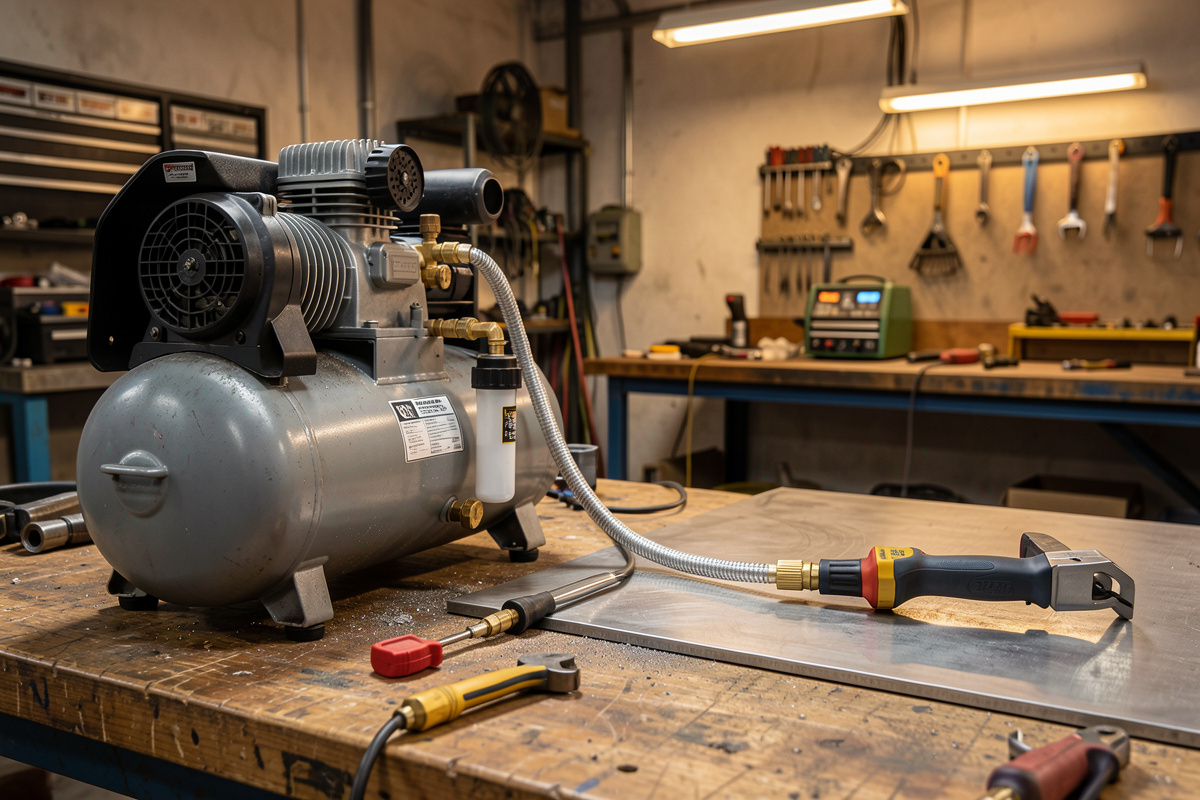

Most home plasma cutters need 4 to 6 CFM of air at 60 to 90 PSI, which in practice means a compressor with at least a 20 to 30 gallon tank and a 5 CFM at 90 PSI rating to cut without the arc stuttering. The torch does not care about your compressor’s horsepower sticker; it cares about sustained airflow, and that is where undersized units fail.
I sized my shop air around the plasma cutter, not the other way round, and it is the setup mistake I see new owners make most. A pancake compressor will run a plasma cutter for about four seconds before the tank drops below the pressure switch and the arc dies mid-cut. Match the air to the torch’s published demand, add real drying, and the machine finally performs the way the spec sheet promised.
How Much CFM Does a Plasma Cutter Need?
A typical 40 to 50 amp home plasma cutter needs roughly 4 to 6 CFM at 90 PSI of continuous air. Check your machine’s plate for its exact figure, then add a margin, because that number is the demand at the torch and your compressor must deliver it after pressure and line losses, not just on paper.
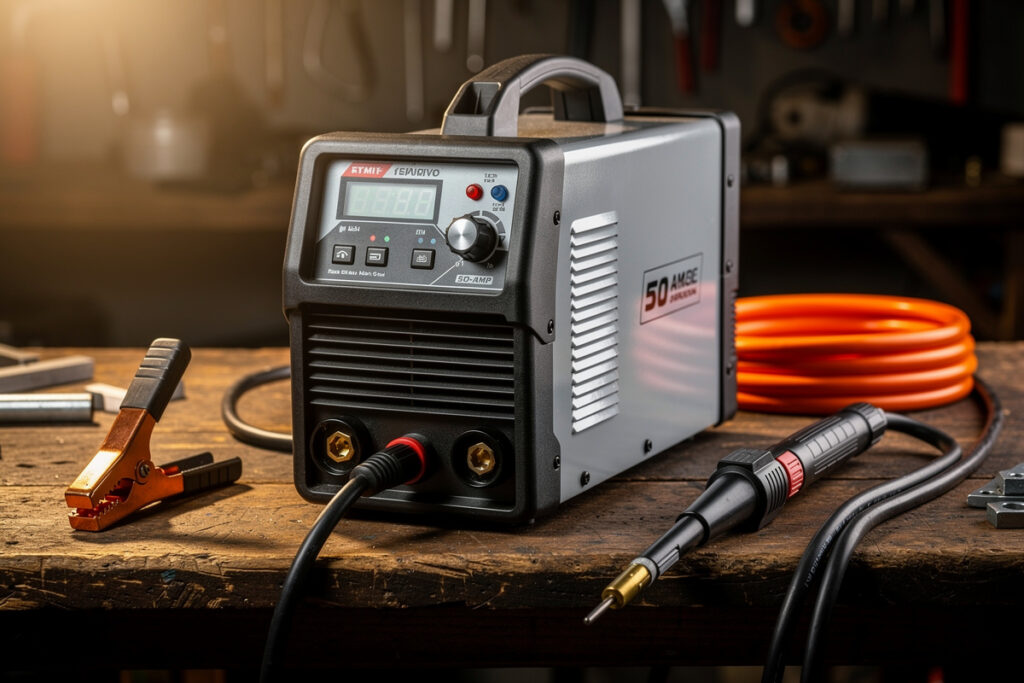
CFM is the figure that actually matters, and it is the one most beginners ignore in favor of tank size or horsepower. The torch consumes air the entire time the arc is lit, so a compressor that can only refill at 3 CFM will slowly lose the race against a torch pulling 5 CFM, no matter how big the tank. My rule is to take the machine’s rated CFM and look for a compressor rated at least 1.5 times that at 90 PSI, so the pump keeps up during a long cut. Torch makers publish the exact air demand in their operator manuals; Hypertherm, for example, lists gas flow and inlet pressure as hard requirements in the Powermax spec sheets, and treating those as a floor rather than a suggestion is what separates a clean cut from a sputtering one. The YesWelder plasma I run lists its demand on the case, and I sized a 30-gallon two-stage unit comfortably above it. If you cut only short tabs and brackets, a smaller compressor coasts on the tank; if you cut long lines in plate, the pump’s continuous output is what saves you.
What PSI Should You Set for Plasma Cutting?
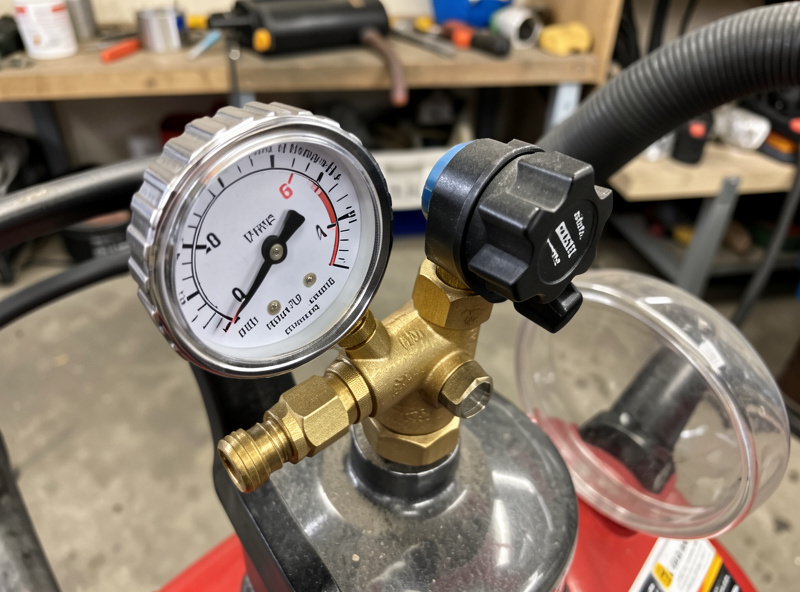
Most handheld plasma cutters run best at 60 to 90 PSI at the torch, with the exact setting on the machine’s gauge per the manual. Set it with the air flowing, not static, because pressure sags under flow and a gauge reading 90 PSI at rest can drop to 70 PSI the instant you pull the trigger.
This dynamic-versus-static trap catches people constantly. You dial 90 PSI with the torch off, start a cut, and the arc is weak and sputtery because the real flowing pressure collapsed. Set the regulator while purging air through the torch so the gauge shows the true working pressure. Too low and the arc lacks the force to blow molten metal clear, leaving dross; too high wastes air and can actually shorten consumable life by cooling the arc column. The right window is narrow, and it is printed in your manual for a reason. I keep a paper note of my best settings for each thickness taped inside the cabinet door so I am not re-guessing every session.
What Size Air Tank Do You Need for Plasma?
A 20 to 30 gallon tank is the practical minimum for steady plasma cutting, and 60 gallons or more is comfortable for long work. The tank is a buffer: it lets you cut through the moments the pump cannot keep up, so a bigger tank smooths out short bursts even if the pump’s CFM is marginal.
Think of the tank and the pump as two separate jobs. The pump’s CFM is your sustained ceiling; the tank is your short-term reserve. A big tank on a weak pump gives you a great first cut and then nothing, because once the reserve drains the pump cannot refill it fast enough to keep cutting. A right-sized pump with a modest tank cuts all day. For a one-person home shop, a 30-gallon tank on a pump rated above the torch demand is the sweet spot, and it doubles for running grinders and impact tools. My compressor shares duty with the rest of the bench, so I sized it to cover the plasma’s continuous draw with margin to spare for the angle grinder work that always follows a cut.
Why Does Air Quality Matter More Than Compressor Size?
Clean, dry air matters as much as volume because moisture and oil reaching the torch cause internal arcing, rough cuts, and consumable life cut in half or worse. A perfectly sized compressor with wet air will cut worse and cost more in tips than a marginal one feeding dry air.
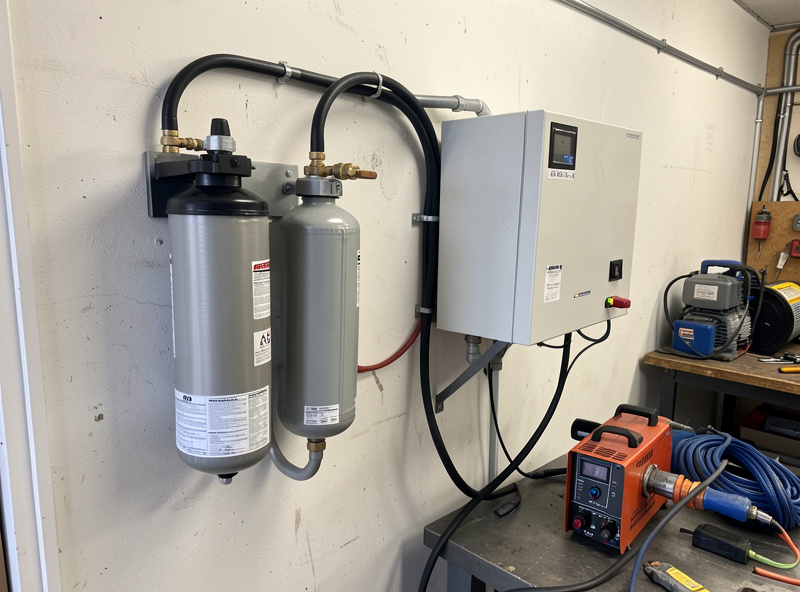
This is the part of plasma nobody warns you about. The compressor pulls humid room air, compresses it, and water condenses in the tank and lines; oil from the pump can carry over too. That water and oil hit the hafnium electrode and the arc reacts badly, leaving you chasing a “bad cut” that is really a wet-air problem. Compressed-air quality even has a standard, ISO 8573-1, that classes air by water, oil, and particulate content, and plasma wants air well toward the dry end of it. I run a coalescing filter and a desiccant dryer in series downstream of the tank, drain the tank every session, and slope my air line so condensation runs back to a drop-leg trap instead of forward to the torch. The payoff shows up directly in how long my electrodes and nozzles last, which I track closely in my notes on plasma cutter consumables. Dry air is the cheapest upgrade you can make to cut quality.
Can You Run a Plasma Cutter Without a Separate Compressor?
Some modern plasma cutters include a built-in compressor, which is convenient for portable work but typically limits you to thinner material, around 1/4 inch and under, because the onboard pump is small. For a fixed home shop, a separate shop compressor sized to the torch is more capable and quieter at the cut.
Built-in-compressor units have a real place: site work, no air line to drag, grab and go. But the onboard pumps are modest, so their cut capacity and duty cycle are limited compared with feeding the same class of torch from a proper 30-gallon shop compressor. If you already own shop air, buy the torch-only machine and feed it from your compressor; you will get more cutting capacity for the money. If you have no air at all and cut occasionally on thin stock, the all-in-one is a reasonable single-box answer. Either way, get the air dry first; that priority does not change. Once your air is sorted, the guides and jigs in my straight-line cutting guide are what turn good air into good cuts.
Plasma Cutter Air Requirements by Amperage
| Torch Amperage | Typical CFM Needed | Working PSI | Recommended Tank |
|---|---|---|---|
| 25-30 A (light) | 3-4 CFM | 60-70 PSI | 20 gal minimum |
| 40-50 A (home shop) | 4-6 CFM | 70-90 PSI | 30 gal |
| 60 A (heavier plate) | 6-7 CFM | 80-90 PSI | 60 gal preferred |
| 80 A+ (production) | 7-9 CFM | 90 PSI | 60-80 gal |
Frequently Asked Questions
How much CFM does a home plasma cutter need?
A typical 40 to 50 amp home plasma cutter needs about 4 to 6 CFM at 90 PSI of continuous air. Check the machine plate for the exact figure and choose a compressor rated at least 1.5 times that at 90 PSI so the pump keeps up during long cuts.
What PSI should I set for plasma cutting?
Most handheld plasma cutters run at 60 to 90 PSI at the torch. Always set the pressure while air is flowing through the torch, because static pressure sags under flow and a gauge reading 90 PSI at rest can drop to 70 PSI the moment you cut.
What size air tank do I need for a plasma cutter?
A 20 to 30 gallon tank is the practical minimum, and 60 gallons or more is comfortable for long cuts. The tank is a reserve buffer, but the pump’s sustained CFM is what lets you keep cutting once that reserve drains.
Can a pancake or small compressor run a plasma cutter?
Only for very short cuts. A small pancake compressor will run a plasma cutter for a few seconds before the tank drops below the pressure switch and the arc dies. Match the compressor’s continuous CFM to the torch demand instead.
Why does my plasma cut quality get worse over time?
Often it is wet or oily air, not the compressor size. Moisture and pump oil reaching the torch cause internal arcing and rough cuts and can halve consumable life. Add a coalescing filter and desiccant dryer and drain the tank every session.
Do plasma cutters with built-in compressors work well?
They are convenient for portable thin-material work but their onboard pumps limit cut capacity, usually to around 1/4 inch and under. For a fixed shop, a torch fed from a properly sized separate compressor cuts thicker and runs longer.

Discussion (0)