

To calculate steel weight, multiply the volume in cubic inches by 0.2836 pounds per cubic inch, then multiply weight by your price per pound for cost. Steel weighs about 0.2836 lb/in³ (490 lb/ft³); aluminum is roughly a third of that.
Knowing what a steel order weighs before you buy it is one of those quiet skills that saves real money and stops you ordering a trailer-tongue worth of stock you cannot lift. I run these numbers before every project — partly to budget the steel, partly so I know what the finished piece will weigh on the bench and on the build. This guide gives you the density figure, the per-shape formulas, a worked example, and a weight-per-foot table for the stock home welders actually buy. Pair it with my where to buy steel guide to turn the weight into a real-world price.
How Do You Calculate Steel Weight?
Calculate the volume of the steel in cubic inches, then multiply by 0.2836, the weight of steel per cubic inch in pounds. For a solid bar or plate, volume equals length times width times thickness. The same method works for any shape once you find its volume.
Steel has a remarkably consistent density — about 0.2836 pounds per cubic inch, or 490 pounds per cubic foot, or 7.85 grams per cubic centimeter. That single number drives every calculation. The only trick is finding the volume of odd shapes: a solid bar is simple length-times-cross-section, a tube is the outer area minus the hollow inner area, and an angle is two legs added up minus the overlapping corner. Once you have cubic inches, the density does the rest. For mild steel, stainless, and aluminum the method is identical — only the density figure changes.
The Formulas for Common Shapes
For plate and solid bar, weight in pounds equals length times width times thickness in inches, times 0.2836. For weight per foot, round bar is diameter squared times 2.67, solid square bar is side squared times 3.40, and flat bar is width times thickness times 3.40.
Those per-foot shortcuts come straight from the density and save you redoing the volume each time:
- Plate or flat bar (total): length(in) x width(in) x thickness(in) x 0.2836 = pounds.
- Round bar: diameter(in)² x 2.67 = pounds per foot. A 1-inch round bar is 2.67 lb/ft.
- Solid square bar: side(in)² x 3.40 = pounds per foot. A 1-inch square solid bar is 3.40 lb/ft.
- Flat bar: width(in) x thickness(in) x 3.40 = pounds per foot. A 2 x 1/4 inch flat bar is 1.70 lb/ft.
- Sheet/plate per area: thickness(in) x 40.8 = pounds per square foot. An eighth-inch plate is 5.10 lb/ft².
- Square/rectangular tube: (outer cross-section area − inner hollow area) x 12 x 0.2836 = pounds per foot.
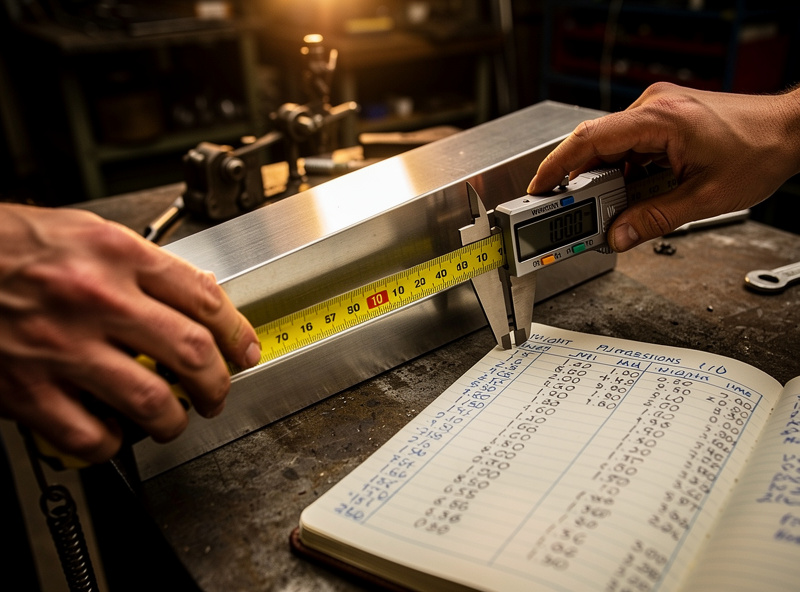
For tube and angle, the cross-section subtraction is the only fiddly part — measure the wall thickness with digital calipers because listings round it, and the wall has a big effect on weight. A long tape measure handles the lengths. Knowing the real thickness also drives your MIG voltage and wire-speed settings, so the same measurement does double duty.
A Worked Example: A Welding Cart Frame
Say a welding cart frame uses 24 feet of 1-inch square tubing with a 0.065-inch wall. That tubing weighs about 0.83 pounds per foot, so 24 feet is roughly 20 pounds of steel. At a local-supplier price near 1.00 dollar per pound, the frame steel costs about 20 dollars before cuts.
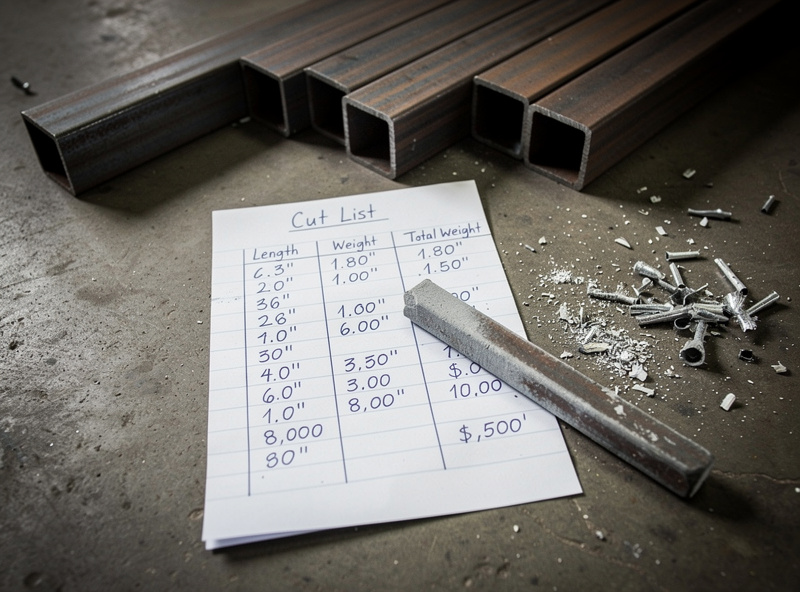
Here is the math behind it. The cross-section of 1-inch square tube with a 0.065-inch wall is the outer area minus the hollow: 1.0² minus 0.87² equals about 0.243 square inches. Multiply by 12 inches and by 0.2836, and you get 0.83 pounds per foot. Twenty-four feet is just under 20 pounds. I mark every cut on the stock with a soapstone marker from the cut list first. That tells me three useful things at once: the steel budget (about 20 dollars at a buck a pound), the shipping weight if I order it online, and that the finished frame plus casters and a welder will be a one-person lift. Running this before buying is how I avoid the classic mistake of ordering 20-foot sticks that will not fit the car and weigh more than I planned to carry. Roll the steel cost into the bigger picture with my cost to start welding breakdown.
Disclosure: HomeWelder is reader-supported. As an Amazon Associate I earn from qualifying purchases made through links in this article, at no extra cost to you. I only point to gear I actually use or would buy for my own shop.
Steel Weight Per Foot for Common Stock
| Shape and Size | Weight | Quick Formula |
|---|---|---|
| 1″ round bar (solid) | 2.67 lb/ft | dia² x 2.67 |
| 1″ square bar (solid) | 3.40 lb/ft | side² x 3.40 |
| 2″ x 1/4″ flat bar | 1.70 lb/ft | w x t x 3.40 |
| 1″ square tube, 0.065″ wall | 0.83 lb/ft | (area diff) x 3.40 |
| 1/8″ plate | 5.10 lb/ft² | thick x 40.8 |
These cover the stock that makes up most home builds. For other sizes, scale with the squared term — doubling a round bar’s diameter quadruples its weight per foot, which is worth remembering before you “upgrade” to heavier stock than the job needs.
Calculating Aluminum and Stainless Weight
The method is identical; only the density changes. Aluminum is about 0.098 pounds per cubic inch — roughly one-third of steel — so any aluminum part weighs about a third of the same shape in steel. Stainless is about 0.289 lb/in³, very slightly heavier than mild steel.
This is exactly why aluminum is the boatbuilding metal: the same hull in aluminum weighs a third of steel, which is the whole point on the water. To convert any of the steel formulas above, swap the 0.2836 for 0.098 for aluminum or 0.289 for stainless. So an aluminum plate the same size as that 5.10 lb/ft² eighth-inch steel plate is about 1.76 lb/ft². The grade within each metal barely changes the density — a 6061 and a 5052 aluminum weigh essentially the same — so you can use one density per metal and not worry about the specific alloy. Choose the right alloy with my aluminum grades and steel types guides, then weigh it with these numbers.
Frequently Asked Questions
How much does steel weigh per cubic inch?
Steel weighs about 0.2836 pounds per cubic inch, which is 490 pounds per cubic foot or 7.85 grams per cubic centimeter. Multiply the volume of any steel part in cubic inches by 0.2836 to get its weight in pounds. This density is consistent across mild steel grades.
How do you calculate the weight of a steel bar?
Find the volume in cubic inches, then multiply by 0.2836. For a solid round bar, weight per foot equals diameter squared times 2.67. For a solid square bar, it is side squared times 3.40. For flat bar, width times thickness times 3.40 gives pounds per foot.
How do you calculate steel cost?
Calculate the total weight in pounds, then multiply by the price per pound from your supplier. For example, 20 pounds of steel at 1.00 dollar per pound costs 20 dollars before cut charges or shipping. Local suppliers usually price per pound, making this calculation straightforward.
Does aluminum weigh the same as steel?
No. Aluminum is about 0.098 pounds per cubic inch, roughly one-third the weight of steel at 0.2836. The same shape and size in aluminum weighs about a third of the steel version, which is why aluminum is favored for boats, trailers, and anything where weight matters.
How much does a 4×8 sheet of steel weigh?
It depends on thickness. An eighth-inch (0.125) plate weighs about 5.10 pounds per square foot, so a 4×8 sheet (32 square feet) weighs roughly 163 pounds. Quarter-inch plate doubles that to about 327 pounds. Multiply 40.8 by the thickness in inches for pounds per square foot.
Why measure wall thickness with calipers?
Online and store listings often round the wall thickness of tube and pipe, and wall thickness has a large effect on weight and on weld settings. Measuring the actual wall with digital calipers gives you an accurate weight calculation and the correct heat input for the real material thickness.

Discussion (0)