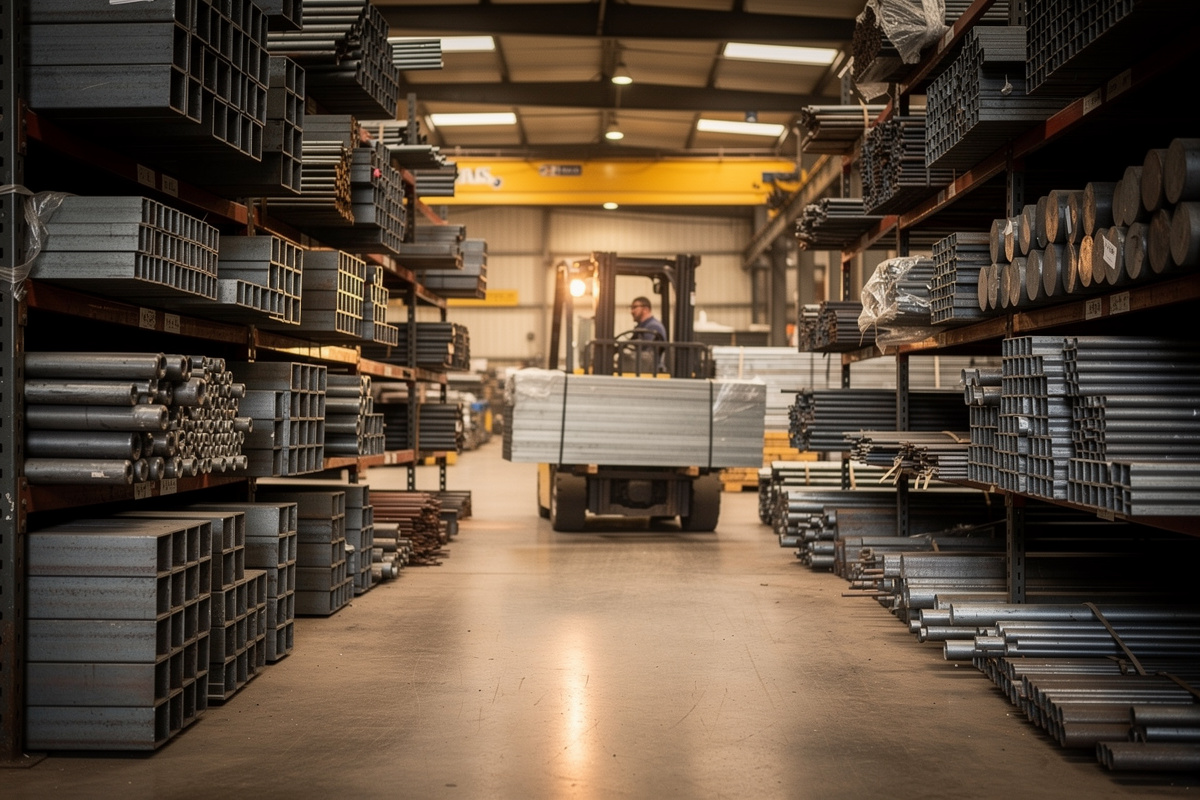

Buy steel from a local supplier for cheapest price per pound, scrap yards for budget projects, big-box stores for small quantities, and online suppliers (Online Metals, Metal Supermarkets) for specific alloys. Local suppliers run 30-50% cheaper than big-box retail.
I bought my first 50 lbs of 1″ square tube at Home Depot in 2019 for $156. The same stock at the local steel supplier the next month was $96. The Home Depot tax I paid for convenience that first year added up to roughly $300 across four projects. Most home welders default to big-box for the entire first year because the convenience is real and the cuts are pre-sized — by project four or five the price markup forces a search for alternatives, typically discovering a local supplier 20 minutes away selling the same 1-inch square tubing for 35-40% less per foot. The savings compound quickly: a welder buying 200 pounds of steel per year saves $150-$300 annually by switching from big-box to a local supplier. This guide breaks down all four major sources, what each is good for, and the price differences across them in 2026. For the broader sourcing context, see the how to identify mystery steel guide for what to do with scrap yard finds.
The Four Main Sources for Project Steel
Local steel suppliers, scrap yards, big-box hardware stores, and online metal retailers cover almost every home-welder need. Each excels at a different combination of price, selection, convenience, and consistency. Most experienced hobbyists rotate among all four depending on the project requirements.
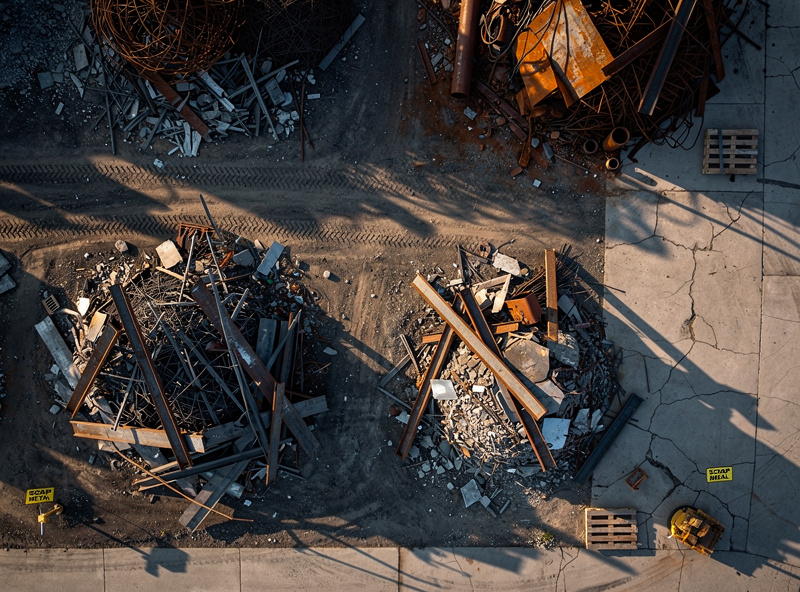
Source overview:
- Local steel supplier (Metal Supermarkets, Industrial Metal Supply, regional suppliers): 30-50% cheaper per pound than big-box. Full range of sizes and alloys. Cut-to-length service. Requires driving and hauling.
- Scrap yards: Cheapest source for non-critical projects. Mystery alloys, irregular sizes, often dirty or rusty. Best for fire pits, garden projects, and skill-building practice.
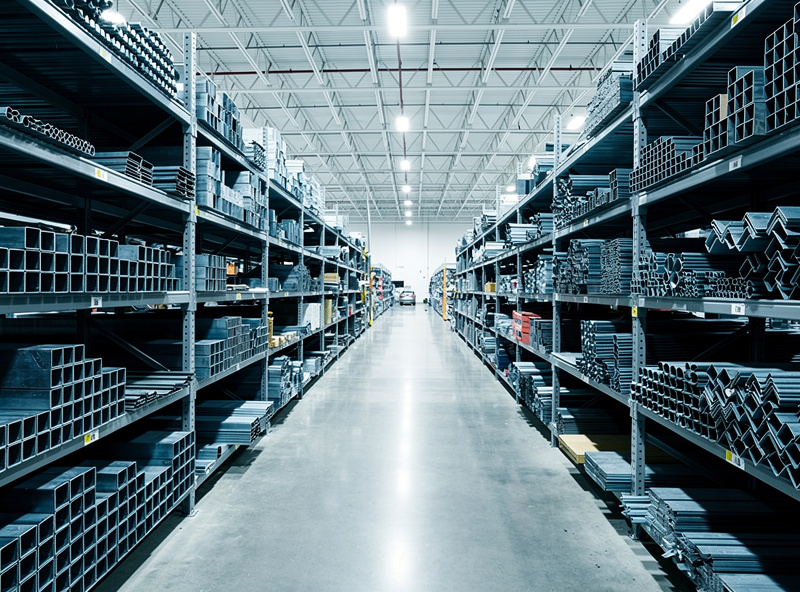
- Big-box hardware (Home Depot, Lowes, Tractor Supply): Convenient, pre-cut to manageable lengths, premium-priced. Selection limited to mild steel basics.
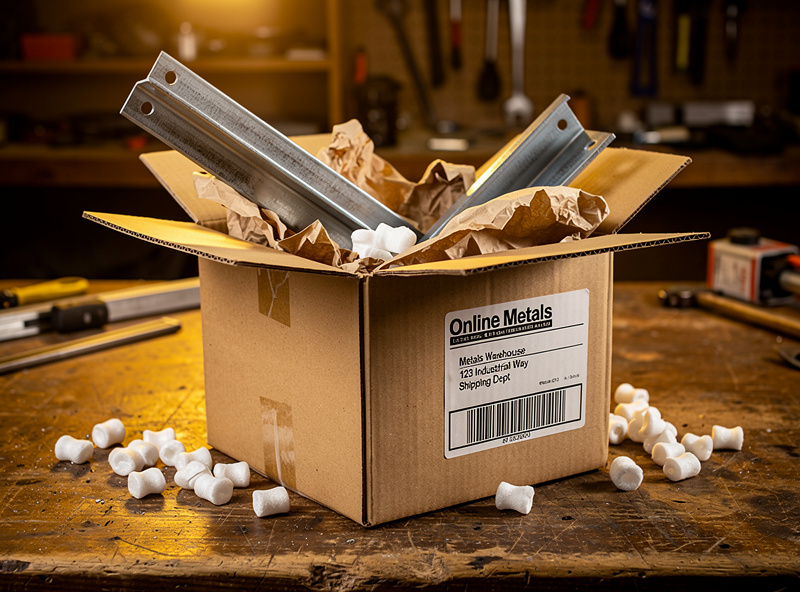
- Online metals (Online Metals, Metal Supermarkets shipping, Speedy Metals): Specific alloys, exotic sizes, ships to door. Higher per-pound cost plus shipping but worth it for stainless, aluminum, or unusual profiles.
- Steel mill direct (custom orders): Cheapest per pound at quantity, but requires bulk minimum orders (typically 500-2,000 pounds). Not realistic for most hobbyists.
- Marketplace/Craigslist scrap: Sometimes excellent finds (an old project canceled, surplus), often disappointing. Worth checking but unreliable.
For a typical hobbyist project under 200 pounds of steel, the local steel supplier wins on price, big-box wins on convenience, and online wins on availability of unusual specs. Scrap yards win for budget non-critical builds where mystery steel works fine. Read about identifying scrap yard finds in our how to identify mystery steel guide.
Local Steel Suppliers: The Hobbyist Sweet Spot
Local steel suppliers — chains like Metal Supermarkets, Industrial Metal Supply, and regional fabrication suppliers — sell to commercial welders and hobbyists. Pricing is roughly 30-50% below big-box per pound, the selection covers every standard alloy and shape, and most offer cut-to-length service for an additional 1-3 dollars per cut.
What to know about local steel suppliers:
- No membership or business license required: Most accept walk-in cash sales from individuals.
- Standard hours match commercial trade: Often 7 AM to 4 PM Monday-Friday, limited Saturday. Plan around the schedule.
- Cut-to-length service for 1-3 dollars per cut: Standard length is 20-foot stock; cut your stock to fit your truck or workshop.
- Will-call counter is faster than full-service: Bring your own list, get cuts and pickup in 20-30 minutes versus 45-60 with full service.
- Bring straps or a truck: 20-foot lengths do not fit cars; some suppliers offer delivery for a 50-150 dollar fee. My how to transport steel guide covers truck, trailer, and roof-rack hauling safely.
- Volume discounts at 100-pound order tiers: Order multiple project’s worth at once for additional 5-10% off.
- Drops (offcut bin): Many suppliers maintain a drops bin where short ends sell at 50-70% off list price.
The drops bin is the underrated feature. Pieces under 6 feet often sell at half price or less just to clear yard space. For small projects, the drops bin alone often beats big-box pricing for the same end product. Stop in periodically just to check what is in the bin. The drops bin is also the top source in my cheap steel for welding practice guide.
Scrap Yards: Cheap Steel for Non-Critical Projects
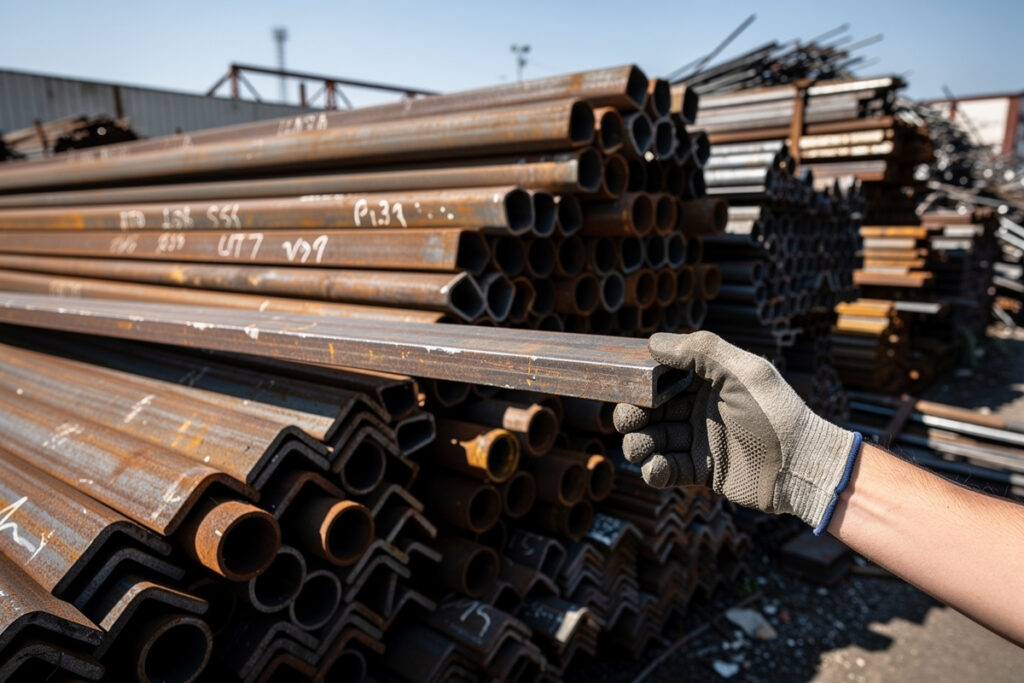
Scrap yards (metal recyclers, salvage yards) sell steel by the pound at 30-60% below new prices for clean recyclable material. The catch: you do not know exact alloy or condition, lengths and sizes are random, and material is often rusty or contaminated. Best for fire pits, garden art, BBQ smokers, and welding-skill practice. For the full rundown on when recycled metal is fine, see my new vs used steel guide.
How to buy from scrap yards effectively:
- Call ahead: Many yards charge for individual buyers or limit walk-in hours. Confirm before driving.
- Bring cash: Most scrap yards prefer cash and offer a small discount for it.
- Wear work boots and gloves: Yards are dirty, sharp, and uneven. Steel-toed boots and leather gloves are required PPE.
- Inspect before buying: Look for thread damage on round bar, deep pitting on plate, severe rust on tubing. Light surface rust grinds off; heavy pitting weakens the metal.
- Avoid unknown coatings: Painted or galvanized scrap is harder to weld safely without burning the coating off in a controlled outdoor setting first.
- Spark test or magnet check: Verifies the metal is actually steel and not aluminum or stainless if appearance is ambiguous.
- Negotiate per-pound rates: Posted prices are starting points. 50-100 pound purchases typically get 10-20% per-pound discounts.
The mystery-alloy issue is the biggest constraint. Scrap yard steel could be A36, 1018, 1045, T1, A572, or any of dozens of grades. For decorative or low-stress projects, this does not matter. For load-bearing applications, the unknown alloy is a structural risk. Read about specific identification techniques in how to identify mystery steel from a scrap yard.
Big-Box Hardware: Convenience at a Premium
Home Depot, Lowes, Tractor Supply, and Menards all carry mild steel in pre-cut lengths from 1-foot to 6-foot. Pricing runs 40-80% above local steel suppliers. Selection is limited to common shapes and sizes. Useful for tiny last-minute purchases, weekend project finishing, and customers without truck access for 20-foot stock.
Big-box steel reality:
- Common sizes only: 1/2″, 3/4″, 1″ square tubing; 1/8″ and 3/16″ flat bar; 1″ and 1.5″ angle iron. No specialty profiles.
- Pre-cut 1-6 foot lengths: Convenient for car transport but expensive per linear foot.
- Mild steel only: No stainless, no aluminum, no specialty alloys.
- Pricing 40-80% above local suppliers: A 6-foot stick of 1″ square tubing at Home Depot in 2026 averages 18-24 dollars; the same 6-foot piece at a local supplier runs 9-13 dollars.
- Tractor Supply often best of big-box: Slightly better selection of angle iron and flat bar than home-improvement stores, sometimes priced 15-20% lower.
- Cut-off saw at the customer-service desk: Most big-box stores will trim down longer pieces for free if requested politely.
The convenience math sometimes works. A weekend project that needs 4 feet of 1″ square at 11 PM on Saturday is going to come from Home Depot at 22 dollars or wait until Monday for the local supplier at 12 dollars. Time-cost is real. But for any project planned more than 24 hours out, the local supplier wins.
Online Metal Suppliers: Specialty and Convenience
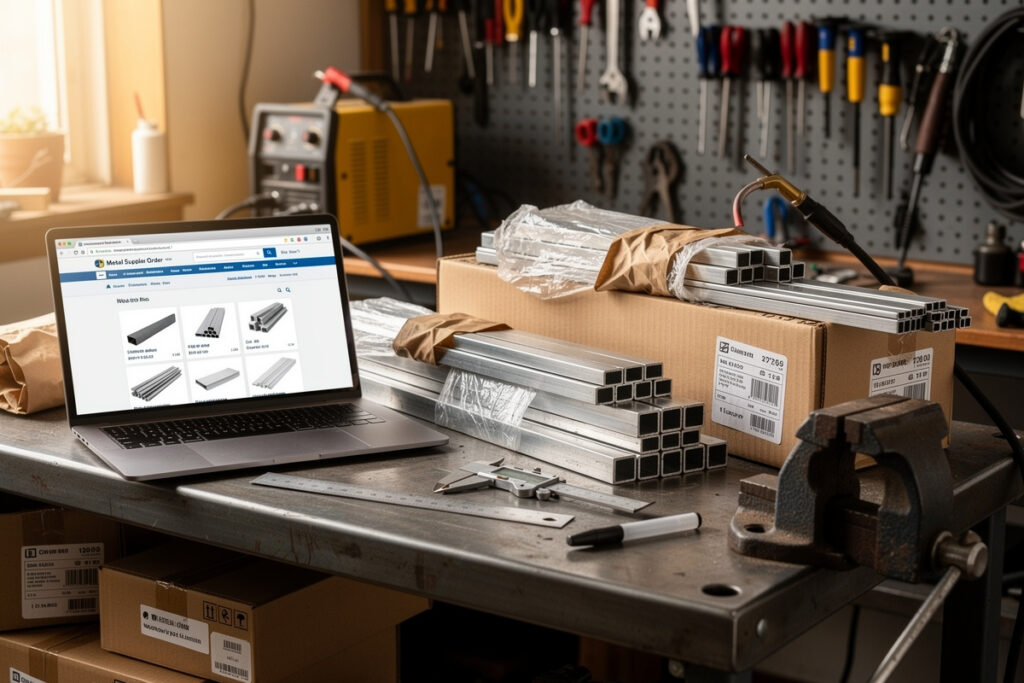
Online Metals, Metal Supermarkets shipping, Speedy Metals, and Discount Steel ship to the door. Pricing runs 15-30% above local supplier rates plus shipping. Best for stainless, aluminum, copper, brass, or unusual profiles that local suppliers do not stock. Shipping costs 25-150 dollars depending on length and weight.
When online makes sense:
- Specialty alloys: 4140 chromoly, 17-4 stainless, 6061 aluminum, brass — local suppliers rarely stock these.
- Unusual profiles: Hex bar, octagon bar, tee-bar, channels in less-common sizes.
- Small precise quantities: Online sites cut pieces to-the-inch and ship them; local cuts at 1/2-inch increments.
- Rural areas without local suppliers: Online beats driving 90 minutes to the nearest steel yard.
- One-off project parts: When you need exactly 18 inches of 0.250 wall hex bar in 4140 once, online gets it done.
Online price comparison: 1-inch square tubing 14-gauge in mild steel from Online Metals runs about 5.50 per foot in 2026; same product at a local supplier runs 3.50-4.00 per foot; same at Home Depot runs 4.00-4.50 per foot for 6-foot pieces (effectively higher when you account for cuts). Online is the most expensive per pound but cheapest in time and effort for specialty needs. For a head-to-head of the major online houses, see my online metal suppliers compared breakdown.
Comparison Table: Steel Sources Compared (2026 Pricing)
| Source | Per-lb Cost (1″ sq tube) | Selection | Best For | Drawback |
|---|---|---|---|---|
| Local Steel Supplier | 0.85-1.10 dollars | Excellent | Most projects | Trade hours, truck needed |
| Scrap Yard | 0.40-0.70 dollars | Mystery | Non-critical builds | Unknown alloy |
| Big-Box Hardware | 1.40-1.80 dollars | Limited | Last-minute small needs | 40-80% markup |
| Online Metals | 1.30-1.70 dollars + shipping | Excellent | Specialty alloys | Shipping cost |
| Marketplace/Craigslist | 0.50-0.80 dollars | Random | Bargain hunters | Inconsistent |
Pricing reflects mild steel 1-inch square 14-gauge tubing in 2026. Other shapes scale similarly. Stainless and aluminum run 3-5x these prices across all sources. To turn a cut list into pounds and dollars before you buy, use my steel weight and cost calculation guide.
Steel Types Every Home Welder Should Know
Mild steel (A36, 1018, 1020) accounts for roughly 85% of home welding projects. It is the cheapest metal per pound, welds with all three processes (MIG, TIG, stick), and is available at every source from scrap yards to online retailers. A36 is the structural grade used for construction and general fabrication — it is the default choice for any project that does not require corrosion resistance or specific mechanical properties. For a deeper breakdown, see my guide to steel types for welding covering A36, 1018, 4140, and AR500.
Stainless steel (304, 316) resists rust and handles high temperatures but costs 3-5 times more per pound than mild steel. Welding stainless requires different filler wire (ER308L for 304, ER316L for 316), lower heat input to prevent warping, and better ventilation because stainless fumes contain hexavalent chromium. Home welders typically use stainless only for food-contact projects (smoker grates, brewing equipment) or outdoor applications where mild steel would rust through. My stainless steel for welding guide compares 304, 316, and 409 and their fillers.
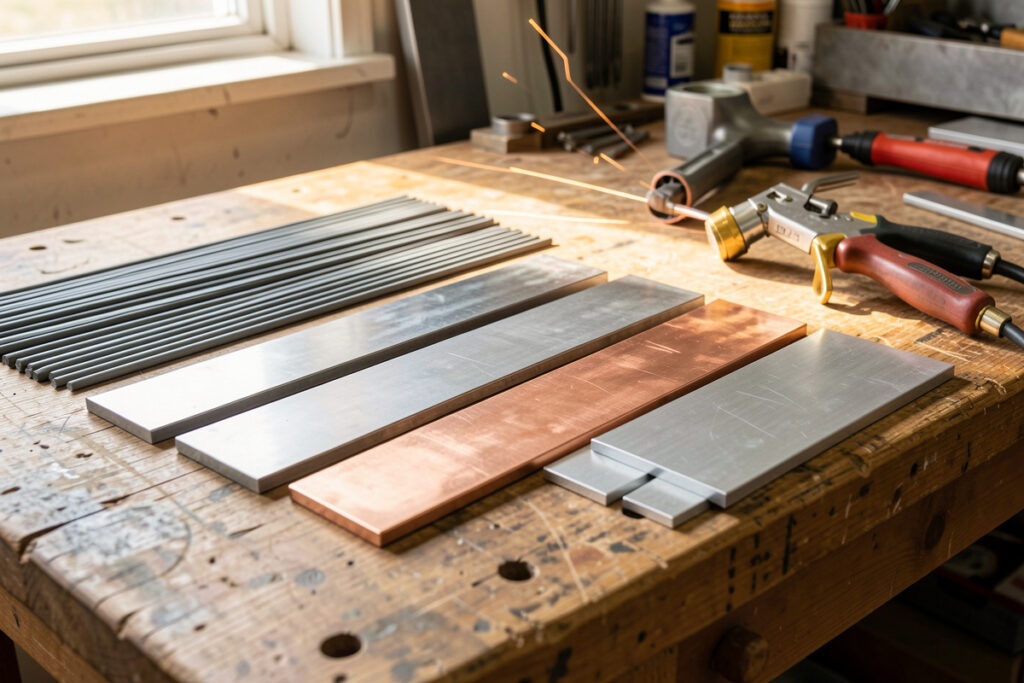
Aluminum (6061, 5052) is lightweight and corrosion-resistant but requires TIG welding (or a MIG spool gun) with pure argon shielding gas. Aluminum conducts heat five times faster than steel, making it harder to control the weld pool without burning through. Most beginners should master mild steel before attempting aluminum. See my aluminum grades for welding guide for choosing between 6061, 5052, and 3003 and their fillers. Online metals suppliers and local aluminum distributors are the best sources — big-box stores rarely stock aluminum bar stock.
Preparing and Cutting Steel for Welding Projects
Steel purchased from any source needs preparation before welding: cutting to length, removing mill scale or rust, deburring cut edges, and wiping off oil or grease. Skipping preparation causes porosity, lack of fusion, and ugly bead appearance. Budget 15-30 minutes of prep time per project before striking the first arc.
Cutting steel to length uses one of four tools: an angle grinder with a cutoff wheel ($30-$60), a horizontal bandsaw ($150-$250), a chop saw ($100-$200), or a plasma cutter ($300-$600). For beginners cutting mild steel up to 3/16 inch, an angle grinder with a 0.045-inch cutoff wheel is the cheapest and most versatile option. The bandsaw produces the cleanest, most accurate cuts and is the standard upgrade once you are cutting more than 20 pieces per project.
Mill scale — the dark blue-black oxide layer on hot-rolled steel — must be ground off the weld zone before welding. Mill scale causes porosity and incomplete fusion because it melts at a different temperature than the base metal. A flap disc on an angle grinder removes mill scale in seconds. Cold-rolled steel has no mill scale and is ready to weld as-is, but costs 20-40% more per pound.
Oil and grease on steel cause porosity even after grinding. Wipe all steel with acetone or a dedicated metal cleaner before welding. Never weld on steel that has cutting oil, shop rags, or fingerprints in the weld zone — the organic material vaporizes into the weld pool and creates gas pockets that weaken the joint. This single step — a 30-second wipe with a rag and acetone — prevents the majority of beginner porosity problems on new steel from any source.
Steel Storage and Organization for Home Workshops
Steel stock stored on a garage floor collects moisture, rust, and dirt that add 15-30 minutes of prep time to every project. A simple vertical rack from angle iron or a horizontal rack mounted to the wall keeps stock dry, organized, and ready to cut. Building your own rack from scrap steel is an ideal first welding project.
Organize stock by type and size: flat bar in one section, angle iron in another, square tubing in a third. Label each section with a paint marker or engraved tag. This organization system saves 5-10 minutes per project that would otherwise be spent searching through piles for the right size. Keep the most-used sizes (1-inch square tubing, 1/8-inch flat bar, 1-inch angle iron) at waist height for quick access.
Store steel indoors or under a covered area. Unprotected outdoor storage causes surface rust within 2-4 weeks in humid climates. Surface rust grinds off easily but adds prep time. If you must store steel outdoors, elevate it off the ground on a pallet and cover it with a tarp. Steel stored directly on concrete absorbs ground moisture and rusts from the bottom up.
Scrap drops (short pieces left over from cuts) accumulate quickly in any active welding shop. Keep a labeled bin for drops under 12 inches — these pieces are useful for practice beads, test coupons, brackets, and small repair patches. Discard drops shorter than 3 inches unless you have a specific use — they clutter the workspace and create trip hazards on the shop floor.
Frequently Asked Questions
Where is the cheapest place to buy steel for welding?
Local steel suppliers consistently undercut big-box hardware stores by 30-50 percent and online retailers by 15-30 percent for standard mild steel shapes. Scrap yards are cheaper still for non-critical projects where the exact alloy does not matter. The order of cheapest to most expensive is: scrap yard, local supplier, online metals, big-box hardware.
Can I buy steel from Home Depot for welding?
Yes — Home Depot stocks mild steel square tubing, flat bar, and angle iron in pre-cut 1-6 foot lengths. Pricing is 40-80 percent above local steel suppliers but the convenience and small quantities work for hobby projects. Selection is limited to common sizes and shapes only.
What is the best online metal supplier for hobbyists?
Online Metals (onlinemetals.com), Metal Supermarkets (metalsupermarkets.com), and Speedy Metals are the three most-used by hobbyists. All three cut to length, ship most metals, and have similar pricing. Online Metals tends to have the deepest stainless inventory; Speedy Metals often has the lowest shipping costs.
Is scrap yard steel safe to use for welding projects?
For non-structural or decorative projects (fire pits, garden art, BBQ frames), yes. The mystery alloy is rarely a problem at hobby scale. For load-bearing applications (trailers, structural supports, anything carrying body weight), buy known A36 or 1018 from a supplier where the alloy is certified.
How much does steel cost in 2026?
Mild steel 1-inch square 14-gauge tubing runs roughly 0.85-1.80 dollars per pound depending on source. A36 hot-rolled flat bar runs 0.75-1.50 dollars per pound. Stainless runs 3-5 dollars per pound. Aluminum runs 4-7 dollars per pound. Prices fluctuate with global steel commodity markets.
Can I get steel delivered for welding projects?
Yes. Local steel suppliers offer delivery for 50-150 dollars per trip; many have a free delivery threshold around 500-1000 dollar orders. Online metals suppliers ship via FedEx Ground or freight depending on length. Marketplace sellers sometimes deliver for fuel cost.

Discussion (0)