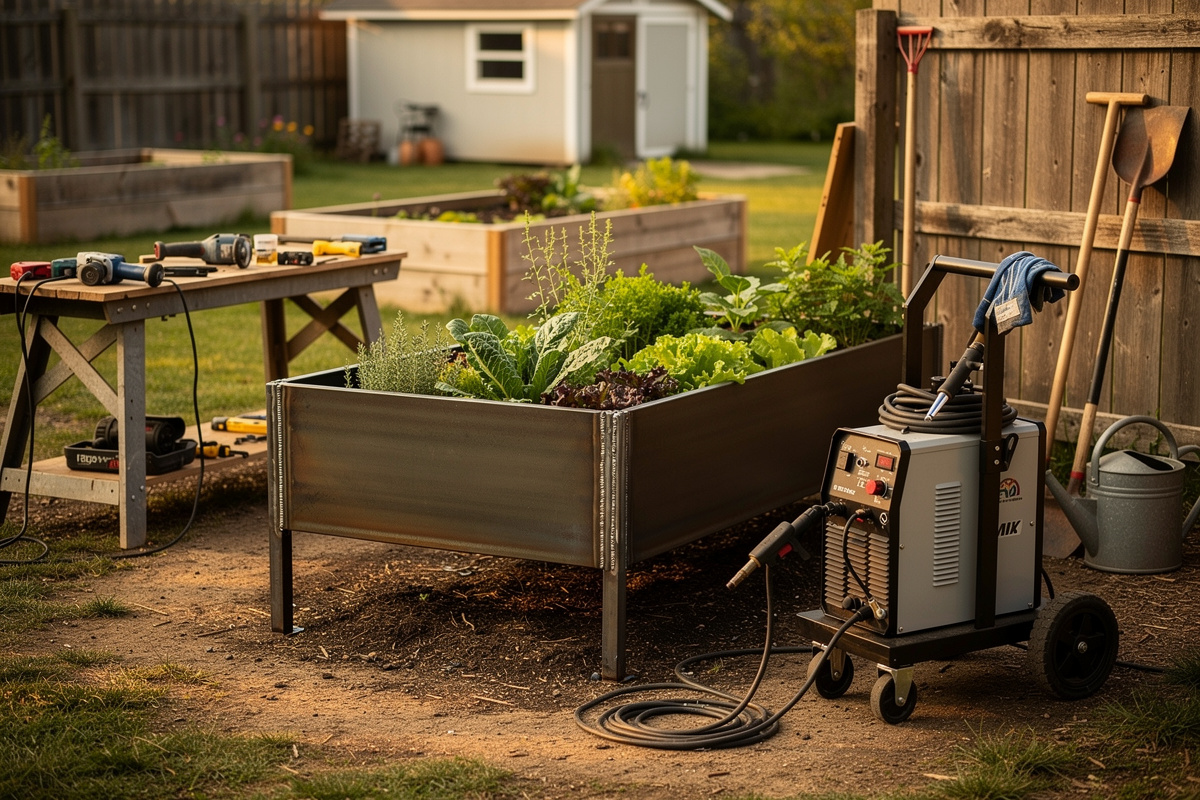

A welded steel raised garden bed lasts 30+ years; a wood raised bed lasts 5-8. The math gets compelling fast: $80-$180 in steel and 4-6 hours of welding work delivers a permanent garden installation that does not rot, warp, sag, or harbor termites. The full project context is in the DIY welding projects guide.
This guide covers steel selection by gauge and corrosion resistance, the standard 4×8 ft and 4×4 ft frame designs that produce dimensionally stable beds, the MIG welder settings that handle structural welds reliably for someone who is not a welding professional, and the finishing options (powder coat, raw weathering, galvanized) that determine whether the bed lasts 20 years or 50. Every dimension below is from real builds across two homestead garden installations.
Why Steel for Raised Beds Wins on Long-Term Cost
Cedar and redwood raised beds are pretty for a few years. After 5-8 seasons of soil moisture, freeze-thaw cycles, and termite pressure, they soften, sag, and need replacement. Treated lumber lasts longer but introduces preservative chemicals near edible-vegetable root zones. Composite plastic beds wave aside the rot issue but lack the structural rigidity that supports tall corn or trellised vines.
Steel solves all three:
- Does not rot — galvanized or powder-coated steel beds in service since 1995 still hold dimensional shape
- Does not leach harmful chemicals (untreated mild steel is food-safe at root contact distance)
- Provides structural rigidity for trellis attachment, hoop-tunnel hoops, and netting
- Conducts heat — slightly warms early-spring soil, extending growing season by 1-2 weeks
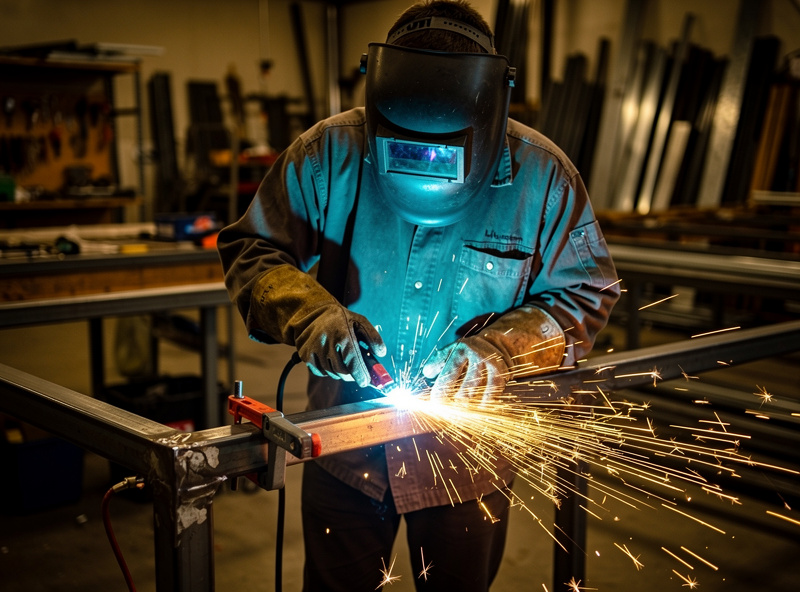
The tradeoff is upfront cost and labor. A wood 4×8 raised bed costs $40-90 in lumber and 2 hours of work. A welded steel equivalent costs $80-180 in steel and 4-6 hours of work plus access to a welder. Lifetime cost favors steel by a factor of 4-5x once you account for replacement.
Steel Selection — Gauge, Type, and Corrosion Resistance
Three steel choices cover most raised bed applications:
| Steel type | Thickness | Cost (4×8 bed) | Lifespan | Notes |
|---|---|---|---|---|
| Galvanized corrugated panel | 26 ga | $120-180 | 20-30 years | Easy to source. Cannot weld through zinc safely; bolt to angle frame. |
| Cor-Ten weathering steel | 14 ga | $140-220 | 50+ years | Forms protective rust patina. Premium look. Welds beautifully. |
| Mild steel angle iron + plate | 1/8 inch | $80-140 | 15-20 years (raw); 30+ powder coated | Most common. Welds easily. Requires coating or paint. |
| Stainless steel 304 | 14-16 ga | $280-450 | 50+ years | Premium option. Specialized welding (TIG); not for first builds. |
For first welded raised bed, mild steel angle iron 1/8 inch with corrugated galvanized panel sides is the right choice. Welder skill required is minimal (the angle frame is the only welding work; panels bolt on), cost is reasonable at $90-140 for a 4×8 bed, and the visual result is excellent. After your first build, consider Cor-Ten for the next bed — it welds easier and looks better with age.
The Standard 4×8 Frame Design
A 4×8 raised bed at 18 inches tall is the default size — fits most garden plots, accessible from both sides without stepping on soil, deep enough for most root vegetables. The frame design:
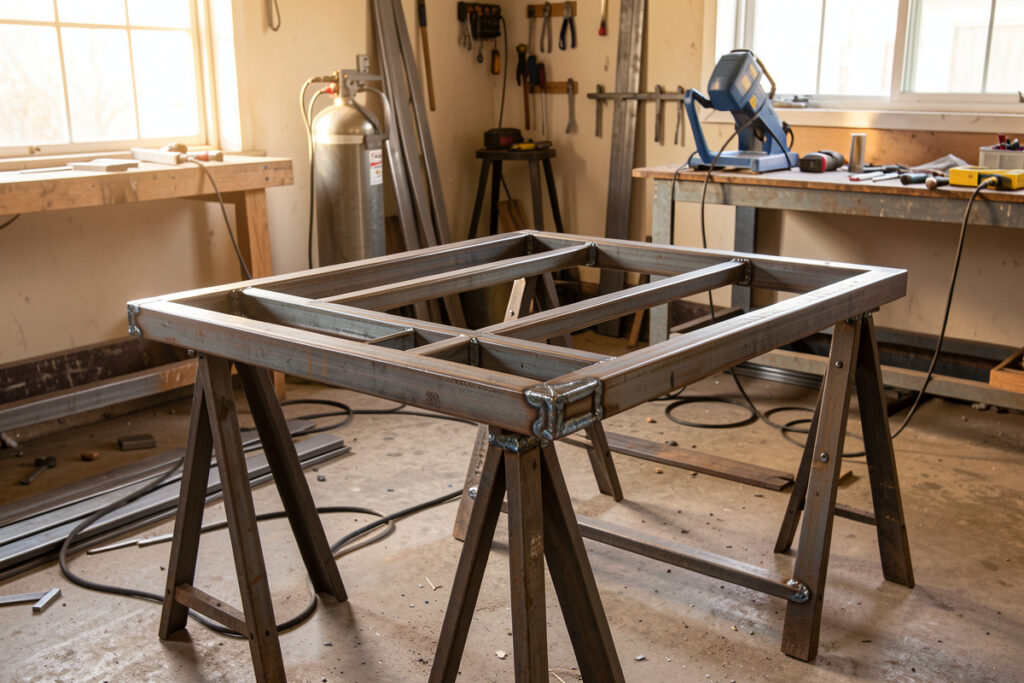
- Four corner posts: 1.5×1.5×1/8 inch angle iron, 18 inches tall
- Top rail: same angle iron, four pieces, two at 4 ft and two at 8 ft
- Bottom rail: same angle iron, four pieces, same dimensions as top rail
- Optional cross-brace: 1/8 inch flat bar, mid-height, prevents bowing on long sides
- Sides: 26-gauge galvanized corrugated panel (4 pieces total: two 8 ft, two 4 ft, all 16-18 inches tall)
Total steel cost: about $100 for the frame plus $40-60 for the panels. Total weight assembled: about 75-90 lb. Two people lift it into place easily; one strong person can do it solo.
Welder Settings That Actually Work
For a 1/8 inch angle iron frame, a 120V 140A MIG welder with 0.030 inch wire and 75/25 argon-CO2 shielding gas handles every weld in the project. Settings:
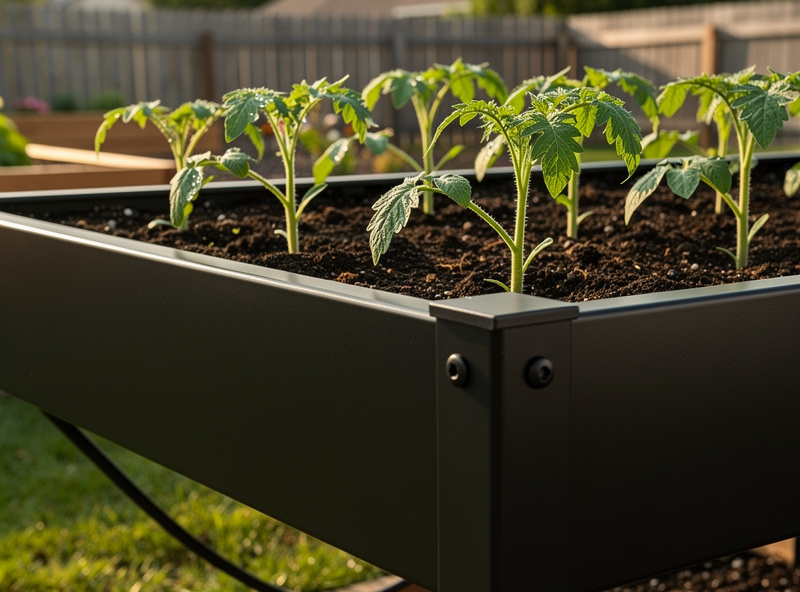
- Wire feed speed: 200-220 IPM
- Voltage: 17-19V
- Wire stickout: 1/4 to 3/8 inch
- Travel speed: medium-slow, about 8-10 inches per minute
- Joint preparation: 45-degree bevels on the angle ends for full corner penetration
- Tack-weld first, square check, then full welds
The work is structural but not exotic. If you have welded a basic project before — the welding cart, a bench frame, a trailer modification — a raised bed is squarely within first-year welder skill range. If this is your first welded structure, consult our MIG welding settings chart for tuning by material thickness, and our welding vs CNC decision framework for whether welding is the right tool for your specific build.
For weld inspection, look for: full bead at every corner joint, no excessive porosity, no undercuts at the top of fillet welds. The angle iron beds I have built have not failed mechanically; they fail at the coating-to-steel boundary if surface preparation is sloppy before powder coating.
Finishing — Powder Coat or Let It Patina
Three finishes cover the welded raised bed market:
Powder coating ($60-120 per bed at a local job shop). Best long-term durability. The shop sandblasts the welded frame, applies polyester or epoxy powder, and bakes at 400°F. Result: hard durable finish in any color, 20+ year service life, no maintenance needed. Worth the money.
Cor-Ten weathering steel — let it patina. If you used Cor-Ten, do nothing. The steel develops a stable oxide layer that looks sculptural and slows further oxidation. The patina takes 6-18 months to fully develop depending on climate. Iconic look on modern garden installations.
Rust-converter primer + outdoor enamel. Budget option for mild steel. After welding, apply a rust-converter primer (Rust-Oleum products work well) followed by outdoor-rated enamel paint. Result: 5-8 years of service before re-coating needed. Cheaper but more maintenance over time.
Avoid: galvanized spray paint over welded mild steel (peels at heat-affected zones), vehicle automotive paint (does not handle moisture), and any finish that has not been outdoor-tested. Get the finish right and the bed lasts decades; cut corners on it and you will refinish in 3-5 years.
Filling and Soil Considerations
An 18-inch deep 4×8 raised bed holds about 48 cubic feet of soil. Fill from the bottom up:
- Bottom 6 inches: hugelkultur fill — branches, leaves, brush, lawn clippings
- Middle 8 inches: aged compost mixed with native soil
- Top 4 inches: high-quality vegetable soil mix
The hugelkultur layer settles 2-3 inches over the first season — top up with compost in spring of year two. After that, the bed is dimensionally stable for decades.
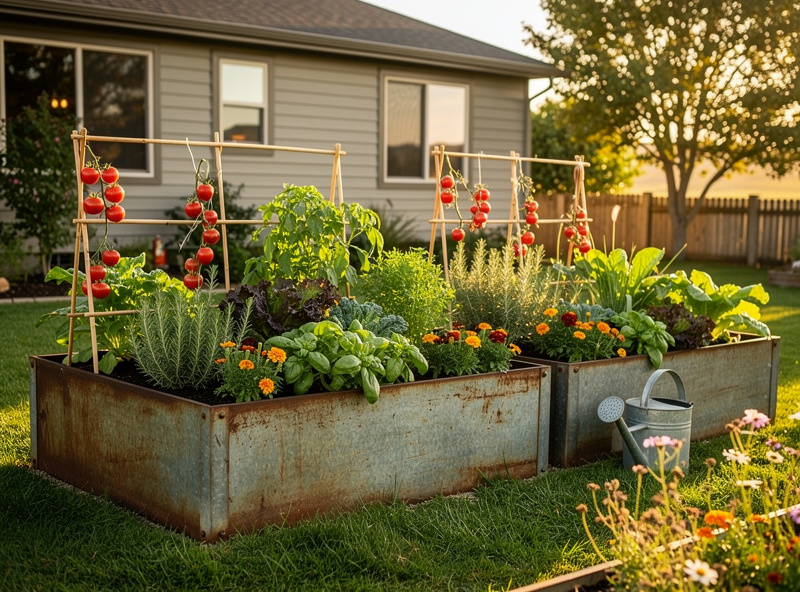
For deeper guidance on what to grow inside the welded bed and how to mix soil for productive vegetable production, there’s a complete raised beds and planters guide that covers soil mix ratios, plant rotation patterns, and the irrigation choices that pair with steel-framed beds. The best soil for raised beds reference handles the soil chemistry side, and the container gardening guide covers the broader cultivation context. Pair that gardening guidance with this welding-side build and the bed produces from year one.
Variations Worth Considering
The basic 4×8 design adapts cleanly to several variations:
Wheelchair-accessible 4×4 at 30 inches tall. Same construction, taller posts, smaller footprint. Extra steel cost: $30-40. Bed accessible from a seated position; ideal for elderly or mobility-limited gardeners.
Long bed (4×16 ft). Add cross-bracing every 4 ft along the long sides. The mid-bed cross member also provides a useful trellis attachment point. Total steel cost: $180-250.
Trough bed (2×8 ft, 24 inches tall). Smaller footprint for narrow garden alleyways. Same construction, narrower side panels. Useful for tight side-yards or balcony-edge gardens.
Hoop tunnel attachment. Weld 4 vertical 1/2 inch EMT conduit anchors to the inside top rail at 18-inch spacing. EMT hoops insert into the anchors for season-extension hoops without modifying the bed structure.
Safety and Soil Considerations
Three safety considerations for welded raised garden beds:
Surface preparation between welds and soil contact. Mild steel that contacts wet soil for 20+ years requires either powder coating, galvanizing, or paint. Untreated mild steel develops a protective rust layer relatively slowly underground, but the surface oxidation can stain root crops. Cor-Ten, galvanized, and stainless are all safe untreated.
Lead and other contaminants in salvage steel. If you source steel from a scrapyard, verify the steel was not from a structure that processed lead, mercury, or other heavy metal contamination. Painted scrap from older buildings (pre-1978) may carry lead from the paint.
Welding in a ventilated space. MIG fumes contain manganese and other compounds. Weld outdoors or with a fume extractor; never weld a galvanized panel without proper respiratory protection. According to OSHA welding safety guidance, hexavalent chromium and manganese exposure are the chronic health concerns in hobby welding; ventilation is the primary control.
For the broader welding context that supports projects like this, the welding vs CNC routing decision framework covers tool choice, the welding ventilation home garage guide covers respiratory safety, and the where to buy steel for welding projects covers sourcing.
Frequently Asked Questions
What gauge steel for a welded raised garden bed?
1/8 inch (about 11 gauge) angle iron for the frame, 26-gauge galvanized corrugated panel for the sides. The frame carries all the structural load; the panels just retain soil. Heavier gauge frame is fine but adds weight and cost without functional benefit. Lighter frame deflects under soil load.
Will a steel raised bed leach chemicals into vegetables?
Untreated mild steel is food-safe at root contact distance. Galvanized steel may leach trace zinc into highly acidic soil (below pH 6.0); not a concern in normal garden pH 6.2-7.0 range. Cor-Ten weathering steel is food-safe with its protective patina. Avoid raw galvanized in low-pH soils; for everything else, steel beds are safe.
How long does a welded steel raised bed last?
Powder-coated mild steel: 20-30 years. Cor-Ten weathering steel: 50+ years. Galvanized steel: 20-30 years. Stainless steel: 50+ years. All vastly outlast wood beds (5-8 years) or treated lumber (8-15 years). The frame typically outlasts the gardener.
Can I weld my own raised bed without prior welding experience?
Yes, but plan a practice piece first. The welds are not exotic — straight fillet welds on 1/8 inch angle iron are achievable for a first-year hobby welder. Watch a welding course (free YouTube tutorials are abundant), practice on scrap angle iron until your beads are consistent, then commit to the bed project. A 140A MIG welder is the right tool.
Do I need to powder coat the bed or can I leave it raw?
Powder coat strongly recommended for mild steel. Raw mild steel develops surface rust within 3-6 months of soil contact and slowly oxidizes throughout its service life — about 15-20 years before the rust compromises structural integrity. Powder coating doubles the lifespan to 30+ years for $60-120 at a local shop.
What welder do I need for a raised bed project?
A 120V 140A MIG welder with 0.030 inch wire and 75/25 argon-CO2 gas handles every weld in the project. Current-generation Hobart, Lincoln, and Miller 140A units run in the $650-1,150 range now that the older sub-$500 models (Hobart Handler 140, Miller Millermatic 141) have been discontinued and replaced. Flux-core only welders work but produce more spatter and require more cleanup. Avoid Harbor Freight low-end MIG without true gas shielding.
How do I attach the corrugated panels to the welded frame?
Use 1/4 inch carriage bolts every 12 inches along the top and bottom rails. Pre-drill holes through the panel and angle iron, install bolts with the head outward and nuts inward. The bolts add visual texture and are easy to replace if a panel ever needs swapping. Welding through galvanized panels is unsafe due to zinc fume; bolt them on instead.

Discussion (0)