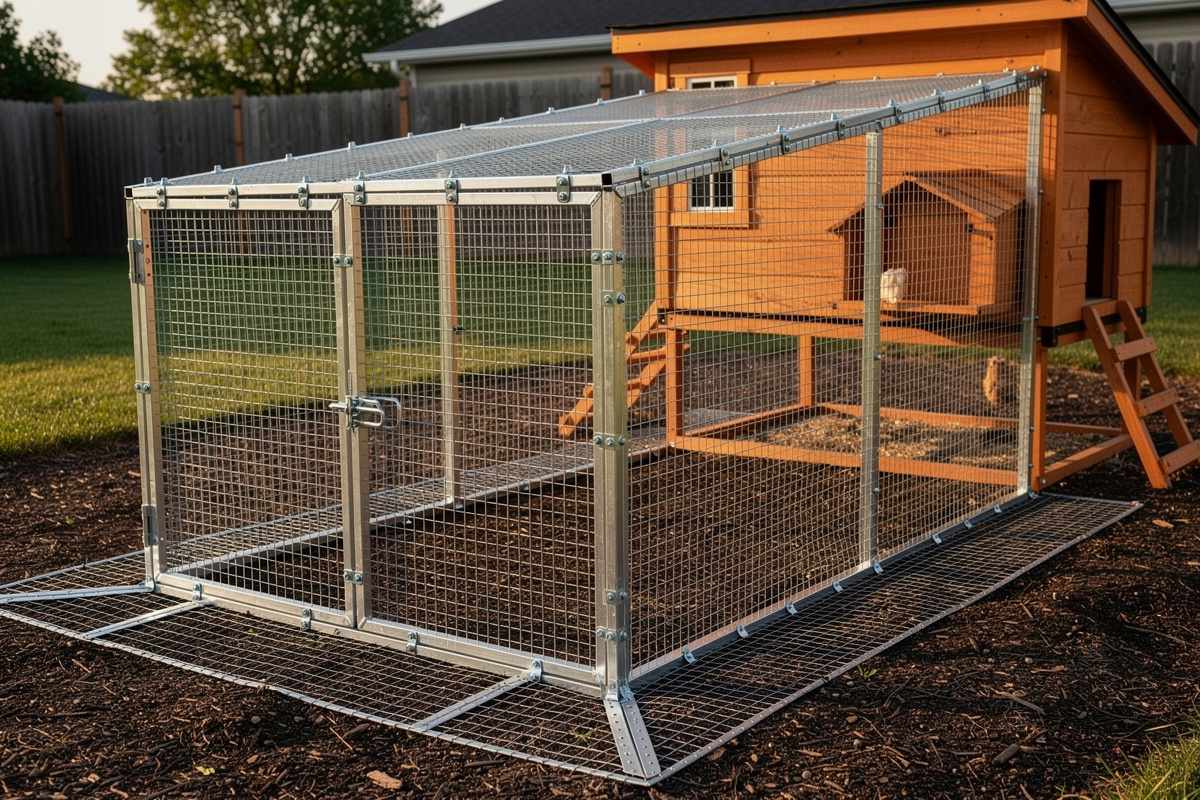

A welded steel chicken run frame from 25-millimeter square tube with 2-millimeter wall, buried 300 millimeters below grade, resists a determined fox for 20 years. An aluminum frame resists corrosion indefinitely but costs three times as much.
The predator-proof run frame is a welding project that pays for itself in chickens not killed, and the choice between steel and aluminum is a choice between a weekend of welding and a decade of maintenance, or a decade of no maintenance and a weekend of more expensive welding with a spool gun you may not own yet.
The way I approach a predator-proof build is to overbuild the frame and underspend on the cosmetics — the fox doesn’t care if the welds look pretty, only whether they hold. For the full technique progression that builds to structural frames like this, the DIY welding projects guide covers every skill this run frame depends on. A fox digs with real, sustained force at its front paws — enough to bend 19-gauge hardware cloth that is not backed by a rigid frame within a single determined session at the fence line. The frame’s job is to turn the hardware cloth from a flexible barrier into a rigid one by giving it a skeleton that does not flex under sustained digging pressure at any point along the perimeter. A 25-millimeter square steel tube with a 2-millimeter wall spanning 1.2 meters between vertical posts holds its shape under that load — the hardware cloth stays flat, the fox’s claws cannot get purchase between the mesh and the frame, and the predator moves on to easier prey. The same span in aluminum requires 40-millimeter tube to achieve the same stiffness, because aluminum’s elastic modulus is roughly one-third that of steel. The bigger tube costs more but weighs less and never rusts. The tradeoff is not about which material is better — it is about which tradeoff you prefer to live with for the 15-year life of the run.
Steel Frame: MIG Welding 25mm Square Tube for a Predator-Proof Perimeter
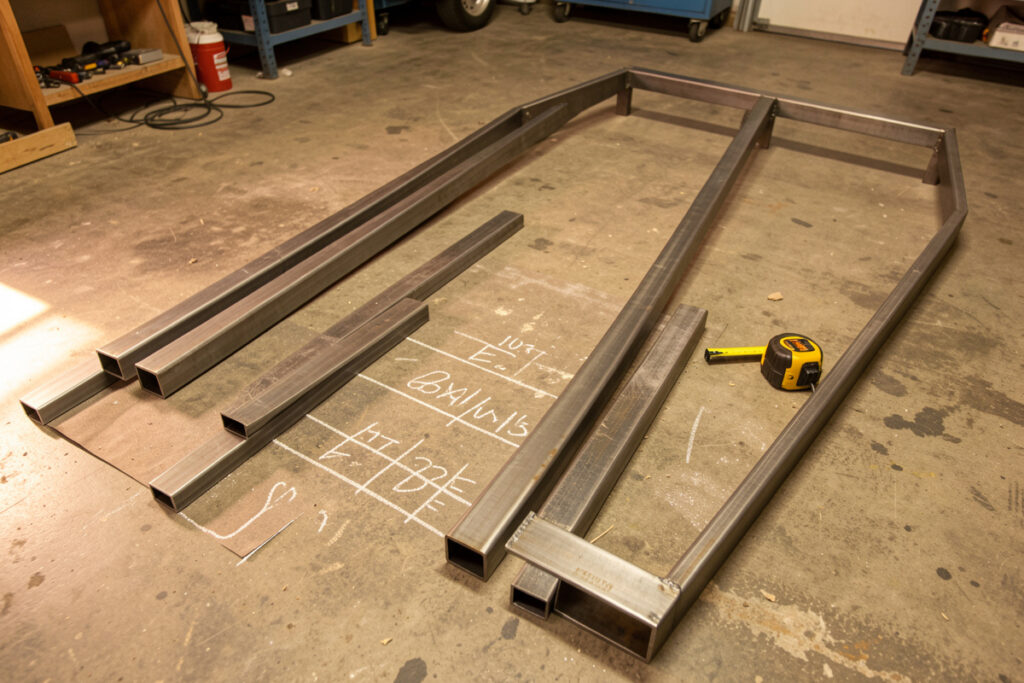
The run frame is a rectangular box — typically 3 meters wide, 4 meters long, and 2 meters tall — made from 25-millimeter square steel tube with 2-millimeter wall thickness, welded at every joint. The bottom horizontal members sit on a concrete footing or are buried 300 millimeters below grade to form the dig-proof apron. The top horizontal members support the roof — corrugated metal, polycarbonate panels, or hardware cloth — and the vertical posts are spaced every 1.2 meters along the perimeter. At each post-to-horizontal intersection, a full perimeter fillet weld on all four sides of the square tube locks the joint against racking forces from wind and predator pressure.
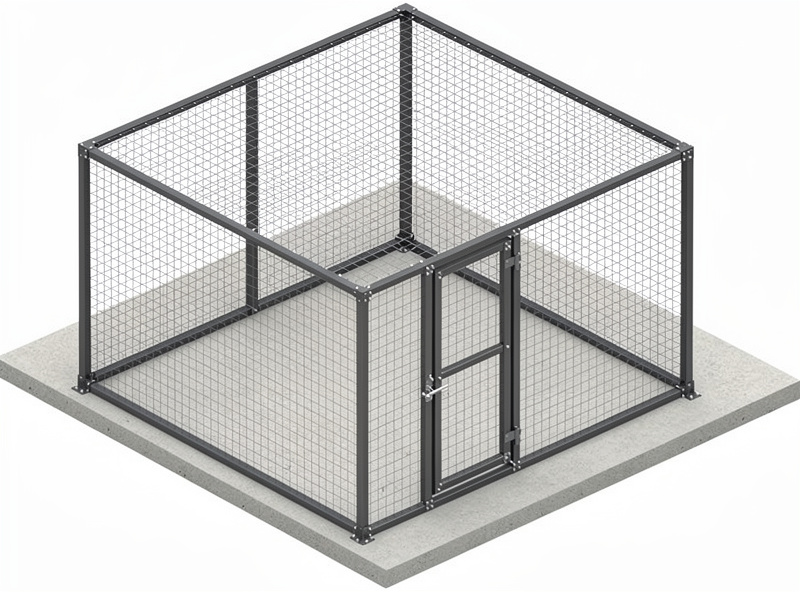
MIG settings for 25-millimeter, 2-millimeter-wall square tube: 18 volts, 250 inches per minute wire speed, 0.030-inch ER70S-6 wire per AWS A5.18 specification, 75/25 argon-CO2 gas, 10-millimeter stickout. The thin wall demands short welds — 30 to 40 millimeters per bead — with a 10-second pause between beads to prevent burn-through. A 2-millimeter wall burns through at 20 volts without a backing technique; the fix is to hold the gun at a 15-degree push angle and travel fast enough that the puddle trails the arc rather than sitting under it. The welds that hold the run frame together are not structural in the building-code sense — they hold chickens in and predators out, not a roof over human heads — but they must be continuous and free of pinholes because every gap in the weld bead is a gap in the predator-proof perimeter.
Aluminum Frame: When Corrosion Resistance Justifies the Cost
Aluminum run frames make sense in two situations: coastal properties where salt spray corrodes steel within 5 years regardless of paint, and permanent installations where the builder wants to weld the frame once and never touch it again. 6061-T6 aluminum square tube at 40 millimeters with a 3-millimeter wall matches the stiffness of 25-millimeter steel at roughly the same weight, and the material cost is roughly $12 per meter for aluminum versus $4 per meter for steel — three times the material cost, one-third the maintenance.
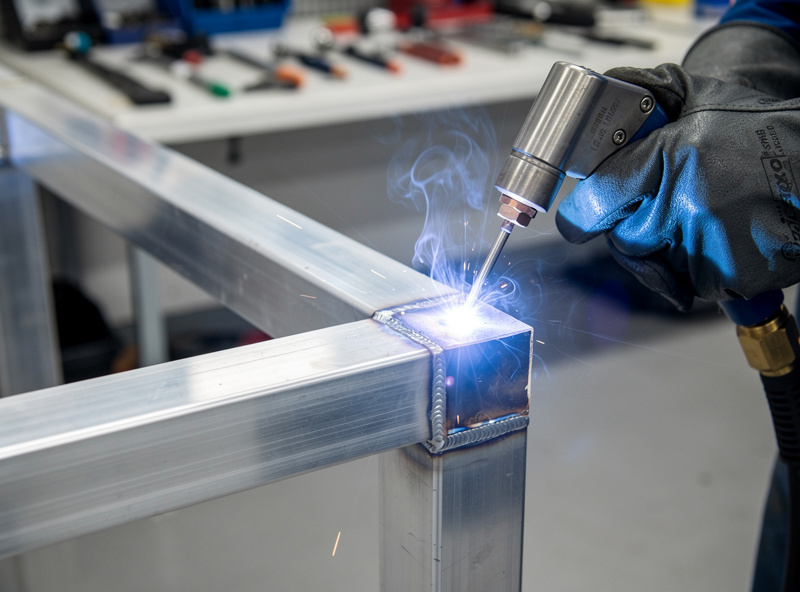
Welding aluminum requires AC TIG or a MIG spool gun — the standard MIG setup for steel cannot feed aluminum wire through the standard gun because the soft wire birds-nests in the liner. A spool gun costs $100 to $300 and mounts directly to the MIG power source, feeding aluminum wire from a small spool inside the gun body to eliminate the feed-distance problem. The settings for 3-millimeter 6061 aluminum with 0.035-inch 4043 filler wire: 21 to 22 volts, 400 to 450 inches per minute wire speed, pure argon shielding gas at 20 to 25 cubic feet per hour, and a 15-degree push angle. Aluminum welds faster than steel — roughly twice the travel speed — and the puddle freezes faster, so the bead must be laid in one continuous pass without the start-stop rhythm that works for thin steel. The learning curve from steel MIG to aluminum MIG is roughly two weekends of practice on scrap tube, and the spool gun is a tool that pays for itself across multiple outdoor projects — the run frame, the boat trailer, the patio furniture — once it is in the workshop.
Predator-Proof Details: The Apron, the Door, and the Hardware Cloth
In the run I built for my own flock, the apron extends 600 millimeters — I’d rather burn an extra hour of welding on the bench than lose another hen to something that dug under a 300-millimeter strip. The dig-proof apron is a horizontal extension of the bottom frame member that extends 300 to 600 millimeters outward from the run perimeter, buried under 50 millimeters of soil or gravel — an L-shaped foot that follows the same logic University of Maryland Extension recommends for digging predators (fencing buried at least a foot deep, turned outward another 8 to 10 inches). A predator that digs at the base of the run hits the buried apron and cannot dig under the vertical wall. The apron is welded to the bottom frame member at a 90-degree angle — an L-shaped cross section — and the weld runs the full length of every perimeter side. This is the longest continuous weld in the project and the one that separates a predator-proof run from a run that a fox digs under in one night.
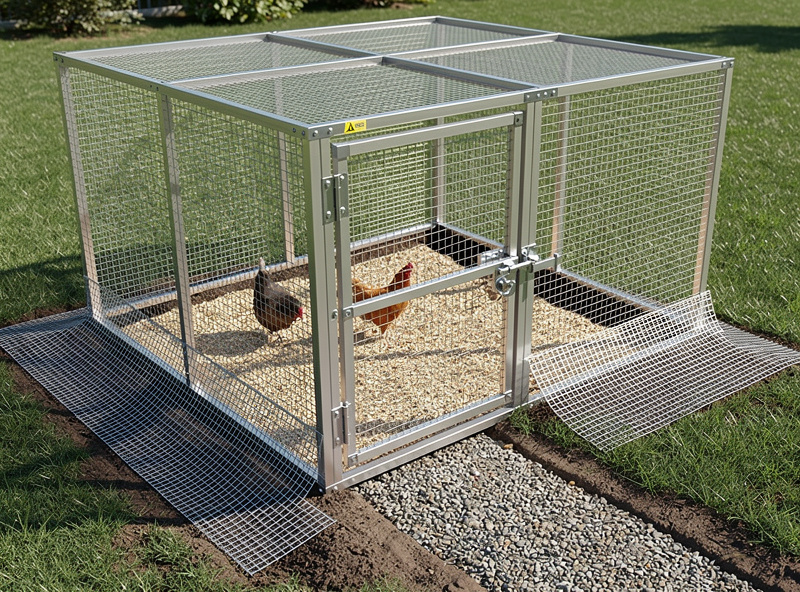
The door frame is the most highly-stressed part of the run because it cycles open and closed thousands of times, the hinges carry the full weight of the door, and the latch takes whatever force a curious raccoon can apply at 2 a.m. Weld the door frame from the same 25-millimeter tube as the run frame, with the hinge side reinforced by a second vertical member that doubles the wall thickness at the hinge mounting points. The latch is a gravity lock or a spring-loaded slide bolt — raccoons defeat simple hook-and-eye latches within minutes and twist-locks within an hour — and the strike plate that the latch engages is welded to the door frame, not screwed, because screws back out under repeated cycling and the latch that unscrews itself at 3 a.m. is the latch that lets the fox in.
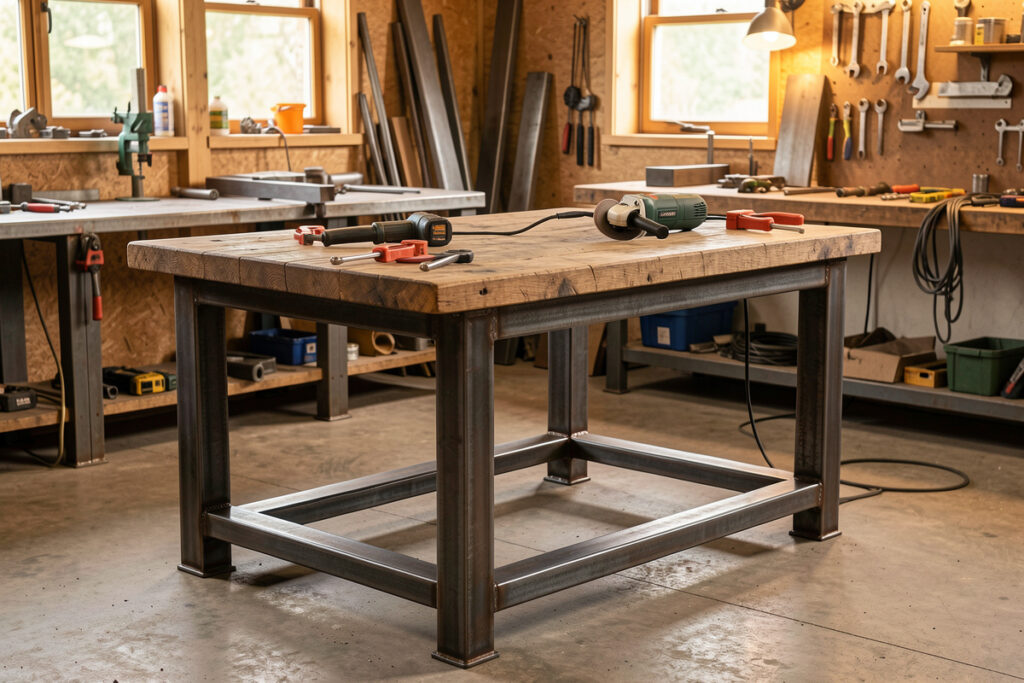
A welded predator-proof run frame is the project that separates chicken keepers who lose birds to digging predators from chicken keepers who don’t. The steel version costs less in materials, welds with the gear already on your bench, and needs a coat of paint every few years. If building a proper welding station is next on the list, the DIY welding workbench frame plans cover how to build a rigid steel-tube workbench sized to a home shop. The aluminum version costs more up front and requires a spool gun, but it never rusts and never needs paint. Either way, the frame that is sized to your run, welded at every joint, and buried at the perimeter with a 600-millimeter apron is a structure that outlasts the chickens it protects and the predators it outsmarts.
Frequently Asked Questions
Is steel or aluminum better for a chicken run frame?
Steel wins for cost and weldability — $4 per meter, welded with standard MIG, no spool gun required. Aluminum wins for corrosion resistance — never rusts, zero maintenance. Steel needs paint every 3 to 5 years. Aluminum needs a spool gun for MIG or an AC TIG setup. Choose steel unless you live on the coast or want zero maintenance.
What size square tube should I use for a chicken run?
25-millimeter square steel tube with 2-millimeter wall for spans up to 1.2 meters between vertical posts. For longer spans or snow-load roofs, step up to 30-millimeter or 40-millimeter tube. Aluminum needs 40-millimeter tube with 3-millimeter wall to match the stiffness of 25-millimeter steel.
How deep should the predator-proof apron be buried?
The apron should extend 300 to 600 millimeters outward from the run perimeter, buried 50 millimeters below the surface. Weld it to the bottom frame member at a 90-degree angle. A fox digging at the base encounters the horizontal apron and cannot dig under it. Six hundred millimeters is safer for determined predators.
Can I use a flux-core welder on the run frame?
Yes, for steel only. Flux-core runs on the same MIG power source without gas, making it viable for outdoor welding where wind blows shielding gas away. The welds need slag removal and are less aesthetically clean than gas-shielded MIG, but the strength is adequate for a non-structural chicken run frame. Aluminum cannot be flux-core welded.
What is the best latch for a predator-proof run door?
A gravity lock or a spring-loaded slide bolt that requires a specific motion to open — lifting, pulling, and sliding simultaneously. Raccoons defeat simple hook-and-eye latches and twist-locks. Weld the strike plate to the door frame rather than screwing it — screws back out under repeated cycling and the latch fails open.
How do I prevent the steel frame from rusting at the weld joints?
Wire-brush every weld to remove mill scale and spatter, then paint with a zinc-rich cold-galvanizing primer followed by an exterior enamel topcoat. The weld joint is the most corrosion-prone part of the frame because the heat-affected zone has a different crystalline structure than the base metal and rusts first. Re-coat the welds every 3 to 5 years.

Discussion (0)