
Stainless steel for welding rewards you with corrosion resistance and punishes you with warping and rainbow heat tint the moment you rush it. Which grade is on the bench decides everything downstream: 304 covers most everyday and food-contact work, 316 buys saltwater and chemical resistance with its molybdenum, and 409 is the cheap magnetic grade that lives in exhaust systems. The grade sets your filler and your purge — and on every one of them I ventilate hard, because the fume carries hexavalent chromium.
Stainless is where a lot of home welders get their first real respect for heat control and for fumes. It warps if you look at it wrong, it rusts if you grind it with the same wheel you used on mild steel, and the smoke it makes is genuinely dangerous. I weld stainless for smoker grates, brackets that live outdoors, and tank work, and I treat the ventilation around it as seriously as the weld itself. This guide breaks down 304, 316, and 409 — what each resists, which filler to run, and the safety rules that are not optional. For sourcing, stainless almost always comes from the suppliers in my online metal suppliers roundup rather than a local rack.
Which Stainless Grade Do You Need?
Use 304 for general food-contact and indoor-outdoor projects, 316 when saltwater, pool chemicals, or marine exposure are involved, and 409 for automotive exhaust where heat tolerance matters more than a flawless finish. 304 and 316 are non-magnetic austenitic grades; 409 is a magnetic ferritic grade.
The families matter as much as the numbers. 304 and 316 are austenitic stainless — high chromium and nickel, non-magnetic, the corrosion-resistant grades you picture when someone says stainless. 409 is ferritic — lower chromium, little or no nickel, magnetic, and cheaper, designed to survive exhaust heat rather than look pretty forever. Picking the family first tells you the filler, the cost bracket, and roughly how it will behave under the arc. Then you fine-tune to the exact grade based on what the part has to survive.
304 Stainless: The Everyday Workhorse
304 is the most common stainless — roughly 18% chromium and 8% nickel, non-magnetic, food-safe, and corrosion-resistant in most indoor and outdoor settings. Weld it with ER308L filler, keep heat input low to limit warping, and the L grade prevents carbide precipitation that would otherwise cause rust at the weld.
304 covers the bulk of stainless work in a home shop: smoker grates, kitchen and brewing fixtures, handrails, and outdoor brackets that need to resist rust without paint. The rule I never break is matching ER308L filler to it — the “L” means low carbon, and that low carbon stops chromium carbides from forming at the grain boundaries in the heat-affected zone, a problem called sensitization that quietly destroys corrosion resistance and shows up later as rust lines along the weld. I run it on TIG for clean visible work and keep the amperage down because stainless holds heat and distorts more than mild steel. A dedicated stainless wire brush — never one that has touched carbon steel — keeps embedded iron from rusting on the surface. The right filler and gas for it are covered in my consumables guide.
316 Stainless: When Saltwater Is in Play
316 is 304 plus 2-3% molybdenum, and that molybdenum buys dramatically better resistance to chlorides — saltwater, pool chemicals, de-icing salt, and marine air. It costs noticeably more and is welded with ER316L filler. For any project that lives near the ocean or sees harsh chemicals, 316 is worth the premium.
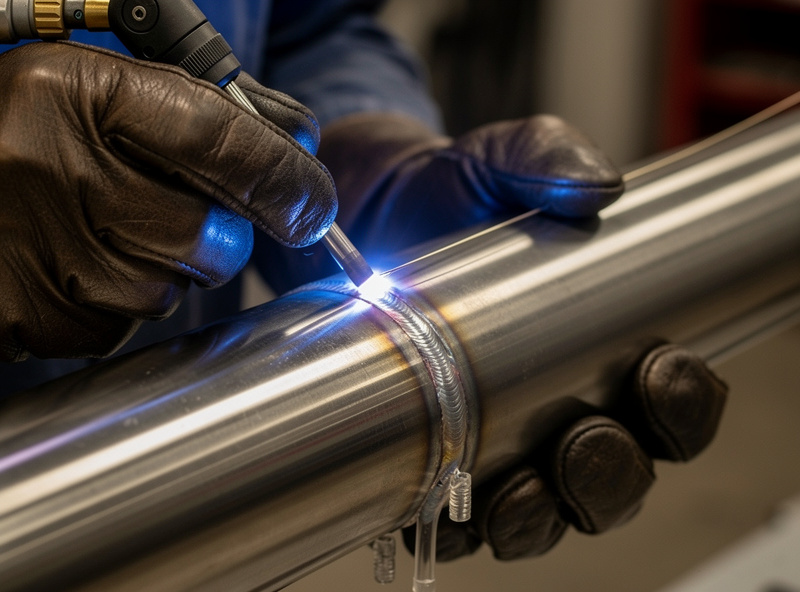
316 welds almost identically to 304 — low heat, ER316L filler to match the molybdenum chemistry and keep carbon low — but the projects it goes into often demand one more step: backpurging. When you weld stainless tube or pipe, the back side of the root oxidizes badly without an argon purge inside, a chalky gray crust called sugaring that wrecks both corrosion resistance and strength. For sanitary, food, or marine tube, I flood the inside with argon before striking the arc. On open plate and brackets, backpurging is overkill, but on closed tube it is the difference between a real corrosion-proof joint and one that rots from the inside. 316 is what I would choose for hardware on the aluminum boat that has to share saltwater duty with the hull. Compare it to the aluminum side in my aluminum grades guide.
Disclosure: HomeWelder is reader-supported. As an Amazon Associate I earn from qualifying purchases made through links in this article, at no extra cost to you. I only point to gear I actually use or would buy for my own shop.
409 Stainless: The Exhaust Grade
409 is a ferritic stainless at about 11% chromium with little nickel — magnetic, the cheapest stainless, and built for automotive exhaust. It tolerates exhaust heat and resists corrosion far better than mild steel, but it can show surface rust and lacks the polished look and full corrosion resistance of 304 or 316.
409 exists because nobody wants to pay 316 prices to build an exhaust system. It handles the heat-and-cool cycling of exhaust gas without scaling away like mild steel, and the magnetic ferritic structure is fine for that job. The trade-off is real: lower chromium means less corrosion resistance, so 409 will haze and surface-rust where 304 stays bright. It is welded with ER409 filler or, commonly in home shops, ER308L, which ties it in reliably. For a header or muffler build it is the right economical choice; for anything that needs to look like stainless or live in saltwater, step up to 304 or 316. Cutting any stainless cleanly is easier with the right tooling from my supplier roundup and a dedicated cutoff setup.
Stainless Grades Compared for Welding
| Grade | Family | Key Alloy | Magnetic | Filler / Best Use |
|---|---|---|---|---|
| 304 | Austenitic | 18% Cr, 8% Ni | No | ER308L / food, general |
| 316 | Austenitic | +2-3% Molybdenum | No | ER316L / marine, chemical |
| 409 | Ferritic | ~11% Cr, low Ni | Yes | ER409 / exhaust |
| 430 | Ferritic | ~17% Cr, no Ni | Yes | ER430 / trim, appliances |
| 2205 | Duplex | 22% Cr + Mo | Slightly | ER2209 / high-strength marine |
For dissimilar joints — welding any stainless to mild steel — ER309L is the filler that bridges the two chemistries reliably, a useful one to keep on the shelf. Dial heat to the actual thickness with my settings chart, and remember stainless wants less of it than mild steel.
Stainless Welding Safety: Hexavalent Chromium
Welding stainless releases hexavalent chromium, a confirmed carcinogen, in the fume. This is not a nuisance to wave off — it is a genuine cancer risk that demands real ventilation, a fume extractor at the arc, and a P100 or PAPR respirator. Stainless fume safety is non-negotiable in any home shop.
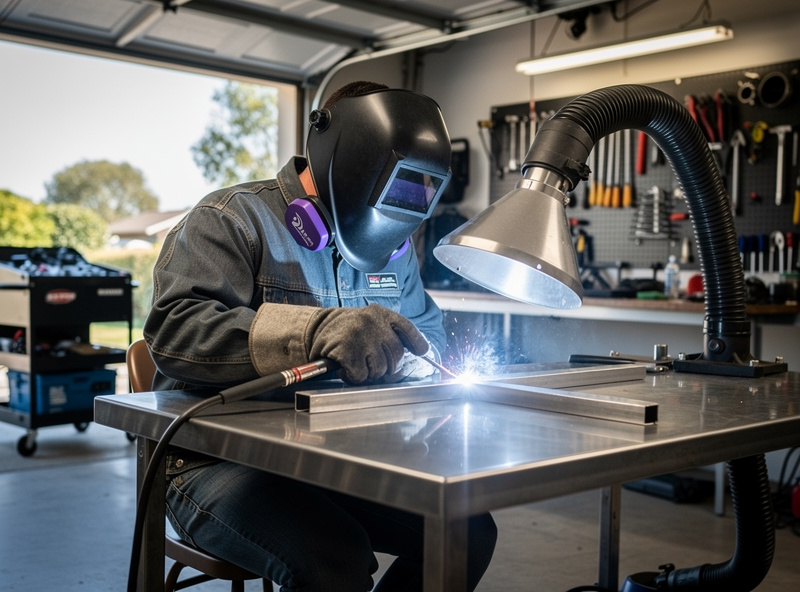
Every stainless grade contains the chromium that makes hex chrome under the arc, so this applies to 304, 316, and 409 alike. I will not weld stainless without forced ventilation pulling fume away from my face and a P100 respirator on, and in a closed garage I run a powered extractor over the bench. The fume is worse the hotter and more you grind, so good fitup that needs less rework cuts your exposure too. The full ventilation setup — capture velocity, extractor sizing, garage airflow — is in my home garage ventilation guide. Keep matching ER308L stainless wire dry and clean, the same as any consumable. Treat this section as the one that actually keeps you alive — the rust line on a bad weld is cosmetic; the fume is not.
Frequently Asked Questions
What is the difference between 304 and 316 stainless?
316 is 304 with 2-3 percent molybdenum added, which dramatically improves resistance to chlorides like saltwater, pool chemicals, and de-icing salt. 304 is the cheaper everyday food-grade choice; 316 is the marine and chemical grade. Both are non-magnetic austenitic stainless that weld almost identically.
What filler rod do I use to weld 304 stainless?
ER308L is the standard filler for 304 stainless. The L means low carbon, which prevents chromium carbides from forming in the heat-affected zone, a problem called sensitization that causes rust along the weld. Use ER316L for 316, and ER309L when joining stainless to mild steel.
Is welding stainless steel dangerous?
Yes, the fume is. Welding any stainless releases hexavalent chromium, a confirmed carcinogen. You need forced ventilation or a fume extractor at the arc plus a P100 or PAPR respirator. This applies to 304, 316, and 409 alike, since all contain the chromium that forms hex chrome under heat.
Can you weld 409 stainless exhaust?
Yes. 409 is a ferritic stainless made for automotive exhaust and welds with ER409 filler or commonly ER308L in home shops. It tolerates exhaust heat far better than mild steel but offers lower corrosion resistance than 304 and can show surface rust over time.
Why does stainless warp so much when welded?
Stainless has lower thermal conductivity and higher thermal expansion than mild steel, so heat concentrates locally and the metal moves more as it expands and contracts. Keep heat input low, use tack welds and a sequence that balances the heat, and clamp the work to control distortion.
What is backpurging stainless?
Backpurging floods the back side of a stainless weld with argon to stop the root from oxidizing into a chalky gray crust called sugaring. It is essential on closed tube and pipe for sanitary, food, or marine work, but unnecessary on open plate and brackets where the root is exposed to air.

Discussion (0)