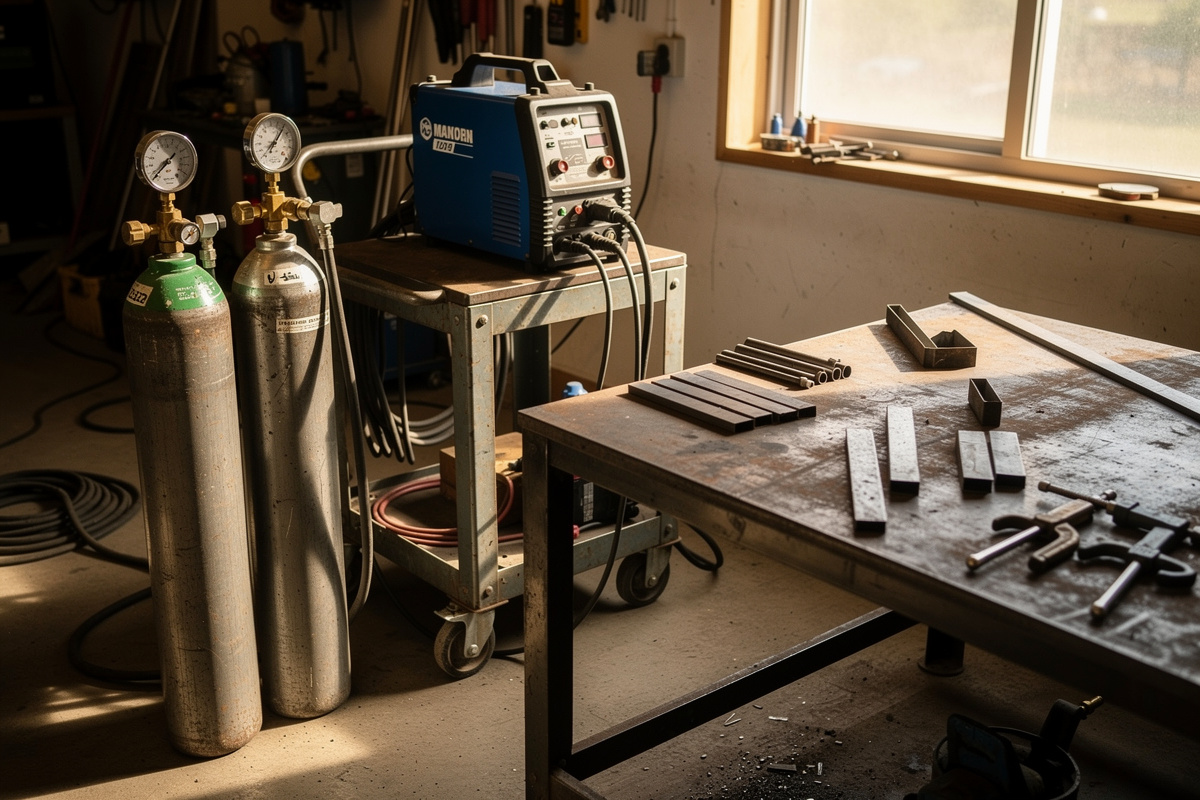

The short answer most beginners need: run C25 (75% argon / 25% CO2) for everyday short-circuit MIG on mild steel. C100 (straight CO2) penetrates deeper and costs less but spatters hard, and C10 (90/10) is the mix you reach for once you want spray transfer on thicker plate.
Gas is the cheapest thing on the cart and the first thing a beginner blames for an ugly weld — usually wrongly. After years of running a single 80 CF cylinder on my YesWelder MIG-PRO205DS until the dial-in was muscle memory, I can tell you the mix matters less than the people selling exotic bottles claim, but the wrong mix absolutely reads as “bad welder” to anyone who knows steel. This guide is the mix chart I wish someone had handed me, with the trade-offs that actually change your bead. It sits under the MIG welding complete guide; for the broader picture of every shielding gas (including TIG and tri-mix), see my welding gas guide.
What the C25, C100, and C10 Numbers Mean
The “C” stands for carbon dioxide and the number is its percentage. C25 is 25% CO2 with the balance argon (75/25). C100 is 100% CO2. C10 is 10% CO2, 90% argon. That single CO2 percentage controls penetration depth, spatter, arc harshness, and whether the gas can support spray transfer.
Argon is the inert workhorse — it gives a smooth, stable arc and a soft, wetting puddle, but on its own it barely penetrates steel and tends to run ropey. CO2 is a reactive gas that drives the arc deeper and hotter and is dirt cheap, but it makes the arc rougher and throws more spatter. Every MIG steel mix is a balancing act between those two: enough CO2 to dig in, enough argon to stay smooth. That is the whole story behind the numbers. Straight argon, by the way, is for aluminum and TIG only — run it on steel and you get a wandering, under-penetrated bead that fools beginners into thinking their machine is weak.
C25 (75/25): The Home Shop Default
C25 is the right first cylinder for 95% of home welders. The 25% CO2 gives enough penetration for 16-gauge through about 1/4-inch steel in short-circuit transfer, while the 75% argon keeps spatter low and the arc soft enough to read. It is the most widely stocked mix, so refills are easy and cheap.
This is what lives on my cart. An 80 CF bottle runs me about $42 to refill locally, and on a hobby duty cycle a single fill lasts months. C25 forgives a beginner: the arc is quiet enough that you can actually hear the “bacon-frying” sizzle that tells you the voltage and wire speed are balanced, and the bead wets out flat without the violent crackle of straight CO2. If you only ever own one gas, this is it. The one place C25 falls short is spray transfer — at 25% CO2 the arc will not transition into the fine, hissing spray mode, so for high-deposition work on thick plate you have to step down to a lower-CO2 mix. For everything a home fabricator builds — brackets, carts, frames, the kind of work feeding toward my aluminum boat — C25 in short-circuit is the answer.
C100 (Straight CO2): Cheap and Deep, But It Bites
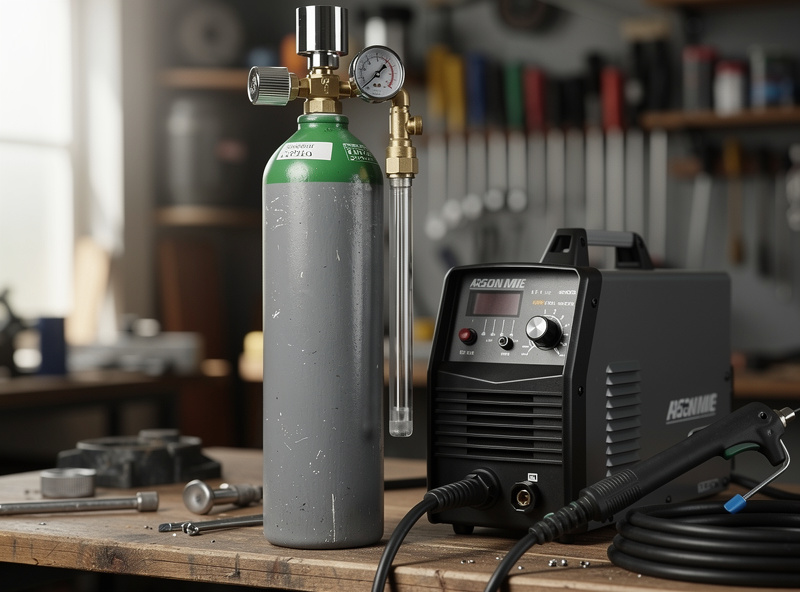
C100 is 100% CO2 — the cheapest shielding gas you can buy and the deepest-penetrating for short-circuit MIG. It is the budget and rust-tolerant choice: it digs through mill scale and light contamination better than C25 and costs a fraction as much. The price is spatter, a harsher arc, and a taller, more rounded bead.
I keep a CO2 bottle around for two reasons: cost and penetration on thicker, dirtier steel where a clean cosmetic bead does not matter — gate hinges, trailer repairs, scrap practice. CO2 produces a globular-leaning transfer that pops and throws molten balls everywhere, so plan on more grinding and a coated nozzle. It also runs hotter, so you typically drop voltage slightly versus C25 to keep from blowing through thin stock. The myth that CO2 is “industrial grade” and therefore better is backwards for a home shop: pros run it for cost and penetration on heavy structural steel, not because it lays a prettier bead. If you weld a lot of rusty reclaimed steel and grinding does not bother you, a CO2 bottle pays for itself. For show-surface work, the spatter is a tax you do not want to pay — and if you are chasing spatter problems, my guide on excessive MIG spatter causes and fixes walks through every cause.
C10 and the Spray-Transfer Mixes
C10 (90% argon / 10% CO2) is the mix for spray transfer and clean work on thicker steel. With argon above roughly 80%, the arc can transition into spray mode at high enough voltage and amperage, depositing metal in a fine, fast, low-spatter stream. C10 also runs cooler-looking and flatter than C25, which welders like on visible structural joints.
Spray transfer is not a short-circuit trick — it needs a machine and a power level most 120V home units cannot reach, generally 200+ amps on 1/4-inch and thicker, which is why I run it off the 240V side of my MIG-PRO. When the conditions are right, spray is gorgeous: a smooth hiss, almost no spatter, and high deposition that eats through a long joint fast. The downside for a beginner is that spray pours a large, hot, fluid puddle that will sag straight through thin material and only works in flat and horizontal positions. There are tighter mixes too — C5 and C8 (5% and 8% CO2) push even further toward spray and are common in production — but for a home shop C10 is the practical “I want spray on thick steel” cylinder. Stainless is a different animal entirely and usually wants a tri-mix (argon/CO2/helium); I cover that in the broader gas guide rather than here.
| Gas Mix | Composition | Penetration | Spatter | Best Use | Relative Cost |
|---|---|---|---|---|---|
| C25 | 75% Ar / 25% CO2 | Medium | Low | Everyday short-circuit on 16 ga to 1/4 in steel | Medium |
| C100 | 100% CO2 | Deep | High | Dirty/rusty steel, thick plate, budget work | Low |
| C10 | 90% Ar / 10% CO2 | Medium-deep (spray) | Very low | Spray transfer on 1/4 in+ steel | High |
| C8 / C5 | 92 to 95% Ar / 5 to 8% CO2 | Spray, shallow short-arc | Very low | Production spray, clean cosmetic welds | High |
| Straight Argon | 100% Ar | Poor on steel | Low | Aluminum MIG/spool gun and TIG only | Medium |
Disclosure: HomeWelder is reader-supported. As an Amazon Associate I earn from qualifying purchases made through links in this article, at no extra cost to you. I only point to gear I actually use or would buy for my own shop.
How Your Gas Choice Changes Your Settings
Switching gas means re-dialing your machine. Moving from C25 to C100 generally calls for dropping voltage about 1 to 2 volts to tame the hotter, deeper arc; moving from short-circuit C25 to spray-capable C10 means raising both voltage and wire speed dramatically to cross into spray. You cannot just swap bottles and weld the same numbers.
On my bench the routine is: change the gas, grab a piece of scrap the same thickness as the job, and run test beads until the sound is right before I touch the real part. C25 short-circuit gives that steady frying sizzle; CO2 sounds coarser and pops; spray on C10 settles into a smooth, unbroken hiss. The numbers on a chart get you close, but the sound and the puddle tell the truth — chase those, not a sticker on the door. My full MIG settings chart by metal thickness gives the starting voltage and wire-speed ranges; treat the gas as the variable that shifts those a notch one way or the other. And remember that gas is only one leg of the consumable triangle — wire and contact tips matter just as much, which I break down in the welding consumables guide.
Flow Rate, Regulators, and the Gear That Matters
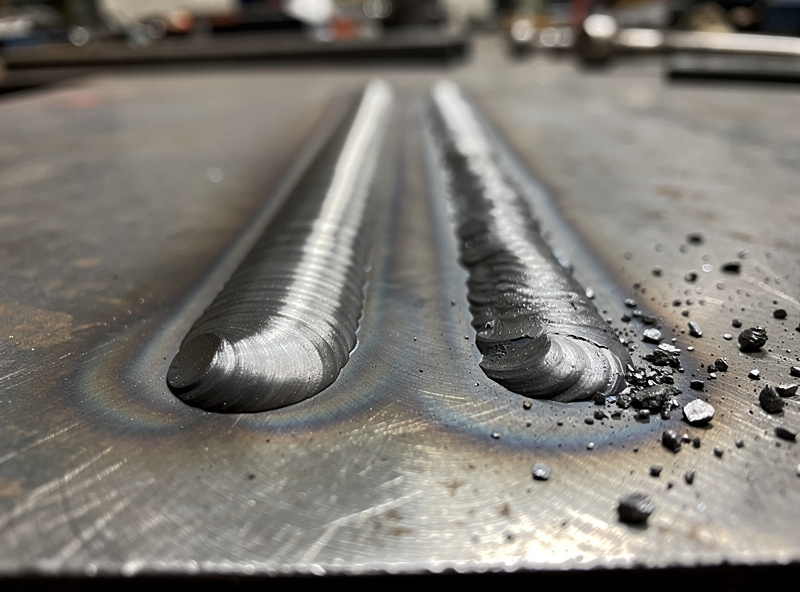
Set your flow to roughly 20 to 25 CFH for indoor MIG, not higher. More gas is not more protection — past about 25 CFH the flow turns turbulent at the nozzle and actually sucks air into the puddle, causing the exact porosity beginners crank the gas up to prevent. The single most common beginner gas mistake is over-flowing.
I learned this one the painful way. Early on I cranked my flowmeter to 35 CFH thinking more shielding had to be better, and pinholed the entire length of my first C25 bead — porosity start to finish from turbulence pulling in air. Dropping to 22 CFH fixed it instantly, and 22 has been my indoor number ever since. Read the gas off a proper flowmeter, not a cheap pressure-only regulator — I run a floating-ball flowmeter so I can see actual CFH, not guess from PSI. If you weld in any breeze, no flow rate saves you; the wind strips the shield away, which is exactly when you switch to self-shielded flux-core instead. A clean regulator, a leak-free hose, and tips that match your wire keep the gas doing its job. A reliable MIG flowmeter regulator with a floating ball is the upgrade I push hardest, a pack of correctly-sized MIG contact tips keeps feeding consistent, and a can of anti-spatter nozzle gel earns its place the day you run CO2. None of it is pricey, and all of it protects the gas you paid for.

Frequently Asked Questions
What is the best MIG welding gas for a beginner?
C25 (75% argon, 25% CO2) is the best all-around gas for a home beginner welding mild steel. It penetrates well from 16 gauge to about 1/4 inch, spatters far less than straight CO2, and the soft arc is easy to read by sound while you learn to balance voltage and wire speed.
Can I use 100% CO2 instead of C25 for MIG welding?
Yes. Straight CO2 penetrates deeper and costs much less than C25, and handles rusty steel better, but it spatters heavily and gives a harsher arc and a taller bead. It is a good budget or heavy-penetration choice, just expect more grinding and drop the voltage slightly versus C25.
What gas do I need for MIG spray transfer?
Spray transfer needs a high-argon mix, generally 90% argon or more, such as C10 (90/10), C8, or C5. With argon above about 80% and enough voltage and amperage (usually 200+ amps), the arc transitions into a fine, low-spatter spray. C25 has too much CO2 to spray.
Why is my MIG weld porous even with gas on?
The most common cause is too much gas flow. Above roughly 25 CFH the stream turns turbulent at the nozzle and pulls air into the puddle, creating pinhole porosity. Set 20 to 25 CFH indoors, check for hose leaks, and never weld in a breeze that blows the shield away.
What flow rate should I set for MIG welding?
Set about 20 to 25 CFH for indoor MIG on a standard nozzle. Increase slightly for a larger nozzle or longer stickout, but more is not better — excessive flow causes turbulence and porosity. Use a floating-ball flowmeter so you read actual CFH rather than guessing from a pressure gauge.
Can I use straight argon for MIG welding steel?
No. Straight argon does not penetrate steel well and produces a narrow, ropey, under-fused bead because steel needs the reactive CO2 component for arc stability and penetration. Save pure argon for aluminum MIG, spool-gun work, and TIG. For steel, use C25, CO2, or a spray mix instead.

Discussion (0)