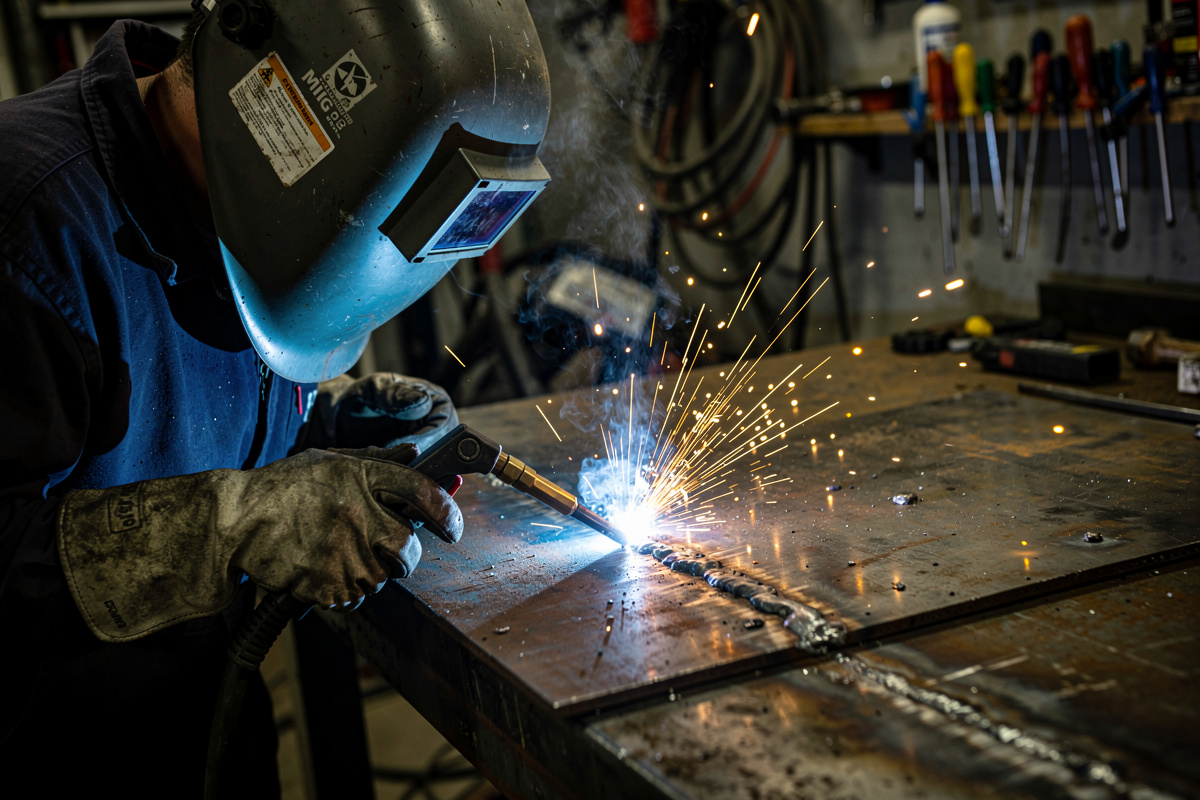

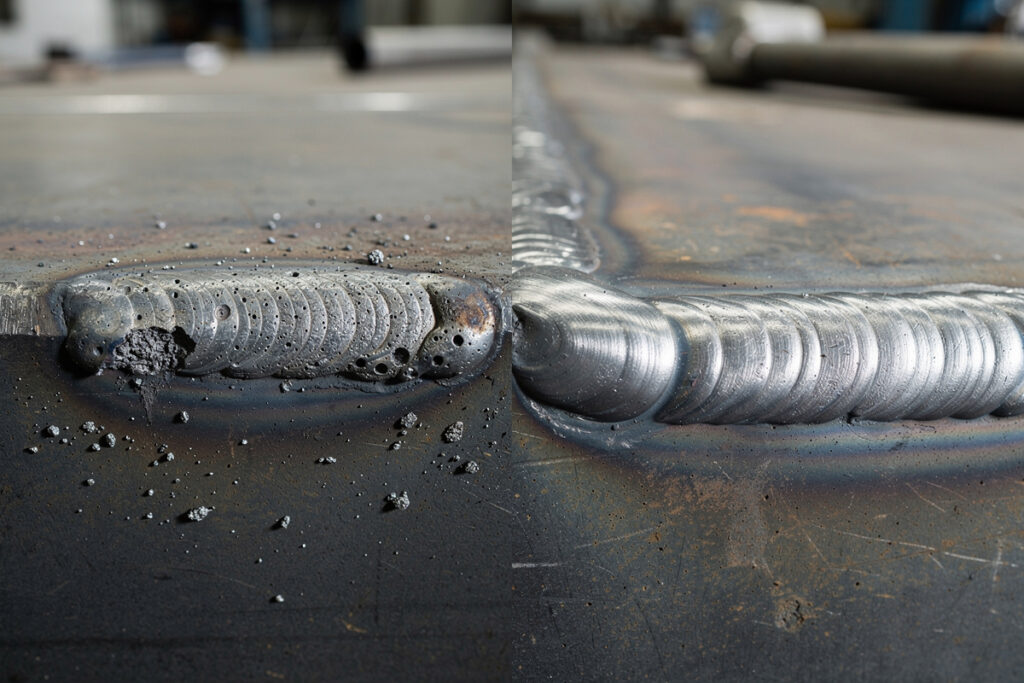
The 10 common causes of excessive MIG welding spatter (the spatter some people spell “splatter”): voltage wrong for amperage, dirty steel surface, wrong shielding gas, gun angle too steep, travel speed wrong, contaminated ground, gas flow wrong, worn or wrong-sized contact tip, wire feed inconsistency, damp wire. To reduce spatter fast, the single biggest fix is to clean steel to bare metal and tune voltage by sound.
I have hit nine of the ten causes on this list at least once across 80 home projects. The most-frequently-self-inflicted is dirty steel — I assumed mill scale was fine because the wire is ER70S-6 (per AWS A5.18) and the deoxidizers tolerate light contamination. They tolerate light scale, not the heavy oxide and oil from a yard rack. Listen for the steady frying-bacon hiss; popping = voltage too high, sluggish hissing = wire speed too high. The full diagnostic playbook is in the welding troubleshooting guide. Written by Kenny Nyhus Fadil.
Cause 1: Voltage Mismatch with Wire Feed Speed
Voltage too low for the wire feed speed produces “cold” spatter — large round beads of metal scattered around a weak under-penetrated weld. Under-penetration is also a cracking risk on anything that sees load — the weld cracking causes and prevention guide covers why cold welds crack first and what you can change to get genuine fusion. Voltage too high produces “hot” spatter — finer beads with a noisy popping arc. Both are mismatches between the two main MIG controls. The right combination produces a steady frying-bacon sound and a smooth bead.
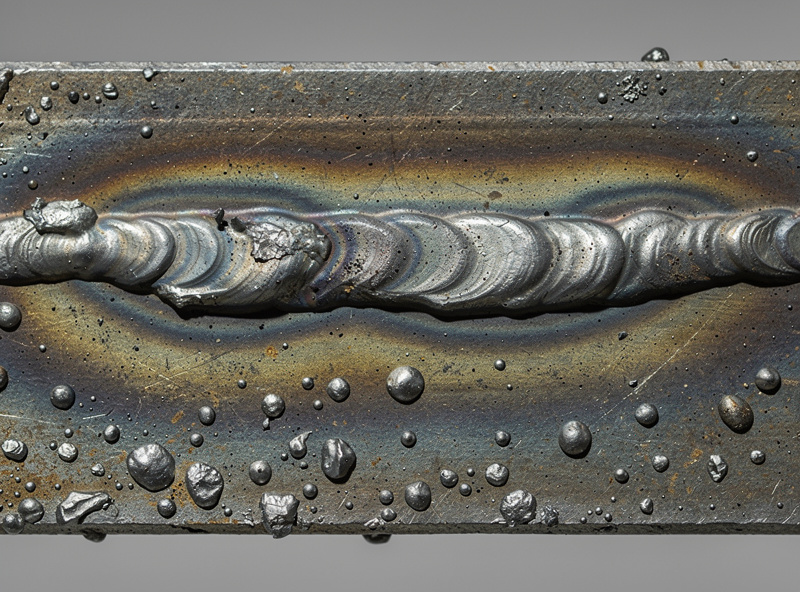
Use the chart inside your welder’s wire compartment as a starting point, then fine-tune by ear. Crackling or popping = voltage too high; turn down a quarter turn or raise wire speed 5%. Sluggish hissing = wire speed too high or voltage too low; turn voltage up a quarter turn. The MIG welding settings chart covers voltage and wire speed by metal thickness.
Cause 2: Dirty Steel Surface
Mill scale, rust, oil, paint, and galvanized coating all cause spatter. The contamination boils off into the weld puddle, blowing molten metal outward as bubbles burst. The visual signature is a porous bead with random spatter direction. Mill scale is the most common offender on new steel — it looks like clean metal but is a thin oxide layer that boils into the weld.
The fix is mechanical preparation. Grind the weld zone to bare bright metal with a flap disc — extending an inch on either side of the joint. Solvent-wipe with acetone after grinding to remove grinding residue. This single step fixes about 30% of “spattery weld” complaints from beginners. Stick welding tolerates dirty steel; MIG does not. If you run both processes and are seeing problems specific to stick, the stick welding problems and fixes guide covers electrode sticking, arc blow, porosity, and cracking in one place.
Cause 3: Wrong Shielding Gas
Pure CO2 produces more spatter than 75/25 argon-CO2 mix on mild steel. Pure argon (used for aluminum) produces extreme spatter on steel because it does not stabilize the arc. Many beginners with multi-gas welders accidentally use the wrong cylinder. The classic confusion is using stainless tri-mix (90/7.5/2.5 helium-argon-CO2) on carbon steel — very expensive and produces erratic spatter.
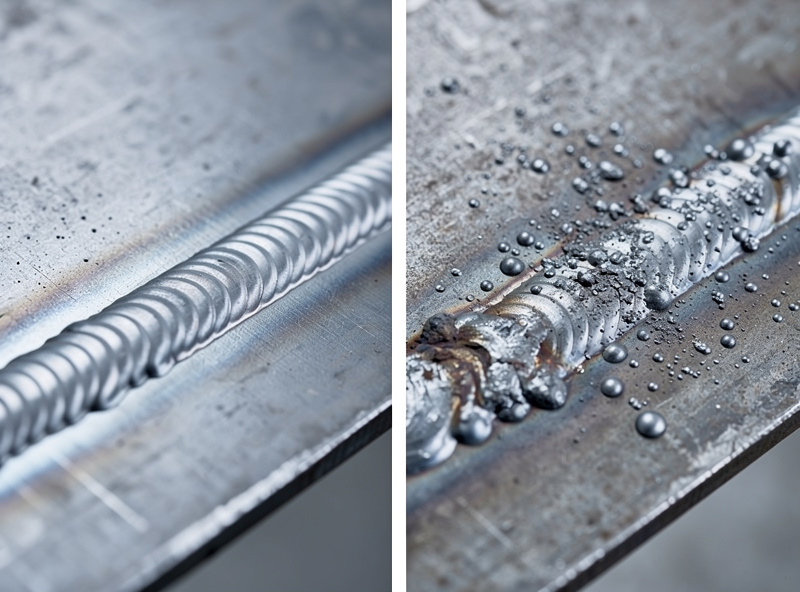
For mild steel, use 75/25 argon-CO2 (often called C25) — it produces the cleanest beads with minimal spatter and good penetration. Pure CO2 is cheaper but always spatters more. Verify the cylinder label before connecting; different gases sometimes ship in identical-looking bottles. The welding consumables guide covers gas mix selection by metal type.
Cause 4: Gun Angle Wrong
MIG works best at a 5-15 degree push or pull angle from vertical. Holding the gun at 30+ degrees forces molten metal to spray outward instead of building into the bead. The classic beginner mistake is dragging the gun nearly flat to the workpiece “to see better” — this produces both spatter and weak penetration.
The fix is wrist position. Pretend you are pushing the wire into the joint from a slight angle, not raking it across the surface. Beginners benefit from practicing on cardboard with a marker first to build the muscle memory of correct gun position. Most welder instruction videos demonstrate this; watch one and mimic until it feels natural.
Cause 5: Travel Speed Wrong
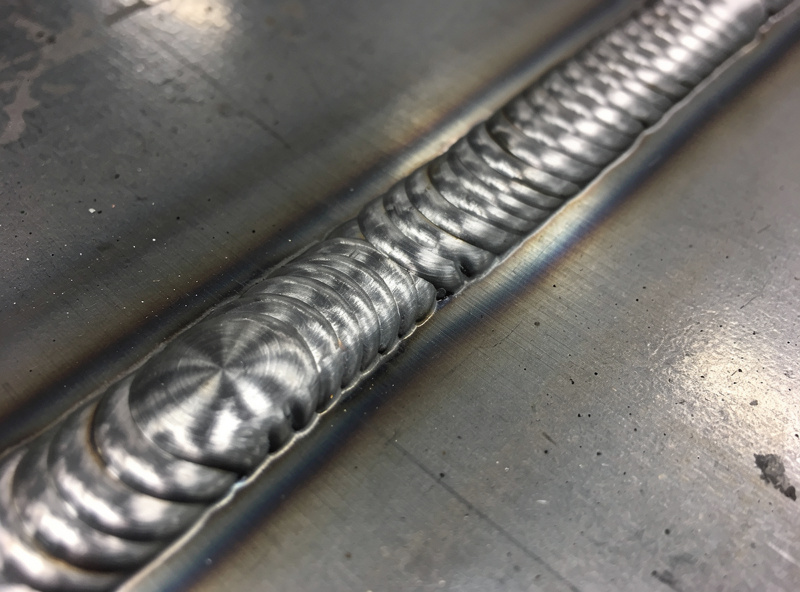
Moving too slowly produces a fat bead with high heat that spatters as molten metal piles up — and high heat input is also what pulls metal out of square and causes warping in thin stock. The welding distortion control guide covers the backstep, tack-sequence, and fixture strategies that reduce warping when heat cannot be avoided. Moving too fast produces a thin string-bead with cold spatter that did not have time to integrate. The right travel speed produces a stacked-dime ripple pattern with bead width roughly 2-3 times the wire diameter.
Beginners universally start by moving too slowly — the welder’s hand instinct is to “weld it well” by lingering. Train yourself to move steadily across the joint at a pace where the bead width stays consistent. A useful mental cue: count “one-thousand-one, one-thousand-two” while moving 1 inch of bead — that pace is roughly right for most home MIG settings.
Cause 6: Bad Ground Connection
Ground clamp on paint, rust, mill scale, or galvanized coating produces voltage drops at the arc that mimic voltage-too-high symptoms — popping, spatter, and inconsistent penetration. The diagnostic test: grind a clean spot on the workpiece and clamp directly to that spot. If spatter improves immediately, the original ground was the cause.
Make this a checklist item before every weld: clean spot, direct attachment, no painted welding table between clamp and workpiece. Bad ground accounts for roughly 20% of “spattery weld” complaints and is the easiest fix on the list. See the MIG burnback troubleshooting guide for related ground-circuit diagnostics.
Cause 7: Gas Flow Rate Wrong
Shielding gas flow needs to be 18-25 cubic feet per hour (CFH) for typical home MIG. Too low (under 15 CFH) causes porosity and spatter from atmospheric contamination. Too high (over 30 CFH) creates turbulent flow that pulls air INTO the shielding gas envelope — same effect, more spatter. Both extremes produce the same visual symptom.
Set the regulator to 20 CFH as a starting point and adjust by results. If welding outdoors in any breeze, increase to 25 CFH and also use a windbreak — even gentle wind disrupts shielding at standard flow rates. Verify gas is actually flowing by triggering the gun briefly before welding; sometimes the cylinder valve is partly closed and the welder thinks gas is on.
Cause 8: Contact Tip Worn or Wrong Size
Contact tips wear out after 8-15 hours of welding. A worn tip cannot maintain consistent electrical contact with the wire, producing arc instability that manifests as spatter. Wrong tip size (mismatched to wire diameter) causes erratic feeding plus arc instability. Replace tips at the first sign of arc inconsistency, not when they look worn.
Buy a 10-pack of contact tips in your wire size for $8-12. Swap one in any time spatter increases for no apparent reason. Verify the size stamping on each new tip matches your wire diameter — 0.030 with 0.030, 0.035 with 0.035. Tip mismatch is one of the cheapest possible mistakes to fix and one of the most common spatter causes for first-month welders.
Cause 9: Wire Feed Inconsistency
Erratic wire feed — caused by drive roll tension wrong, kinked liner, or worn drive rolls — produces irregular spatter as the arc length varies during the weld. For a complete diagnosis of every wire-feed failure mode, the MIG wire feed problems guide covers birdnesting, slipping drive rolls, and liner replacements step by step. The diagnostic is observing the wire feed: if the wire occasionally hesitates or surges visibly during welding, the feed mechanism is the issue. A consistent wire push produces a consistent arc.
The fix order is: re-tension drive rolls (minimum tension that prevents slip), inspect liner for kinks (replace if present), then check drive rolls for wear (deep grooves indicate replacement needed). Drive rolls cost $10-25 and last 200-500 hours of welding. Liners cost $10-30 and last 100-300 hours.
Cause 10: Damp or Contaminated Welding Wire
Welding wire absorbs moisture from humid air. Wire stored in a garage through summer humidity often shows porosity and spatter from the moisture boiling out during welding. The visual signature is fine spatter scattered around an otherwise reasonable bead. New wire from a sealed package welds clean; opened spools left exposed for months tend to deteriorate.
Store opened wire spools in sealed containers with desiccant packets, especially in humid climates. If a spool produces unexpectedly poor welds and the welder has been working fine on other tasks, replace the wire and see if welds improve. Wire is cheap ($10-30 per pound); chasing other causes when the wire is the actual problem wastes hours.
Spatter Symptom Decoder
| Spatter pattern | Most likely cause | Fix in 5 minutes |
|---|---|---|
| Large round cold beads | Voltage too low | Raise voltage 1/4 turn |
| Fine spatter, popping arc | Voltage too high | Lower voltage 1/4 turn |
| Random spatter + porosity | Dirty steel or bad gas | Grind clean, verify gas mix |
| Spatter mostly to one side | Wrong gun angle | Hold at 5-15° from vertical |
| Cold thin bead with spatter | Travel speed too fast | Slow down to count pace |
| Hot fat bead with spatter | Travel speed too slow | Speed up by 30% |
| Spatter + weak arc | Bad ground | Grind clean spot, attach directly |
| Spatter outdoors only | Gas flow too low or wind | Raise to 25 CFH + windbreak |
| Spatter after years of OK welds | Damp wire spool | Replace wire spool |
Gear That Actually Cuts Spatter
Disclosure: HomeWelder is reader-supported. As an Amazon Associate I earn from qualifying purchases, at no extra cost to you. I only point to gear I run on my own bench or would buy again.
Technique fixes most spatter — but once your settings are dialed in, the right consumables keep it from creeping back. Four things live permanently within arm’s reach of my bench:
- Quality ER70S-6 wire. Cheap no-name wire feeds erratically and spatters more. I run Lincoln SuperArc L-56 (ER70S-6) in 0.030 — the copper coating and high-silicon deoxidizers give a steadier arc on mild steel and shrug off light mill scale that makes budget wire pop and scatter.
- Anti-spatter nozzle gel. It won’t stop spatter forming, but dipping the hot nozzle in anti-spatter nozzle gel stops it clogging, which keeps gas coverage even — a choked nozzle is its own slow spatter cause (see Cause 7).
- Fresh contact tips. A worn tip is one of the most overlooked spatter causes on this list (Cause 8). Keep a 10-pack of contact tips in your exact wire size on the shelf and swap one in the moment the arc turns erratic.
- MIG pliers. A pair of MIG welding pliers reams spatter out of the nozzle, pulls hot tips, and snips wire — the fastest way to keep a clean nozzle between welds instead of letting buildup choke your gas.
Frequently Asked Questions
Why is my MIG welder spattering so much?
The most common causes of excessive MIG spatter are voltage mismatched with wire feed speed, dirty steel surface (mill scale, rust, paint), wrong shielding gas, and bad ground clamp connection. Listen for a smooth frying-bacon sound at the correct settings; popping or crackling indicates voltage too high relative to wire speed. Clean steel down to bare bright metal before welding to fix about 30% of cases.
What gas reduces MIG welding spatter?
Use 75/25 argon-CO2 mix (C25) for mild steel — it produces the cleanest welds with minimal spatter and good penetration. Pure CO2 is cheaper but always produces more spatter. Pure argon is for aluminum only and causes extreme spatter on steel. For stainless steel, use a tri-mix (98/2/0.5 argon/CO2/oxygen or similar) — never use C25 on stainless.
Should I use anti-spatter spray on MIG welds?
Anti-spatter spray prevents spatter from sticking to the workpiece and the contact tip nozzle, but does not reduce the spatter produced. Apply it to the work surface before welding to make cleanup easier and to the inside of the gas nozzle to prevent spatter buildup. Anti-spatter spray is a useful aid but does not solve underlying spatter causes — focus on technique first.
What is the right voltage for MIG welding 1/8 inch steel?
For 1/8 inch (3 mm) mild steel with 0.030 wire and 75/25 gas, start at 18-20 volts and 250-300 IPM wire feed speed. Adjust by sound: a steady frying-bacon noise indicates correct settings. Crackling means voltage is too high; sluggish hissing means feed speed is too high or voltage too low. Reference your welder’s internal chart for specific machine recommendations.
Can a worn contact tip cause MIG spatter?
Yes — a worn contact tip loses consistent electrical contact with the wire, producing arc instability that manifests as random spatter and inconsistent welds. Contact tips last 8-15 hours of moderate welding before performance degrades. Replace tips at the first sign of arc inconsistency rather than waiting for visible damage. New tips cost $1-3 each in 10-packs.
Does mill scale on steel cause MIG spatter?
Yes — mill scale is a thin oxide layer on new hot-rolled steel that looks like clean metal but boils off during welding, blowing molten metal outward as bubbles burst. The result is porous welds with random spatter direction. Always grind the weld zone to bare bright metal with a flap disc, extending an inch on either side of the joint, before MIG welding.

Discussion (0)