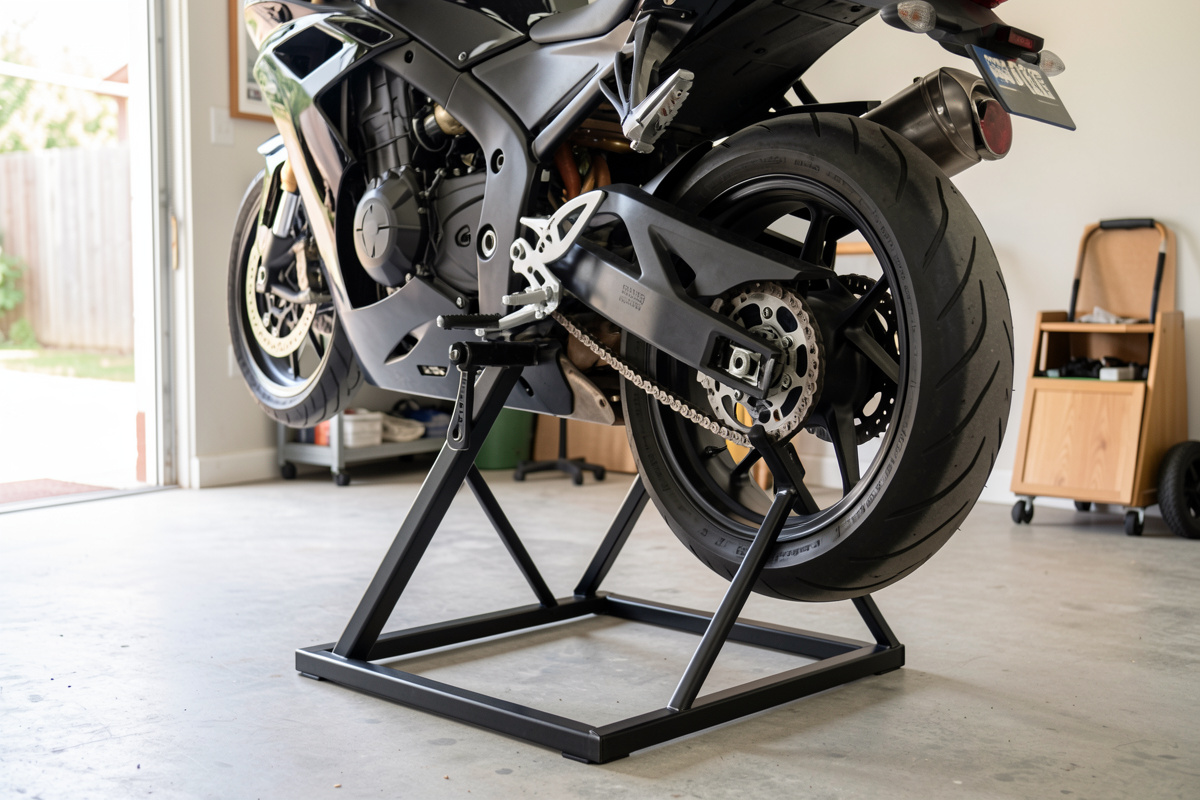

A welded motorcycle maintenance stand is built from 1.5-inch square tube with a triangulated base wide enough that the bike cannot tip, and a lift point matched to your machine: a swingarm-spool stand for sportbikes, a center-lift or scissor design for everything else. I welded mine to lift the rear wheel off the ground for chain and tire work, and the single rule I will not bend is this: triangulate the base and overbuild it, because a stand that folds under a 400-pound motorcycle is a wrecked bike at best.
This is a load-bearing safety project, which changes how I weld it compared to a trellis or a bench. Every joint is in the load path, so there are no decorative tack-and-move welds here; everything gets fully fused and, where I can, gusseted. I will walk the swingarm-spool rear stand I built, the geometry that keeps it stable, and the weld quality this project actually demands.
Pick the Stand Type for Your Bike
A rear swingarm stand lifts a sportbike by spools threaded into the swingarm and is the simplest strong build. A rear stand with L-shaped lift hooks catches the swingarm directly on bikes without spools. A front stand lifts under the lower triple clamp and needs the rear stand in place first. A center-lift or scissor jack handles cruisers and bikes with no good rear lift point. Build the one that matches your bike’s lift points, not the one with the prettiest plans, because a stand that contacts the wrong part of the frame bends bodywork or the swingarm.
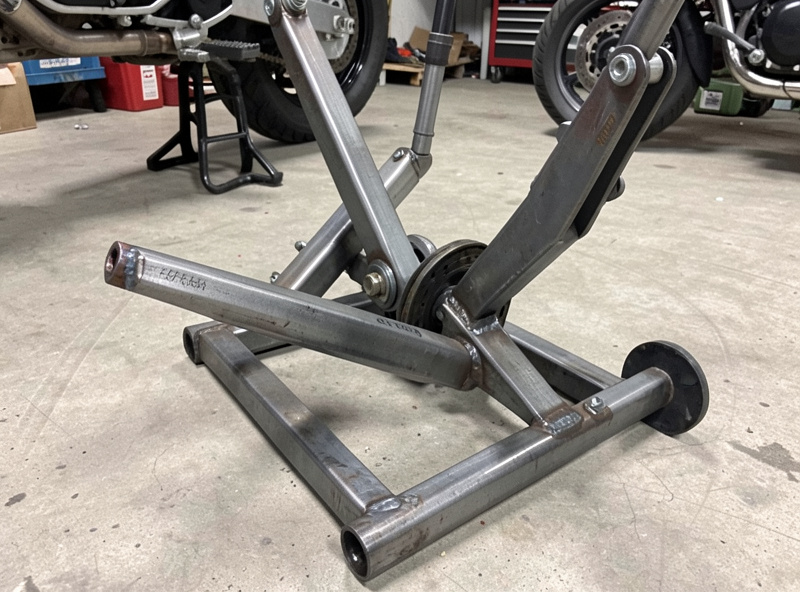
I built the swingarm-spool rear stand because my bike has the spool bosses and it is the most stable design for chain, sprocket, and rear-tire work. The lift arms cradle the spools, the bike pivots up as I push the handle down, and a stop holds it at full lift. Everything below depends on that geometry being right, so I mocked it up in cardboard and steel offcuts before I cut good tube.
The Geometry That Keeps It Stable
Stability comes from base width and a low, forward center of gravity, not from heavy steel. My base is a wide U that straddles past the rear tire footprint, so any tip force lands inside the base footprint rather than levering the stand over. The lift arms pivot on a cross tube, and the handle gives enough leverage that the lift is a controlled push, not a heave. I set the over-center geometry so that at full lift the load actually holds the stand down rather than wanting to spring back. That over-center detail is what lets you walk away from a lifted bike.
Casters are a trap on a lift stand unless they lock hard; a bike that can roll while elevated is a bike on the floor. I left mine on fixed feet with rubber pads for grip. Mock the geometry with clamps and scrap before welding, set the bike on it at every stage, and confirm the lift travel and the stop position with the actual motorcycle, never by eye. The numbers that matter here are your bike’s, not a generic plan’s.
Welding to a Load-Bearing Standard
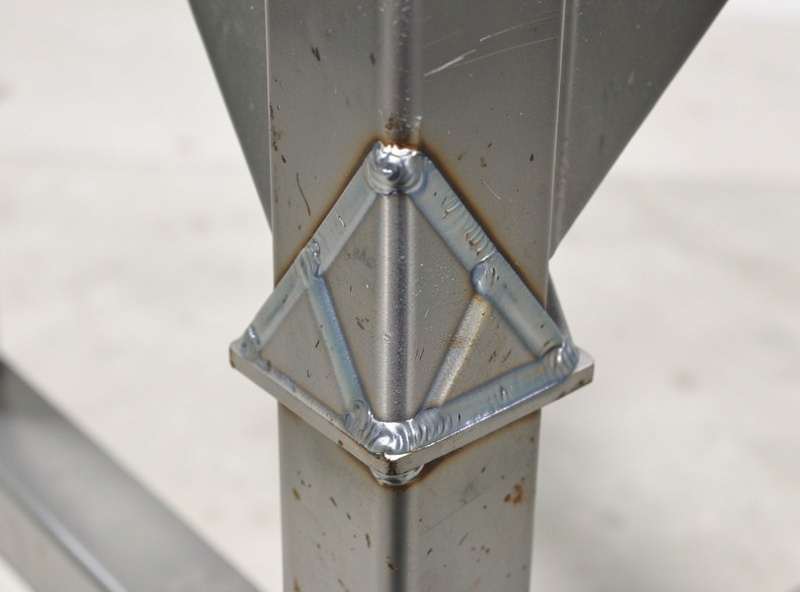
Every joint on this stand is structural, so I fully weld all around each joint where access allows, not stitch-and-skip like a trellis. My MIG-PRO205DS runs 0.030 ER70S-6 under 75/25 on the 1.5-inch tube, around 19 to 20 volts, hot enough for full penetration on the joint thickness. I bevel the heavier joints to open them up for a root pass plus a cap. The lift-arm pivots and the handle junction get gussets, triangular plates welded into the corner, because those are the highest-stress points and a gusset turns a single joint into a braced one.
Grind every joint to bright metal first and check your fitup so joints are tight, not gap-filled with wire. On a load path, lack of fusion is the failure mode that hides: the weld looks fine and lets go under load. Where I cannot see both sides of a critical joint, I weld it before final assembly so I can reach it. After welding, I load-test the stand with weight beyond the bike before I trust it with the motorcycle. A stand you have not tested past working load is not finished.
Pivots, Handles, and Finish
The lift arms pivot on a bolt through a welded sleeve, not a welded-solid joint, so they swing. I weld a tube sleeve into the frame, run a grade-8 bolt through with a nylon-lock nut, and leave it snug but free. The handle is long enough for leverage but not so long it hits the wall behind the bike. I cap the spool-contact ends with hard nylon or weld a smooth cradle so steel never grinds against the bike’s spools.
For the parts of this build that come off a shelf rather than the steel rack, here is what I use. As an Amazon Associate I earn from qualifying purchases.
- Swingarm spools in the right thread for your bike’s bosses.
- Grade-8 bolts and nylon-lock nuts for the pivot.
- Rubber foot pads so the stand grips the floor instead of skating.
Once it passes the load test, I wire-wheel the welds, prime, and paint. A maintenance stand lives in the corner and gets kicked, so a tough enamel beats a pretty finish. Mine has held up to years of oil drips and boot scuffs and still lifts the bike dead level.
| Stand type | Lift point | Best for |
|---|---|---|
| Rear swingarm spool | Spools on swingarm | Sportbikes with spool bosses |
| Rear L-hook | Swingarm underside | Bikes without spools |
| Front triple-clamp | Under lower triple | Front-end work (rear stand first) |
| Center / scissor lift | Frame or engine | Cruisers, no rear lift point |
Frequently Asked Questions
What steel should I use for a motorcycle stand?
Use 1.5-inch square tube for a rear maintenance stand. It is stiff enough for the load and easy to weld with full penetration. Every joint is in the load path, so fully weld each one and add gusset plates at the pivot and handle junctions.
How do I make a welded motorcycle stand stable?
Build a wide, triangulated base that extends past the tire footprint so tip forces land inside the base. Set over-center lift geometry so the load holds the stand down at full lift, and load-test with weight beyond the bike before trusting it with the motorcycle.
What type of motorcycle stand should I build?
Match the stand to your bike’s lift points: a swingarm-spool rear stand for sportbikes with spool bosses, an L-hook rear stand for bikes without spools, a triple-clamp front stand for front work, or a center or scissor lift for cruisers.
Do the lift arms need to be welded solid?
No. The lift arms must pivot, so weld a tube sleeve into the frame and run a grade-8 bolt with a nylon-lock nut through it, snug but free. Welding the arms solid prevents the lift motion. Reserve full welds for the fixed structural joints.
How do I know my motorcycle stand is strong enough?
Load-test it. Apply weight beyond the bike’s lift load and watch every joint before you ever put the motorcycle on it. Lack of fusion on a load path looks fine and fails under load, so testing past working load is the only proof that matters.


Discussion (0)