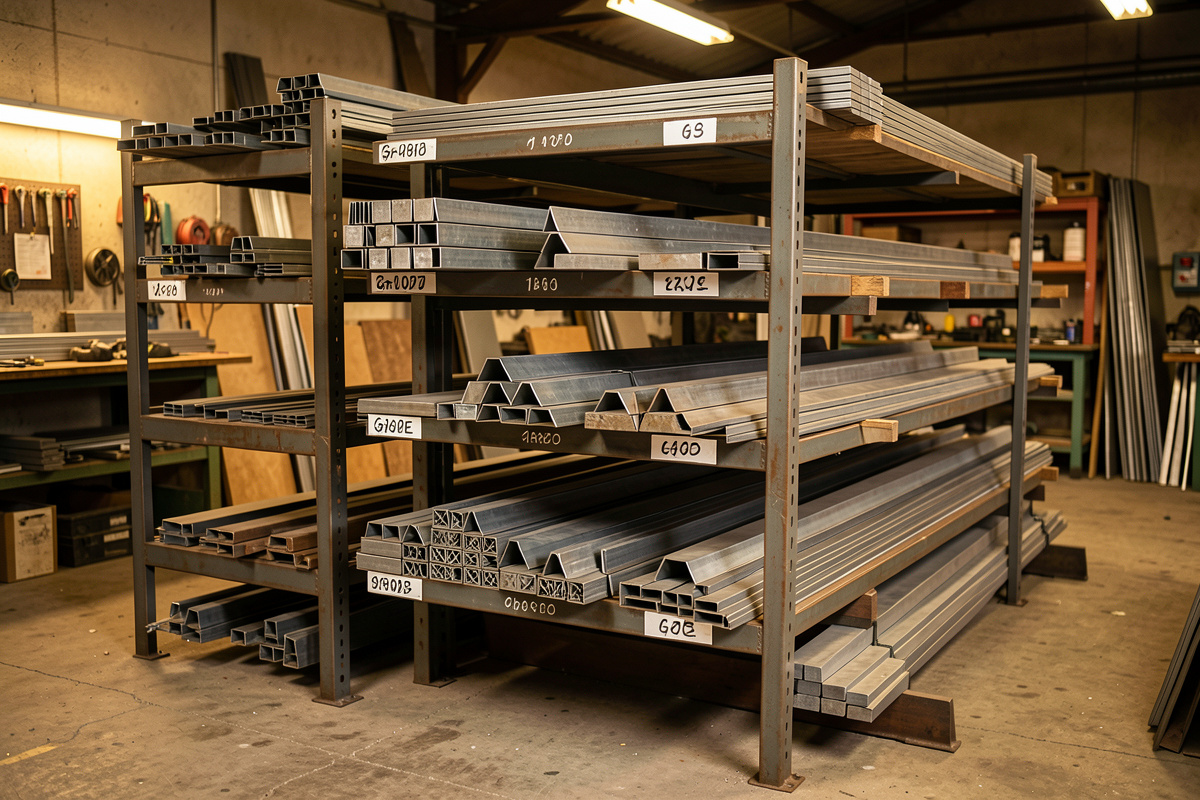

Steel grades tell you how a steel will weld before you ever strike an arc, because the grade encodes the carbon and alloy content that decides hardening and cracking. The fast rule on my bench: under about 0.30% carbon welds freely, and the four-digit grade number tells you that carbon level directly — a 1018 is 0.18% carbon, a 1045 is 0.45% and a different animal entirely.
I run a YesWelder MIG-PRO205DS and I have welded everything from 0.8 mm sheet to 10 mm plate on this bench, and the single biggest predictor of whether a structural weld behaves is which steel grade I am holding. This guide explains what the grade designations actually mean and how to read weldability straight off the number — the understanding layer above the practical pick-this-stock comparison in my steel types for welding breakdown. For the full chemistry picture, this spoke sits under the welding metallurgy guide.
How Steel Grade Numbers Work
The AISI/SAE four-digit system is the code most shop steel is sold under, and once you can read it the steel tells you how it welds. The first two digits identify the alloy family; the last two give the carbon content in hundredths of a percent. So 1045 is plain carbon steel with 0.45% carbon, and 4140 is a chromium-molybdenum steel with 0.40% carbon.
The families that matter to a home welder are short. The 10xx series is plain carbon steel — 1018 and 1020 are the friendly low-carbon ones, 1045 is medium carbon. The 41xx series (4130, 4140) adds chromium and molybdenum for strength and hardenability, which is exactly what makes it harder to weld. Then there is ASTM A36, the workhorse structural steel, which is specified by its mechanical properties rather than an exact recipe — it runs around 0.26% carbon and welds like a dream. When someone hands me unmarked steel, identifying it is step one, and I lean on the same tricks in the existing identify mystery steel guide before I trust a structural joint.
Carbon Content Is the Master Variable
Carbon decides how hard a steel can get when it cools fast, and that hardness is what cracks. Below roughly 0.30% carbon a steel cannot harden enough in the weld zone to be a real cracking risk; between 0.30% and 0.50% it starts to matter; above that, an unmanaged weld can quench to brittle martensite right in the heat-affected zone.
This is why I sort steel into weldability tiers in my head the moment I read the grade. Low-carbon steel (A36, 1018, 1020) welds with no special precautions — clean it, set the machine, go. Medium-carbon steel (1045) needs preheat and a low-hydrogen mindset because its heat-affected zone will harden. High-carbon and tool steels are a different project entirely. The carbon number on the grade is your first and best warning, and it feeds directly into the cooling-rate story I lay out in the heat affected zone welding guide.
Carbon Equivalent: Reading Alloy Steels
For alloy steels, carbon alone undersells the risk, so welders use the carbon equivalent (CE) — a formula that folds carbon and the alloying elements into one number. The common IIW version is CE = C + Mn/6 + (Cr + Mo + V)/5 + (Ni + Cu)/15, and the bench rule is simple: under about 0.40 weld freely, 0.40 to 0.45 start preheating, above 0.45 preheat and post-heat are mandatory. This is the same logic AWS D1.1 uses, basing its prequalified preheat minimums on a steel’s carbon equivalent and section thickness.
Run the numbers on 4140 and you see why it has a reputation. Around 0.40% carbon plus chromium and molybdenum pushes its CE well past 0.60 — firmly in the “preheat or it cracks” zone. A36, by contrast, lands near 0.40 CE, which is exactly why beginners learn on it. The chromium and moly in 4140 are there to make the steel hardenable for shafts and gears; that same hardenability is what turns a cold, fast-cooled weld into a crack waiting to happen. When I have to weld 4140, I preheat to 150–200°C, run it hot, and let it cool slowly — the full routine is in the preheat postheat welding guide.
Matching Filler to the Grade
The filler is part of the steel’s final chemistry, so it has to match the job, not just the look. For the low-carbon steels that make up most home projects, ER70S-6 MIG wire or a 6013/7018 stick electrode covers nearly everything — the 70,000 psi class matches A36 and 1018 strength with room to spare.
It gets more deliberate with alloy steel. On 4140 I reach for a low-hydrogen approach and a filler chosen for the service — sometimes a matching low-alloy wire like ER80S-D2 when strength has to carry through, sometimes deliberately running a tougher, lower-strength filler so the weld stays ductile while the base metal does the hard work. Dirty or rusty steel gets a rod that tolerates it, like 6011, rather than fighting porosity with a wire that demands a spotless joint. The consumable side of this decision is collected in the existing welding consumables guide, and the MIG dial-in is in my MIG settings chart. Where the work crosses into coded or structural territory — a load-bearing 4140 part that someone’s safety rides on — I hand it to my welder friend Mike, who holds the tickets I do not.
The Grades a Home Welder Actually Meets
Most home and hobby steel falls into a handful of grades, and knowing the short list saves a lot of guessing. A36 hot-rolled is the default for frames and brackets; 1018 cold-rolled shows up as bright, accurate bar; mild steel tube and angle is usually A500 or A513; and the trouble grades — 4140, AR400/AR500 wear plate, and spring steels — turn up in salvage and demand respect.
The table below is the cheat sheet I keep in my head when I read a grade off a mill mark or a supplier’s listing. It maps each common grade to its rough carbon level, weldability, and the one thing to do differently.
| Grade | Carbon (approx) | Weldability | What to Do |
|---|---|---|---|
| A36 structural | ~0.26% | Excellent | Clean joint, weld normally |
| 1018 cold-rolled | 0.18% | Excellent | Weld normally, watch tighter fit-up |
| A500 / A513 tube | ~0.23% | Excellent | Grind off mill scale and coatings |
| 1045 medium-carbon | 0.45% | Fair | Preheat, low-hydrogen filler |
| 4140 chromoly | 0.40% | Difficult | Preheat + post-heat, slow cool |
| AR400 / AR500 plate | 0.20–0.30% + alloy | Difficult | Preheat, low-hydrogen, soft filler |
How to Tell What Grade You Have
Unmarked steel is the home welder’s constant problem, and you cannot weld a grade safely if you are guessing at it. Mill markings, supplier paperwork, and a spark test get you most of the way; for anything structural, I treat unknown steel as suspect until proven otherwise.
A spark test on the grinder is the cheapest first read: low-carbon steel throws long, straight, sparse sparks with few bursts, while higher-carbon and alloy steels throw shorter, brighter, more explosive sparkbursts. It is not laboratory chemistry, but on my bench it reliably separates “weld it freely” from “slow down and preheat.” A hardness file confirms it — if a file skates instead of biting, the steel is hard and almost certainly carbon-rich or alloyed. When the stakes are real, I do a destructive test: weld a coupon of the mystery steel with my planned settings, then bend it to failure and read the fracture. A clean, bright, crystalline snap says the heat-affected zone hardened and I need preheat; a ductile tear says I am fine. That break test is the same one I describe in the weld metallurgy basics guide.
Why the Grade Matters More Than the Machine
Beginners obsess over the welder and ignore the steel, but the grade in your hand sets the ceiling on what any machine can do. A 200-amp inverter cannot save a cold weld on 4140 that was never preheated, and the cleanest double-pulse settings in the world will not stop a high-carbon coupon from cracking as it quenches against thick plate.
I learned this the slow way. Early on I blamed my machine for a bracket that cracked at the toe, chased wire speed and voltage for an evening, and only later realized the steel was a mystery alloy from the scrap rack that hardened the moment it cooled. The settings were never the problem — the metallurgy was. Now the grade is the first question I ask, before I touch a dial: what is this steel, what is its carbon, does it need preheat? Answer those and the machine settings become the easy part. Get the grade wrong and no amount of technique covers for it. That ordering — chemistry first, settings second — is the throughline of the whole welding metallurgy guide.
Frequently Asked Questions
What do the numbers in a steel grade mean?
In the four-digit AISI/SAE system, the first two digits give the alloy family and the last two give the carbon content in hundredths of a percent. So 1045 is plain carbon steel with 0.45% carbon, and 4140 is a chromium-moly steel with 0.40% carbon.
What steel grade is easiest to weld?
Low-carbon steels like A36 structural and 1018 are the easiest to weld. They sit near or below 0.30% carbon, so the heat-affected zone cannot harden enough to crack, and they need no preheat or special filler for most home projects.
Why is 4140 steel hard to weld?
4140 has about 0.40% carbon plus chromium and molybdenum, pushing its carbon equivalent past 0.60. That makes the weld zone harden to brittle martensite if it cools fast, so 4140 needs preheat, post-heat, and slow cooling to weld without cracking.
What filler wire should I use for mild steel?
ER70S-6 MIG wire covers nearly all low-carbon steel like A36 and 1018. Its 70,000 psi strength class matches the base metal, and the extra deoxidizers in the S-6 grade tolerate light mill scale better than leaner wires.
How can I tell what grade of steel I have?
Start with mill markings or supplier paperwork. With none, a grinder spark test separates low-carbon (long, sparse sparks) from high-carbon and alloy steel (short, bright, bursting sparks). For structural work, weld and bend a test coupon to confirm it is not hardening.
Can I weld two different steel grades together?
Yes, but match the filler and precautions to the more demanding grade. Welding mild steel to 4140 means treating the joint like 4140: preheat, low-hydrogen filler, and slow cooling, because the alloy side controls the cracking risk.

Discussion (0)