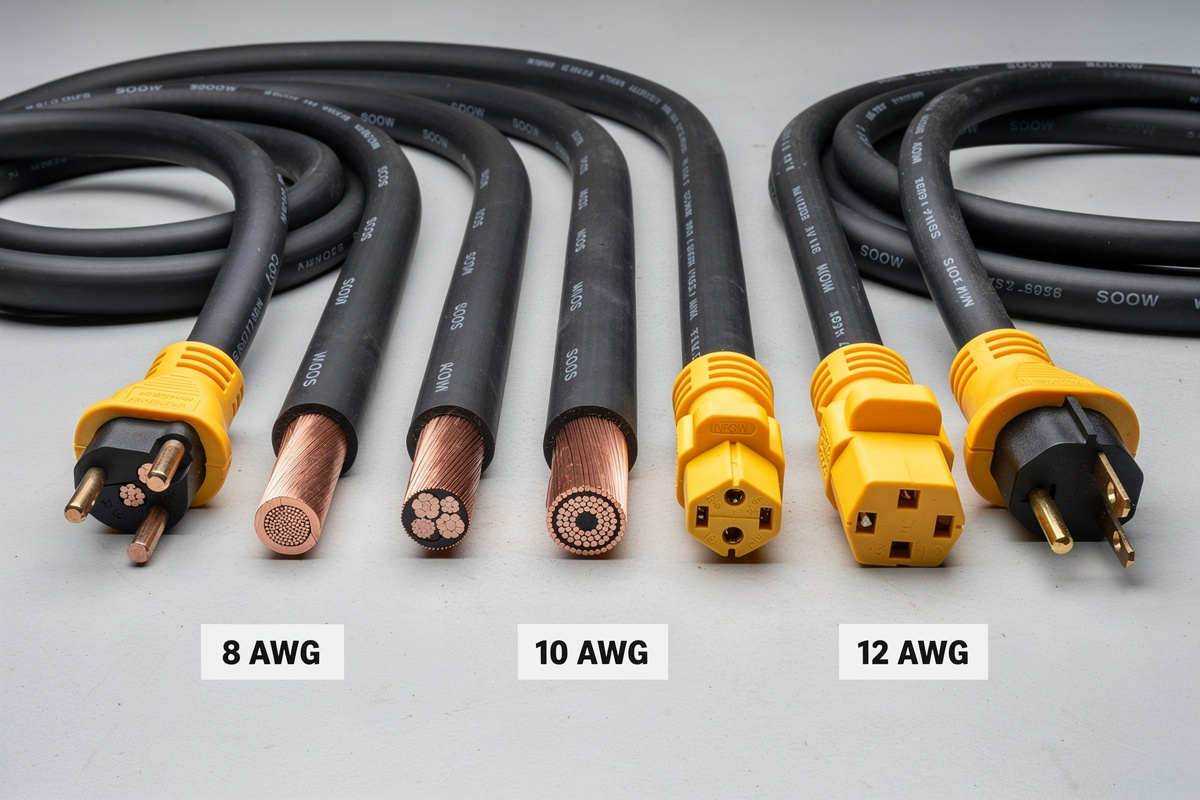

A 240V welder drawing 30-50 amps needs an 8-gauge extension cord no longer than 50 feet to avoid voltage drop that kills arc stability and penetration. A 120V welder on a 20-amp circuit needs 12-gauge minimum up to 50 feet or 10-gauge for 50-100 feet.
I learned this on my own driveway. The garage circuit was not in yet, the welder had to reach 40 feet to an outdoor outlet, and the orange 16-gauge cord I grabbed was the one I use for Christmas lights. The result: my MIG behaved like a machine half its size. Beads that penetrated fine on the machine’s own power cord sat on top of the steel like toothpaste, and no amount of turning up the dials fixed it — because the problem was upstream of the dials. A proper 8-gauge welding cord restored full performance the same afternoon. That cord is part of the bench now (an Iron Box heavy-gauge unit that feeds my YesWelder MIG-PRO205DS), and this guide is everything I checked before buying it. For the rest of the power picture — breaker sizing, outlet types, circuit planning — see welder power requirements for a home shop and the home welding workshop setup guide. Written by Kenny Nyhus Fadil.
Why Voltage Drop Matters for Welders
Voltage drop is the voltage lost between the outlet and the welder to resistance in the cord — and it scales with all three things you control: cord length, wire thinness, and amperage. A welding machine’s output is tied directly to its input voltage; starve the input by 10 volts and the machine cannot deliver its rated output no matter where you set voltage and wire speed. The arc gets cold, penetration drops, and the machine may cut out or stutter under load.
The math is worth seeing once. A 50-foot 12-gauge cord is really 100 feet of conductor (out and back), which at 12 AWG is roughly 0.16 ohms. Carrying 20 amps, that drops about 3.2 volts — a 2.7% loss at 120V, which a welder tolerates. The same 50 feet in 16-gauge is about 0.40 ohms and drops 8 volts at 20 amps — a 6.7% loss, and the arc tells you about it immediately. Stretch that 16-gauge cord to 100 feet and the drop doubles to 16 volts, at which point a stable arc is simply not available. This is why the cheap cord feels like a broken welder: it is a resistor in series with your machine.
The practical gauge table by circuit and length:
| Welder circuit | Up to 25 ft | 25-50 ft | 50-100 ft |
|---|---|---|---|
| 120V, 15A circuit (small flux-core) | 14 AWG | 12 AWG | 12 AWG |
| 120V, 20A circuit (typical 120V MIG) | 12 AWG | 12 AWG | 10 AWG |
| 240V, 30A (mid MIG/stick) | 10 AWG | 10 AWG | 8 AWG |
| 240V, 40A (large MIG/stick) | 8 AWG | 8 AWG | 6 AWG |
| 240V, 50A (max home welder) | 8 AWG | 6 AWG | 6 AWG (max 75 ft) |
How to Measure the Drop on Your Own Cord
You do not have to take a chart’s word for it — a multimeter answers this in two minutes. Measure voltage at the wall outlet first, no load. Then plug the welder in through the cord, strike an arc on scrap at your normal settings while a helper reads the voltage at the cord’s far receptacle (or at the machine’s inlet if you can probe it safely — insulated probes, dry hands, and if any of this feels unfamiliar, the welding electrical safety guide comes first). The difference between the two readings under load is your real-world drop. On my bench cord the loaded drop stays under a couple of volts; the day I measured the old Christmas-light cord at the driveway outlet it gave up more than ten. Anything past about 5% of nominal voltage is costing you visible weld quality.
What Makes a Welding Cord Different From a Household Cord
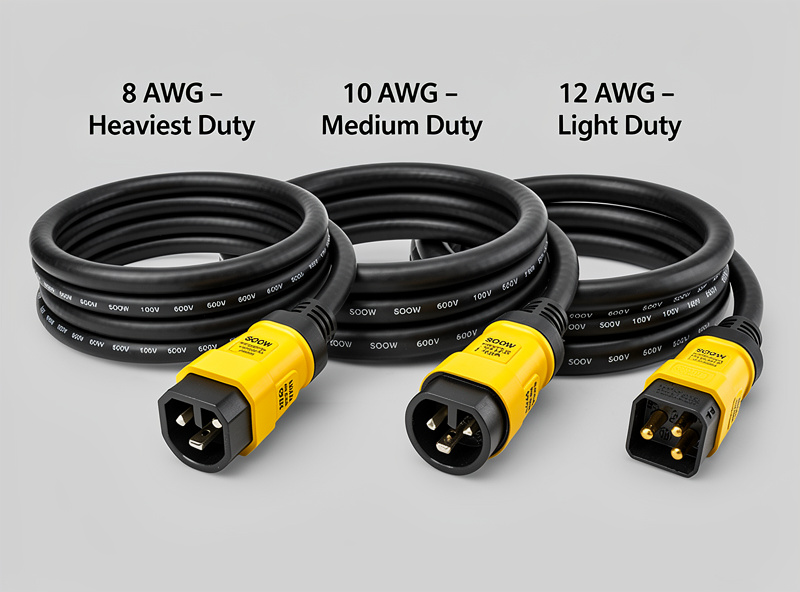
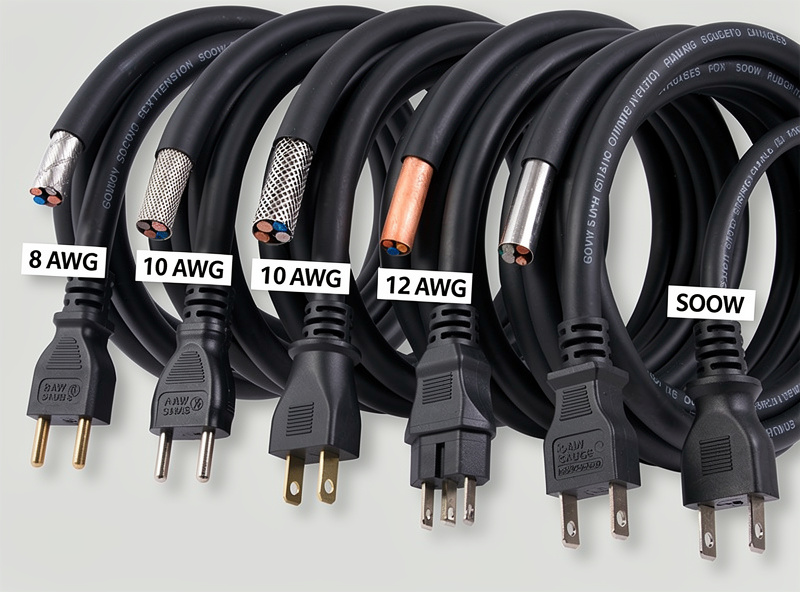
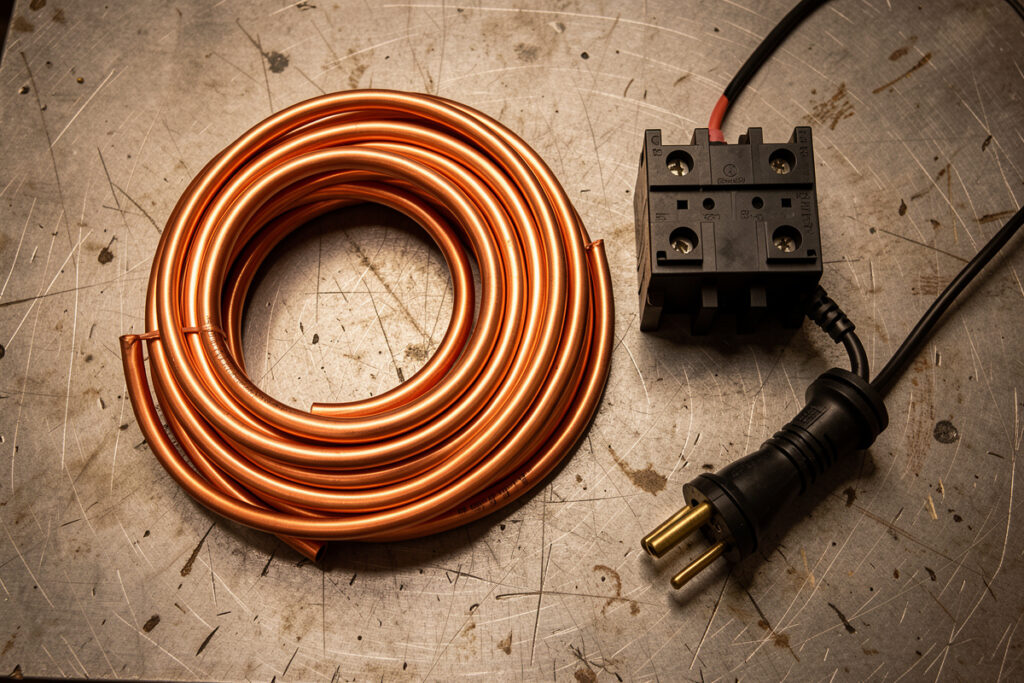
A welding extension cord is not a household cord with bigger plugs. Three construction differences do the work. First, the jacket: welding cords use SOOW-rated rubber cable (Service grade, Oil-resistant jacket and insulation, Weather-resistant) or its 300V-max junior sibling SJOOW. That jacket shrugs off oil, water, abrasion, and the occasional spatter drop; the PVC jacket on a household cord starts softening around 80°C and a hot spatter ball goes straight through it. Second, stranding: welding cords use finely stranded copper that stays flexible in the cold and coils by hand even at 8-gauge, where coarse-stranded household cable at the same gauge fights you like fencing wire. Third, the connectors: proper welding cords terminate in NEMA 6-50 plugs and receptacles rated 50 amps at 250 volts — the same connector on the back of most 240V welding outlets.
One honesty note on ampacity, because cord marketing rounds this up: under NFPA 70 (the National Electrical Code), Table 400.5(A)(1) rates 8 AWG flexible cord at roughly 40 amps continuous — the reason 8/3 SOOW works on “50-amp” welder circuits is that welders are intermittent, duty-cycle loads and the NEC’s welder article treats them with demand factors rather than as continuous draw. A home MIG that never sustains more than 30-something input amps is comfortably inside that. If you genuinely intend to run a machine at 50 amps of input for long stretches, 6 AWG is the by-the-book cord, not 8. That distinction is exactly the kind of thing the spec sheet on a bargain cord hopes you will not ask about.
Adapters deserve the same skepticism. NEMA 14-50 (EV outlet), 14-30 (dryer), and 5-15 (household) adapters all exist and all work — but every adapter is one more pair of brass contacts adding resistance, and resistance under welding load means heat. I run a 14-50 adapter for short jobs off the dryer circuit and the adapter body is noticeably warm after a session in the 30-amp range; that warmth is a budget I do not spend on long welds. Minimize adapters, and never daisy-chain two extension cords — the mid-span connector is both a voltage drop and the least weather-protected point in the run.
What to Buy: Length, Gauge, and Cost
As an Amazon Associate I earn from qualifying purchases.
For a home shop, one 25-foot 8-gauge 240V cord with NEMA 6-50 ends covers 90% of the situations where the machine’s own cord comes up short: the driveway repair, the gate hinge, the far side of a big workpiece. Mine is an Iron Box 8/3 SOOW cord with 6-50 ends, bought after the driveway lesson, and it has never once been the limiting factor in a weld. If your projects regularly sit farther out, a 50-foot 8-gauge cord handles the rest — expect roughly $80-160 for 25 feet and $130-250 for 50 feet depending on gauge and brand, with 6 AWG commanding the top of each range.
| Length | 8 AWG | 6 AWG |
|---|---|---|
| 25 ft | $80-100 | $120-150 |
| 50 ft | $130-160 | $200-250 |
| 100 ft | $250-300 | $350-450 |
Buy pre-made unless you are genuinely comfortable with high-amperage assembly. A factory cord has crimped, sealed, strain-relieved terminations; the classic DIY failure is a terminal screw that was torqued by feel, loosens over heat cycles, and turns the plug into a resistor that cooks its own housing under load. The savings from building your own are modest, and OSHA 1910.305’s wiring rules for flexible cords exist precisely because improvised cord work starts fires. If the budget is tight, the money conversation belongs one level up anyway — the real cost to start welding at home puts the cord in context of the whole kit, and the essential equipment guide ranks what to buy in which order.
Extension Cord Safety Rules for Welders
- Fully uncoil before welding. You will read everywhere that a coiled cord “becomes an electromagnet” — on a normal two-conductor AC cord that is not really what happens, since the outbound and return currents cancel each other’s fields. The real problem is simpler and just as dangerous: a tight coil is an insulated bundle that cannot shed heat. Fifty feet of cord dissipating its resistive losses into open air is fine; the same fifty feet dissipating into itself inside a coil cooks its own jacket. Uncoil it all, every time.
- Never daisy-chain two cords. The mid-span connector adds contact resistance and heat, and it is the one point in the run with no strain relief and the least weather protection. One cord of the right length beats two of the wrong one.
- Inspect before every session. Cuts, abrasion, melted jacket spots, loose or discolored plug blades. A damaged cord at 240V and welding amperage can arc and ignite without ever tripping the breaker — an overcurrent breaker protects the wire in your wall from overload, not you from a frayed cord.
- Route it out of the spatter zone. Behind the machine, never across the table or under the workpiece. SOOW resists spatter; it does not resist it forever.
- Know your GFCI situation. Older 240V garage circuits usually have no GFCI at all, while the 2023 edition of the NEC extended GFCI requirements to 240V garage receptacles in new work — and welders are a known nuisance-trip case on them. Either way the conclusion is the same: do not outsource cord condition to the breaker. The welding electrical safety guide covers grounding and shock prevention properly, and the welding safety guide holds the wider fire and PPE picture.
Frequently Asked Questions
What gauge extension cord do I need for a 240V welder?
An 8-gauge SOOW cord for runs up to 50 feet on 30-40 amp welder circuits. For a true 50-amp continuous load or runs past 50 feet, step to 6-gauge. For 30-amp machines under 50 feet, 10-gauge is acceptable. Always use NEMA 6-50 connectors rated for the circuit.
Can I use a standard household extension cord with my welder?
No. A 16 or 14-gauge household cord drops several volts under welding load — a 50-foot 16-gauge cord at 20 amps loses roughly 8 volts — and the arc goes cold and unstable. The PVC jacket also melts on spatter contact. Use a welding-rated SOOW or SJOOW cord in the correct gauge for your amperage and length.
Why does my welder weld worse on an extension cord?
Voltage drop. Resistance in an undersized cord reduces input voltage at the machine, and output capability falls with it — a 10-volt input loss can cost a MIG welder tens of amps of effective output. The fix is a shorter run or a heavier gauge, not higher dial settings, which cannot compensate for starved input.
How long can a welding extension cord be?
Practical maximum for 8-gauge at high welding amperage is about 75 feet; past that, voltage drop exceeds the 3-5% range even in 8-gauge and 6-gauge becomes necessary. A 30-amp welder tolerates up to about 100 feet on 10-gauge. Shorter is always electrically better — buy the length you need, not the longest available.
Do I really need to uncoil the extension cord before welding?
Yes. The common explanation (a coiled cord acts as an electromagnet) is inaccurate for two-conductor AC cords, but the danger is real for a simpler reason: a tight coil traps the cord’s resistive heat inside an insulated bundle instead of shedding it to the air, and under welding amperage that can melt the jacket. Uncoil the full length every session.
Can I build my own welding extension cord?
Only if you are competent with high-amperage terminations. Use 8/3 or 6/3 SOOW cable with NEMA 6-50P and 6-50R connectors, torque every terminal screw properly, and strain-relieve both ends. A loose terminal adds resistance, heats under load, and can melt the connector. The savings over a factory-assembled cord are modest for the risk taken on.


Discussion (0)