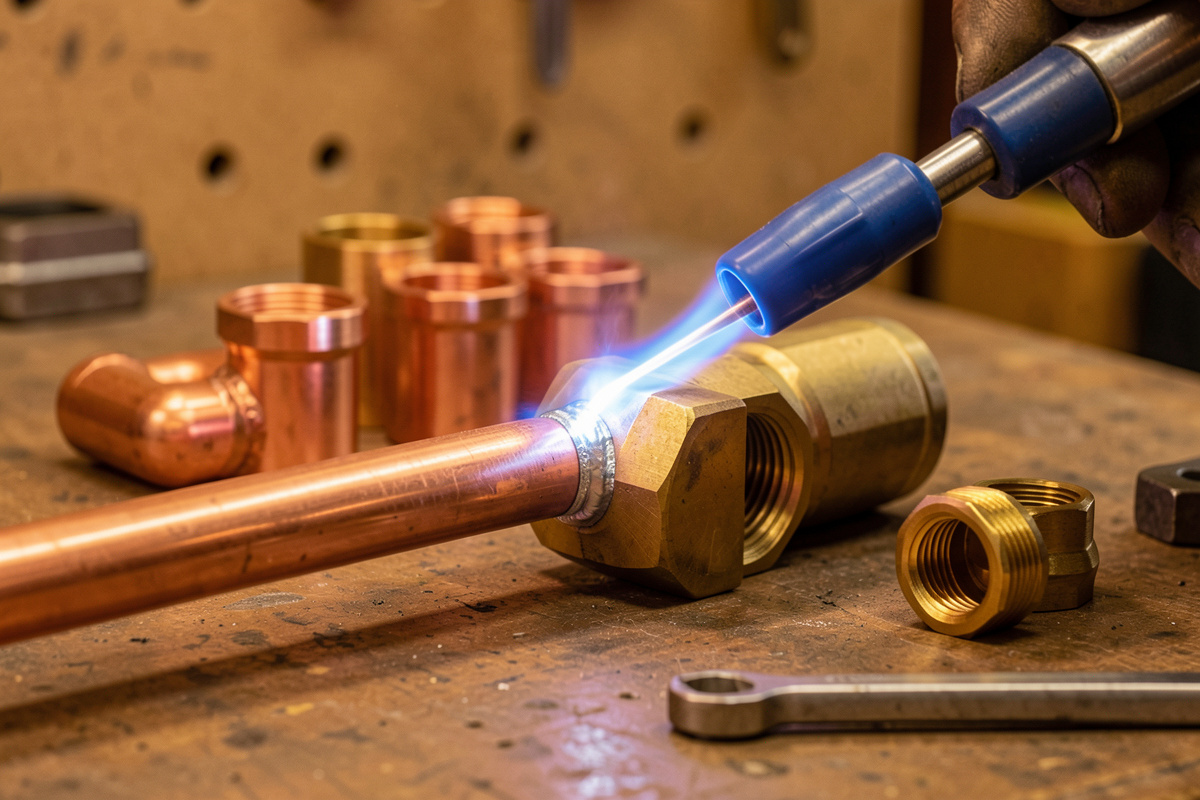

To braze copper and brass you clean the joint to bright metal, set a few-thousandths gap, heat the parts to a dull cherry red around 1100–1300°F, and touch filler rod to the joint so capillary action pulls it through. Copper-to-copper needs no flux with a copper-phosphorus rod; brass always needs flux. Get the heat into the joint, not the rod, and the filler flows on its own.
Copper and brass are where torch brazing earns its place on my bench. I weld steel all day, but you cannot arc-weld a copper line to a brass fitting cleanly — brazing joins them in seconds with a leak-tight bond and almost no distortion. This guide is the exact process I run, the filler and flux choices that matter, and the one hazard with brass that sends people to the doctor if they ignore it.
Pick the Right Filler First
Filler choice depends on what you are joining. For copper to copper, copper-phosphorus rod (the BCuP family) is the standard — it is self-fluxing on copper, so you need no flux at all, which is why HVAC and refrigeration techs use it. For copper to brass or brass to brass, you switch to a silver-bearing filler (a BAg alloy) with flux, because phosphorus rod is not self-fluxing on the zinc in brass. A copper-phosphorus rod with a little silver in it (BCuP-5, around 15% silver) flows lower and more forgivingly than the silverless version and is the friendliest choice for a beginner on copper.
The rod also has to suit the heat you can deliver. Silver-bearing alloys flow lowest, roughly 1145–1400°F; plain copper-phosphorus runs a touch hotter. The deeper filler breakdown lives in the silver brazing guide for beginners, and the parent brazing and soldering guide sets all the filler families side by side.
| Joint | Filler | Flux needed? | Approx. flow temp |
|---|---|---|---|
| Copper to copper | Copper-phosphorus (BCuP) | No (self-fluxing) | 1300–1500°F |
| Copper to brass | Silver (BAg) or BCuP | Yes | 1145–1400°F |
| Brass to brass | Silver (BAg) | Yes | 1145–1400°F |
Clean and Flux: The Step That Decides Everything
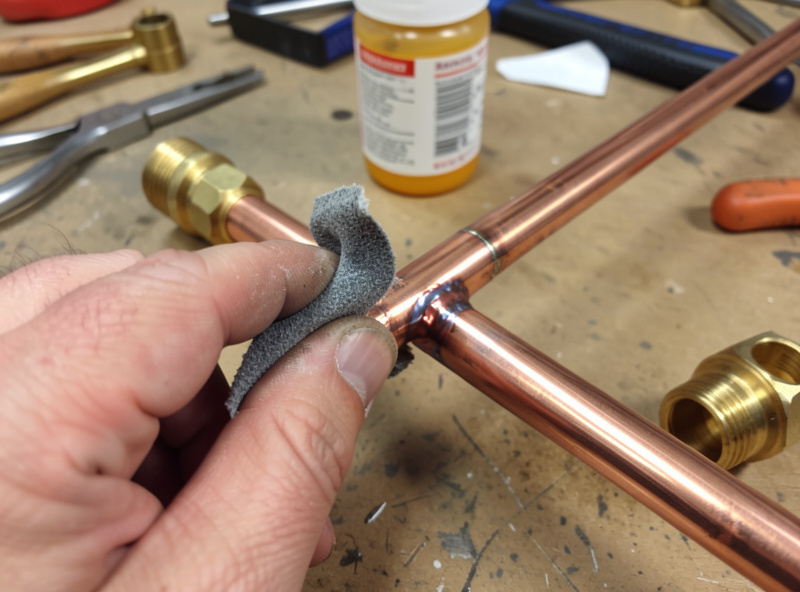
Brazing filler will not wet a dirty surface, and on copper that means scrubbing to bright metal. I clean pipe ends with emery cloth or a fitting brush until they shine, then wipe off any oil — the same bright-metal prep I preach in my angle grinder guide, just gentler. Oxide, oil, or that brown copper tarnish all block wetting and give you a filler ball that rolls off instead of flowing in.
For copper-to-copper with phosphorus rod, skip flux entirely. For anything involving brass, brush a thin, even coat of white silver-braze flux on both mating surfaces. The flux does two jobs: it dissolves oxide as heat builds, and it reads temperature for you — it goes from chalky white to clear and watery right as the joint reaches flow heat. When the flux turns glassy, you are ready for rod.
Set the Joint Gap and Fixture the Parts
Capillary brazing needs a close, even gap — about 0.001 to 0.005 inch — so a sweat fitting that slides on with light resistance is already about right. Do not file a sloppy gap thinking more room helps; a loose joint kills capillary action and leaves a weak, filler-bridged blob. Fixture the parts so nothing moves while the filler freezes; on copper plumbing the fitting usually holds itself, but on odd assemblies I clamp with my Bessey GSCC clamps and let the joint set undisturbed. The joint types guide applies here — design for overlap, not a butt seam, so the filler has surface area to flow across.
Bring the Heat: Torch Choice for Copper
Copper conducts heat fast, which is the whole challenge. A small plumber’s propane torch handles thin copper line, but it stalls on anything chunky because the metal wicks heat away faster than the flame supplies it. I reach for MAP-Pro on most copper and brass work, and step up to oxy-acetylene for large-diameter pipe or heavy fittings. Heat the joint evenly, playing the flame around the whole circumference, and on a pipe-into-fitting joint put more heat into the heavier fitting so both parts reach temperature together. The full torch and gas rundown is in the brazing tools guide and the welding gas guide.
Run the Braze: Heat the Joint, Not the Rod
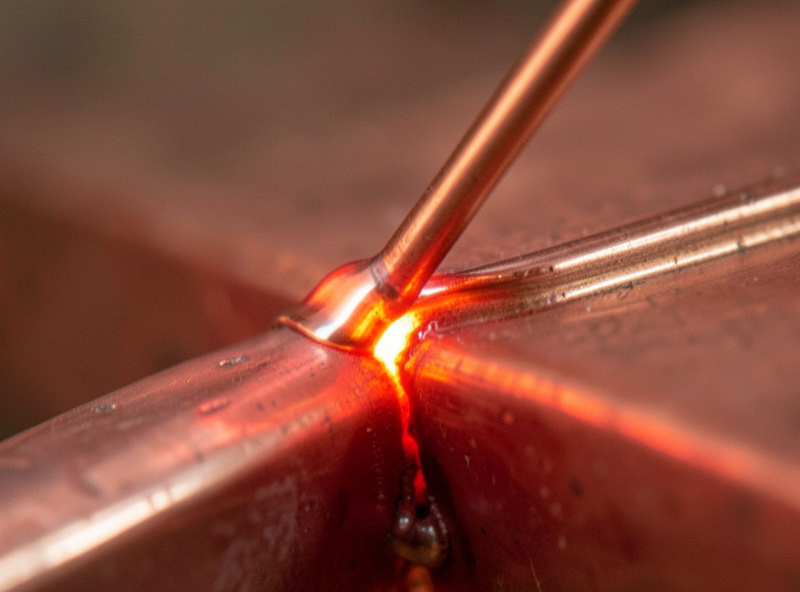
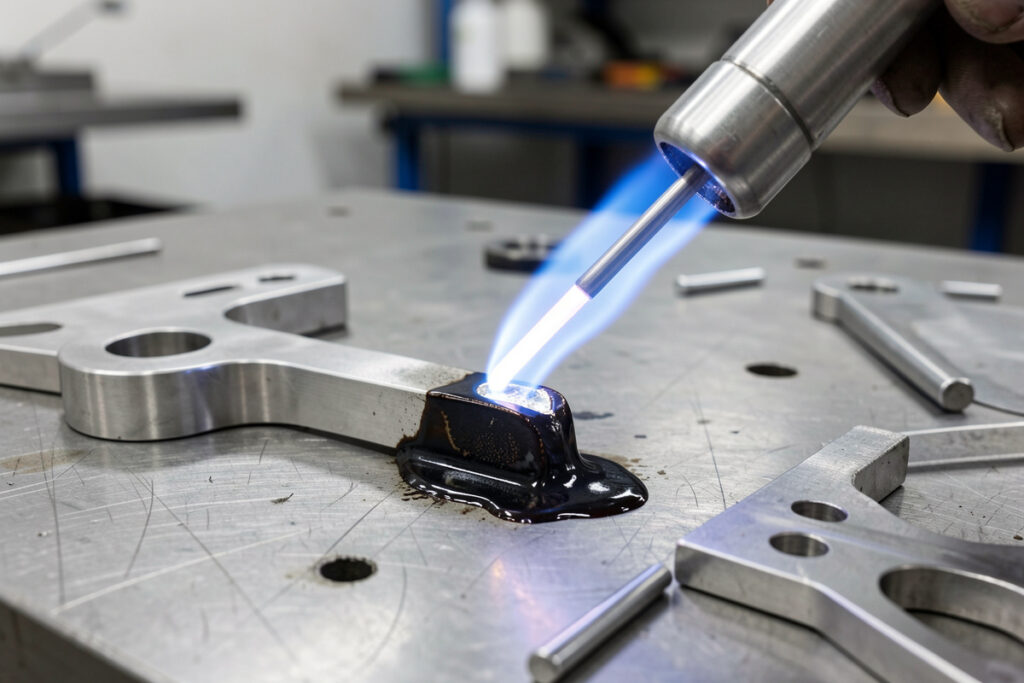
Here is the move that separates a clean braze from a mess. Heat the joint until copper glows a dull cherry red and the flux clears, then touch the filler rod to the joint at a point away from the flame — not into the flame itself. If the metal is hot enough, the rod melts on contact with the joint and capillary action draws it right through to the other side. If you melt the rod with the flame, you are depositing cold filler onto cold metal, and it will not bond.
Feed only enough rod to fill the joint — you want a thin, even fillet, not a pile. Once the filler flashes around the full joint, pull the heat. Let it cool undisturbed, then wash off flux residue with hot water (silver-braze flux is corrosive if left on). On copper-to-copper you will see a bright ring of filler; on brass, a clean silver line. That is a finished braze.
The Brass Hazard: Zinc Fume
Brass is copper plus zinc, and zinc boils off well below brass’s melting point. Overheat brass and you will see a white smoke and a powdery white residue — that is zinc oxide, and breathing it causes metal fume fever: chills, fever, and flu-like aches hours later. It is the same hazard I cover for galvanized steel, and it is real. Two defenses: heat brass gently and no hotter than needed so the zinc stays put, and braze with real ventilation or a fume extractor pulling the smoke away from your face. Add cadmium-free filler (never assume old silver rod is safe — OSHA regulates cadmium under 29 CFR 1910.1027) and the fire-safety basics for an open flame, and you are covered.
Gearing Up
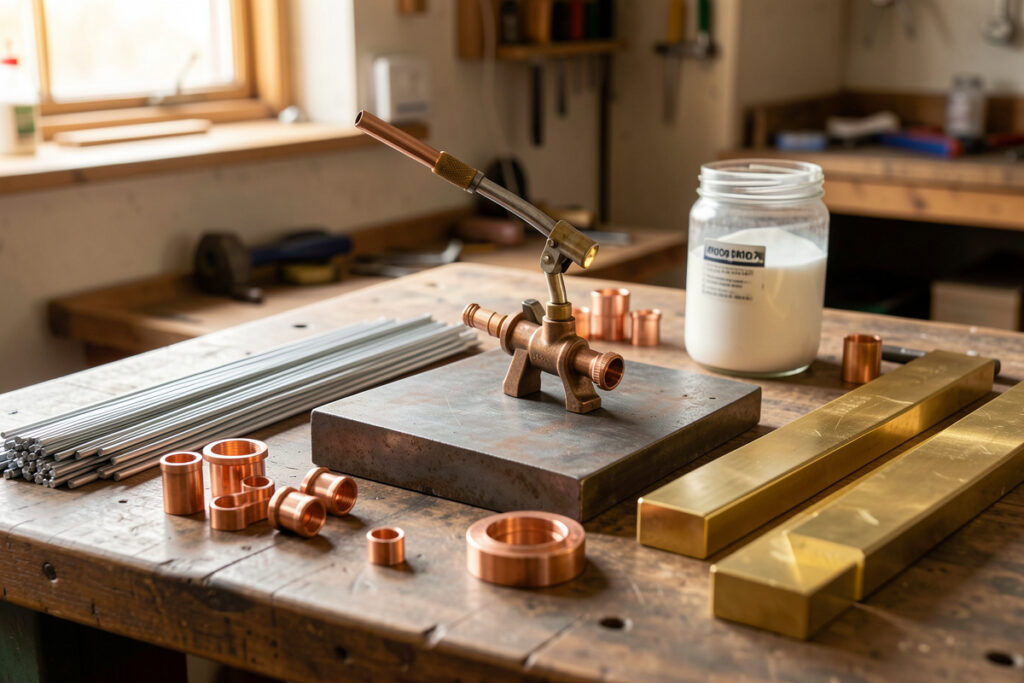
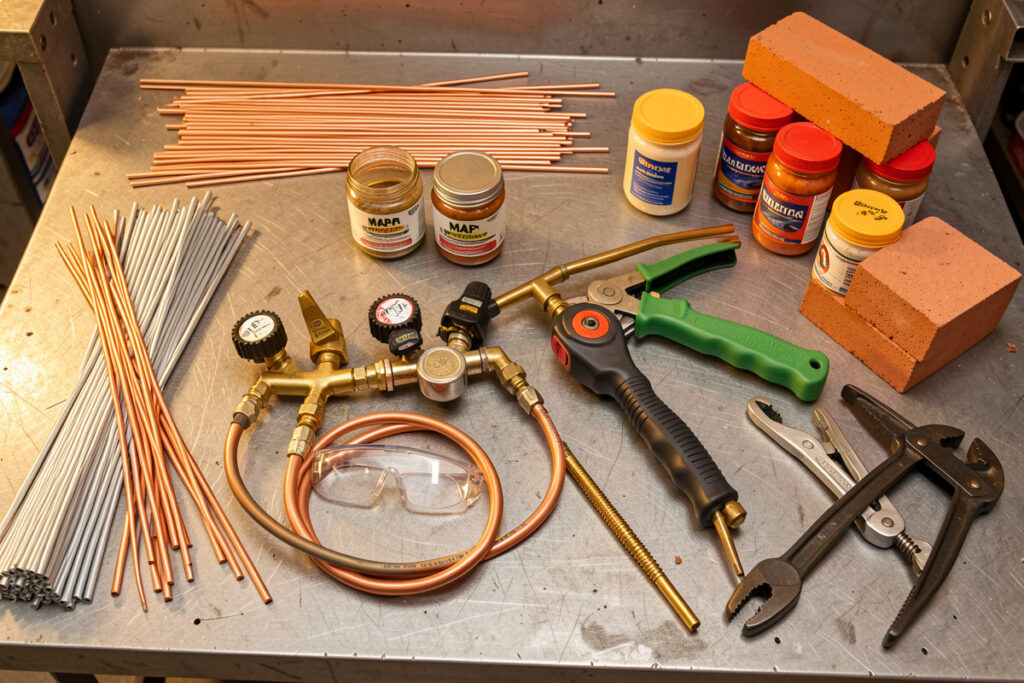
For copper-to-copper you mainly need copper-phosphorus rod and a MAP-Pro torch; for brass, add silver-bearing rod and white flux. As an Amazon Associate I earn from qualifying purchases. A roll of copper-phosphorus brazing rod covers copper line, and a jar of white silver-brazing flux handles the brass joints. Keep rod and flux dry — the same moisture discipline that prevents weld porosity keeps brazing clean too.
Braze or Solder Copper Pipe? Which to Use
People mix these up constantly. Soldering copper pipe uses soft tin solder around 450°F and is the normal choice for household water lines — quick, cheap, and code-accepted for potable water in most places. Brazing copper uses the higher-temperature fillers above 840°F and gives a much stronger, more heat-resistant joint. You braze copper when the line carries high pressure or heat, like refrigerant and medical-gas lines, or where the joint must survive temperatures that would soften solder. For a garden tap or a sink supply, solder is fine; for an AC line set, braze. If your job is the low-temperature side, my soldering thick metals guide covers heat-hungry copper, and the process comparison lays out the strength trade-offs.
Three Mistakes That Wreck Copper Brazes
First, a dirty joint — unbrushed copper or oily fingers, and the filler will not wet. Clean to bright every time. Second, melting the rod in the flame instead of letting the hot joint draw it; cold filler on cold metal never bonds. Third, overheating brass until it fumes white — back off the heat the instant you see zinc smoke, both for the joint and your lungs. Fix those three and copper and brass brazing becomes one of the most satisfying, repeatable jobs on the bench — the kind of low-distortion, leak-tight joint that arc welding simply cannot make on these metals.
Frequently Asked Questions
Do you need flux to braze copper?
Not for copper-to-copper joints if you use a copper-phosphorus (BCuP) rod, which is self-fluxing on copper. But the moment brass is involved, copper-to-brass or brass-to-brass, you must use flux because phosphorus rod will not self-flux the zinc in brass.
What temperature do you braze copper at?
Copper reaches brazing flow temperature around 1100 to 1500 degrees F depending on the filler, showing as a dull cherry red. Silver-bearing fillers flow lower, around 1145 to 1400 F; plain copper-phosphorus runs a little hotter. Heat the joint until the filler melts on contact with the metal, not in the flame.
Can you braze brass without burning the zinc out?
Yes, by keeping the heat gentle and no hotter than needed for the filler to flow. Zinc boils off below brass’s melting point, so overheating makes white zinc-oxide smoke and risks metal fume fever. Heat slowly, watch for white fuming, and always work with good ventilation.
What is the best filler rod for brazing copper?
For copper-to-copper, a copper-phosphorus rod with about 15% silver (BCuP-5) flows low and forgivingly and needs no flux. For copper-to-brass joints, switch to a silver-bearing (BAg) rod with white flux. Match the rod to the metals and to the heat your torch can deliver.
Will a propane torch braze copper?
A propane torch brazes thin copper line but stalls on thick pipe or heavy fittings because copper wicks heat away fast. MAP-Pro gas delivers more usable heat for most copper and brass work, and oxy-acetylene is the answer for large-diameter pipe or chunky joints.

Discussion (0)