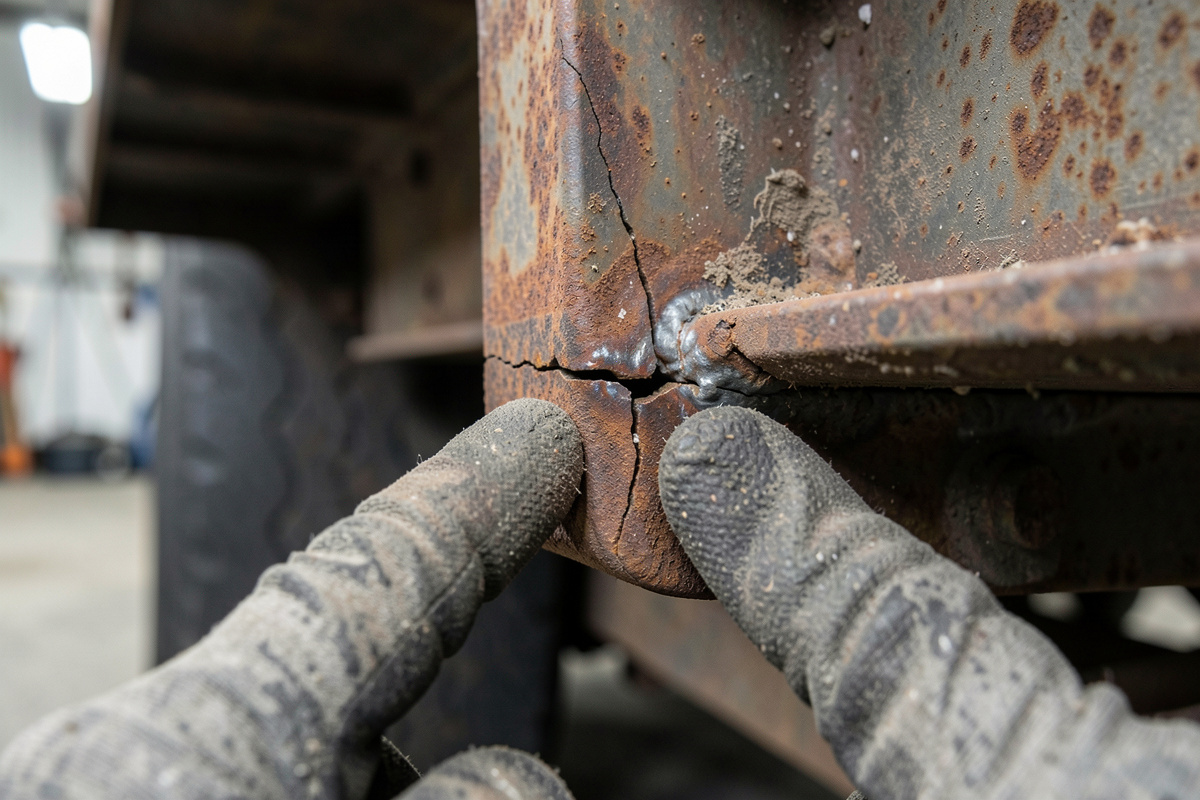

Repairing a cracked trailer frame is a three-part job: find where the crack actually starts and stops, remove all of it before you weld, and reinforce the repair so it does not crack again in the same place. The mistake almost everyone makes is running a bead over the visible crack — that traps the crack underneath, and it comes straight back, usually worse. A crack means the frame moved, so a real fix drills a stop-hole 1/8 to 3/16 inch past each end, grinds the crack out down to bright metal, and addresses why it cracked.
Trailer frames crack at predictable spots: the tongue-to-frame transition, the spring perch and axle mounts, and anywhere a stiff member meets a flexible one. I have chased cracks on shop equipment enough to respect them, and my welder friend Mike’s rule stuck with me — “you do not weld a crack, you remove it.” This guide sits under the full trailer build guide; if you understand how the frame and tongue were built, you will understand where and why they fail.
First, Find the Whole Crack
A crack is almost always longer than the part you can see. Wire-brush and grind the area clean of rust, paint, and grime, then look hard — a hairline can run well past where it is obvious. The classic home method to find the ends: wipe the cleaned area with a solvent, then a bit of penetrating oil or a dye, wipe the surface, and the crack weeps the fluid back out along its full length. That tells you exactly where to start and stop.
While you are looking, figure out why it cracked. A fatigue crack from flexing looks different from a one-time overload, and it changes the fix. If the frame cracked because it was under-built or the tongue flexes, just rewelding it sends you back to square one in a month. Understanding the failure — the mechanics in weld cracking causes and prevention apply directly — is half the repair.
Stop the Crack From Running
Before you grind, drill a small stop-hole at each end of the crack — a 1/8 to 3/16 inch hole right at the crack tip. A crack is a stress concentrator that wants to keep running; the round hole blunts the tip and stops it from traveling while you work and, in a proper repair, becomes part of the fully welded-out joint. Drill just past the visible end of the crack, where the dye or oil showed it stopping, not short of it.
Remove the Crack Completely
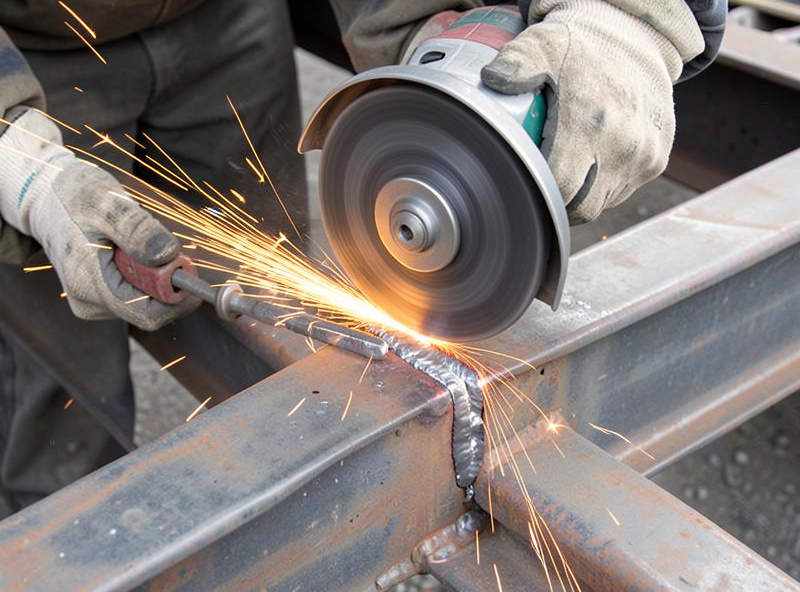
Now grind the crack out. Use the angle grinder to cut a V-groove along the entire length of the crack, all the way to the bottom of it, down to clean bright metal. The goal is to physically remove every bit of the crack so you are welding two sound faces of steel back together, not bridging a flaw. On thicker material grind from both sides if you can reach. When you are done, wire-brush and inspect — if you can still see the dark crack line anywhere in the groove, it is not gone, and you keep grinding.
This is also where any coating becomes a hazard. Old trailers are often painted or galvanized, and grinding and welding that coating releases fumes — galvanizing gives off zinc oxide, which causes metal-fume fever — an exposure OSHA addresses in its welding standard, 29 CFR 1910.252. Grind the coating well back from the weld zone and ventilate hard, every time.
Weld It Solid, Then Reinforce
Weld the grooved joint with real penetration — multi-pass to fill the V from the bottom up, hot enough to fuse the root, treating it exactly like the load-critical joint it is. Grinding the crack out and welding sound face to sound face is the same principle AWS D1.1 (Structural Welding Code — Steel) sets for weld repairs, scaled down to a home shop. A cold weld here is lack of fusion waiting to fail again. Fill the stop-holes as you go. On my bench I run this repair the same way I run any structural joint: clean prep, tight fit, hot multi-pass, and a break-test mindset from weld testing methods so I trust the fusion.
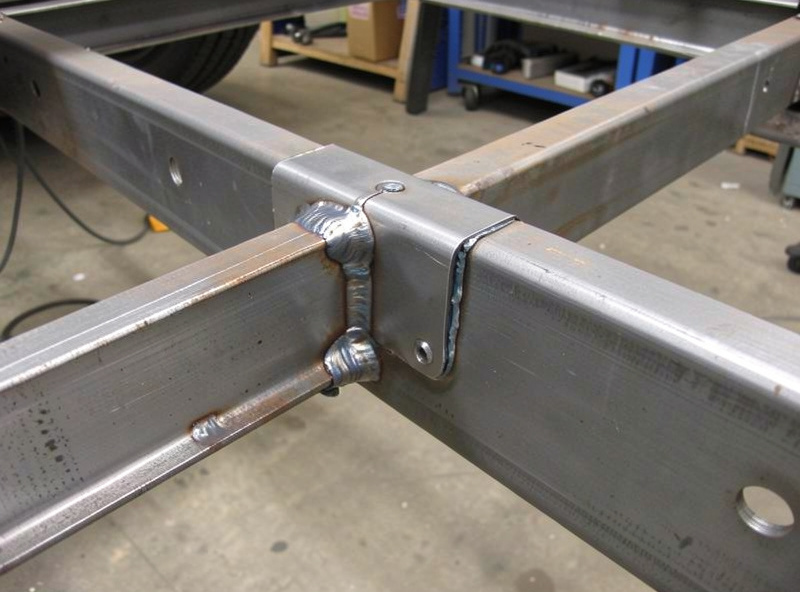
Then reinforce — this is the step that keeps it fixed. If the frame cracked once at a spot, that spot is a stress riser, and a bare reweld often just cracks again right beside the new bead. Weld a fishplate (a steel plate over the repair) or a gusset at a corner to spread the load out past the repaired area into sound metal. Taper the plate’s ends and wrap the welds around rather than stopping them square, so you do not create a brand-new sharp stress line at the edge of your reinforcement. Done right, the repaired area ends up stronger than the original.
Know When to Stop and Get Help
Some cracks are a message that the whole design is under-built, and some are on parts you should not repair at all. A cracked or bent axle beam is not a weld-repair job — replace it, because you cannot restore its engineered camber and strength. Cracks radiating from the coupler or the tongue-to-frame joint are load-critical, public-road failures, and if you have any doubt about the repair holding, this is exactly where an experienced or coded welder should do or check the work. I am a home welder, not a certified structural fabricator, and a trailer that carries a load in traffic is a place to be honest about that line.
The safety around the repair is non-negotiable: clear the fire zone before you strike an arc (an old trailer can have grease, a wood deck, or fuel nearby — see fire safety), ventilate against coating fumes, and never weld on a trailer that still has a loaded propane tank, fuel, or sealed containers on or near it. Fix the crack right, reinforce it, and confirm the trailer is still legal and roadworthy before it carries a load again.
Frequently Asked Questions
Can you weld a cracked trailer frame?
Yes, but you must remove the crack, not weld over it. Find the full length of the crack, drill stop-holes at each end, grind it out into a clean V down to bright metal, weld it solid with multi-pass penetration, and reinforce with a fishplate or gusset so it does not crack again in the same spot.
Why does welding over a crack not work?
Running a bead over a visible crack traps the crack underneath the weld. It is still there, still a stress concentrator, and it propagates back through or beside the new weld, usually failing worse than before. You have to physically grind the crack out before welding.
Do I need to drill stop-holes when repairing a crack?
Yes. A small stop-hole drilled at each crack tip blunts the sharp end and stops the crack from running further while you prep the repair. Drill just past where the crack actually ends, which a dye or penetrating-oil check will reveal, then grind the crack out and weld the holes closed.
How do I stop a trailer frame from cracking again?
Reinforce the repair. A crack means the frame flexed at a stress point, so after welding the crack solid, add a fishplate over the area or a gusset at the corner to spread the load into sound metal. Taper the reinforcement ends and wrap the welds so you do not create a new stress line.
Should I repair a cracked trailer axle?
No. Replace a cracked or bent axle beam rather than welding it. You cannot restore the axle’s engineered camber and strength at home, and a failed axle at road speed is dangerous. Repair frame and mount cracks, but treat the axle itself as a replacement item.

Discussion (0)