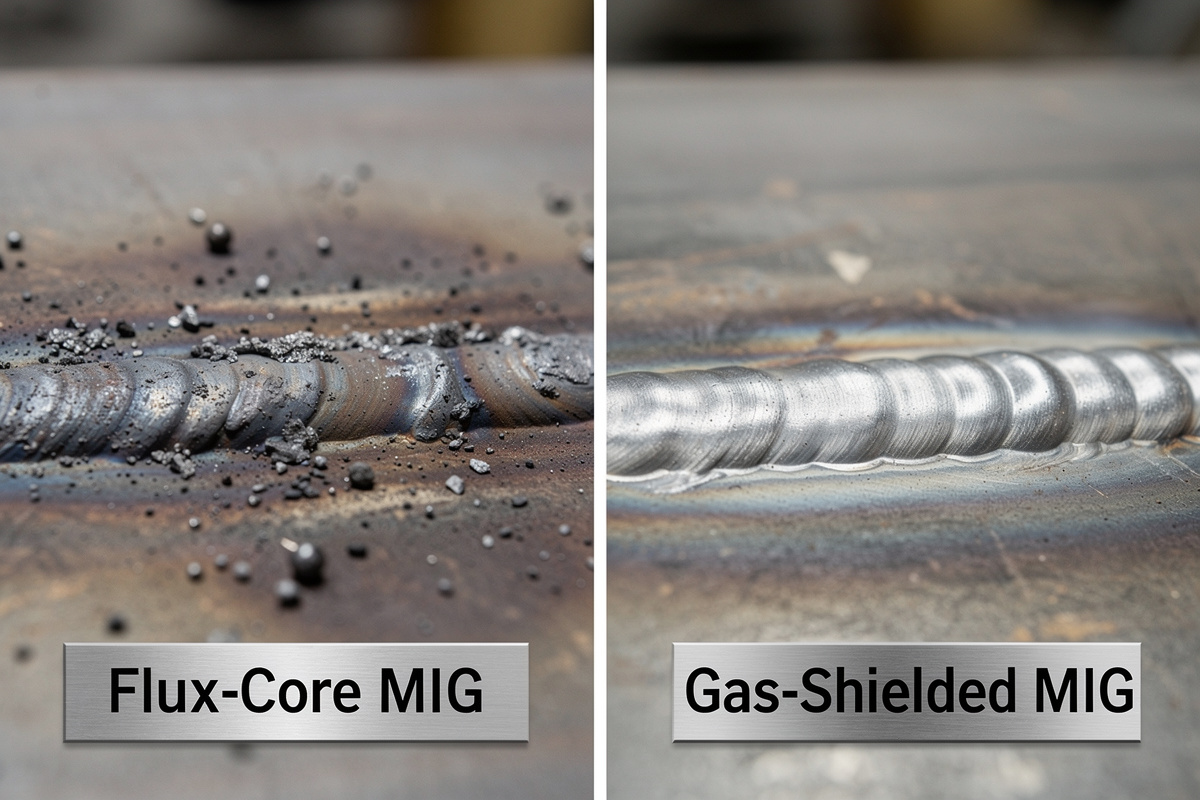

For a first MIG welder, start with flux-core if your total budget is under $600 with PPE, or you weld outdoors. Upgrade to gas-shielded MIG (C25) the moment projects need to look clean, run under 1/8 inch, or you tire of chipping slag from every bead.
I started on flux-core for cost reasons — the Forney Easy Weld 140 and a helmet cost me 370 dollars total, and the idea of adding 180 dollars of cylinder rental to a hobby I might abandon felt reckless. Six months in, I bought the gas setup because the spatter cleanup on a fire pit project took longer than the welding did. The difference in the first gas-MIG bead was so dramatic I laughed out loud in the garage — it was like the welder had been fighting me for six months and suddenly decided to cooperate. For a full comparison of all three processes (MIG, TIG, stick), see MIG vs TIG vs Stick Welding. For the complete equipment picture, the essential welding equipment guide covers every tool.
How Flux-Core (Gasless) MIG Works
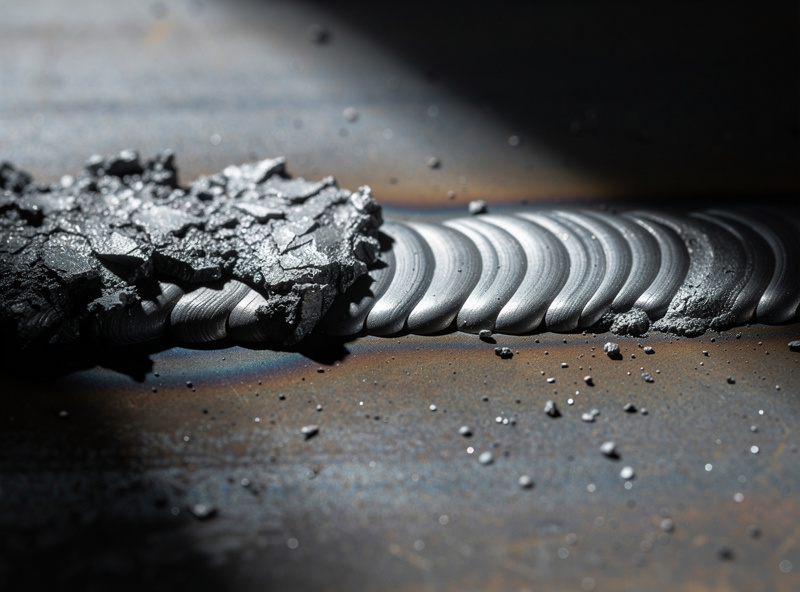
Flux-core wire is a hollow tube of mild steel filled with flux compounds — the same materials that coat a stick welding electrode. The American Welding Society classifies these wires under AWS A5.20/A5.20M (Carbon Steel Electrodes for Flux Cored Arc Welding) — the spec sheet for any E71T-11 or E71T-GS wire on the shelf at the welding supply store, confirmed on the classification line of a real manufacturer datasheet like Hobart’s Fabshield 21B E71T-11 product page (“AWS: A5.20: E71T-11”). When the arc burns, the flux vaporizes into a shielding gas cloud that protects the molten puddle from atmospheric oxygen and nitrogen. A layer of slag forms on top of the cooling bead, which must be chipped off after welding. The entire shielding system is self-contained in the wire — no external gas cylinder needed.
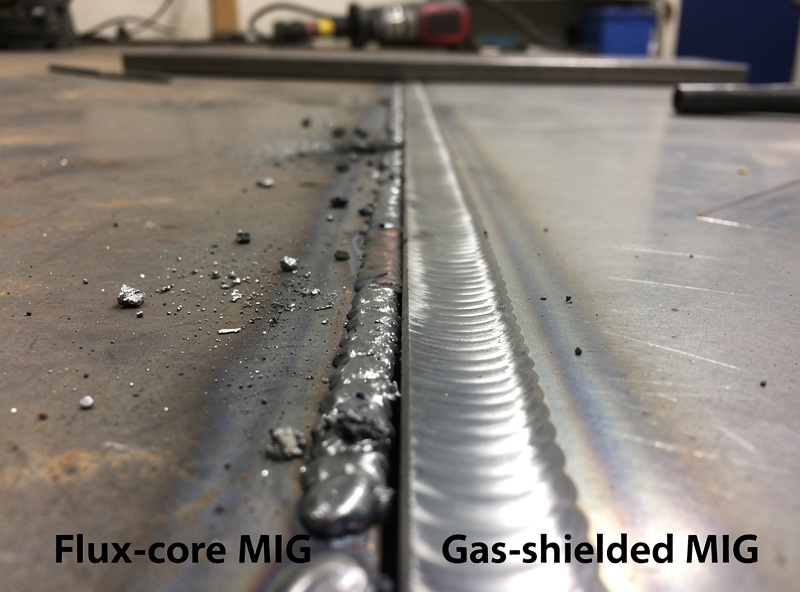
The trade-offs are inherent to the process: the flux generates more spatter because the shielding is less stable than a continuous gas envelope, the slag adds a post-weld cleanup step to every bead, and the fumes are heavier because burning flux produces visible smoke that gas-MIG does not. But the advantages are real — flux-core welds outdoors in 15-mph wind that would scatter a gas-MIG shielding envelope in half a second, and the 120V flux-core welder plugs into any standard outlet with no electrical upgrade.
Flux-core polarity requirement: Flux-core must be run on DCEN (electrode negative) polarity. Most home MIG welders ship set to DCEP for solid wire. Swapping the polarity terminals inside the machine is a 90-second job and is the most common “why do my flux-core welds look terrible?” fix. For more on common beginner issues, see common beginner welding mistakes.
How Gas-Shielded MIG Works
Gas-shielded MIG feeds solid steel wire — typically ER70S-6 per AWS A5.18/A5.18M (Carbon Steel Electrodes and Rods for Gas Shielded Arc Welding) — through the gun while a continuous flow of shielding gas from a cylinder envelopes the arc and puddle. The standard gas for mild steel is C25 — 75% argon, 25% carbon dioxide. Argon provides arc stability and smooth transfer; CO2 adds penetration. The gas flow creates an invisible dome of inert atmosphere around the puddle, preventing oxidation without producing slag or heavy fumes.
The result is a cleaner, quieter, more controllable arc with dramatically less spatter than flux-core — on my own bench, post-weld cleanup time dropped by more than half the week I switched. The bead surface is shiny and slag-free — no chipping hammer needed, just a wire brush pass. The gas cylinder is the only added complexity, and it is really just a rental arrangement with a welding supply store: roughly 180 dollars for the first year (cylinder rental plus initial fill), then 40-60 dollars per refill depending on cylinder size.
The downside is wind sensitivity. Any breeze stronger than roughly 5 mph at the nozzle blows the shielding gas away before it reaches the puddle, and the resulting porosity looks like a sponge. Gas-MIG needs an enclosed workshop or at minimum windbreaks if welding outdoors. The flow rate sweet spot is 20-25 cubic feet per hour — too low and coverage is incomplete, too high and turbulence pulls air into the shielding zone. The MIG welding complete guide covers gas settings in detail.
When Each Setup Wins: The Decision Matrix
The choice between flux-core and gas-MIG is not “which is better” but “which matches your projects, budget, and workspace.” Four factors determine the right answer for a first welder.
Budget: Flux-core wins under 600 dollars total because it eliminates the 180-dollar gas cylinder rental from the startup cost. Above 600 dollars, gas-MIG is the better value because the cylinder cost buys you real time back on every project — no slag chipping, just a quick wire-brush pass — which adds up to dozens of saved hours across a year of hobbyist welding.
Workspace: If you weld outdoors — driveway, farm fence, construction site — flux-core wins because wind does not affect it. If you weld indoors with ventilation, gas-MIG wins because the enclosed space amplifies flux-core fume and the ventilation you already installed handles gas-MIG fume cleanly. For the ventilation discussion, see welding ventilation for home garage.
Project type: For structural projects (gates, frames, outdoor furniture) where bead appearance matters less than strength, flux-core works fine. For appearance-critical projects (indoor furniture, decorative pieces, anything visible in the living room), gas-MIG is the only reasonable choice — the bead is cleaner and the post-weld cleanup is a wire brush pass instead of 10 minutes of chipping and grinding.
Material thickness: Flux-core on 120V handles 18-gauge to 1/4-inch steel. Gas-MIG on a 240V dual-voltage machine handles 24-gauge sheet metal to 3/8-inch plate. For thin metal under 1/8 inch, gas-MIG wins decisively — the lower spatter and smoother arc make thin-metal welding dramatically easier. For thick outdoor structural steel, flux-core wins because the self-shielded arc penetrates deeper at equivalent amperage.
The Dual-Voltage Hybrid Approach: Best of Both Worlds
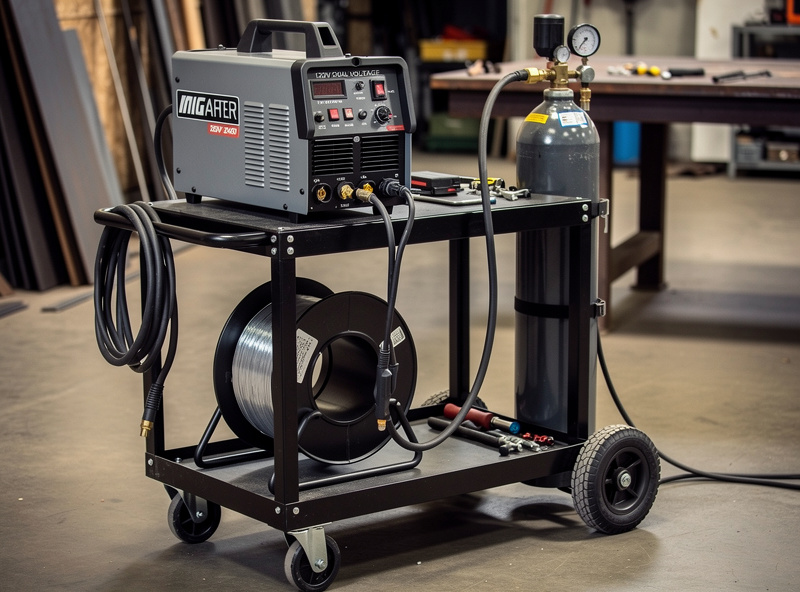
The smartest long-term buying decision for a beginner is a dual-voltage MIG welder that runs both flux-core and gas-MIG — something like the YesWelder MIG-205DS-Pro at 340-450 dollars or the PrimeWeld MIG180 at roughly 550 dollars. You start on flux-core without the gas cost to learn basic bead control and T-joints, and when the spatter frustration peaks around hours 15-20, you add the gas cylinder and switch to solid wire without buying a new machine.
This approach costs more upfront than a dedicated flux-only machine, but it avoids buying two machines outright — a real savings if you already know you will switch to gas-MIG within a year or two. The switch from flux-core to gas on the same machine takes 15 minutes: drain any remaining flux-core wire, swap the drive roll from knurled to smooth U-groove, swap the polarity terminals back to DCEP, load solid wire, connect the gas cylinder, set flow to 20-25 CFH, and run a test bead. It is a 15-minute upgrade, not a machine replacement.
My friend who has been welding for decades put it bluntly when I asked whether to buy gas-capable from day one: “If you quit welding, the 100 dollars you saved on a flux-only machine was a bet you lost. If you keep welding, you will switch to gas within a year and the flux-only machine collects dust or sells for half what you paid. Either way, the dual-voltage gas-capable machine is cheaper over two years.” For specific machine recommendations, see best budget welder under 300 dollars.
Cost Comparison: First Year Total
Here is the total first-year cost for both paths assuming 50 hours of welding and completion of four small projects:
| Cost Item | Flux-Core Only | Gas-MIG From Day One | Hybrid (Start Flux, Add Gas at Month 6) |
|---|---|---|---|
| Dual-voltage MIG welder | $400 | $400 | $400 |
| Gas cylinder rental + first fill | $0 | $180 | $90 (half year) |
| Wire (2 x 10lb spools) | $110 (flux-core) | $60 (solid) | $55 flux + $30 solid |
| Contact tips and nozzles | $40 | $25 | $30 |
| Slag cleanup (discs, time) | $30 | $10 | $20 |
| Total first year | $580 | $675 | $625 |
The 95-dollar first-year difference between flux-only and gas-MIG is real, but it buys roughly 15-20 hours of saved slag-chipping time across a year of projects. At minimum wage, that time is worth more than the cost difference. At hobbyist enjoyment value, it is priceless — slag chipping is the least satisfying part of welding, and gas-MIG eliminates it almost entirely.
Frequently Asked Questions
Can I convert a flux-core welder to gas MIG later?
It depends on the machine. Most dual-voltage MIG welders support gas-MIG with a simple polarity swap, drive roll change, and gas cylinder connection. Dedicated flux-only welders (like the Forney Easy Weld 140) cannot be converted because they lack the gas solenoid valve and plumbing. Check your welder manual for gas-MIG capability before buying.
Does flux-core wire need gas to weld?
No — flux-core (self-shielded FCAW-S) wire generates its own shielding gas from flux compounds inside the hollow wire. Connecting a gas cylinder to flux-core wire is actually counterproductive because the external gas can interfere with the flux’s shielding chemistry. Run flux-core with the gas off.
Why are my flux-core welds full of tiny holes after chipping the slag?
Porosity in flux-core welds is typically caused by too-long stickout letting atmosphere into the flux shielding zone before the puddle solidifies, welding on contaminated metal, or incorrect polarity (flux-core requires DCEN electrode-negative, not DCEP). Keep stickout at 3/8 to 1/2 inch and verify polarity before troubleshooting further.
What shielding gas do I need for MIG welding mild steel at home?
C25 — 75% argon and 25% CO2 — is the standard MIG gas for mild steel. It provides the best balance of arc stability, spatter control, and penetration for home shop welding. Pure CO2 is a cheaper alternative that produces more spatter but deeper penetration on thick steel.
Can I weld outdoors with gas MIG if there is no wind?
On a completely calm day with no breeze, gas-MIG works outdoors. Any detectable wind at the welding nozzle will blow shielding gas away and cause porosity. A wind speed as low as 5 mph is enough to cause problems. Use windbreaks (plywood sheets or welding screens) or switch to flux-core for outdoor work.
Is flux-core welding strong enough for structural projects?
Yes — properly welded flux-core joints on mild steel match or exceed the strength of gas-MIG welds at the same amperage. Flux-core is commonly used for structural steel erection outdoors and in bridge construction. The slag must be chipped clean to inspect the bead for defects, but the weld strength itself is equivalent.
Related Articles
- Welding for Beginners: Complete Guide
- MIG vs TIG vs Stick Welding
- Common Beginner Welding Mistakes
- Best Budget Welder Under $300
- Essential Welding Equipment Guide
- MIG Welding Complete Guide
- MIG Welding Settings Chart
- Welding Ventilation for Home Garage
- Cost to Start Welding at Home
- About Kenny Nyhus Fadil

Discussion (0)