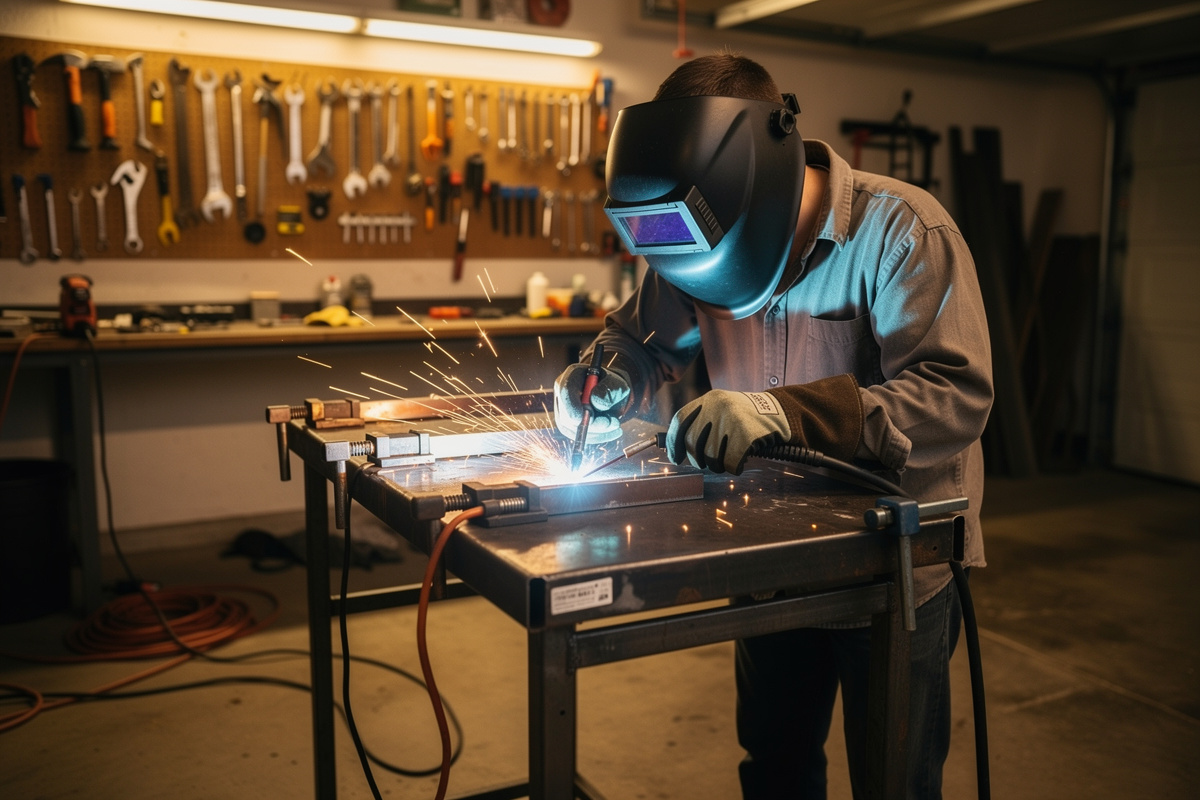

Welding is not hard to learn — most beginners produce structurally sound MIG welds within 10-15 hours of practice. The basic motions are similar to drawing with a thick marker: hold a consistent angle and move at a steady speed.
My first welding session lasted 90 minutes and produced six unrecognizable globs that I assumed meant I was bad at welding. Session two on the same Saturday produced a recognizable bead. Session four (about 4 hours total) produced one I would have welded into a real project. The “10-15 hour curve” is not a marketing claim, it is what every beginner I have taught lives through. People who struggle past hour 5 usually do so because of one of three fixable problems: wrong settings, wrong angle, or material too thin. Each has a straightforward fix that produces immediate improvement. For broader beginner context, see the welding for beginners guide.
What Makes Welding Seem Hard at First?
The most intimidating part of welding for beginners is striking the first arc. The bright light, loud buzzing, and immediate sparks create a sensory overload that makes the process feel more dangerous and complicated than it actually is. After 20-30 minutes of practice beads, this reaction fades and the movements become automatic.
Auto-darkening helmets eliminate the most common beginner fear: arc flash. A fixed-shade helmet requires you to nod the hood down before striking an arc, which shifts your hand position and makes starting the bead harder. Auto-darkening helmets stay in the up position and darken automatically in 1/25,000 of a second, so you can position the gun precisely before the arc starts.
The physical motions of MIG welding are simpler than most people expect. You hold the gun with one hand (like a pistol grip), rest the nozzle on the workpiece at a 10-15 degree angle, pull the trigger, and drag the gun along the joint at a steady speed. The wire feed handles filler metal delivery automatically. Compare this to painting with a spray can — the motor skill level is comparable.
TIG welding genuinely is harder because it requires feeding a filler rod with your non-dominant hand while controlling the torch with your dominant hand and modulating the foot pedal for heat control. This three-variable coordination takes 30-40 hours to develop. But TIG difficulty should not discourage beginners from starting with MIG, which uses a fundamentally simpler set of motions.
The Three Settings That Control Every Weld
Every MIG weld has three adjustable parameters: wire feed speed (which controls amperage), voltage (which controls arc characteristics), and travel speed (how fast you move the gun). Mastering these three settings is most of what separates a beginner’s bead from a confident one.
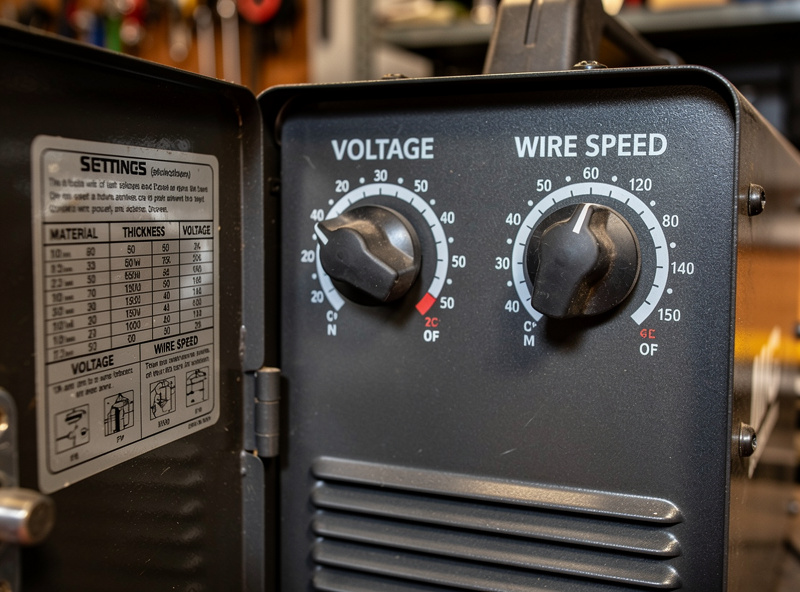
Wire feed speed determines how much filler metal enters the joint per inch of travel. Too fast and the wire stubs into the workpiece, creating a globby, raised bead. Too slow and the wire burns back to the contact tip, causing erratic arcing. Your welder’s door chart lists the correct wire speed for each metal thickness — follow it exactly during your first 20 hours of practice.
Voltage controls arc length and bead profile. Higher voltage produces a flatter, wider bead with deeper penetration. Lower voltage produces a taller, narrower bead with less penetration. Matching voltage to wire speed is the key to consistent welds — the door chart shows the correct pairings.
Travel speed determines heat input per inch of weld. Moving too fast produces a thin, convex bead that sits on top of the metal without fusing. Moving too slow puts too much heat into the joint, causing burn-through on thin material and excessive warping. A good starting speed for 1/8-inch mild steel is 10-12 inches per minute.
Skills That Transfer to Welding
People with experience in soldering, woodworking, or painting with a spray gun often learn MIG welding faster than complete beginners. The hand-eye coordination for maintaining consistent speed and distance transfers directly. If you can draw a straight line with a paintbrush at a steady speed, you can run a MIG bead.
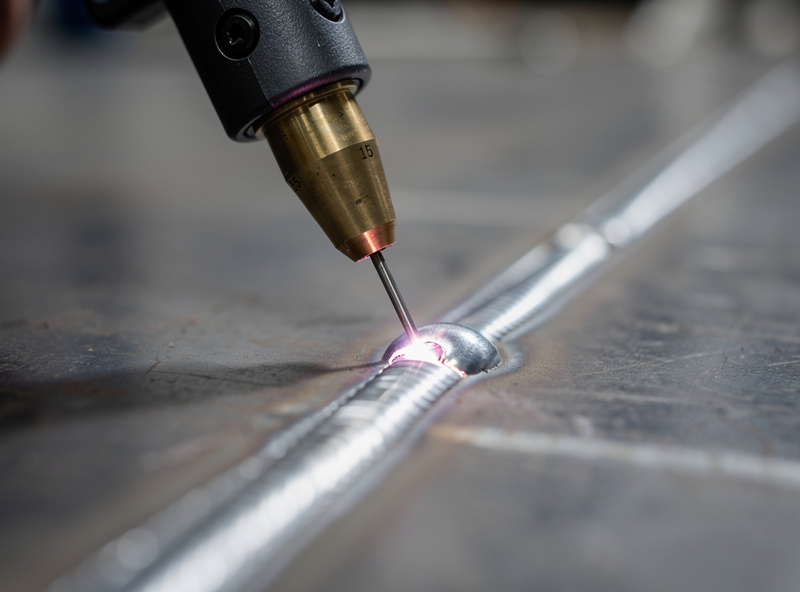
Left-handed welders have no disadvantage in MIG welding because the gun is held in the dominant hand and the direction of travel can go left-to-right or right-to-left. Some left-handed welders find it easier to push the gun (traveling in the direction the gun points) rather than drag it, which is the standard recommendation for right-handed welders.
People who play video games regularly often have the fine motor control in their hands that translates well to welding gun manipulation. The trigger control for maintaining consistent wire feed and the wrist rotation for maintaining gun angle are similar to controller inputs. The real-time feedback of seeing a weld bead form in front of you is similar to the instant feedback loop in gaming — you can see immediately when your speed or angle changes and correct on the next pass.
Common Frustrations and How to Fix Them
The most common beginner frustration is porosity — tiny holes in the weld caused by trapped gas. Porosity has five common causes: insufficient shielding gas flow (increase to 15-25 CFH for indoor work, the range most gas-flow references converge on), wind blowing away gas (move indoors or use flux-core wire), contaminated metal (grind the joint clean before welding), too-long stick-out (keep the nozzle 3/8-1/2 inch from the workpiece), or incorrect gas mixture (use 75% argon / 25% CO2 for mild steel). Flow much above 50 CFH causes the opposite problem — turbulence that pulls atmospheric air back into the shielding zone — so more gas is not automatically a safer fix.
Burn-through on thin metal is the second most frustrating beginner problem. Reducing voltage by one click and increasing travel speed by 20% usually eliminates burn-through on material thinner than 1/8 inch. If the metal is 20 gauge or thinner, switch to a smaller wire diameter (0.023 inch instead of 0.030) and reduce wire speed.
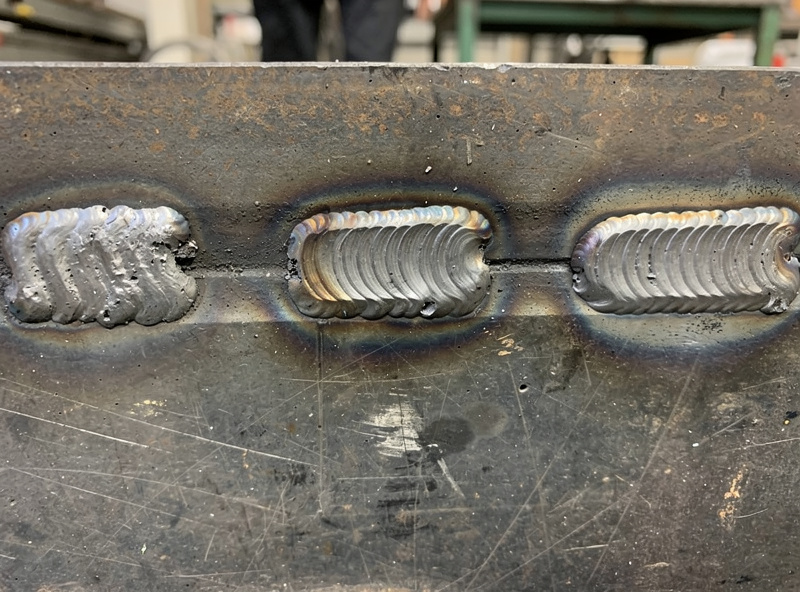
Inconsistent bead appearance — some sections smooth, others lumpy — usually indicates fluctuating travel speed. Practice moving the gun at a constant speed without welding: mark a 12-inch line on scrap steel, hold the gun at working height, and drag it along the line for 30 seconds. If you can maintain a steady speed without stopping, your bead consistency will improve immediately when you add the arc.
Complete beginner guide: equipment, costs, safety, and first projects
Hobby Competence vs. Certified Welding — Different Bars, Not the Same Race
The 10-15 hour figure I keep quoting is real, but it is not the same target as a professional welding certification, and beginners sometimes conflate the two. A structurally sound weld on a garden bracket or a welding cart is a much lower bar than a code-qualified weld that has to pass a bend test or an X-ray. A typical community-college program built around the AWS Level 1 Entry-Welder certification runs 200 hours of instruction across all four major processes (flux-core, stick, MIG, TIG) before a student sits the qualification exam — roughly 15-20x the hours it takes a hobbyist to produce a clean bead on a single process. That gap is not because the hobbyist number is inflated; it is because “sound enough for my own project” and “certified for structural or pressure-vessel work” are different standards measuring different things. If your goal is a welding cart, a fire pit, or shop fixtures, the 10-15 hour hobby curve is the right benchmark. If your goal is a welding career, budget for the full certification timeline — a full apprenticeship toward the AWS Certified Welder credential runs closer to three to four years for someone starting with no prior experience — and do not judge your progress against the hobbyist number. The two paths also diverge in what “good” means: a hobbyist bead gets judged by whether the joint holds under the loads you actually put on it, while a certified weld gets judged against a written procedure, a fixed set of parameters, and a destructive or radiographic test that does not care how the bead looks to the naked eye. Plenty of home welders produce joints that would fail a certification bend test and are still completely adequate for a welding cart or a fire pit — the standards are not ranked on the same scale, and treating hobby work as a lesser version of certified work (rather than a different goal entirely) is where a lot of beginner frustration comes from.
The One Habit That Breaks the “Stuck Beginner” Curve
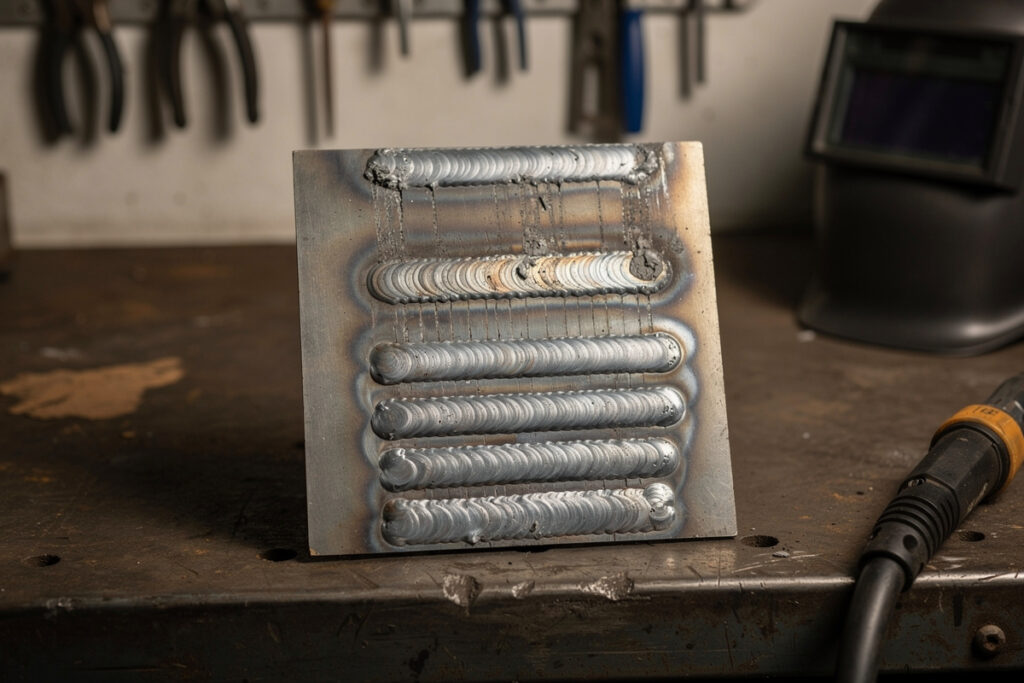
If you are stuck on hour 8 still producing ugly beads, the fix that worked for me and every beginner I have taught is this: weld 10 beads in a row on scrap, then stop and look at all 10 side by side. Looking at one bead at a time, you cannot see your pattern. Looking at 10 in a row, you spot the trend — getting faster as your hand tires, drifting longer stick-out as the gun gets heavy, hot-cold-hot from inconsistent wire-speed pressure. Pattern recognition across 10 beads at once teaches your hand what to fix faster than feedback on individual beads. Fifteen minutes of comparison-looking after each session beats an extra hour of welding without the review.
This is not just a welder’s superstition. The motor-learning research on skill acquisition points the same direction: physical practice with immediate, informative feedback and repeated attempts at the same task produces faster gains than the same hours spent without a feedback loop. A peer-reviewed review of deliberate-practice and motor-learning principles lays out the same structure that works on a welding bench: a well-defined task, immediate feedback on each attempt, and repeated practice of the same movement rather than jumping between unrelated skills. Ten beads reviewed side by side is a crude version of exactly that feedback loop — you are giving your own hands the same kind of structured correction a coach would.
The practical version of this for a beginner: do not switch metals, joint types, or settings mid-session while you are still stuck. Pick one variable to fix (usually travel speed or stick-out), run five to ten beads changing only that variable, and compare the results before moving to the next problem. Beginners who chase every visible flaw at once — porosity this bead, spatter the next, burn-through after that — take longer to improve than beginners who isolate one variable per practice block.
Frequently Asked Questions
Is welding hard for beginners?
No. Most beginners produce structurally sound MIG welds within 10-15 hours of practice. The basic hand motions are similar to drawing with a marker — hold a consistent angle and move at a steady speed. TIG welding takes longer (30-40 hours) due to two-hand coordination.
Can anyone learn to weld?
Yes, with normal hand-eye coordination and the ability to see the weld pool clearly through a helmet. People with experience in soldering, painting, or woodworking often learn MIG faster because the hand motions transfer directly.
What is the hardest part of welding?
The hardest part for beginners is maintaining consistent travel speed. Moving too fast produces thin, unfused beads. Moving too slow causes burn-through and warping. Practicing at a constant speed without the arc on is the fastest way to fix this.
How many hours does it take to get good at welding?
MIG welding: 10-15 hours for structural soundness, 40-60 hours for visually clean beads. TIG welding: 30-40 hours for basic proficiency. Stick welding: 15-25 hours for consistent beads.
Why is my welding so bad?
The most common causes are wrong machine settings (use the door chart), improper gun angle (10-15 degree push for MIG), and welding metal that is too thin for your skill level. Fixing any one of these produces immediate improvement.
Related Articles
- Welding for Beginners Complete Guide
- MIG Weld Spatter: 10 Causes and Fixes
- MIG Welding Settings Chart
- Cost to Start Welding at Home
- Best Budget Welder Under $300
- MIG vs TIG vs Stick Welding
- Best Welding Helmet for Home Use
- MIG Welding Complete Guide
- Welding Troubleshooting Guide
- Welding Safety Guide
- First Year Welding Equipment Checklist

Discussion (0)