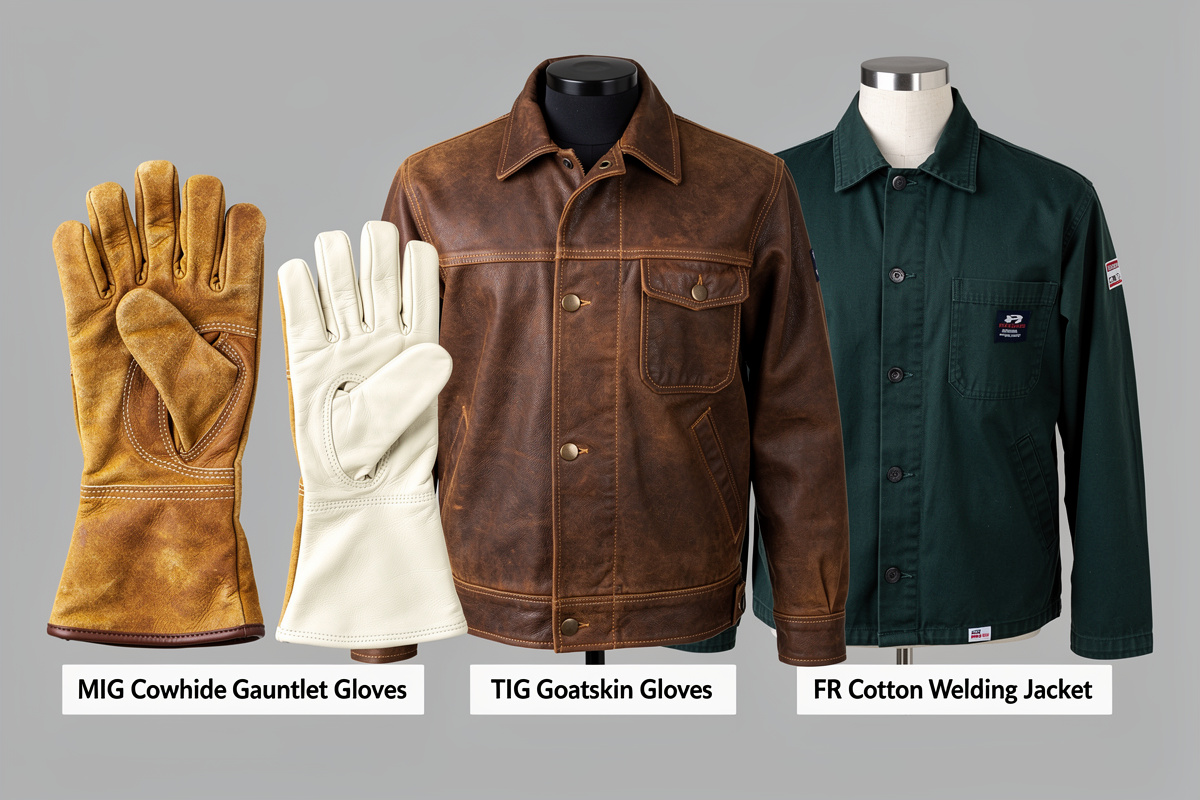

Genuine welding-rated leather gloves (not general-purpose work gloves) and a leather or FR cotton jacket that covers all skin above the waist are the only clothing that safely stops 3,000-degree spatter, 200-amp arc flash, and wire fragments from an angle grinder.
A 30-dollar pair of leather gauntlets and an 80-dollar welding jacket prevent burns that would otherwise happen in the first month of welding. Cotton or synthetic clothing near a welding arc becomes fuel, not protection — and the “safe” fabric most beginners trust isn’t the one they think. The scar on my forearm from my second project is the rest of this paragraph.
I learned the jacket lesson the hard way — second project, a single dime-sized spatter ball landed on my polyester-blend hoodie and melted through to my forearm in under a second. The scar faded; the lesson did not. From that day forward, anything within 3 feet of the arc is leather, denim, or FR-rated cotton. For the full PPE picture beyond gloves and jacket, the welding safety guide covers helmet, respirator, and ear protection. For the broader equipment context, see the essential welding equipment guide.
As an Amazon Associate I earn from qualifying purchases.
Welding Gloves: Leather Type, Cuff Length, and Fit
Welding gloves serve one job: let you handle hot metal and survive direct spatter hits without the glove catching fire, melting, or shrinking onto your hand. Three factors determine whether a glove does that job: the leather type, the cuff length, and how the glove is stitched.
Leather types ranked:
- Top-grain cowhide (15-25 dollars): The standard for MIG and stick welding. Durable, heat-resistant, and stiff enough to handle hot parts. Cowhide does not shrink when hit with spatter and lasts 3-6 months of regular welding. I run a pair of top-grain cowhide gauntlets for MIG on my YesWelder MIG-PRO205DS — double-stitched Kevlar seams, genuine welding-grade cowhide (not a general-purpose work glove wearing a “welding” label), and they’ve outlasted three pairs of the cheaper no-name cowhide gloves I burned through in my first year. The budget sweet spot. (That MIG has been my daily for years; the double-pulse YesWelder Firstess DP200 is the upgrade I’m saving for.)
- Split cowhide (10-15 dollars): Rougher, slightly less heat-resistant, but more flexible and breathable. Adequate for flux-core and hobby MIG. Wears out in 1-3 months of regular welding but costs half as much. Good for spare pairs.
- Goatskin (20-40 dollars): The TIG welder’s glove. Thin, flexible, and provides the dexterity needed to hand-feed filler rod. Less heat protection than cowhide — not suitable for MIG or stick welding where spatter volume is higher. I run Tillman 1338 goatskin TIG gloves for feel work on the argon rig — thin enough to actually sense the filler rod, with a 4-inch split-cowhide cuff that’s plenty since TIG throws almost no spatter.
- Deerskin (25-45 dollars): Maximum dexterity for precision TIG work but minimal spatter protection. Strictly for TIG; a single MIG spatter ball burns through deerskin in under a second.
- Pigskin (12-20 dollars): Breathable, stays flexible when wet, and resists hardening after repeated heat exposure. Less common but a solid budget alternative to cowhide.
Cuff length: 4-inch cuffs cover the wrist. 6-inch gauntlet cuffs cover the forearm halfway to the elbow. For MIG and stick welding, gauntlet cuffs are the minimum — spatter lands on forearms constantly, and a 4-inch cuff leaves a 4-inch gap between glove and jacket sleeve that fills with spatter in the first 10 minutes of welding. TIG welders can use shorter cuffs because TIG produces almost no spatter.
Stitching: Kevlar thread is the standard for welding gloves. Cotton thread burns through on the first spatter hit and the glove comes apart at the seams. Check the label — if it does not say Kevlar thread, the gloves are general-purpose leather work gloves marketed as welding gloves.
Welding Jackets: Leather vs FR Cotton vs Apron
A welding jacket protects your torso, arms, and neck from spatter, arc flash UV radiation, and grinding sparks. The choice between leather, FR cotton, or a leather apron depends on how many hours per session you weld and which process you are using.
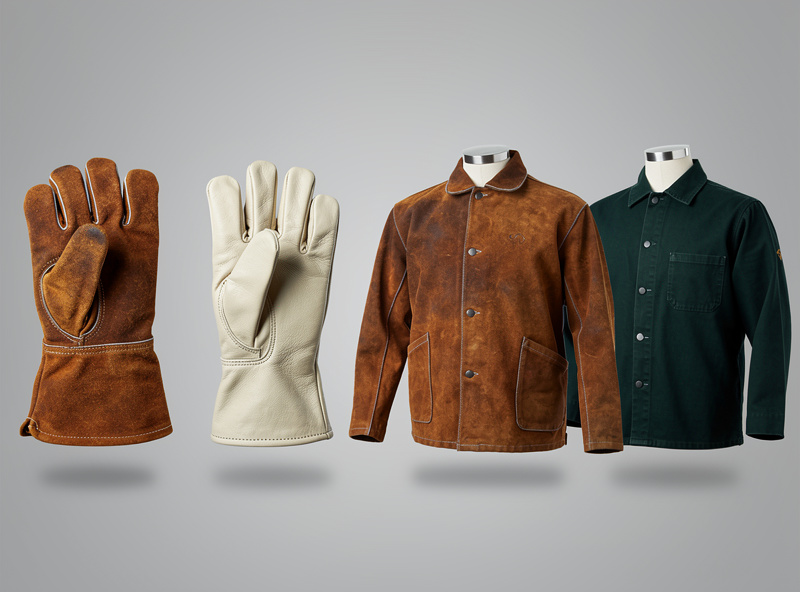
Leather jacket, split cowhide (150-250 dollars): The maximum-protection option — most welding-specific leather jackets on the market, including the one I run, are split cowhide rather than full-grain (split is thicker and more uniform across the hide, which is why it dominates this category). Spatter bounces off leather without burning through, arc flash UV does not penetrate, and a good leather jacket lasts 5-10 years of regular welding. The trade-off is heat — leather does not breathe, and in a warm garage in summer it becomes a sweat lodge. I wear a Lincoln K2989-1 split-cowhide jacket for stick and overhead work — two years in, no burn-through anywhere, and the snap-front design unsnaps fast when the garage gets unbearable in July. Recommended for MIG welding above 150 amps, stick welding at any amperage, and overhead welding where spatter rains down on the welder.
FR cotton jacket (40-70 dollars): Flame-resistant treated cotton blocks spatter for roughly 5-10 seconds before burning through — enough time to feel the heat and brush the spatter off, unlike untreated cotton which ignites on contact. FR cotton breathes, making it the choice for long sessions in warm weather. For summer MIG sessions I switch from the Lincoln leather to a Black Stallion FN9-30C 9 oz FR cotton jacket — breathes well in 85°F garage heat, and the FR treatment is still bouncing spatter after about a year of biweekly use. The FR treatment wears off after roughly 50-100 wash cycles; replace when spatter starts burning through instead of bouncing off.
Leather welding apron (25-50 dollars): Covers the front of the torso and upper legs but leaves arms and back exposed. Sufficient for light MIG and flux-core work where spatter direction is predictable (downward). Inadequate for stick welding, overhead welding, or any position where spatter comes from above or behind. Pair with FR cotton sleeves or a long-sleeve denim shirt for arm coverage.
Denim or heavy cotton (not FR): Better than synthetic, worse than FR. Denim resists spatter for 1-3 seconds before igniting — enough time to notice and brush it off, not enough time to ignore it. A 100% cotton denim jacket is the bare-minimum option for light MIG at low amperage. Never weld in synthetic fleece, polyester, nylon, or any blended fabric.
What Never to Wear While Welding
Three clothing categories turn a minor spatter hit into a hospital visit:
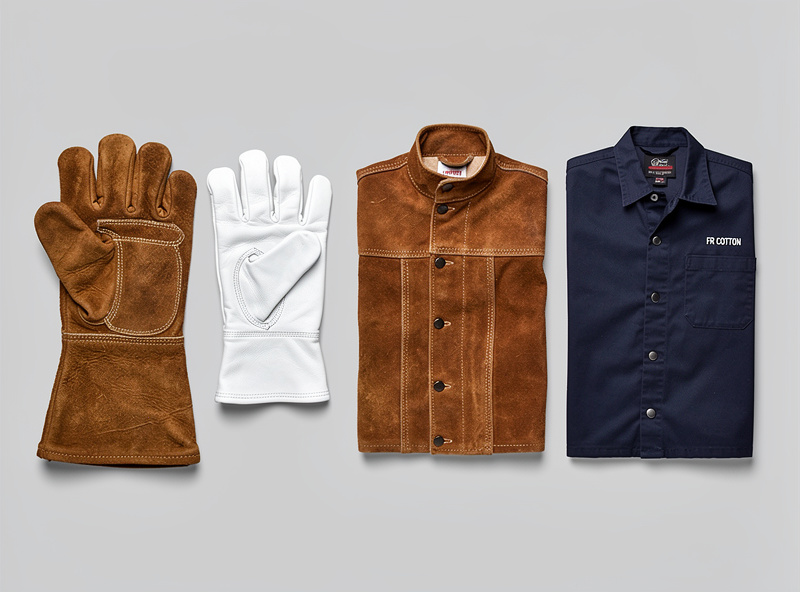
- Synthetic fabrics (polyester, nylon, fleece, spandex): Melt at roughly 400-500 degrees — well below spatter temperature (2,500-3,000 degrees). Melted synthetic fabric adheres to skin and causes third-degree burns that require surgical debridement. ANSI Z49.1:2021 §4.3 (the AWS safety-in-welding standard) states plainly that “materials which can melt and cause severe burns should not be used as clothing when welding or cutting,” and OSHA 29 CFR 1910.132 requires the employer (or, for a home shop, the welder) to assess the hazard and select PPE that actually protects against it — a melting synthetic fails that test. No polyester hoodies, no nylon jackets, no spandex-blend anything within 3 feet of the arc.
- Cuffed pants or rolled sleeves: Spatter lands in cuffs and folds and smolders. Straight-leg jeans without cuffs; sleeves unrolled and buttoned at the wrist. Every fold is a spatter trap.
- Open-toed shoes, mesh sneakers, canvas shoes: Spatter drops downward. Leather boots with the pant leg covering the boot top are the only safe footwear. Mesh sneaker tongues catch spatter and melt into the laces and foot within seconds.
Gloves and Jacket by Welding Process
| Process | Recommended Gloves | Recommended Jacket | Why |
|---|---|---|---|
| MIG (under 150A) | Cowhide gauntlet, 6-inch cuff | FR cotton jacket or leather apron | Moderate spatter, predictable direction |
| MIG (150A+) | Cowhide gauntlet, 6-inch cuff | Leather jacket | Heavy spatter, high heat |
| Flux-core | Cowhide gauntlet, 6-inch cuff | FR cotton jacket minimum; leather preferred | Flux-core spatter is heavier than gas-MIG |
| Stick (all) | Cowhide gauntlet, 6-inch cuff | Leather jacket | Heaviest spatter of all processes, all directions |
| TIG (under 200A) | Goatskin or deerskin, 4-inch cuff | FR cotton shirt or light jacket | Minimal spatter, dexterity prioritized over heat protection |
| TIG (200A+ AC aluminum) | Goatskin gauntlet, 6-inch cuff | FR cotton jacket | Higher heat radiating from workpiece |
| Grinding (angle grinder) | Cowhide or split leather, 4-inch cuff | Any welding jacket; face shield mandatory | Wire fragments, sparks, not arc flash |
Care and Replacement: When to Retire PPE
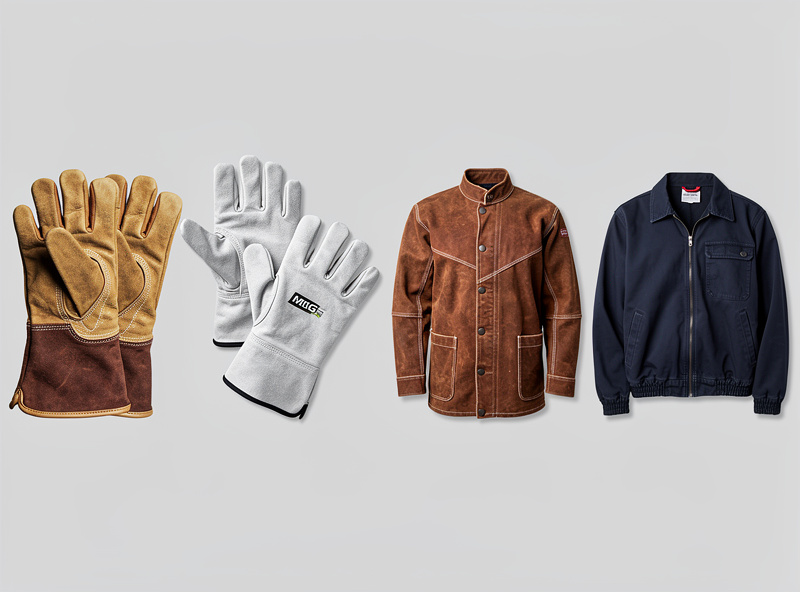
Welding PPE is consumable — it wears out, and worn-out PPE fails without warning. Replace gloves when:
- The leather is stiff and cracked from repeated heat exposure — stiff leather does not grip and you drop hot parts.
- Stitching has broken at any seam — a glove with a hole in the seam is a spatter-entry point.
- The leather is thin and translucent from spatter burn-through — if you can see light through the palm, the next spatter hit goes through to your hand.
Replace jackets when:
- FR cotton shows spatter burn-through anywhere — the FR treatment has worn off.
- Leather cracks at the elbow flex points — cracked leather lets spatter through and UV arc flash to the skin underneath.
- Any hole, tear, or burn-through larger than a pencil eraser — patch it or replace it.
Glove replacement cadence for a welder logging 4-6 hours per week: every 3-6 months for MIG cowhide gloves, every 6-12 months for TIG goatskin gloves. Jacket replacement cadence: 5-10 years for leather, 1-3 years for FR cotton depending on wash frequency. The 50-dollar jacket that prevents one burn pays for itself in the first month of welding. For the complete PPE and safety picture, the welding safety guide and welding burns first aid guide cover what happens when PPE fails.
Frequently Asked Questions
Can I use regular leather work gloves for welding?
No — welding gloves are stitched with Kevlar thread that resists spatter burn-through. Regular leather work gloves use cotton or polyester thread that burns on the first spatter hit, causing the glove to come apart at the seams mid-weld. Buy gloves sold specifically as welding gloves, not general-purpose leather work gloves.
What is the best welding jacket for hot weather?
An FR cotton jacket is the best hot-weather option — it breathes while providing 5-10 seconds of spatter protection per hit. Leather provides maximum protection but does not breathe. For the hottest conditions, a leather apron over an FR cotton long-sleeve shirt protects the front where spatter lands while leaving arms and back ventilated.
Why do TIG welders use different gloves than MIG welders?
TIG welding produces almost no spatter, so glove dexterity is prioritized over heat protection. Goatskin and deerskin TIG gloves are thin and flexible for precise filler-rod feeding. MIG and stick welding produce heavy spatter that burns through thin gloves instantly, so thick cowhide gauntlets are required.
How often should I replace my welding gloves?
Replace MIG/stick cowhide gloves every 3-6 months of regular use (4-6 hours per week). TIG gloves last 6-12 months due to lower spatter exposure. Replace immediately if stitching fails, the leather stiffens from heat, or you can see light through any worn-thin area of the palm or fingers.
Is a welding apron enough protection for MIG welding?
A leather apron protects the torso and upper legs from downward spatter but leaves arms and back exposed. It is sufficient for light MIG welding under 150 amps in flat and horizontal positions where spatter direction is predictable. For vertical, overhead, or stick welding, a full jacket is required because spatter comes from all directions.
Can I weld in a cotton hoodie instead of a welding jacket?
A 100% cotton hoodie ignites on spatter contact in 1-3 seconds versus the 5-10 seconds FR cotton provides. For light MIG under 100 amps, thick denim or cotton works as a bare minimum. For anything above 100 amps, flux-core, or stick welding, FR cotton or leather is required. Never weld in a synthetic-blend hoodie — polyester melts onto skin on contact.

Discussion (0)