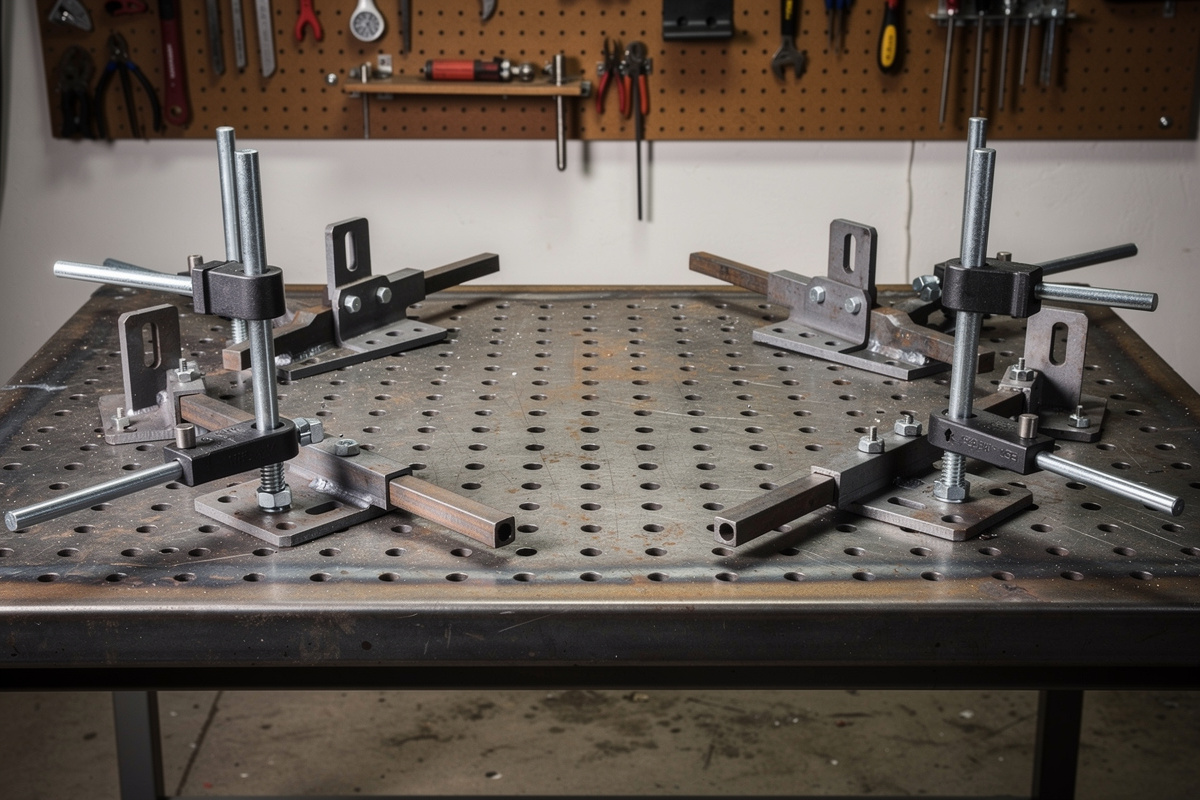

A welding table provides a flat, grounded surface for clamping and welding workpieces. Commercial welding tables cost $150-$500; for beginner welding, a 3/8-inch steel plate on sawhorses works at one-tenth the cost.
I welded my first 30 projects on a 24″x36″ 3/8″ steel plate set across two sawhorses. It was flat enough for fire pits, garden bed frames, and the welding cart that eventually replaced it. I built my own welding table in year three from a 1/2″ plate and angle-iron legs — total cost $90 in steel plus a Saturday — and have not looked back. Commercial tables earn their place when you produce repeating brackets or frames where 1/16″ flatness across 4 feet matters; for one-off projects, the savings beat the convenience. The full equipment context is in the essential welding equipment guide; for the welding cart that doubles as a work surface, see how to build a welding cart.
The decision to buy or build a welding table depends on how many projects you plan to build and whether you need repeatable fixturing. Casual weekend welders building 5-10 projects per year do fine with a steel plate. Welders producing multiple identical pieces — brackets, frames, assemblies — benefit from a table with precision-ground flatness and built-in clamping.
What Makes a Good Welding Table?
The four features that separate a useful welding table from a heavy piece of steel are top flatness, ground connectivity, clamping system, and weight capacity. Flatness determines whether your assemblies come out square. Ground connectivity ensures consistent arc starting. Clamping speed determines setup time per project. Weight capacity limits the size of assemblies you can fixture on the table.
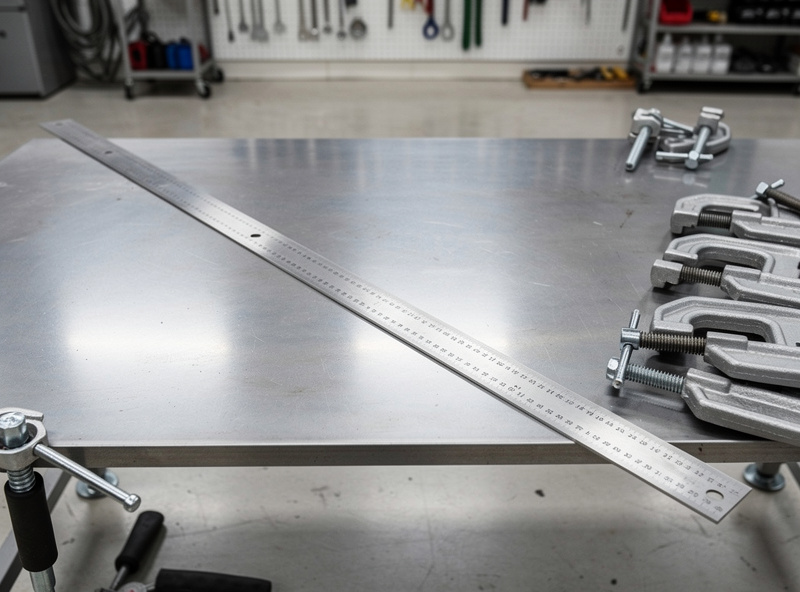
Top flatness matters most for assemblies with multiple joints. If your table surface is flat within 1/16 inch across its entire area, your clamped pieces stay aligned through tack welding and final welding. A warped surface — even 1/8 inch of deviation — compounds through multi-joint assemblies and produces twisted frames.
Genuinely precision-ground flatness is its own price tier, and it’s worth knowing the numbers so a “commercial table” listing doesn’t oversell what you’re buying. A basic DIY or fabricated welded table typically deviates around 0.02-0.2 inches overall depending on build quality, milled tables tighten that to roughly 0.015-0.05 inches, and true ground (Blanchard-ground) surfaces get down to a few thousandths of an inch — but that level of flatness belongs to the modular fixturing tables (Siegmund, BuildPro, and similar) that run well past $1,000, not the $150-500 welded-steel tables this section is mostly about (source). A $150-500 commercial welded table is typically flat within 1/8 inch overall — adequate for single-joint work but the same ballpark as a well-made DIY plate, not precision-milled. If building your own table from steel plate, check flatness with a straightedge before committing to the piece.
A built-in ground stud or clamp point on the table surface eliminates the need to clamp your ground cable to each workpiece individually. This is one of the most time-saving features of a dedicated welding table. Touch the workpiece to the table surface and it is grounded automatically. This saves 30-60 seconds per setup and prevents the inconsistent arc caused by a loose ground clamp — and it isn’t just convenience: a poor ground connection is also a genuine safety issue, since a solid ground path is what keeps stray current from finding an unintended route back to the machine if something in the welder’s insulation fails (source).
Commercial vs DIY Welding Tables
Commercial welding tables in the $200-$500 range for a 36 x 24-inch model get you a flat, grounded, purpose-built surface with hole-pattern or T-slot clamping — real conveniences, but not the milled/ground precision flatness of the $1,000+ modular fixturing tier. DIY tables cost $30-$80 in materials and can be customized to your exact workspace dimensions and workflow needs.
The main advantage of commercial tables is the hole-pattern or T-slot clamping system. These systems let you clamp workpieces anywhere on the table surface using threaded inserts or slot nuts. Setup time drops from 2-3 minutes (measuring and positioning C-clamps) to 15-30 seconds (dropping a clamp into a hole). For production work, this time savings compounds across hundreds of assemblies.
DIY tables can incorporate the same clamping systems by drilling a grid of holes in a steel plate and using toggle clamps or threaded inserts. The DIY approach requires precise drilling (holes must be perpendicular to the surface) but produces a table that matches your specific clamping needs exactly.
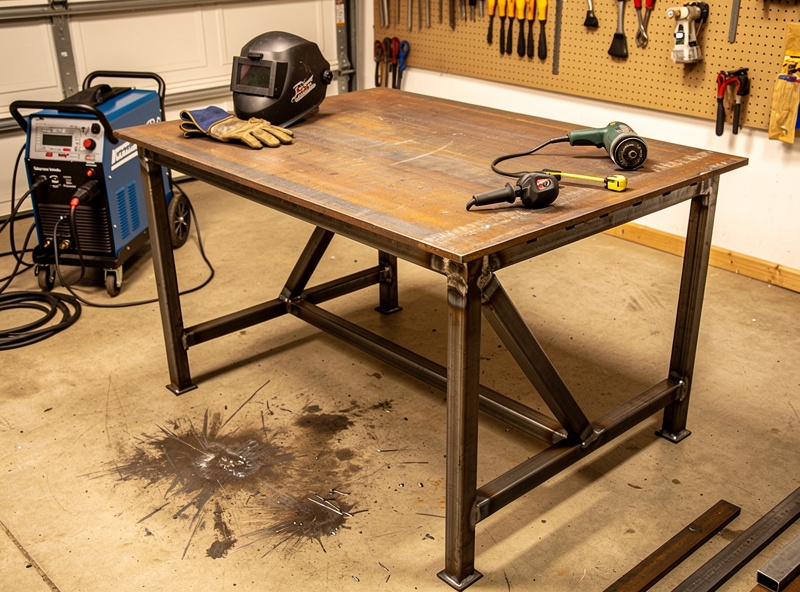
For beginners, a DIY table from 3/8-inch steel plate on a sturdy frame is the best value. Weld the frame from angle iron or square tubing — the table itself becomes your first significant welding project and teaches clamping, fixturing, and flat-welding techniques. Budget 8-12 hours of build time and $50-$80 in materials. A DIY table also teaches you exactly what features matter for your workflow, so if you eventually upgrade to a commercial table, you know which accessories and clamping systems you will actually use.
Welding Table Sizes for Home Garages
A 24 x 36-inch welding table fits in most home garages and handles projects up to 36 inches wide. For larger assemblies (furniture, frames, gates), a 36 x 48-inch table or a 4 x 4-foot steel plate on sawhorses provides the extra surface area. Table height should be 34-38 inches for comfortable standing work.
The table surface area directly affects what you can build. A 24 x 36-inch table handles shelving brackets, plant stands, small furniture legs, and decorative metalwork. A 36 x 48-inch table handles coffee table frames, bench frames, and medium gate assemblies. Anything wider than 48 inches requires either an oversized table or working on the floor with a steel plate.
Consider your garage layout before choosing a table size. A 36 x 48-inch table occupies 12 square feet of floor space plus 30 inches of clearance on working sides — a total footprint of approximately 5 x 7 feet. In a standard two-car garage (20 x 20 feet), this leaves plenty of room for your vehicle and other equipment. In a single-car garage (12 x 20 feet), a 24 x 36-inch table with one-sided access may be more practical.
Do not buy a table larger than your garage can accommodate with room to walk around all sides. A table pushed against a wall limits your clamping options and makes out-of-position welding awkward. Plan for at least 30 inches of clearance on the working sides of the table.
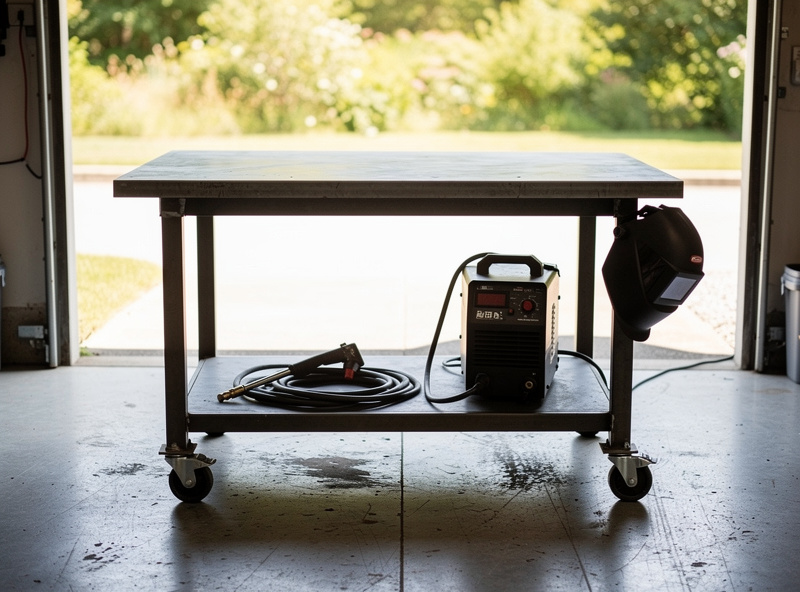
Mobile tables with locking casters let you roll the table to the garage door for outdoor welding (better ventilation) and lock it in position for stationary work. Fixed legs are more stable for heavy assemblies but limit flexibility. If your garage serves multiple purposes (parking, storage, welding), a mobile table that rolls to the corner when not in use prevents the workspace from feeling cramped.
Some welders prefer a two-table setup: a small mobile cart (24 x 18 inches) for grinding and cutting prep work, and a larger fixed table (36 x 48 inches) for welding assemblies. The cart holds the angle grinder, clamps, and measuring tools and rolls between the cutting station and the welding station. This setup separates dirty grinding work from clean welding work and keeps grinding dust off your welding surface.
Build a mobile welding cart that doubles as a compact work surface
Frequently Asked Questions
Do I need a welding table to start welding?
No. A 3/8-inch steel plate on sawhorses works for flat-position practice and beginner projects. Invest in a proper welding table ($150-$500) after you are building projects that require multiple clamping points or out-of-position welds.
What size welding table do I need?
A 24 x 36-inch table handles projects up to 36 inches wide and fits in most home garages. For furniture and larger assemblies, a 36 x 48-inch table or a 4×4-foot steel plate on sawhorses provides enough surface area.
Can I build my own welding table?
Yes. A DIY table from 3/8-inch steel plate on an angle-iron frame costs $50-$80 in materials and takes 8-12 hours to build. The table itself is an excellent first welding project that teaches clamping and fixturing.
What height should a welding table be?
34-38 inches for standing work. Most people work comfortably at elbow height minus 2 inches. Taller welders (over 6 feet) may prefer 38-40 inches. Adjustable-height tables ($300+) accommodate different users and welding positions.
How flat does a welding table need to be?
Within 1/16 inch across the surface for general welding. Precision assemblies benefit from a milled or ground table (roughly 0.015-0.05 inches per foot for milled, down to a few thousandths for ground) but that level of flatness is a $1,000+ modular fixturing table, not a $200-500 basic commercial table. For beginner projects, check flatness with a straightedge — if it looks flat, it is flat enough.

Discussion (0)