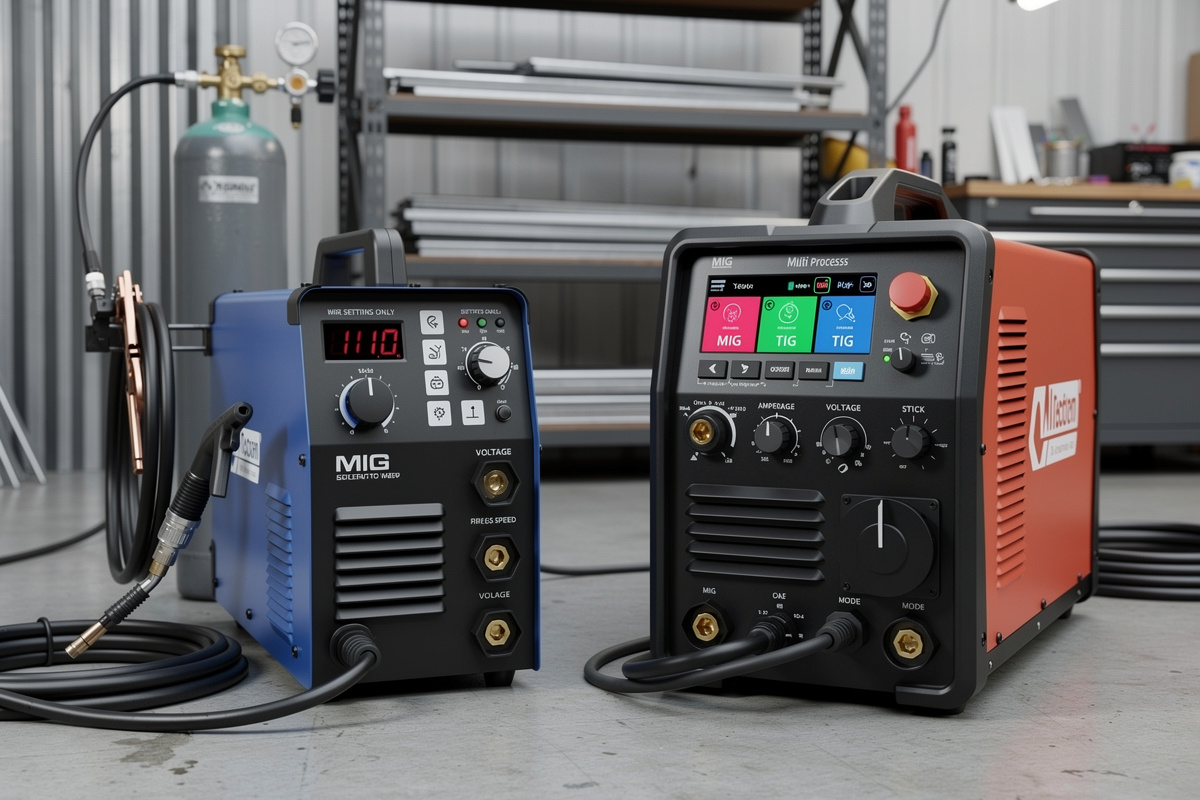

A multi-process welder that does MIG, stick, and lift-TIG in one machine costs 500-700 dollars — roughly 150-200 dollars more than a comparable single-process MIG and 200-300 dollars less than buying separate MIG and stick machines.
The multi-process unit saves money only if you are certain you will use at least two processes within your first two years. Pick wrong and you have either overpaid 200 dollars for capability you will never touch, or underpaid 200 dollars by buying dedicated machines piecemeal — exactly the math trap I walked into, told in the next paragraph and tallied at the end of this guide.
I bought a YesWelder MIG-PRO205DS single-process MIG first (around 400 dollars) because I was not sure I would stick with welding at all — six months in, I added a YesWelder ARC-205DS stick machine (180 dollars) because outdoor projects in wind and rain demanded it. The total cost of the two dedicated machines was roughly 200 dollars more than the multi-process unit I could have bought on day one. But the MIG-PRO205DS is a better MIG than the MIG mode of any sub-700-dollar multi-process I have tried at a friend’s shop, and the dedicated ARC-205DS strikes a cleaner stick arc than the multi-process units I have used. That trade — dedicated quality vs multi-process convenience — is the entire decision. For the full equipment landscape, the essential welding equipment guide covers every tool category. For specific machine recommendations by budget, see best budget welder under 300 dollars and best MIG welder for home garage.
What “Multi-Process” Actually Means
A multi-process welder combines MIG (gas-shielded and flux-core), stick (SMAW), and TIG (typically lift-TIG, not high-frequency start TIG) in a single machine. The user selects the process with a switch or dial, connects the appropriate torch or gun and ground clamp to the corresponding output terminals, and the machine delivers the correct voltage-amperage characteristic for that process.
What multi-process does NOT mean at the 500-800 dollar price tier:
- It does not include AC TIG for aluminum. Multi-process units under roughly 1,200 dollars are DC-only, which means TIG is limited to steel and stainless steel. Aluminum TIG requires AC output, which adds roughly 500-800 dollars to the machine cost.
- It does not include high-frequency (HF) arc start for TIG. Budget multi-process units use lift-TIG (scratch the tungsten on the workpiece to start the arc) or scratch-start. HF start — touching nothing and the arc ignites via high-frequency pulse — is rarer on multi-process machines than the price tiers below might suggest: manufacturer spec sheets confirm even pro-tier units like the Lincoln 210 MP and Miller Multimatic 215 stay lift-arc TIG, not HF. Genuine HF start on a multi-process machine means jumping to a full AC/DC unit like the Miller Multimatic 220 AC/DC, which starts around 4,200 dollars — 3-4x the price of the lift-TIG multi-process units in this guide. Lift-TIG works for steel but is frustrating for thin material where the scratch contaminates the tungsten.
- It does not include a foot pedal for TIG amperage control. Budget units use a finger switch on the TIG torch for on/off control; foot pedal amperage control adds 100-200 dollars as an accessory and is only supported on higher-end units.
Dedicated MIG vs Multi-Process: The Internal Difference
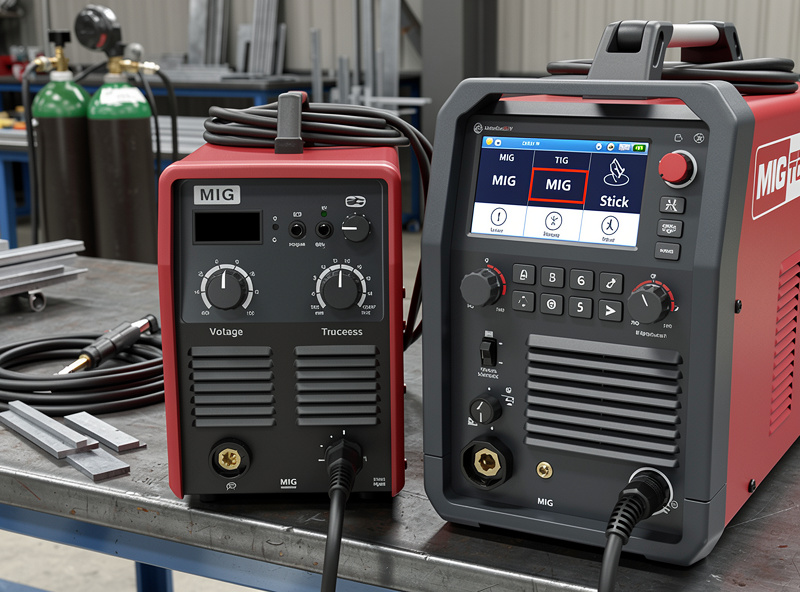
A dedicated MIG welder optimizes every internal component for one process: the transformer or inverter is designed for the constant-voltage output MIG requires, the wire feed motor and drive assembly are permanently mounted and tuned for MIG wire, and the gas solenoid is integrated into the MIG circuit. A multi-process welder shares these components across processes, which means compromises:
- Constant-voltage (MIG) vs constant-current (stick/TIG) output: A multi-process machine switches between CV and CC output modes electronically. The transition is functional but the arc characteristic is never quite as stable as a dedicated machine — MIG mode may have slightly more spatter, stick mode may have a slightly less forgiving arc start. AWS A5.18 (the spec for ER70S-6 carbon-steel MIG wire) lists arc-stability characteristics that only a dedicated CV power supply delivers consistently; multi-process units pass the AWS bend test but throw visibly more spatter on the same wire and gas mix. My MIG-PRO205DS on 0.030 ER70S-6 with C25 produces a noticeably tighter spatter pattern than the borrowed PrimeWeld MIG180 I tried last summer on identical wire. For home-shop work the difference is small; for production welding it is noticeable.
- Duty cycle at equivalent amperage: Multi-process units typically have 10-20% lower duty cycle at the same amperage compared to a dedicated single-process machine at the same price, because the shared power electronics handle the thermal load of all three processes.
- Wire feed quality: Budget multi-process MIG wire feeds are plastic-bodied and tuned for general-purpose use. Dedicated MIG machines in the same price range often have metal-bodied wire feed assemblies with smoother, more consistent feed.
Who Should Buy Which: The Decision Flow
Buy a dedicated single-process MIG welder if:
- You are a beginner who wants the simplest, most forgiving machine to learn on.
- Your projects are entirely mild steel under 1/4 inch thick — which covers 80% of home welding.
- You have a fixed budget and want the best possible MIG performance for your dollar.
- You are certain you will not add stick or TIG welding within your first two years.
Buy a multi-process MIG/stick/TIG welder if:
- You are certain you will weld with at least two processes (typically MIG + stick for outdoor work) within two years.
- You want to learn TIG but do not need aluminum capability (DC TIG on steel/stainless only).
- You have limited shop space and one machine that does everything is more practical than two machines.
- You are willing to pay 20-30% more upfront to save 40-50% versus buying two dedicated machines later.
Multi-Process Models Compared: 500-1200 Dollars
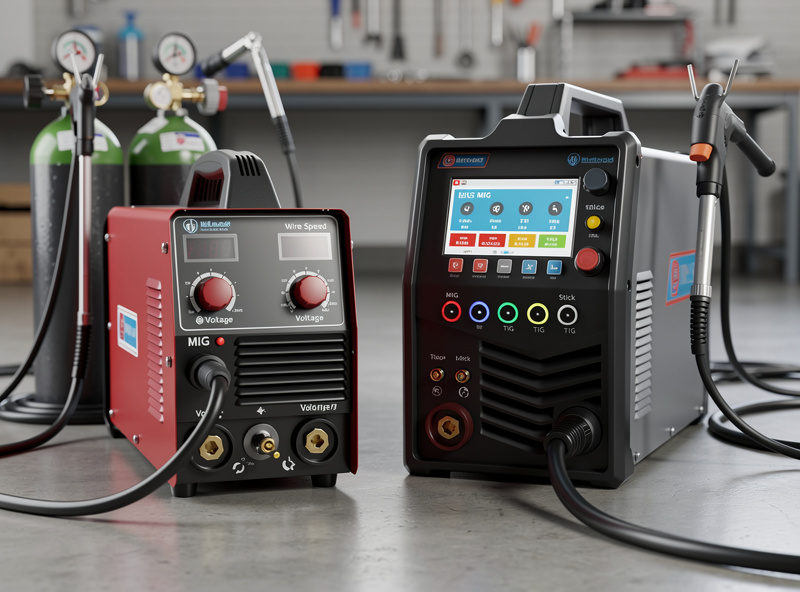
| Model | Processes | Price | TIG Type | Duty Cycle | Best For |
|---|---|---|---|---|---|
| YesWelder MIG-205DS-Pro | MIG, flux-core, stick, lift-TIG (torch sold separately) | $459 | Lift-TIG (DC) | 60% at 205A | Budget MIG + stick + TIG |
| PrimeWeld MIG180 | MIG, flux-core, stick | $549 | No TIG | 30% at 180A | Budget MIG + stick, no TIG |
| Hobart Multi-Handler 200 | MIG, flux-core, stick, lift-TIG | $1,400 | Lift-TIG (DC) | 30% at 165A | Brand reliability |
| ESAB EMP 215ic | MIG, flux-core, stick, lift-TIG | $2,400+ | Lift-TIG (DC), pulsed | 25% at 205A | Pro-sumer portable |
| Lincoln 210 MP (discontinued; replaced by Power MIG 215 MPi) | MIG, flux-core, stick, DC TIG | $1,999 | Lift-TIG (DC) | 30% at 200A | Pro multi-process |
| Miller Multimatic 215 | MIG, flux-core, stick, DC TIG | $1,600 | Lift-TIG (DC) | 20% at 200A | Top-tier portable |
Specs and prices above are pulled from current manufacturer listings: YesWelder’s own MIG-205DS-Pro page confirms the lift-TIG option (torch sold separately) and a 60% duty cycle at 205A, and PrimeWeld’s MIG180 page confirms it ships with MIG, flux-core, and stick only — no TIG option at any price. None of the sub-1,600 dollar multi-process units include AC TIG for aluminum. If aluminum TIG is a requirement, a dedicated AC/DC TIG welder (380-450 dollars for entry-level like the AHP AlphaTIG 200X) plus a separate MIG machine is cheaper and better than any multi-process unit with AC TIG (which starts at roughly 4,200 dollars with the Miller Multimatic 220 AC/DC). The duty-cycle penalty multi-process units pay is published in each manufacturer’s spec sheet — Power MIG 215 MPi datasheet (30% at 200A, the current replacement for the discontinued Lincoln 210 MP), Miller Multimatic 215 datasheet (20% at 200A), ESAB EMP 215ic datasheet (25% at 205A); compare those against the YesWelder MIG-PRO205DS dedicated MIG at 60% at 160A on the same 240V circuit. I have run the Lincoln 210 MP at a friend’s shop for an afternoon — lift-arc TIG felt clean once I had the touch-and-lift timing down, but in MIG mode the arc lacks the consistency of my dedicated MIG-PRO205DS at less than half the price.
The Math: Two Machines vs One Multi-Process
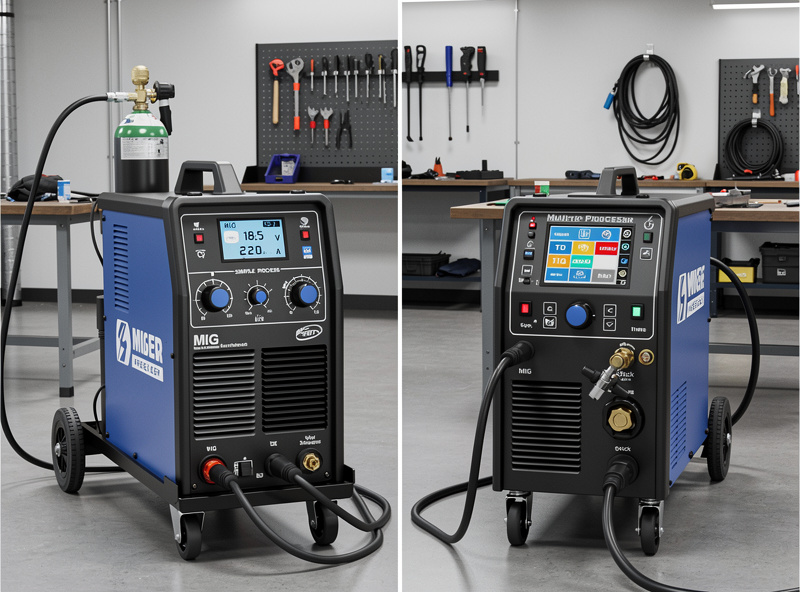
Over two years, comparing the cost of a single-process path vs a multi-process path:
Path A — Dedicated machines: Buy a 280-dollar MIG welder (YesWelder MIG-205DS). After one year, add a 180-dollar stick welder (YesWelder ARC-205DS) for outdoor projects. Total: 460 dollars. You own two machines, each optimized for its process, and if one fails you still have the other.
Path B — Multi-process machine: Buy a 549-dollar multi-process unit (PrimeWeld MIG180) on day one. Total: 549 dollars. You own one machine that does MIG and stick adequately. The MIG mode is slightly less refined than a dedicated MIG; the stick mode is functional. If the machine fails, you have zero welders.
Path A is actually 89 dollars cheaper here, not the wash it might look like on paper — and you get two machines each optimized for its process instead of one compromise unit covering both. The real trade is still quality and redundancy vs footprint and one-box convenience. My friend who has been welding for decades told me “buy the best MIG you can afford and add stick later — the MIG machine will be used 80% of the time and that 80% should be as good as possible.” After owning both paths at different times, I agree. But if shop space is at a premium — an apartment balcony, a shared garage, a mobile welding rig — the single multi-process machine still wins on footprint, even at the slightly higher price.
The Machine I Run — and the Upgrade I’m Saving For
As an Amazon Associate I earn from qualifying purchases.
For the record, my daily machine is the YesWelder MIG-PRO205DS — a dedicated MIG that has handled every project on this site, and exactly the “buy the best MIG you can afford” choice I argued for above. Where I plan to spend next is double-pulse. I ran the YesWelder Firstess DP200 — the flagship dual-pulse multi-process unit — for a full afternoon in my friend Mike’s garage, and the difference on thin steel and aluminum is the real thing: dual-pulse arc control lays a clean, stacked-dime bead at a fraction of the heat input, right where a single-pulse machine starts to fight you. It is the machine I am budgeting to move up to as soon as the shop fund allows. And if pulse-on-aluminum is the one feature pulling you toward spending more, the more affordable YesWelder YWM-211P double-pulse aluminum MIG gets you there for less — a sensible middle step between a dedicated MIG and a do-everything machine.
Frequently Asked Questions
Is a multi-process welder worth it for a beginner?
Only if you are certain you will use at least two processes (usually MIG + stick) within two years. A 549-dollar multi-process unit versus a 280-dollar dedicated MIG — the 269-dollar premium buys stick capability today instead of 180 dollars later, and still costs more up front than buying both machines separately. If you are unsure, buy the dedicated MIG and add stick when projects demand it.
Can a multi-process welder TIG weld aluminum?
No — multi-process welders under 1,600 dollars are DC-only and cannot TIG weld aluminum, which requires AC output. Budget multi-process TIG is limited to steel and stainless steel. For aluminum TIG, buy a dedicated AC/DC TIG welder (380-450 dollars entry-level, like the AHP AlphaTIG 200X) or step up to the Miller Multimatic 220 AC/DC at roughly 4,200 dollars plus.
What is lift-TIG and how is it different from high-frequency start TIG?
Lift-TIG requires touching the tungsten to the workpiece and lifting to strike the arc — the machine detects the short circuit and ramps up current. High-frequency start TIG ignites the arc without touching — a high-voltage pulse jumps the gap. Lift-TIG works for steel but contaminates the tungsten on each start and is frustrating on thin material. HF start is cleaner and faster, but on a multi-process machine it is a big jump, not a small upgrade fee: HF start is essentially absent below full AC/DC units like the Miller Multimatic 220 AC/DC (roughly 4,200 dollars), well above the lift-TIG multi-process units covered here.
Do multi-process welders have shorter lifespans than dedicated machines?
Not inherently, but budget multi-process units share power electronics across processes, which means any component failure disables all processes. A dedicated MIG machine that fails only loses MIG; a multi-process machine that fails loses everything. Higher-end multi-process units (Lincoln, Miller, ESAB) have reliability comparable to dedicated machines.
Can I use a MIG spool gun on a multi-process welder for aluminum?
Some multi-process welders support a spool gun for aluminum MIG (check the machine specifications). The spool gun mounts the wire spool directly on the gun to avoid birdnesting in a long liner. Aluminum MIG with a spool gun on a multi-process unit works for thick aluminum (1/8 inch and up) but not for thin-gauge or cosmetic aluminum work that needs TIG.
Which is better: one multi-process welder or two dedicated machines?
Two dedicated machines provide better process-specific performance, built-in redundancy (one fails, you still have the other), and typically cost about the same total. One multi-process machine saves shop space, reduces cord and gas cylinder clutter, and means one set of consumables and accessories. For home shops with space, two dedicated machines win. For mobile or small-space welding, one multi-process wins.

Discussion (0)