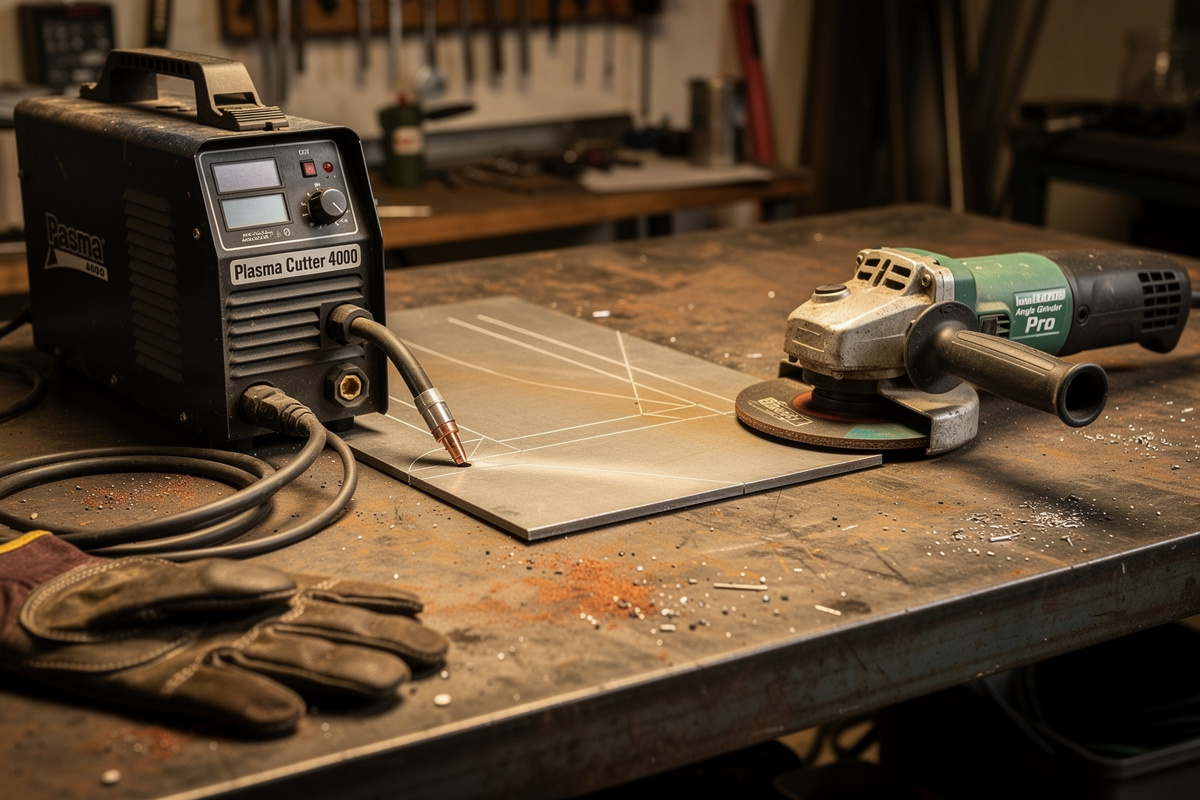

Plasma cutters cut steel 5-10x faster than angle grinders with cleaner edges, but cost $300-$1,500 versus $50-$150 for a grinder. For occasional cuts (under 30/month), the grinder wins on total cost. For volume work above 50/month or curved cuts, plasma pays back in 6 months.
I cut a 24-inch line through 1/4″ plate with my grinder and a 4.5″ cutoff wheel — 11 minutes, three burned-through wheels, and edges I had to clean before tacking. The same cut on my plasma 90 seconds later was square enough to weld immediately. The cumulative time savings on a fire-pit build (8 cuts × ~10 minutes saved each = 80 minutes per project) is what makes plasma worth it once your project flow exceeds 4-6 cut-heavy builds per year. The full plasma context is in the plasma cutting guide. Written by Kenny Nyhus Fadil.
As an Amazon Associate I earn from qualifying purchases.
How Plasma Cutters Work
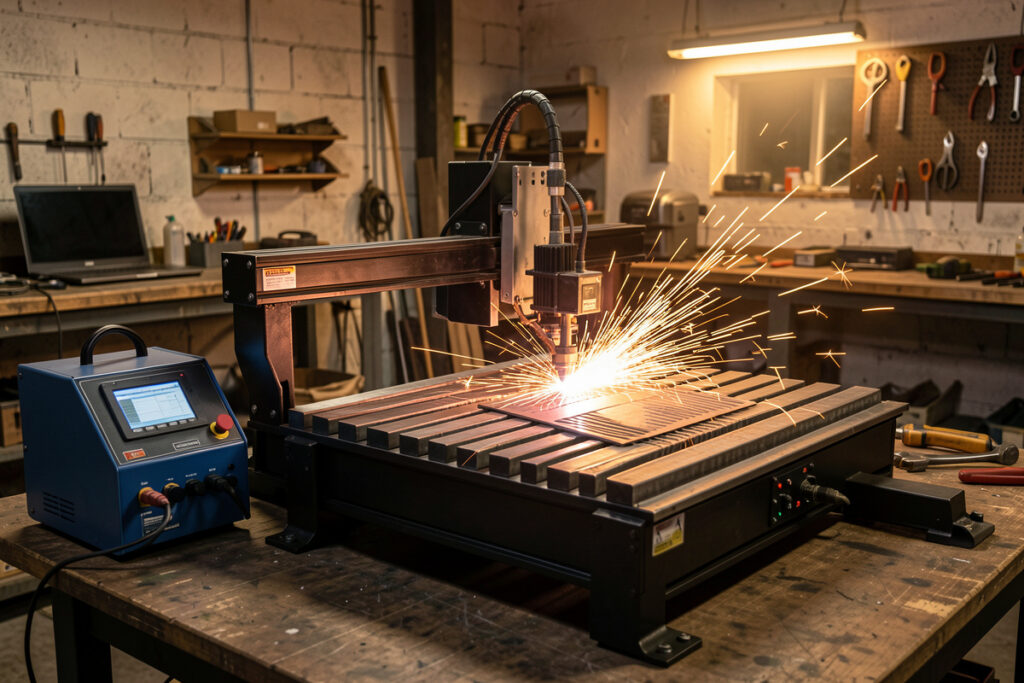
Plasma cutting uses compressed air forced through an electric arc to ionize the air into superheated plasma — Hypertherm’s own explainer walks through the same electrode-arc-ionization mechanism — running about 25,000-35,000°F at the cut nozzle. The plasma stream melts the steel and the high-velocity airflow blows the molten metal out of the kerf. The result is a thin (0.1-0.2 inch wide) clean cut with minimal heat-affected zone outside the kerf.
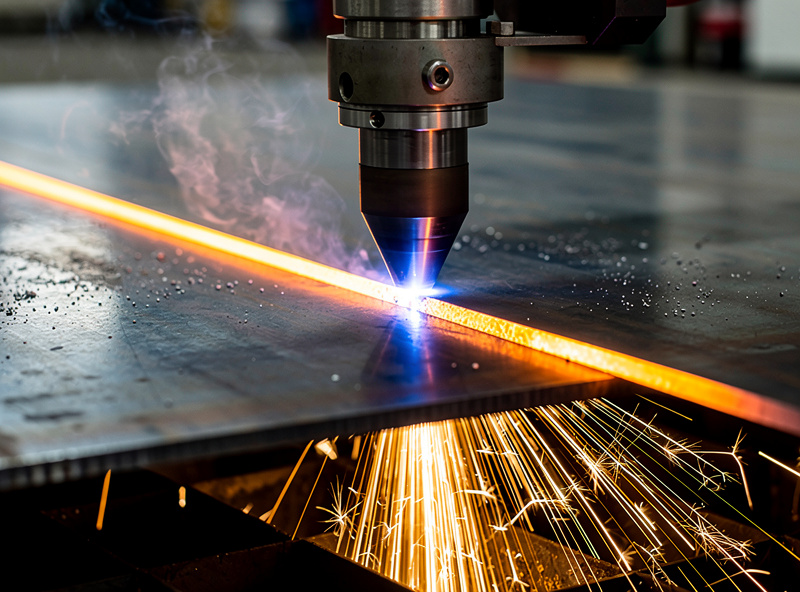
Cut speed on 1/4-inch mild steel is typically 30-60 inches per minute on a 30-amp home plasma unit. Cut speed on 3/8-inch steel drops to 15-25 IPM. The same cuts on an angle grinder with cutoff wheel run at 4-8 IPM regardless of thickness. Plasma also cuts curves easily — angle grinders only cut straight lines unless you’re willing to swap to a jigsaw with metal blades.
How Angle Grinders Cut Steel
Angle grinders use a high-RPM (10,000-12,000) rotating abrasive disc to grind through metal. Cutoff wheels (1.0-2.5 mm thick) cut faster but produce wider kerfs than plasma. Grinding wheels (4-6 mm) shape rather than cut. The grinder approach is mechanical — sparks are ground-off steel particles, not melted slag — so heat input to the workpiece is much lower than plasma.
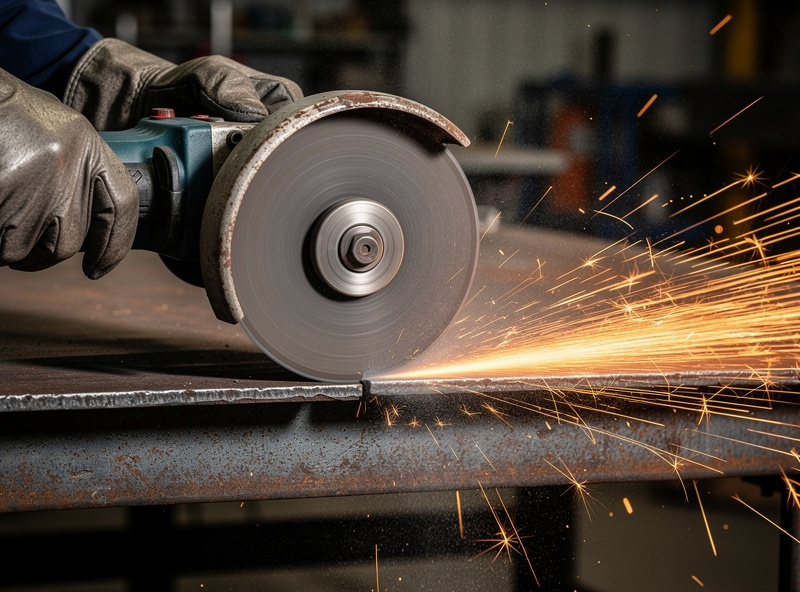
Cut speed on 1/4-inch steel with a 4.5-inch grinder and 1.5mm cutoff wheel is roughly 4-8 IPM with the operator pushing steadily. The kerf is about 0.07-0.10 inch wide — narrower than plasma actually. The trade-off is rough edge quality (plenty of cleanup grinding required) and the inability to cut curves easily. Grinders also consume disposable wheels — a $5 cutoff wheel cuts roughly 30-60 inches of 1/4-inch steel before retiring. The essential welding equipment guide covers cutoff wheel selection.
Speed and Volume Comparison
For a single 12-inch cut through 1/4-inch steel, plasma takes 12-24 seconds while angle grinder takes 90-180 seconds. The plasma is 5-10x faster. For 100 such cuts (a small fabrication project), plasma totals 20-40 minutes of cutting; angle grinder totals 2.5-5 hours. The time savings dominate at production volumes, even at hobby scale.
Curved cuts shift the balance further. A plasma cutter follows a marker line on a curved layout at full speed. An angle grinder cannot follow tight curves at all — you score and snap, then grind to the line, which adds 5-10 minutes per curved feature. For decorative fire pit cutouts, plasma turns a 4-hour decoration into a 30-minute one. The welding fire pit project covers specifically when cutout work justifies plasma.
True Cost Comparison Including Consumables
Upfront cost: a 4.5-inch angle grinder runs $40-150 (Makita and DeWalt are the reliable brands). A 30-amp home plasma cutter runs $300-700 from Yeswelder/Lotos/Hypertherm value lines, $700-1,500 from Hypertherm/Miller commercial lines. Per-cut cost is where the comparison gets interesting. Plasma consumables (electrode, swirl ring, nozzle) add up to roughly $0.10-0.25 per linear foot of cut. Angle grinder cutoff wheels cost roughly $0.50-1.00 per linear foot of cut.
Break-even calculation: at $0.50/foot grinder vs $0.15/foot plasma, the $300 price difference between a budget plasma and a budget grinder covers itself across roughly 850 linear feet of cutting — equivalent to about 50-100 hobby-scale projects. For a welder running fewer than 30 cuts per month, the grinder is cheaper for the next 5+ years. For a welder running 100+ cuts per month, plasma pays back inside 6 months.
Edge Quality and Cleanup Time
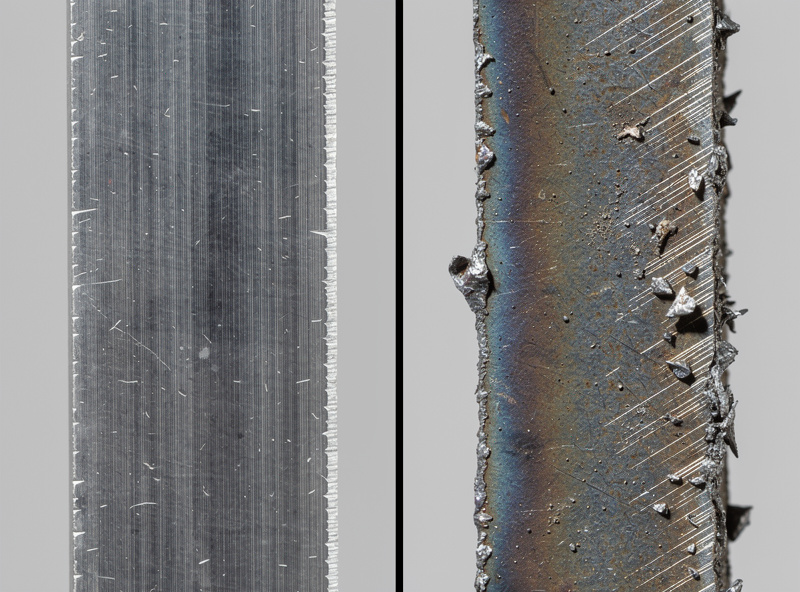
Plasma cuts produce a smooth perpendicular edge with minimal slag — typically 30 seconds of light flap-disc cleanup per linear foot. The dross underneath the cut peels off with pliers in most cases. The cut surface is clean enough to weld directly without grinding. Heat-affected zone is narrow (1-2 mm), so material properties stay close to original — Hypertherm’s own spec page for the class of 30-amp home unit I’m describing here confirms the narrow-kerf, minimal-dross, minimal-HAZ combination is the whole point of the technology, not a marketing exaggeration.
Angle grinder cuts produce a rough beveled edge with burrs, requiring 1-3 minutes of cleanup per linear foot. The cut path often wanders if the operator does not stay perfectly square to the work. Heat input is much less than plasma, so the steel does not warp during cutting — an actual advantage of grinders for thin sheet (under 1/8 inch). Grinder cuts on thin sheet are more controllable than plasma cuts on the same material.
When Each Tool Is the Right Choice
Pick a plasma cutter if you cut more than 50 linear feet per month, do regular curved or decorative cuts, work with material consistently above 1/8 inch, or need clean weld-ready edges. Pick an angle grinder if you cut less than 30 feet per month, work mainly straight cuts, work with thin sheet under 1/8 inch, or want versatility (the grinder also handles flap discs for cleanup, wire wheels for paint removal, etc.).
The honest answer for most home welders in their first year: get the angle grinder first, work through 100 hours of welding projects, and revisit plasma after you know what cuts you actually do. Most beginners overestimate how much cutting they will do. The grinder also serves welds-cleanup, paint removal, and sharpening tasks the plasma cannot. Read the welding safety guide for cutting-specific PPE per ANSI Z87.1+ — cutting produces more debris and metal dust than welding does.
Comparison Table: Plasma vs Angle Grinder
| Attribute | Plasma Cutter | Angle Grinder |
|---|---|---|
| Upfront cost | $300-1,500 | $40-150 |
| Cut speed (1/4″ steel) | 30-60 IPM | 4-8 IPM |
| Consumable cost/foot | $0.10-0.25 | $0.50-1.00 |
| Curved cuts | Easy | Difficult |
| Edge quality | Clean, weld-ready | Rough, needs cleanup |
| Cleanup time/foot | 30 seconds | 60-180 seconds |
| Best material thickness | 1/8″ – 1/2″ | 22ga – 1/4″ |
| Versatility | Cutting only | Cut, grind, sand, paint removal |
| Break-even at hobby use | ~50-100 projects | Wins below 30 cuts/month |
Frequently Asked Questions
Is a plasma cutter worth it for a home shop?
A plasma cutter is worth it for home shops doing more than 50 linear feet of cutting per month or regular curved/decorative cuts. For under 30 cuts per month, the angle grinder is cheaper across the next 5+ years even after factoring in cutoff wheel consumables. Most beginners overestimate cutting volume — start with the grinder, then upgrade after 100 hours of welding when you know your actual workflow.
How thick steel can a 30-amp plasma cutter cut?
A 30-amp home plasma cutter (Yeswelder, Lotos, or similar budget brands) cuts up to 3/8 inch mild steel comfortably and severs up to 1/2 inch with reduced speed. Production cut quality drops above 1/4 inch — for thicker work, consider a 50-amp unit. Steel thicker than 5/8 inch is outside home plasma cutter range; use oxy-acetylene torch or saw instead.
How fast does an angle grinder cut steel?
A 4.5-inch angle grinder with a 1.5 mm cutoff wheel cuts 1/4-inch mild steel at roughly 4-8 inches per minute with steady operator pressure. The wheel itself spins at 10,000-12,000 RPM but cut speed depends on operator pressure and wheel sharpness. Each $5 cutoff wheel cuts about 30-60 inches of 1/4-inch steel before being too worn to use safely.
What is the cleanest cutting tool for steel at home?
Plasma cutters produce the cleanest cuts at home — smooth perpendicular edges with minimal slag and a narrow heat-affected zone, suitable for direct welding without grinding. Cold saws produce equally clean cuts but only on straight lines. Angle grinder cuts are functional but rough, requiring 1-3 minutes per linear foot of cleanup with a flap disc.
Can you cut curves with an angle grinder?
Angle grinders can cut gentle curves on thin sheet metal (under 1/8 inch) with practice, but tight curves are difficult and unsafe — the cutoff wheel can bind and shatter. For curved cuts in steel, a plasma cutter is the right tool. Alternatively, a jigsaw with metal-cutting blades handles curves slowly but reliably for hobby-scale work.
Do plasma cutters require a special air compressor?
Yes — plasma cutters require clean dry compressed air at consistent pressure. A 30-amp home unit (Hypertherm’s own Powermax30 XP spec sheet lists 4 SCFM at 80 PSI as the recommended gas inlet flow) needs a compressor that can hold that flow continuously, not just hit it briefly. A small 1-2 gallon pancake compressor cannot keep up with continuous cutting; size for at least 5-6 SCFM at 90 PSI from a 20-30 gallon tank so pressure does not sag mid-cut. An air dryer or coalescing filter is essential — water in the air line damages plasma electrodes and ruins cuts.


Discussion (0)